Evidence · FSL
FLIRT
flirt finds the affine matrix that aligns one image with another, and fMRIPrep uses its boundary-based registration to align every BOLD run with its T1w. Both ports also run the ten other programs FSL builds with it, from convert_xfm to applyxfm4D, and its scripts pairreg, extracttxt and aff2rigid. The replica (larmorx-nc) gives FSL 6.0.7.23’s matrices, images and printed results byte for byte in all 211 of its compared cases, out of 305, fMRIPrep’s own calls among them. The clean room (larmorx) is within its record’s thresholds in 239 of its 240 compared cases, out of 339, and gives FSL’s bytes in 209 of them. On fMRIPrep’s three calls its matrices are within 0.0113 mm of FSL’s at the 95th percentile of the brain, and on 14 threads it runs fMRIPrep’s call 12 to 14 times as fast as FSL.
- Ports
- replica
larmorx-ncFSL Licence: non-commercial use only: translated from FSL 6.0.7.23's source (fsl-flirt 2111.4); it runs as a separate program - clean room
larmorxApache-2.0: cratelarmorx-fsl, on the registration engine it shares with head-motion correction, written from specs/flirt.md, the FLIRT and BBR papers and runs of FSL 6.0.7.23, without FSL's source
- replica
- Status
- replica experimental; clean room experimental
- Records
- the replica's: standard comparison (FSL 6.0.7.23) · the clean room's: standard comparison (FSL 6.0.7.23) · benchmark fsl-flirt
- Reference
flirt,convert_xfm,avscale,img2imgcoord,std2imgcoord,img2stdcoord,rmsdiff,makerot,midtrans,pointflirt,applyxfm4D,pairreg,extracttxt,aff2rigid· API page fsl-flirt
What is compared
FLIRT finds the affine matrix that best aligns an input image with a reference. A cost function compares the two images under a candidate matrix: the correlation ratio by default; mutual information, normalised correlation, least squares and others on request. A search over rotations on a coarse grid finds the basin. Powell’s method then refines it over a pyramid of blurred and subsampled copies, from 8 mm to the images’ own resolution, by the steps of a schedule. The boundary-based cost (-cost bbr) instead samples the input’s intensity on both sides of a white-matter surface, taken from a segmentation of the reference (-wmseg), and rewards a contrast across it. fMRIPrep relies on it to put each BOLD run on its T1w. -applyxfm applies a given matrix; convert_xfm inverts, concatenates and decomposes matrices.
fMRIPrep calls it once per BOLD run, in its boundary-based registration (bold_reg_wf/fsl_bbr_wf/flt_bbr), after mri_coreg’s initial alignment: flirt -in <boldref> -ref <T1w brain> -wmseg <white matter> -init <initial matrix> -schedule $FSLDIR/etc/flirtsch/bbr.sch -dof 6 -searchcost bbr -basescale 1.
The two ports run beside FSL 6.0.7.23’s programs on the same files with the same arguments. fMRIPrep’s own output is the file it wrote in its run, with FSL in fMRIPrep 25.2.6’s image.
larmorx fsl flirt -in boldref.nii.gz -ref T1w_brain.nii.gz -dof 6 -cost bbr \
    -wmseg wm.nii.gz -init init.mat -schedule bbr.sch -omat bold2t1.mat -out bold_in_t1
larmorx fsl convert_xfm -omat t12bold.mat -inverse bold2t1.mat
larmorx fsl avscale --allparams bold2t1.mat boldref.nii.gz
larmorx fsl rmsdiff bold2t1.mat other.mat boldref.nii.gz
avscale prints the matrix’s rotations, scales and skews; rmsdiff the RMS deviation between two matrices, in mm.
import larmorx as lx

r = lx.fsl.flirt("boldref.nii.gz", "T1w_brain.nii.gz", init="init.mat", cost="bbr",
                 search_cost="bbr", dof=6, base_scale=1, schedule="bbr.sch",
                 wm_seg="wm_mask.nii.gz")
r.matrix          # the 4 × 4 matrix, as -omat writes it
r.image           # the BOLD reference on the T1w's grid
The calls above leave implementation at "auto". The API page describes every program and option. How to read what follows: how to read the evidence.
Its two ports
FSL comes under the FSL Licence, which allows non-commercial use only. So LARMORX has two ports of its FSL programs. The replica is translated from FSL’s source and lives in its own package, larmorx-nc (pip install larmorx-nc). The clean room is in larmorx itself. It is written without FSL’s code, from a description of what the programs do (specs/flirt.md), the papers (Jenkinson and Smith 2001; Jenkinson et al. 2002; Greve and Fischl 2009) and runs of FSL’s programs as black boxes.
implementation="auto" | "replica" | "clean-room" chooses between them ("original" in 0.1.0rc1). On the command line, larmorx --implementation clean-room fsl flirt ... does the same from the next release; in 0.1.0rc1 it is the environment variable LARMORX_IMPLEMENTATION. auto takes the replica when larmorx-nc is installed, else the clean room.
The replica follows FSL 6.0.7.23. It runs none of FSL’s programs and needs no FSL installation. Its FSL libraries are the ones the replicas of mcflirt and BET in larmorx-nc use too: newimage, its cost functions, and the matrix arithmetic of Armadillo 14.2.1 on OpenBLAS’s LAPACK.
The clean room follows FSL 6.0.7.23 too. It has every program, option, message and exit status of the replica. It computes FLIRT’s costs, Powell’s optimiser and its matrix algebra on the engine that LARMORX’s head-motion correction uses (lx.mri.hmc), so the two share one piece of code for the correlation ratio and Woods’ cost. It is built for speed. The boundary points, the correlation ratio’s bins and the search’s grid run in parallel and are summed in a fixed order, so the result is the same at any thread count. Its memory peak stays within 10 % of FSL’s, plus the interpreter’s 8 MiB, on every measured call.
The C library’s last digits (since 2026-11-04). FLIRT’s arithmetic calls the C library for its rotations’ sines and cosines (sinf, cosf), the angles of a matrix (atan2f), the Gaussian blurs (exp), the windowed sinc’s kernel (sinf, cos) and the mutual information’s logarithms (logf). FSL takes them from glibc, the C library of Linux, whose results are now and then one unit in the last place away from the exact value rounded once. LARMORX computes them correctly rounded, the same on every platform, and until 2026-11-04 the clean room did so in fix and in reproduce. Since then its reproduce computes them exactly as glibc 2.35 does, with LARMORX’s versions of glibc’s functions (larmorx_core::math), and what moved is large:
- 41 cases of its record that were within the thresholds without FSL’s bytes now give FSL’s files byte for byte: FLIRT’s default registration and those with 6, 7 and 9 degrees of freedom, mutual information and
normmi, the windowed sinc, the schedules, the verbose levels up to 3; -cost normmiand weightednormmipass, 10 mm off before;- fMRIPrep’s three boundary-based calls came closer to FSL’s matrices: at the 95th percentile of the brain from 0.0101, 0.0011 and 0.006 mm to 0.0065, 0.0002 and under 0.00001 mm, each then within FSL’s own variability (ds005040’s is 0.0113 mm since the clean-room catch-up of 2026-11-05, when the clean room took in the specification’s answers of 2026-11-03: the verdicts, History);
- a registration is an iterative fit, so a few other cases moved the other way, by the size of the fit’s own sensitivity to those last bits and within their thresholds:
bbr/defaultfrom 0.020 to 0.069 mm of its 0.1 mm,real/searchrfrom 0.033 to 0.135 mm andreal/weightsfrom 0.21 to 0.31 mm of their 0.5 mm. The clean room’s own two modes part by as much (findings).
Its default, fix, still computes these functions correctly rounded. That is a deliberate correction, GLIBC-07 in the register, and a registration names it nowhere: whether a registration moved with such last bits cannot be told without running it twice (a decision of the project of 2026-11-04, recorded with GLIBC-07). avscale, makerot and convert_xfm -fixscaleskew name it exactly where their printed or written values differ.
The verdicts at a glance
The replica is a translation of FSL’s source, so the question for it is whether it gives FSL’s bytes: every file FSL writes (the matrix as text, the registered image’s header and data), its exit status and its messages.
Select a segment to list its cases below.
The replica’s record runs 305 cases against FSL 6.0.7.23 (the record). 211 give FSL’s files byte for byte. In 87 FSL refuses the input and the replica refuses it alike, with the same message and exit status (rejected by both). In 7 FSL crashes or never finishes, where the replica goes on, or stops with the reason, as its register entry says (expected divergences: FSL-71, FSL-72, FSL-75, FSL-93, FSL-204). The cases cover:
- fMRIPrep’s boundary-based calls on three fMRIPrep runs (a young adult, the data panel’s 82-year-old and its three-year-old), whose matrices are also fMRIPrep’s own, as text;
- every cost function with and without weights, the degrees of freedom, the search options, every interpolation and output data type;
- every schedule FSL ships, and written ones that use every command of the schedule language, the principal-axes alignment
alignpaxesand parameter subsets of any weights among them; -applyxfmand-applyisoxfmon 3D and 4D images, the boundary-based options (its types, slope, given coordinates and normals, a field map), the 2D mode, quaternion parameters (-anglerep quaternion), the debug volumes (-debug) and every error of the command line;convert_xfmwith every option;- each path of FLIRT’s other programs (
avscale,img2imgcoord,std2imgcoord,img2stdcoord,rmsdiff,makerot,midtrans,pointflirt,applyxfm4Din every data type and interpolation) and of its scripts (pairreg,extracttxt,aff2rigid): their usage, every option, their printed results and messages.
Each case also runs the replica’s default, fix, where LARMORX corrects FSL’s deterministic defects and names them; on fMRIPrep’s calls it changes nothing.
Four random-testing runs of the replica:
- Its first run, 3,945 random calls on small synthetic images, found two kinds of difference, both fixed and kept as cases of the record. The rest were settled next (findings): FSL corrupting its heap on small images, traced to its background value (FSL-75, below), a base-scale quotient FLIRT takes in single precision (fixed), and two defects LARMORX’s default had corrected without naming them (named now).
- Two shorter runs of the new paths, 12,376 and 3,274 random calls (quaternions and the other programs), found one missing message, the background value’s order of NaN voxels and makerot’s notices, all fixed.
- A run of half an hour on part 3’s paths, 209,657 random calls (
midtrans,pointflirt,applyxfm4D, the schedule’salignpaxesand parameter subsets,extracttxt), foundapplyxfm4D’s double-precision arithmetic, the order of NaN voxels in its background value, a singular matrix in a cost evaluation and a volume too large to allocate (FLIRT’s exceptions), andextracttxt’s messages for a range before the first line: all fixed and kept as cases. The sign of NaN results from images with NaN or infinite voxels inreproduceis left open (findings).
Every other finding that fits a run’s memory budget agrees, in its shrunk and drawn forms.
The clean room is written without FSL’s source, so its record holds it to thresholds instead (specs/flirt.md §13):
- exit statuses and messages FSL’s, the numbers in them read as numbers;
- every file FSL writes identical;
- a registration’s matrix within a displacement of FSL’s over the reference’s brain: its 95th percentile within 0.1 mm for the boundary-based and 6-dof registrations, 0.5 mm for the others, or within FSL’s own variability where the registration is poorly conditioned;
- its image then within a correlation of FSL’s.
A case is bit-identical when every value it compares is FSL’s. It is within the original’s own variability when the matrix is beyond the fixed threshold but within FSL’s own on the same call with its input perturbed by noise of half an intensity unit (for the worked examples, within that variability measured for them). It is open when a file only meets its threshold, or misses it.
- Bit-identical 209
- Within the original's own variability 3
- Expected divergence 10
- Rejected by both 89
- Open difference 28
Select a segment to list its cases below.
The clean room’s record runs the replica’s standard cases and its own against FSL 6.0.7.23 (the record): the verbose levels and -debug, and since the clean-room catch-up of 2026-11-05 also the specification’s answers and random testing’s permanent cases. 239 of its 240 compared cases are within the thresholds, since the record was made again on 2026-11-07 with the weighted correlation’s count (below). 89 are rejected by both alike. 10 are expected divergences: FLIRT crashes or never finishes (FSL-71, FSL-72, FSL-75, FSL-93, and pointflirt without points: FSL-204), or midtrans writes rows of NaN with exit status 0 (FSL-241, found by the catch-up’s runs of FSL; the clean room refuses such transforms in fix and in reproduce).
- Bit-identical, 209 cases. Since 2026-11-04 most registrations: FLIRT’s default and 6, 7 and 9 degrees of freedom, the correlation ratio, mutual information and
normmi, the schedules,-nosearch,-init, the output’s sinc interpolation. The verbose levels up to 3, with-debug.-applyxfmwith nearest neighbour, trilinear and windowed-sinc interpolation, andconvert_xfm. FLIRT’s other programs’ printed results and files:avscale, the coordinate programs,rmsdiff,makerot,midtrans,pointflirt,applyxfm4Dbut for its double-precision sinc and its spline kernels’ last bits,pairreg’s messages,extracttxt,aff2rigid. The schedules’ and the command line’s messages. - Within the thresholds. The verbose levels 5 to 7 and level 2 with
-out: FSL’s lines, their numbers those of the clean room’s own path; at levels 5 and above each run of cost evaluations is counted as one, their number following the optimiser’s path. A registration that is not bit-identical ends a little elsewhere: its costs follow FSL’s arithmetic within their last bits, and the optimiser’s path then parts (the boundary-based registrations,-searchrx,-bins 64, the weighted costs). - fMRIPrep’s three boundary-based calls are within 0.0113 mm of FSL’s matrices at the 95th percentile of the brain. Two are within FSL’s own variability. ds005040’s 0.0113 mm is just beyond FSL’s own 0.0086 mm (open; 0.0065 mm before the catch-up): its boundary-based path, whose costs are not FSL’s to the last bit, parts elsewhere since a perturbed row keeps its scales (specs/flirt.md §8.1 step 9). The default 12-dof registration is FSL’s, byte for byte.
- The one case it misses is the
woodswarning’s place in the stream: an ill-posed registration, whose matrix is FSL’s text. - Cases that pass since 2026-11-04. Weighted
normcorr(0.508 mm of its 0.5 mm before) passes since 2026-11-07, its matrix and-cost normcorr’s FSL’s as text: the weighted correlation’s count takes each point’s weight as the point is visited (specs/flirt.md §6.4, the specification’s answer of 2026-11-06), where the clean room had added each row’s total at the row’s end, which rounds otherwise where the weights are fractional. FSL-91’s and FSL-92’s reproduced runs and a one-voxel input, where every cost is the same, pass since 2026-11-05: FLIRT’s search keeps its starting points of equal cost in the order FSL’s sort gives them (libstdc++'sstd::sort, which is not stable), where the clean room had kept the order it found them in.-cost leastsqpasses since the catch-up (its three-level sums),-cost normmiand weightednormmisince 2026-11-04.pointflirtwithout points is refused infixand inreproduce, naming FSL-204.
The record’s findings explain each (findings).
Random testing’s run of every program, 9,854 realistic random calls in 24 minutes, found 2,712 differences. The kinds that were the clean room’s mistakes were fixed, each checked on the run’s cases of its kind: the headers of -applyisoxfm and of a reference without coordinates, the zstd and bzip2 outputs of integer images, the forms of an unset sform or qform, the messages of BBR without a boundary point, the -dof 3 messages, the coordinate programs’ and avscale’s last digits, convert_xfm -inverse. One is a defect of FSL’s own (FSL-111, below). The registrations whose paths part on random, often ill-posed pairs stay open, with the sinc and spline kernels’ last bits.
In fMRIPrep: the boundary-based registration of a BOLD reference
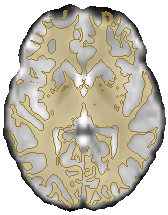
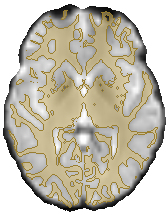
fMRIPrep’s own call on one of its runs, given to FSL 6.0.7.23, to the replica and to the clean room, each in reproduce and in fix, and at one thread: both ports’ parallel steps give the same values at any thread count. Choose the panels: the T1w (the reference), the white-matter mask drawn over the BOLD reference at the initial alignment and over FSL’s result (the boundary the cost aligns the BOLD contrast to), FSL’s registered image, the replica’s and the clean room’s. FSL’s result against its initial alignment shows what the registration changed; the replica’s differences from FSL are zero.
The clean room’s matrix is 0.0113 mm from FSL’s at the 95th percentile of the brain: within its record’s 0.1 mm, and just beyond FSL’s own 0.0086 mm on the same BOLD reference perturbed by noise of half an intensity unit. Its registered image then differs from FSL’s in 42.2 % of the voxels (1 − NCC 2.6 × 10⁻⁶), the largest where a voxel at the edge of the BOLD reference’s field of view falls inside it for one matrix and outside for the other. Below the viewer, the matrices as the files hold them, and the displacement each pair gives over the brain.
Worked example
fMRIPrep's boundary-based registration of a BOLD reference
What this shows: On fMRIPrep’s own call, the replica gives FSL’s registered image, every value, and FSL’s matrix byte for byte, the same bytes as fMRIPrep’s own. The clean room’s matrix is 0.0113 mm from FSL’s at the 95th percentile of the brain: within its record’s 0.1 mm, but beyond FSL’s own variability on this input (0.00855 mm), so the comparison stays open.
- Replica against FSL flirt 6.0.7.23Bit-identical
- Clean room against FSL flirt 6.0.7.23Open difference
The BBR node fMRIPrep 25.2.6 ran on a young adult’s BOLD reference (ds005040, slice timing, field maps): flirt -in <boldref> -ref <T1w brain> -wmseg <white matter> -init <mri_coreg> -schedule bbr.sch -dof 6 -searchcost bbr -basescale 1, given to FSL 6.0.7.23 and to the replica (larmorx-nc) in reproduce and in fix. The white-matter mask is drawn over the BOLD reference at the initial alignment and over FSL’s result: the boundary the cost aligns the BOLD contrast to. The matrices follow as text, with fMRIPrep’s own, and the displacement each pair gives over the brain. LARMORX’s clean room (Apache-2.0, written from the specification without FSL’s source) runs the same call in reproduce and in fix and at one thread; FSL runs it once more on the BOLD reference perturbed by noise of half an intensity unit, which measures FSL’s own variability, the yardstick of a registration that is not bit-identical.
- Data
- OpenNeuro ds005040, sub-002 (CC0-1.0): the BOLD reference and the T1w fMRIPrep computed; shown inside the T1w’s brain mask, dilated by 2 voxels
- Node
- fMRIPrep 25.2.6,
work/fmriprep_25_2_wf/sub_002_wf/bold_task_clip_run_1_wf/bold_fit_wf/bold_reg_wf/fsl_bbr_wf/flt_bbr - Command
flirt -in sub-002_task-clip_run-1_desc-coreg_boldref.nii.gz -ref sub-002_desc-preproc_T1w_masked.nii.gz -out sub-002_task-clip_run-1_desc-coreg_boldref_flirt.nii.gz -omat sub-002_task-clip_run-1_desc-coreg_boldref_flirt.mat -basescale 1 -searchcost bbr -dof 6 -init out.mat -schedule bbr.sch -wmseg sub-002_dseg_mask.nii.gz- Programs
- FSL 6.0.7.23 (fsl-flirt 2111.4; ~/fsl-6.0.7.23, never on the PATH, OpenBLAS on its Haswell kernels) (its run served from the cache of the original’s runs, as the record ran it); larmorx-nc 0.0.1 (the replica), from LARMORX at commit
301fab7dfc56; LARMORX 0.0.1 (crate larmorx-fsl: the clean room, Apache-2.0, written from specs/flirt.md), from LARMORX at commit80cc208fa4a3 - Matrix
- the replica’s file byte for byte FSL’s; fMRIPrep’s own the same bytes; BBR moved the brain by 1.79 mm on average from the initial alignment (at most 3.36 mm)
- Clean room
- the clean room’s matrix 0.0113 mm from FSL’s at the 95th percentile of the brain (at most 0.0136 mm); FSL’s own on a perturbed input 0.00855 mm (at most 0.00997 mm); at 1 thread the same values as at 4; in
fix, its default, another matrix (the comparisons below) - Grid
- 191 × 288 × 288 voxels of 0.85 × 0.833 × 0.833 mm; shown: 168 × 215 × 168 around the brain
Data shown
- Political Moralization (OpenNeuro ds005040, version 1.2.0, doi:10.18112/openneuro.ds005040.v1.2.0), CC0 1.0 public-domain dedication.
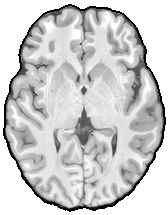
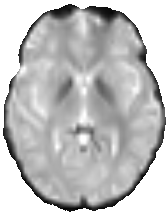
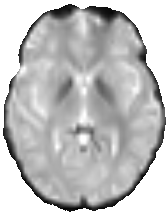

Bit-identical15,842,304 of 15,842,304 voxels equal


Axial slice 79 of 168; the crosshair where FSL's result differs most from its initial alignment. The interactive viewer needs JavaScript; the metrics below are complete without it.
Every comparison, computed in float64 over every voxel of the outputs
| Comparison (A − B), verdict and reason | max |Δ| | Values that differ | RMS of Δ | max |Δ| ÷ range | 1 − NCC |
|---|---|---|---|---|---|
| The original against its starting point | |||||
| FSL flirt 6.0.7.23 − initial alignment (-init)referenceNot a comparison of ports: FSL’s registered image against the same input resampled at the call’s initial matrix (fMRIPrep’s mri_coreg, converted by lta_to_fsl), the change the boundary-based optimisation made. | 9.7e4 | 6,805,707 of 15,842,304 (43 %) | 3.04e3 | 0.803 | 0.0107 |
| The replica against the original | |||||
| replica − FSL flirt 6.0.7.23Bit-identicalThe same values, every one, on this call; the matrices too, byte for byte as text. | identical: 0 of 15,842,304 values differ | ||||
| The replica against itself: thread counts, fix and reproduce | |||||
| replica, 1 thread − 4 threadsBit-identicalThe thread count changes nothing: FLIRT’s parallel steps (the boundary points, the blurs) give the same values at any thread count. | identical: 0 of 15,842,304 values differ | ||||
replica, fix − reproduceBit-identicalNo correction of the register applies to this call: fix and reproduce give the same values. | identical: 0 of 15,842,304 values differ | ||||
| The clean room against the original and the replica | |||||
| clean room − FSL flirt 6.0.7.23Open differenceWritten without FSL’s source, the clean room is not bit-identical by design: its matrix is 0.0113 mm from FSL’s at the 95th percentile of the brain (at most 0.0136 mm), against FSL’s own 0.00855 mm when its input changes by noise of half an intensity unit (at most 0.00997 mm); the images differ in 42.2% of their values, by at most 0.57 of the range (1 − NCC 2.6e-06; the largest where a voxel at the edge of the input’s field of view is inside it for one matrix and outside, at the background value, for the other), the input interpolated at slightly other positions. Within the record’s threshold (0.1 mm), above FSL’s own variability on this input: the cost’s last bits and the optimiser’s path (docs/findings/fsl-flirt-clean-room.md). record | 7.06e4 | 6,691,126 of 15,842,304 (42.2 %) | 47.2 | 0.566 | 2.6e−6 |
| clean room − replicaOpen differenceWritten without FSL’s source, the clean room is not bit-identical by design: its matrix is 0.0113 mm from the replica’s (FSL’s bytes) at the 95th percentile of the brain (at most 0.0136 mm), against FSL’s own 0.00855 mm when its input changes by noise of half an intensity unit (at most 0.00997 mm); the images differ in 42.2% of their values, by at most 0.57 of the range (1 − NCC 2.6e-06; the largest where a voxel at the edge of the input’s field of view is inside it for one matrix and outside, at the background value, for the other), the input interpolated at slightly other positions. Within the record’s threshold (0.1 mm), above FSL’s own variability on this input: the cost’s last bits and the optimiser’s path (docs/findings/fsl-flirt-clean-room.md). record | 7.06e4 | 6,691,126 of 15,842,304 (42.2 %) | 47.2 | 0.566 | 2.6e−6 |
| The clean room against itself: thread counts, fix and reproduce | |||||
| clean room, 1 thread − 4 threadsBit-identicalThe thread count changes nothing: the clean room’s parallel steps (the boundary points’ terms, the correlation ratio’s bins, the search’s grid points) are summed in a fixed order, so the values are the same at any thread count. record | identical: 0 of 15,842,304 values differ | ||||
clean room, fix − reproduceDeliberate correctionGLIBC-07, a correction by default: the default computes sinf, cosf, atan2f, cos, exp and logf correctly rounded on every platform, where reproduce computes them as glibc 2.35 does, as FSL’s build (LARMORX’s glibc functions, since 2026-11-04); FLIRT names it nowhere: an iterative fit cannot tell whether its result moved with those last bits (as decided on 2026-11-04). Here the two modes’ matrices part by 0.00251 mm at the 95th percentile of the brain (at most 0.00252 mm), against FSL’s own 0.00855 mm on a perturbed input: the fit’s sensitivity to the C library’s last bits. record GLIBC-07 | 2.11e4 | 6,689,553 of 15,842,304 (42.2 %) | 8.61 | 0.169 | 8.65e−8 |
Δ is A − B, computed in float64 over all 15,842,304 voxels of the outputs, not only those shown. The records’ thresholds: every file FSL writes bit-identical (images decompressed, descrip left out), with FSL’s exit status and messages (the replica); FSL’s exit status and messages, the numbers in them read as numbers, the matrix FSL’s text or within 0.1 mm of it at the 95th percentile of the reference’s brain (0.5 mm for registrations other than the boundary-based and 6-dof ones), and the image from its own matrix with a correlation of at least 0.999 with FSL’s inside the reference’s mask, bit-identical from the same matrix (the clean room, specs/flirt.md §13).
The matrices as the files hold them, both ports against the original: FSL flirt 6.0.7.23 (input millimetres to reference millimetres, FLIRT’s convention)
| FSL flirt 6.0.7.23 | replica, reproduce | replica, fix | clean room, reproduce | clean room, fix | fMRIPrep's output (FSL in its image) | the initial matrix (-init) | |
|---|---|---|---|---|---|---|---|
| row 1 | 0.9997946565 0.009039069054 -0.01813961096 -14.93036592 | 0.9997946565 0.009039069054 -0.01813961096 -14.93036592 | 0.9997946565 0.009039069054 -0.01813961096 -14.93036592 | 0.9997960418 0.008978942795 -0.01809395406 -14.92869479 | 0.9997961128 0.008979152222 -0.01809328011 -14.92876286 | 0.9997946565 0.009039069054 -0.01813961096 -14.93036592 | 0.99973863 0.00760034 -0.02156423 -14.54669762 |
| row 2 | -0.008074701193 0.9985856646 0.05255029316 14.28776341 | -0.008074701193 0.9985856646 0.05255029316 14.28776341 | -0.008074701193 0.9985856646 0.05255029316 14.28776341 | -0.00801558061 0.9985819946 0.0526289076 14.2819025 | -0.008015822649 0.9985820188 0.0526290324 14.27941674 | -0.008074701193 0.9985856646 0.05255029316 14.28776341 | -0.00601620 0.99734318 0.07259799 12.04777431 |
| row 3 | 0.01858896419 -0.05239302043 0.9984534561 81.72078273 | 0.01858896419 -0.05239302043 0.9984534561 81.72078273 | 0.01858896419 -0.05239302043 0.9984534561 81.72078273 | 0.01854085161 -0.05247313056 0.9984501524 81.72939616 | 0.01854018945 -0.05247325387 0.9984501581 81.72942577 | 0.01858896419 -0.05239302043 0.9984534561 81.72078273 | 0.02205871 -0.07244927 0.99712807 81.83596802 |
| row 4 | 0 0 0 1 | 0 0 0 1 | 0 0 0 1 | 0 0 0 1 | 0 0 0 1 | 0 0 0 1 | 0.00000000 0.00000000 0.00000000 1.00000000 |
| the file, byte for byte | the reference | identical | identical | differs | differs | identical | – |
Each matrix file as written (-omat), its numbers as text; fMRIPrep’s own is the node’s output in the run’s working directory (FSL in fMRIPrep 25.2.6’s image), the initial matrix the call’s -init (mri_coreg’s, converted by lta_to_fsl). identical: the same bytes as FSL 6.0.7.23’s file. The clean room’s matrices are its own result, written as FSL writes them.
The displacement between two matrices over the reference’s brain, both ports against the original: FSL flirt 6.0.7.23 (mm)
| Matrices | largest | mean | 95th percentile | FSL's RMS deviation (80 mm) |
|---|---|---|---|---|
| replica − FSL flirt 6.0.7.23 | 0 | 0 | 0 | 0 |
| replica, fix − FSL flirt 6.0.7.23 | 0 | 0 | 0 | 0 |
| clean room − FSL flirt 6.0.7.23 | 0.0136 | 0.00637 | 0.0113 | 0.0157 |
| clean room, fix − FSL flirt 6.0.7.23 | 0.0128 | 0.00539 | 0.0101 | 0.0177 |
| FSL flirt 6.0.7.23 on a perturbed input − FSL flirt 6.0.7.23 (its own variability) | 0.00997 | 0.00534 | 0.00855 | 0.00852 |
| fMRIPrep’s output − FSL flirt 6.0.7.23 | 0 | 0 | 0 | 0 |
| FSL flirt 6.0.7.23 − the initial matrix (what the registration changed) | 3.36 | 1.79 | 2.83 | 4.08 |
For every one of the 2,446,665 voxels of the reference’s brain mask (its voxels above zero), the distance in millimetres between the two points of the input the matrices map onto it, computed in float64 from the matrices as the files hold them; the last column is FSL’s own measure (rmsdiff’s: the RMS deviation over a sphere of radius 80 mm about the origin).
Provenance of this example
- Data: OpenNeuro ds005040, sub-002, CC0-1.0
- Inputs: -in (sha256 db30ecbef0f5769a…); -ref (sha256 ade613b412e42a59…); -wmseg (sha256 5731cb930d625adb…); -init (sha256 a0b1a1fbd5ee6f32…)
- Runs: figures cache entry
fsl-flirt/fmriprep-ds005040-sub-002-noreconall, computed 2026-11-01T16:10:32+00:00 with larmorx301fab7dfc56; FSL 6.0.7.23 (fsl-flirt 2111.4; ~/fsl-6.0.7.23, never on the PATH, OpenBLAS on its Haswell kernels); larmorx-nc 0.0.1; every command, its environment, threads and exit status are in itsRUN_INFO.json - Inputs: -in (sha256 db30ecbef0f5769a…); -ref (sha256 ade613b412e42a59…); -wmseg (sha256 5731cb930d625adb…); -init (sha256 a0b1a1fbd5ee6f32…)
- Runs: figures cache entry
fsl-flirt/fmriprep-ds005040-sub-002-noreconall-original, computed 2026-11-02T21:04:08+00:00; 3 of its 4 runs made again since, last on 2026-11-07T02:05:04+00:00, with larmorx80cc208fa4a3; FSL 6.0.7.23 (fsl-flirt 2111.4; ~/fsl-6.0.7.23, never on the PATH, OpenBLAS on its Haswell kernels); “larmorx 0.0.1 (crate larmorx-fsl: the clean-room original, Apache-2.0, written from specs/flirt.md)”, as the cache entry records it; every command, its environment, threads and exit status are in itsRUN_INFO.json
Every number above is in fsl-flirt.json, exported by python -m larmorx_validation evidence fsl-flirt.
A default registration
FLIRT without options beyond its inputs: 12 degrees of freedom, the correlation ratio, the search over rotations and the default schedule, registering the same BOLD reference to the T1w at half resolution (the record’s case real/default). Since 2026-11-04 the clean room’s matrix and registered image are FSL’s, byte for byte. Its default, fix, still computes the C library’s functions correctly rounded, and its matrix is 0.033 mm from FSL’s at the 95th percentile (the comparison clean room, fix − reproduce); FSL’s own on a perturbed input is 0.005 mm.
Worked example
A default registration: 12 degrees of freedom, the correlation ratio
What this shows: On FLIRT’s default registration, the replica and the clean room both give FSL’s matrix and image, every value. In fix, its default, the clean room computes the C library’s functions correctly rounded (GLIBC-07), and its matrix moves by 0.0331 mm at the 95th percentile of the brain, more than FSL’s own 0.0048 mm on a perturbed input.
- Replica against FSL flirt 6.0.7.23Bit-identical
- Clean room against FSL flirt 6.0.7.23Bit-identical
The record’s case real/default: FLIRT’s default (12 degrees of freedom, the correlation ratio, its search over rotations and its multi-resolution schedule) registering ds005040’s BOLD reference to the subject’s T1w brain at half resolution, by FSL 6.0.7.23 and the replica in reproduce and in fix; the white-matter mask drawn over FSL’s result shows the fit. LARMORX’s clean room runs the same call in fix and in reproduce and at one thread, and FSL once more on the BOLD reference perturbed by noise of half an intensity unit (its own variability).
- Data
- OpenNeuro ds005040, sub-002 (CC0-1.0): the record’s inputs derived from fMRIPrep’s run (oracles/inputs/fsl-flirt-replica/); shown inside the T1w’s brain mask, dilated by 2 voxels
- Case
real/defaultof the record (fsl-flirt-replica)- Command
flirt -in epi.nii -ref t1.nii -out out -omat out.mat- Programs
- FSL 6.0.7.23 (fsl-flirt 2111.4; ~/fsl-6.0.7.23, never on the PATH, OpenBLAS on its Haswell kernels) (its run served from the cache of the original’s runs, as the record ran it); larmorx-nc 0.0.1 (the replica), from LARMORX at commit
301fab7dfc56; LARMORX 0.0.1 (crate larmorx-fsl: the clean room, Apache-2.0, written from specs/flirt.md), from LARMORX at commit80cc208fa4a3 - Clean room
- the clean room’s matrix 0 mm from FSL’s at the 95th percentile of the brain (at most 0 mm); FSL’s own on a perturbed input 0.0048 mm (at most 0.00606 mm)
- Grid
- 96 × 144 × 144 voxels of 1.7 × 1.67 × 1.67 mm; shown: 88 × 112 × 88 around the brain
Data shown
- Political Moralization (OpenNeuro ds005040, version 1.2.0, doi:10.18112/openneuro.ds005040.v1.2.0), CC0 1.0 public-domain dedication.


Bit-identical1,990,656 of 1,990,656 voxels equal
Bit-identical1,990,656 of 1,990,656 voxels equal
Bit-identical1,990,656 of 1,990,656 voxels equal

Axial slice 43 of 88; the crosshair at the centre of the brain. The interactive viewer needs JavaScript; the metrics below are complete without it.
Every comparison, computed in float64 over every voxel of the outputs
| Comparison (A − B), verdict and reason | max |Δ| | Values that differ | RMS of Δ | max |Δ| ÷ range | 1 − NCC |
|---|---|---|---|---|---|
| The replica against the original | |||||
| replica − FSL flirt 6.0.7.23Bit-identicalThe same values, every one, on this call; the matrices too, byte for byte as text. | identical: 0 of 1,990,656 values differ | ||||
| The replica against itself: thread counts, fix and reproduce | |||||
| replica, 1 thread − 4 threadsBit-identicalThe thread count changes nothing: FLIRT’s parallel steps (the boundary points, the blurs) give the same values at any thread count. | identical: 0 of 1,990,656 values differ | ||||
replica, fix − reproduceBit-identicalNo correction of the register applies to this call: fix and reproduce give the same values. | identical: 0 of 1,990,656 values differ | ||||
| The clean room against the original and the replica | |||||
| clean room − FSL flirt 6.0.7.23Bit-identicalThe clean room gives FSL’s values, every one. record | identical: 0 of 1,990,656 values differ | ||||
| clean room − replicaBit-identicalThe clean room gives the replica’s (FSL’s bytes) values, every one. record | identical: 0 of 1,990,656 values differ | ||||
| The clean room against itself: thread counts, fix and reproduce | |||||
| clean room, 1 thread − 4 threadsBit-identicalThe thread count changes nothing: the clean room’s parallel steps (the boundary points’ terms, the correlation ratio’s bins, the search’s grid points) are summed in a fixed order, so the values are the same at any thread count. record | identical: 0 of 1,990,656 values differ | ||||
clean room, fix − reproduceDeliberate correctionGLIBC-07, a correction by default: the default computes sinf, cosf, atan2f, cos, exp and logf correctly rounded on every platform, where reproduce computes them as glibc 2.35 does, as FSL’s build (LARMORX’s glibc functions, since 2026-11-04); FLIRT names it nowhere: an iterative fit cannot tell whether its result moved with those last bits (as decided on 2026-11-04). Here the two modes’ matrices part by 0.0331 mm at the 95th percentile of the brain (at most 0.042 mm), against FSL’s own 0.0048 mm on a perturbed input: the fit’s sensitivity to the C library’s last bits. record GLIBC-07 | 5.09e4 | 866,816 of 1,990,656 (43.5 %) | 47.9 | 0.431 | 2.59e−6 |
Δ is A − B, computed in float64 over all 1,990,656 voxels of the outputs, not only those shown. The records’ thresholds: every file FSL writes bit-identical (images decompressed, descrip left out), with FSL’s exit status and messages (the replica); FSL’s exit status and messages, the numbers in them read as numbers, the matrix FSL’s text or within 0.1 mm of it at the 95th percentile of the reference’s brain (0.5 mm for registrations other than the boundary-based and 6-dof ones), and the image from its own matrix with a correlation of at least 0.999 with FSL’s inside the reference’s mask, bit-identical from the same matrix (the clean room, specs/flirt.md §13).
The matrices as the files hold them, both ports against the original: FSL flirt 6.0.7.23 (input millimetres to reference millimetres, FLIRT’s convention)
| FSL flirt 6.0.7.23 | replica, reproduce | replica, fix | clean room, reproduce | clean room, fix | |
|---|---|---|---|---|---|
| row 1 | 1.016059013 0.01501063208 -0.0301453908 -16.24678433 | 1.016059013 0.01501063208 -0.0301453908 -16.24678433 | 1.016059013 0.01501063208 -0.0301453908 -16.24678433 | 1.016059013 0.01501063208 -0.0301453908 -16.24678433 | 1.016061684 0.01472990717 -0.03061194368 -16.19458306 |
| row 2 | -0.01835764209 1.002918871 0.08292936251 11.46911575 | -0.01835764209 1.002918871 0.08292936251 11.46911575 | -0.01835764209 1.002918871 0.08292936251 11.46911575 | -0.01835764209 1.002918871 0.08292936251 11.46911575 | -0.01834992389 1.002943648 0.08271480958 11.47912664 |
| row 3 | 0.03345222159 -0.08911393648 1.019501435 79.66990539 | 0.03345222159 -0.08911393648 1.019501435 79.66990539 | 0.03345222159 -0.08911393648 1.019501435 79.66990539 | 0.03345222159 -0.08911393648 1.019501435 79.66990539 | 0.03347213586 -0.0891252173 1.019498175 79.66912412 |
| row 4 | 0 0 0 1 | 0 0 0 1 | 0 0 0 1 | 0 0 0 1 | 0 0 0 1 |
| the file, byte for byte | the reference | identical | identical | identical | differs |
Each matrix file as written (-omat), its numbers as text. identical: the same bytes as FSL 6.0.7.23’s file. The clean room’s matrices are its own result, written as FSL writes them.
The displacement between two matrices over the reference’s brain, both ports against the original: FSL flirt 6.0.7.23 (mm)
| Matrices | largest | mean | 95th percentile | FSL's RMS deviation (80 mm) |
|---|---|---|---|---|
| replica − FSL flirt 6.0.7.23 | 0 | 0 | 0 | 0 |
| replica, fix − FSL flirt 6.0.7.23 | 0 | 0 | 0 | 0 |
| clean room − FSL flirt 6.0.7.23 | 0 | 0 | 0 | 0 |
| clean room, fix − FSL flirt 6.0.7.23 | 0.042 | 0.0162 | 0.0331 | 0.0966 |
| FSL flirt 6.0.7.23 on a perturbed input − FSL flirt 6.0.7.23 (its own variability) | 0.00606 | 0.00243 | 0.0048 | 0.0124 |
For every one of the 305,805 voxels of the reference’s brain mask (its voxels above zero), the distance in millimetres between the two points of the input the matrices map onto it, computed in float64 from the matrices as the files hold them; the last column is FSL’s own measure (rmsdiff’s: the RMS deviation over a sphere of radius 80 mm about the origin).
Provenance of this example
- Data: OpenNeuro ds005040, sub-002, CC0-1.0
- Inputs: epi.nii (sha256 fefefce4f108f492…); t1.nii (sha256 5a3725fbb21ceccc…)
- Runs: figures cache entry
fsl-flirt/real-default, computed 2026-11-01T16:13:50+00:00 with larmorx301fab7dfc56; FSL 6.0.7.23 (fsl-flirt 2111.4; ~/fsl-6.0.7.23, never on the PATH, OpenBLAS on its Haswell kernels); larmorx-nc 0.0.1; every command, its environment, threads and exit status are in itsRUN_INFO.json - Inputs: epi.nii (sha256 fefefce4f108f492…); t1.nii (sha256 5a3725fbb21ceccc…)
- Runs: figures cache entry
fsl-flirt/real-default-original, computed 2026-11-02T21:06:24+00:00; 3 of its 4 runs made again since, last on 2026-11-07T02:06:24+00:00, with larmorx80cc208fa4a3; FSL 6.0.7.23 (fsl-flirt 2111.4; ~/fsl-6.0.7.23, never on the PATH, OpenBLAS on its Haswell kernels); “larmorx 0.0.1 (crate larmorx-fsl: the clean-room original, Apache-2.0, written from specs/flirt.md)”, as the cache entry records it; every command, its environment, threads and exit status are in itsRUN_INFO.json
Every number above is in fsl-flirt.json, exported by python -m larmorx_validation evidence fsl-flirt.
-applyxfm on a raw BOLD series
A given matrix applied to four volumes of the raw BOLD series with windowed-sinc interpolation, onto the T1w’s grid (the record’s case real/applyxfm-4d): the resampling part of FLIRT, with its blur of the input where the output grid is coarser. From the same matrix the clean room’s values are FSL’s, every one, since 2026-11-04. What the specification had left open was the kernel’s sinf and cos, which its reproduce now computes as glibc 2.35 does. Its default, fix, computes them correctly rounded and differs in 1.6 % of the values, by at most 2.6 × 10⁻⁷ of the image’s range, as the clean room did in both modes before.
Worked example
-applyxfm on a raw BOLD series, sinc interpolation
What this shows: From the same matrix, the replica and the clean room both give FSL’s image, every value. In fix, its default, the clean room computes the C library’s functions correctly rounded (GLIBC-07), and 1.6% of the values change.
- Replica against FSL flirt 6.0.7.23Bit-identical
- Clean room against FSL flirt 6.0.7.23Bit-identical
The record’s case real/applyxfm-4d: four volumes of ds005040’s raw BOLD series resampled onto the T1w’s grid (every second voxel) through fMRIPrep’s initial matrix, with -applyxfm -interp sinc, by FSL 6.0.7.23 and the replica in reproduce and in fix; choose the volume below the panels. LARMORX’s clean room applies the same matrix in fix and in reproduce and at one thread.
- Data
- OpenNeuro ds005040, sub-002 (CC0-1.0): the record’s inputs derived from fMRIPrep’s run (oracles/inputs/fsl-flirt-replica/); shown inside the T1w’s brain mask, dilated by 2 voxels
- Case
real/applyxfm-4dof the record (fsl-flirt-replica)- Command
flirt -in bold4.nii -ref t1.nii -init init.mat -applyxfm -interp sinc -out out- Programs
- FSL 6.0.7.23 (fsl-flirt 2111.4; ~/fsl-6.0.7.23, never on the PATH, OpenBLAS on its Haswell kernels) (its run served from the cache of the original’s runs, as the record ran it); larmorx-nc 0.0.1 (the replica), from LARMORX at commit
301fab7dfc56; LARMORX 0.0.1 (crate larmorx-fsl: the clean room, Apache-2.0, written from specs/flirt.md), from LARMORX at commit80cc208fa4a3 - Grid
- 96 × 144 × 144 voxels of 1.7 × 1.67 × 1.67 mm; shown: 88 × 112 × 88 around the brain
Data shown
- Political Moralization (OpenNeuro ds005040, version 1.2.0, doi:10.18112/openneuro.ds005040.v1.2.0), CC0 1.0 public-domain dedication.
Bit-identical7,962,624 of 7,962,624 voxels equal
Bit-identical7,962,624 of 7,962,624 voxels equal
Bit-identical7,962,624 of 7,962,624 voxels equal

Axial slice 43 of 88; the crosshair at the centre of the brain. The interactive viewer needs JavaScript; the metrics below are complete without it.
Every comparison, computed in float64 over every voxel of the outputs
| Comparison (A − B), verdict and reason | max |Δ| | Values that differ | RMS of Δ | max |Δ| ÷ range | 1 − NCC |
|---|---|---|---|---|---|
| The replica against the original | |||||
| replica − FSL flirt 6.0.7.23Bit-identicalThe same values, every one, on this call; the matrices too, byte for byte as text. | identical: 0 of 7,962,624 values differ | ||||
| The replica against itself: thread counts, fix and reproduce | |||||
| replica, 1 thread − 4 threadsBit-identicalThe thread count changes nothing: FLIRT’s parallel steps (the boundary points, the blurs) give the same values at any thread count. | identical: 0 of 7,962,624 values differ | ||||
replica, fix − reproduceBit-identicalNo correction of the register applies to this call: fix and reproduce give the same values. | identical: 0 of 7,962,624 values differ | ||||
| The clean room against the original and the replica | |||||
| clean room − FSL flirt 6.0.7.23Bit-identicalThe clean room gives FSL’s values, every one. record | identical: 0 of 7,962,624 values differ | ||||
| clean room − replicaBit-identicalThe clean room gives the replica’s (FSL’s bytes) values, every one. record | identical: 0 of 7,962,624 values differ | ||||
| The clean room against itself: thread counts, fix and reproduce | |||||
| clean room, 1 thread − 4 threadsBit-identicalThe thread count changes nothing: the clean room’s parallel steps (the boundary points’ terms, the correlation ratio’s bins, the search’s grid points) are summed in a fixed order, so the values are the same at any thread count. record | identical: 0 of 7,962,624 values differ | ||||
clean room, fix − reproduceDeliberate correctionGLIBC-07, a correction by default: the default computes sinf, cosf, atan2f, cos, exp and logf correctly rounded on every platform, where reproduce computes them as glibc 2.35 does, as FSL’s build (LARMORX’s glibc functions, since 2026-11-04); FLIRT names it nowhere: an iterative fit cannot tell whether its result moved with those last bits (as decided on 2026-11-04). Here the two modes’ images differ in 1.6% of their values. record GLIBC-07 | 0.0469 | 128,674 of 7,962,624 (1.62 %) | 0.00057 | 2.59e−7 | 3.17e−16 |
Δ is A − B, computed in float64 over all 7,962,624 voxels of the outputs, not only those shown. The records’ thresholds: every file FSL writes bit-identical (images decompressed, descrip left out), with FSL’s exit status and messages (the replica); FSL’s exit status and messages, the numbers in them read as numbers, the matrix FSL’s text or within 0.1 mm of it at the 95th percentile of the reference’s brain (0.5 mm for registrations other than the boundary-based and 6-dof ones), and the image from its own matrix with a correlation of at least 0.999 with FSL’s inside the reference’s mask, bit-identical from the same matrix (the clean room, specs/flirt.md §13).
Provenance of this example
- Data: OpenNeuro ds005040, sub-002, CC0-1.0
- Inputs: bold4.nii (sha256 92acf4858e24217c…); t1.nii (sha256 5a3725fbb21ceccc…); init.mat (sha256 a0b1a1fbd5ee6f32…)
- Runs: figures cache entry
fsl-flirt/real-applyxfm-4d, computed 2026-11-01T16:14:02+00:00 with larmorx301fab7dfc56; FSL 6.0.7.23 (fsl-flirt 2111.4; ~/fsl-6.0.7.23, never on the PATH, OpenBLAS on its Haswell kernels); larmorx-nc 0.0.1; every command, its environment, threads and exit status are in itsRUN_INFO.json - Inputs: bold4.nii (sha256 92acf4858e24217c…); t1.nii (sha256 5a3725fbb21ceccc…); init.mat (sha256 a0b1a1fbd5ee6f32…)
- Runs: figures cache entry
fsl-flirt/real-applyxfm-4d-original, computed 2026-11-02T21:06:27+00:00; its runs made again since, last on 2026-11-07T02:06:27+00:00, with larmorx80cc208fa4a3; FSL 6.0.7.23 (fsl-flirt 2111.4; ~/fsl-6.0.7.23, never on the PATH, OpenBLAS on its Haswell kernels); “larmorx 0.0.1 (crate larmorx-fsl: the clean-room original, Apache-2.0, written from specs/flirt.md)”, as the cache entry records it; every command, its environment, threads and exit status are in itsRUN_INFO.json
Every number above is in fsl-flirt.json, exported by python -m larmorx_validation evidence fsl-flirt.
On the data panel: an 82-year-old and a three-year-old
fMRIPrep’s boundary-based call on two runs of the data panel: the first echo of an 82-year-old’s multi-echo BOLD run (ds003592) and a three-year-old’s BOLD reference (ds000228, a small head and an oblique field of view). As data-panel cases beside the examples above, they are stored as three full-resolution slices, and the crosshair moves through them. On both, the clean room’s matrix is within FSL’s own variability: 0.0002 mm against 0.0031 mm, and under 0.00001 mm against 0.091 mm.
Worked example
Data panel: an 82-year-old's BOLD reference
What this shows: On the data panel’s 82-year-old, the replica gives FSL’s registered image, every value, and FSL’s matrix byte for byte, the same bytes as fMRIPrep’s own. The clean room’s matrix is 0.000212 mm from FSL’s at the 95th percentile of the brain, within FSL’s own variability on this input (0.00314 mm).
- Replica against FSL flirt 6.0.7.23Bit-identical
- Clean room against FSL flirt 6.0.7.23Within the original's own variability
The BBR node fMRIPrep 25.2.6 ran on an 82-year-old’s first echo (ds003592, multi-echo): flirt -in <boldref> -ref <T1w brain> -wmseg <white matter> -init <mri_coreg> -schedule bbr.sch -dof 6 -searchcost bbr -basescale 1, given to FSL 6.0.7.23 and to the replica (larmorx-nc) in reproduce and in fix. The white-matter mask is drawn over the BOLD reference at the initial alignment and over FSL’s result: the boundary the cost aligns the BOLD contrast to. The matrices follow as text, with fMRIPrep’s own, and the displacement each pair gives over the brain. LARMORX’s clean room (Apache-2.0, written from the specification without FSL’s source) runs the same call in reproduce and in fix and at one thread; FSL runs it once more on the BOLD reference perturbed by noise of half an intensity unit, which measures FSL’s own variability, the yardstick of a registration that is not bit-identical. As a data-panel case beside the first example, it is stored as three full-resolution slices.
- Data
- OpenNeuro ds003592, sub-280 (CC0-1.0): the BOLD reference and the T1w fMRIPrep computed; shown inside the T1w’s brain mask, dilated by 2 voxels
- Node
- fMRIPrep 25.2.6,
work/fmriprep_25_2_wf/sub_280_ses_1_wf/bold_ses_1_task_rest_echo_1_wf/bold_fit_wf/bold_reg_wf/fsl_bbr_wf/flt_bbr - Command
flirt -in sub-280_ses-1_task-rest_desc-coreg_boldref.nii.gz -ref sub-280_ses-1_desc-preproc_T1w_masked.nii.gz -out sub-280_ses-1_task-rest_desc-coreg_boldref_flirt.nii.gz -omat sub-280_ses-1_task-rest_desc-coreg_boldref_flirt.mat -basescale 1 -searchcost bbr -dof 6 -init out.mat -schedule bbr.sch -wmseg sub-280_ses-1_dseg_mask.nii.gz- Programs
- FSL 6.0.7.23 (fsl-flirt 2111.4; ~/fsl-6.0.7.23, never on the PATH, OpenBLAS on its Haswell kernels) (its run served from the cache of the original’s runs, as the record ran it); larmorx-nc 0.0.1 (the replica), from LARMORX at commit
301fab7dfc56; LARMORX 0.0.1 (crate larmorx-fsl: the clean room, Apache-2.0, written from specs/flirt.md), from LARMORX at commit80cc208fa4a3 - Matrix
- the replica’s file byte for byte FSL’s; fMRIPrep’s own the same bytes; BBR moved the brain by 1.32 mm on average from the initial alignment (at most 1.91 mm)
- Clean room
- the clean room’s matrix 0.000212 mm from FSL’s at the 95th percentile of the brain (at most 0.000267 mm); FSL’s own on a perturbed input 0.00314 mm (at most 0.00328 mm); at 1 thread the same values as at 4; in
fix, its default, another matrix (the comparisons below) - Grid
- 192 × 256 × 256 voxels of 1 × 1 × 1 mm; shown: 151 × 177 × 148 around the brain
Data shown
- Neurocognitive aging data release (OpenNeuro ds003592, version 1.0.13, doi:10.18112/openneuro.ds003592.v1.0.13), CC0 1.0 public-domain dedication.


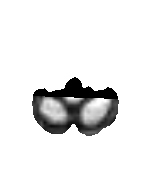

Bit-identical12,582,912 of 12,582,912 voxels equal


Axial slice 13 of 148; the crosshair where FSL's result differs most from its initial alignment; the three slices through it are stored at full resolution. The interactive viewer needs JavaScript; the metrics below are complete without it.
Stored for this example: three full-resolution slices, one per plane, through display voxel (75, 83, 13): where the main comparison differs most, or the field's centre where nothing differs; every metric is computed over every voxel of the files.
Every comparison, computed in float64 over every voxel of the outputs
| Comparison (A − B), verdict and reason | max |Δ| | Values that differ | RMS of Δ | max |Δ| ÷ range | 1 − NCC |
|---|---|---|---|---|---|
| The original against its starting point | |||||
| FSL flirt 6.0.7.23 − initial alignment (-init)referenceNot a comparison of ports: FSL’s registered image against the same input resampled at the call’s initial matrix (fMRIPrep’s mri_coreg, converted by lta_to_fsl), the change the boundary-based optimisation made. | 1.1e3 | 5,204,755 of 12,582,912 (41.4 %) | 26.4 | 0.836 | 0.00589 |
| The replica against the original | |||||
| replica − FSL flirt 6.0.7.23Bit-identicalThe same values, every one, on this call; the matrices too, byte for byte as text. | identical: 0 of 12,582,912 values differ | ||||
| The replica against itself: thread counts, fix and reproduce | |||||
| replica, 1 thread − 4 threadsBit-identicalThe thread count changes nothing: FLIRT’s parallel steps (the boundary points, the blurs) give the same values at any thread count. | identical: 0 of 12,582,912 values differ | ||||
replica, fix − reproduceBit-identicalNo correction of the register applies to this call: fix and reproduce give the same values. | identical: 0 of 12,582,912 values differ | ||||
| The clean room against the original and the replica | |||||
| clean room − FSL flirt 6.0.7.23Within the original's own variabilityWritten without FSL’s source, the clean room is not bit-identical by design: its matrix is 0.000212 mm from FSL’s at the 95th percentile of the brain (at most 0.000267 mm), against FSL’s own 0.00314 mm when its input changes by noise of half an intensity unit (at most 0.00328 mm); the images differ in 40.7% of their values, by at most 0.22 of the range (1 − NCC 1.2e-07; the largest where a voxel at the edge of the input’s field of view is inside it for one matrix and outside, at the background value, for the other), the input interpolated at slightly other positions. The difference is within FSL’s own variability. record | 289 | 5,127,418 of 12,582,912 (40.7 %) | 0.118 | 0.218 | 1.17e−7 |
| clean room − replicaWithin the original's own variabilityWritten without FSL’s source, the clean room is not bit-identical by design: its matrix is 0.000212 mm from the replica’s (FSL’s bytes) at the 95th percentile of the brain (at most 0.000267 mm), against FSL’s own 0.00314 mm when its input changes by noise of half an intensity unit (at most 0.00328 mm); the images differ in 40.7% of their values, by at most 0.22 of the range (1 − NCC 1.2e-07; the largest where a voxel at the edge of the input’s field of view is inside it for one matrix and outside, at the background value, for the other), the input interpolated at slightly other positions. The difference is within FSL’s own variability. record | 289 | 5,127,418 of 12,582,912 (40.7 %) | 0.118 | 0.218 | 1.17e−7 |
| The clean room against itself: thread counts, fix and reproduce | |||||
| clean room, 1 thread − 4 threadsBit-identicalThe thread count changes nothing: the clean room’s parallel steps (the boundary points’ terms, the correlation ratio’s bins, the search’s grid points) are summed in a fixed order, so the values are the same at any thread count. record | identical: 0 of 12,582,912 values differ | ||||
clean room, fix − reproduceDeliberate correctionGLIBC-07, a correction by default: the default computes sinf, cosf, atan2f, cos, exp and logf correctly rounded on every platform, where reproduce computes them as glibc 2.35 does, as FSL’s build (LARMORX’s glibc functions, since 2026-11-04); FLIRT names it nowhere: an iterative fit cannot tell whether its result moved with those last bits (as decided on 2026-11-04). Here the two modes’ matrices part by 0.00136 mm at the 95th percentile of the brain (at most 0.00174 mm), against FSL’s own 0.00314 mm on a perturbed input: the fit’s sensitivity to the C library’s last bits. record GLIBC-07 | 741 | 5,140,499 of 12,582,912 (40.9 %) | 0.249 | 0.56 | 5.23e−7 |
Δ is A − B, computed in float64 over all 12,582,912 voxels of the outputs, not only those shown. The records’ thresholds: every file FSL writes bit-identical (images decompressed, descrip left out), with FSL’s exit status and messages (the replica); FSL’s exit status and messages, the numbers in them read as numbers, the matrix FSL’s text or within 0.1 mm of it at the 95th percentile of the reference’s brain (0.5 mm for registrations other than the boundary-based and 6-dof ones), and the image from its own matrix with a correlation of at least 0.999 with FSL’s inside the reference’s mask, bit-identical from the same matrix (the clean room, specs/flirt.md §13).
The matrices as the files hold them, both ports against the original: FSL flirt 6.0.7.23 (input millimetres to reference millimetres, FLIRT’s convention)
| FSL flirt 6.0.7.23 | replica, reproduce | replica, fix | clean room, reproduce | clean room, fix | fMRIPrep's output (FSL in its image) | the initial matrix (-init) | |
|---|---|---|---|---|---|---|---|
| row 1 | 0.9999789461 0.000344049261 0.006523709465 -13.69018624 | 0.9999789461 0.000344049261 0.006523709465 -13.69018624 | 0.9999789461 0.000344049261 0.006523709465 -13.69018624 | 0.9999788404 0.0003442933607 0.006523883862 -13.6902108 | 0.9999788391 0.0003420573105 0.006533222366 -13.69071466 | 0.9999789461 0.000344049261 0.006523709465 -13.69018624 | 0.99999636 0.00144488 0.00235537 -13.52341270 |
| row 2 | 0.0009319920387 0.9808839998 -0.1945906627 38.29028725 | 0.0009319920387 0.9808839998 -0.1945906627 38.29028725 | 0.0009319920387 0.9808839998 -0.1945906627 38.29028725 | 0.000931801665 0.980883597 -0.1945929454 38.2904835 | 0.0009357211036 0.9808863349 -0.1945791354 38.28859196 | 0.0009319920387 0.9808839998 -0.1945906627 38.29028725 | -0.00098047 0.98246926 -0.18642190 36.97615433 |
| row 3 | -0.006465954659 0.1945926059 0.9808630277 55.09992093 | -0.006465954659 0.1945926059 0.9808630277 55.09992093 | -0.006465954659 0.1945926059 0.9808630277 55.09992093 | -0.006466171845 0.1945948849 0.9808626106 55.09981791 | -0.006474909406 0.1945810904 0.9808652498 55.10196123 | -0.006465954659 0.1945926059 0.9808630277 55.09992093 | -0.00258344 0.18641889 0.98246717 54.38763809 |
| row 4 | 0 0 0 1 | 0 0 0 1 | 0 0 0 1 | 0 0 0 1 | 0 0 0 1 | 0 0 0 1 | 0.00000000 0.00000000 0.00000000 1.00000000 |
| the file, byte for byte | the reference | identical | identical | differs | differs | identical | – |
Each matrix file as written (-omat), its numbers as text; fMRIPrep’s own is the node’s output in the run’s working directory (FSL in fMRIPrep 25.2.6’s image), the initial matrix the call’s -init (mri_coreg’s, converted by lta_to_fsl). identical: the same bytes as FSL 6.0.7.23’s file. The clean room’s matrices are its own result, written as FSL writes them.
The displacement between two matrices over the reference’s brain, both ports against the original: FSL flirt 6.0.7.23 (mm)
| Matrices | largest | mean | 95th percentile | FSL's RMS deviation (80 mm) |
|---|---|---|---|---|
| replica − FSL flirt 6.0.7.23 | 0 | 0 | 0 | 0 |
| replica, fix − FSL flirt 6.0.7.23 | 0 | 0 | 0 | 0 |
| clean room − FSL flirt 6.0.7.23 | 0.000267 | 0.000111 | 0.000212 | 0.000396 |
| clean room, fix − FSL flirt 6.0.7.23 | 0.00162 | 0.000709 | 0.00128 | 0.0035 |
| FSL flirt 6.0.7.23 on a perturbed input − FSL flirt 6.0.7.23 (its own variability) | 0.00328 | 0.00268 | 0.00314 | 0.00406 |
| fMRIPrep’s output − FSL flirt 6.0.7.23 | 0 | 0 | 0 | 0 |
| FSL flirt 6.0.7.23 − the initial matrix (what the registration changed) | 1.91 | 1.32 | 1.71 | 1.91 |
For every one of the 1,471,297 voxels of the reference’s brain mask (its voxels above zero), the distance in millimetres between the two points of the input the matrices map onto it, computed in float64 from the matrices as the files hold them; the last column is FSL’s own measure (rmsdiff’s: the RMS deviation over a sphere of radius 80 mm about the origin).
Provenance of this example
- Data: OpenNeuro ds003592, sub-280, CC0-1.0
- Inputs: -in (sha256 e53f3282faee1ee9…); -ref (sha256 701828f56fca12a5…); -wmseg (sha256 be9a746f9714eab6…); -init (sha256 36960edc109a5abc…)
- Runs: figures cache entry
fsl-flirt/fmriprep-ds003592-sub-280-noreconall, computed 2026-11-01T16:12:39+00:00 with larmorx301fab7dfc56; FSL 6.0.7.23 (fsl-flirt 2111.4; ~/fsl-6.0.7.23, never on the PATH, OpenBLAS on its Haswell kernels); larmorx-nc 0.0.1; every command, its environment, threads and exit status are in itsRUN_INFO.json - Inputs: -in (sha256 e53f3282faee1ee9…); -ref (sha256 701828f56fca12a5…); -wmseg (sha256 be9a746f9714eab6…); -init (sha256 36960edc109a5abc…)
- Runs: figures cache entry
fsl-flirt/fmriprep-ds003592-sub-280-noreconall-original, computed 2026-11-02T21:05:35+00:00; 3 of its 4 runs made again since, last on 2026-11-07T02:05:57+00:00, with larmorx80cc208fa4a3; FSL 6.0.7.23 (fsl-flirt 2111.4; ~/fsl-6.0.7.23, never on the PATH, OpenBLAS on its Haswell kernels); “larmorx 0.0.1 (crate larmorx-fsl: the clean-room original, Apache-2.0, written from specs/flirt.md)”, as the cache entry records it; every command, its environment, threads and exit status are in itsRUN_INFO.json
Every number above is in fsl-flirt.json, exported by python -m larmorx_validation evidence fsl-flirt.
Worked example
Data panel: a three-year-old's BOLD reference
What this shows: On the data panel’s three-year-old, the replica gives FSL’s registered image, every value, and FSL’s matrix byte for byte, the same bytes as fMRIPrep’s own. The clean room’s matrix is 4.87 × 10⁻⁶ mm from FSL’s at the 95th percentile of the brain, within FSL’s own variability on this input (0.0907 mm).
- Replica against FSL flirt 6.0.7.23Bit-identical
- Clean room against FSL flirt 6.0.7.23Within the original's own variability
The BBR node fMRIPrep 25.2.6 ran on a three-year-old’s BOLD reference (ds000228): flirt -in <boldref> -ref <T1w brain> -wmseg <white matter> -init <mri_coreg> -schedule bbr.sch -dof 6 -searchcost bbr -basescale 1, given to FSL 6.0.7.23 and to the replica (larmorx-nc) in reproduce and in fix. The white-matter mask is drawn over the BOLD reference at the initial alignment and over FSL’s result: the boundary the cost aligns the BOLD contrast to. The matrices follow as text, with fMRIPrep’s own, and the displacement each pair gives over the brain. LARMORX’s clean room (Apache-2.0, written from the specification without FSL’s source) runs the same call in reproduce and in fix and at one thread; FSL runs it once more on the BOLD reference perturbed by noise of half an intensity unit, which measures FSL’s own variability, the yardstick of a registration that is not bit-identical. As a data-panel case beside the first example, it is stored as three full-resolution slices.
- Data
- OpenNeuro ds000228, sub-pixar008 (CC0-1.0): the BOLD reference and the T1w fMRIPrep computed; shown inside the T1w’s brain mask, dilated by 2 voxels
- Node
- fMRIPrep 25.2.6,
work/fmriprep_25_2_wf/sub_pixar008_wf/bold_task_pixar_wf/bold_fit_wf/bold_reg_wf/fsl_bbr_wf/flt_bbr - Command
flirt -in sub-pixar008_task-pixar_desc-coreg_boldref.nii.gz -ref sub-pixar008_desc-preproc_T1w_masked.nii.gz -out sub-pixar008_task-pixar_desc-coreg_boldref_flirt.nii.gz -omat sub-pixar008_task-pixar_desc-coreg_boldref_flirt.mat -basescale 1 -searchcost bbr -dof 6 -init out.mat -schedule bbr.sch -wmseg sub-pixar008_dseg_mask.nii.gz- Programs
- FSL 6.0.7.23 (fsl-flirt 2111.4; ~/fsl-6.0.7.23, never on the PATH, OpenBLAS on its Haswell kernels) (its run served from the cache of the original’s runs, as the record ran it); larmorx-nc 0.0.1 (the replica), from LARMORX at commit
301fab7dfc56; LARMORX 0.0.1 (crate larmorx-fsl: the clean room, Apache-2.0, written from specs/flirt.md), from LARMORX at commit80cc208fa4a3 - Matrix
- the replica’s file byte for byte FSL’s; fMRIPrep’s own the same bytes; BBR moved the brain by 0.77 mm on average from the initial alignment (at most 1.06 mm)
- Clean room
- the clean room’s matrix 4.87e-06 mm from FSL’s at the 95th percentile of the brain (at most 5.97e-06 mm); FSL’s own on a perturbed input 0.0907 mm (at most 0.113 mm); at 1 thread the same values as at 4; in
fix, its default, another matrix (the comparisons below) - Grid
- 176 × 192 × 192 voxels of 1 × 1 × 1 mm; shown: 140 × 166 × 124 around the brain
Data shown
- Children and adults watching a short film (OpenNeuro ds000228, version 1.1.1, doi:10.18112/openneuro.ds000228.v1.1.1), CC0 1.0 public-domain dedication.
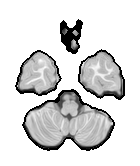
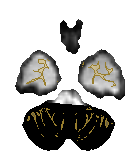
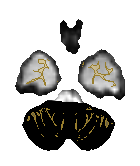
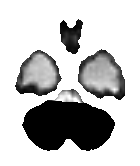
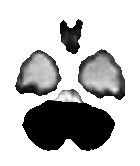
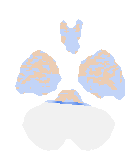
Bit-identical6,488,064 of 6,488,064 voxels equal
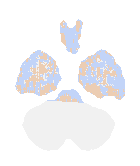

Axial slice 20 of 124; the crosshair where FSL's result differs most from its initial alignment; the three slices through it are stored at full resolution. The interactive viewer needs JavaScript; the metrics below are complete without it.
Stored for this example: three full-resolution slices, one per plane, through display voxel (59, 64, 20): where the main comparison differs most, or the field's centre where nothing differs; every metric is computed over every voxel of the files.
Every comparison, computed in float64 over every voxel of the outputs
| Comparison (A − B), verdict and reason | max |Δ| | Values that differ | RMS of Δ | max |Δ| ÷ range | 1 − NCC |
|---|---|---|---|---|---|
| The original against its starting point | |||||
| FSL flirt 6.0.7.23 − initial alignment (-init)referenceNot a comparison of ports: FSL’s registered image against the same input resampled at the call’s initial matrix (fMRIPrep’s mri_coreg, converted by lta_to_fsl), the change the boundary-based optimisation made. | 2.44e3 | 3,287,621 of 6,488,064 (50.7 %) | 40.3 | 0.997 | 0.00308 |
| The replica against the original | |||||
| replica − FSL flirt 6.0.7.23Bit-identicalThe same values, every one, on this call; the matrices too, byte for byte as text. | identical: 0 of 6,488,064 values differ | ||||
| The replica against itself: thread counts, fix and reproduce | |||||
| replica, 1 thread − 4 threadsBit-identicalThe thread count changes nothing: FLIRT’s parallel steps (the boundary points, the blurs) give the same values at any thread count. | identical: 0 of 6,488,064 values differ | ||||
replica, fix − reproduceBit-identicalNo correction of the register applies to this call: fix and reproduce give the same values. | identical: 0 of 6,488,064 values differ | ||||
| The clean room against the original and the replica | |||||
| clean room − FSL flirt 6.0.7.23Within the original's own variabilityWritten without FSL’s source, the clean room is not bit-identical by design: its matrix is 4.87e-06 mm from FSL’s at the 95th percentile of the brain (at most 5.97e-06 mm), against FSL’s own 0.0907 mm when its input changes by noise of half an intensity unit (at most 0.113 mm); the images differ in 44.4% of their values, by at most 4.1e-06 of the range (1 − NCC 2.9e-13), the input interpolated at slightly other positions. The difference is within FSL’s own variability. record | 0.00916 | 2,879,043 of 6,488,064 (44.4 %) | 0.000394 | 4.09e−6 | 2.94e−13 |
| clean room − replicaWithin the original's own variabilityWritten without FSL’s source, the clean room is not bit-identical by design: its matrix is 4.87e-06 mm from the replica’s (FSL’s bytes) at the 95th percentile of the brain (at most 5.97e-06 mm), against FSL’s own 0.0907 mm when its input changes by noise of half an intensity unit (at most 0.113 mm); the images differ in 44.4% of their values, by at most 4.1e-06 of the range (1 − NCC 2.9e-13), the input interpolated at slightly other positions. The difference is within FSL’s own variability. record | 0.00916 | 2,879,043 of 6,488,064 (44.4 %) | 0.000394 | 4.09e−6 | 2.94e−13 |
| The clean room against itself: thread counts, fix and reproduce | |||||
| clean room, 1 thread − 4 threadsBit-identicalThe thread count changes nothing: the clean room’s parallel steps (the boundary points’ terms, the correlation ratio’s bins, the search’s grid points) are summed in a fixed order, so the values are the same at any thread count. record | identical: 0 of 6,488,064 values differ | ||||
clean room, fix − reproduceDeliberate correctionGLIBC-07, a correction by default: the default computes sinf, cosf, atan2f, cos, exp and logf correctly rounded on every platform, where reproduce computes them as glibc 2.35 does, as FSL’s build (LARMORX’s glibc functions, since 2026-11-04); FLIRT names it nowhere: an iterative fit cannot tell whether its result moved with those last bits (as decided on 2026-11-04). Here the two modes’ matrices part by 0.00604 mm at the 95th percentile of the brain (at most 0.00745 mm), against FSL’s own 0.0907 mm on a perturbed input: the fit’s sensitivity to the C library’s last bits. record GLIBC-07 | 1.29e3 | 3,265,579 of 6,488,064 (50.3 %) | 0.879 | 0.575 | 1.47e−6 |
Δ is A − B, computed in float64 over all 6,488,064 voxels of the outputs, not only those shown. The records’ thresholds: every file FSL writes bit-identical (images decompressed, descrip left out), with FSL’s exit status and messages (the replica); FSL’s exit status and messages, the numbers in them read as numbers, the matrix FSL’s text or within 0.1 mm of it at the 95th percentile of the reference’s brain (0.5 mm for registrations other than the boundary-based and 6-dof ones), and the image from its own matrix with a correlation of at least 0.999 with FSL’s inside the reference’s mask, bit-identical from the same matrix (the clean room, specs/flirt.md §13).
The matrices as the files hold them, both ports against the original: FSL flirt 6.0.7.23 (input millimetres to reference millimetres, FLIRT’s convention)
| FSL flirt 6.0.7.23 | replica, reproduce | replica, fix | clean room, reproduce | clean room, fix | fMRIPrep's output (FSL in its image) | the initial matrix (-init) | |
|---|---|---|---|---|---|---|---|
| row 1 | 0.9998815716 0.002805483187 -0.01513461164 -5.255104351 | 0.9998815716 0.002805483187 -0.01513461164 -5.255104351 | 0.9998815716 0.002805483187 -0.01513461164 -5.255104351 | 0.999881572 0.002805477616 -0.01513458952 -5.255103077 | 0.9998816372 0.002871674131 -0.0151178772 -5.259789913 | 0.9998815716 0.002805483187 -0.01513461164 -5.255104351 | 0.99978888 0.00323859 -0.02029305 -5.28424311 |
| row 2 | 0.0009408139998 0.9702730696 0.2420112957 -15.08793318 | 0.0009408139998 0.9702730696 0.2420112957 -15.08793318 | 0.0009408139998 0.9702730696 0.2420112957 -15.08793318 | 0.0009408141138 0.9702731353 0.242011312 -15.08794001 | 0.0008725537645 0.9702728647 0.242012653 -15.08104896 | 0.0009408139998 0.9702730696 0.2420112957 -15.08793318 | 0.00181520 0.96972632 0.24418817 -15.75937462 |
| row 3 | 0.01536364661 -0.2419968245 0.9701554835 103.1073253 | 0.01536364661 -0.2419968245 0.9701554835 103.1073253 | 0.01536364661 -0.2419968245 0.9701554835 103.1073253 | 0.0153636238 -0.2419968242 0.9701554841 103.1073275 | 0.01536342958 -0.241997145 0.970155457 103.1073795 | 0.01536364661 -0.2419968245 0.9701554835 103.1073253 | 0.02046951 -0.24417339 0.96951562 102.36650848 |
| row 4 | 0 0 0 1 | 0 0 0 1 | 0 0 0 1 | 0 0 0 1 | 0 0 0 1 | 0 0 0 1 | 0.00000000 0.00000000 0.00000000 1.00000000 |
| the file, byte for byte | the reference | identical | identical | differs | differs | identical | – |
Each matrix file as written (-omat), its numbers as text; fMRIPrep’s own is the node’s output in the run’s working directory (FSL in fMRIPrep 25.2.6’s image), the initial matrix the call’s -init (mri_coreg’s, converted by lta_to_fsl). identical: the same bytes as FSL 6.0.7.23’s file. The clean room’s matrices are its own result, written as FSL writes them.
The displacement between two matrices over the reference’s brain, both ports against the original: FSL flirt 6.0.7.23 (mm)
| Matrices | largest | mean | 95th percentile | FSL's RMS deviation (80 mm) |
|---|---|---|---|---|
| replica − FSL flirt 6.0.7.23 | 0 | 0 | 0 | 0 |
| replica, fix − FSL flirt 6.0.7.23 | 0 | 0 | 0 | 0 |
| clean room − FSL flirt 6.0.7.23 | 5.97e−6 | 3.07e−6 | 4.87e−6 | 6.8e−6 |
| clean room, fix − FSL flirt 6.0.7.23 | 0.00745 | 0.00326 | 0.00604 | 0.00822 |
| FSL flirt 6.0.7.23 on a perturbed input − FSL flirt 6.0.7.23 (its own variability) | 0.113 | 0.0562 | 0.0907 | 0.236 |
| fMRIPrep’s output − FSL flirt 6.0.7.23 | 0 | 0 | 0 | 0 |
| FSL flirt 6.0.7.23 − the initial matrix (what the registration changed) | 1.06 | 0.768 | 0.979 | 1.3 |
For every one of the 1,229,002 voxels of the reference’s brain mask (its voxels above zero), the distance in millimetres between the two points of the input the matrices map onto it, computed in float64 from the matrices as the files hold them; the last column is FSL’s own measure (rmsdiff’s: the RMS deviation over a sphere of radius 80 mm about the origin).
Provenance of this example
- Data: OpenNeuro ds000228, sub-pixar008, CC0-1.0
- Inputs: -in (sha256 8f6990655e926cfd…); -ref (sha256 90ec7743ccdfb7f1…); -wmseg (sha256 d6b7d92587c21922…); -init (sha256 a12603b405470263…)
- Runs: figures cache entry
fsl-flirt/fmriprep-ds000228-sub-pixar008-noreconall, computed 2026-11-01T16:13:46+00:00 with larmorx301fab7dfc56; FSL 6.0.7.23 (fsl-flirt 2111.4; ~/fsl-6.0.7.23, never on the PATH, OpenBLAS on its Haswell kernels); larmorx-nc 0.0.1; every command, its environment, threads and exit status are in itsRUN_INFO.json - Inputs: -in (sha256 8f6990655e926cfd…); -ref (sha256 90ec7743ccdfb7f1…); -wmseg (sha256 d6b7d92587c21922…); -init (sha256 a12603b405470263…)
- Runs: figures cache entry
fsl-flirt/fmriprep-ds000228-sub-pixar008-noreconall-original, computed 2026-11-02T21:06:20+00:00; 3 of its 4 runs made again since, last on 2026-11-07T02:06:22+00:00, with larmorx80cc208fa4a3; FSL 6.0.7.23 (fsl-flirt 2111.4; ~/fsl-6.0.7.23, never on the PATH, OpenBLAS on its Haswell kernels); “larmorx 0.0.1 (crate larmorx-fsl: the clean-room original, Apache-2.0, written from specs/flirt.md)”, as the cache entry records it; every command, its environment, threads and exit status are in itsRUN_INFO.json
Every number above is in fsl-flirt.json, exported by python -m larmorx_validation evidence fsl-flirt.
FLIRT’s other programs
FSL builds these programs with FLIRT, each with FSL’s command line in larmorx fsl <program> and a Python function. avscale decomposes a matrix into rotations, translations, scales and skews (and the half transforms). img2imgcoord, std2imgcoord and img2stdcoord map coordinates between images through a matrix. rmsdiff gives the RMS deviation between two matrices over a sphere of 80 mm, or the largest and RMS displacement over a mask. makerot writes a rotation about an axis through a centre. What they print is FSL’s text, character for character, from both ports, in the record’s programs/ cases below and in the probe calls behind them (avscale on 400 random matrices).
import numpy as np

m = np.loadtxt("bold2t1.mat")
d = lx.fsl.avscale(m, "boldref.nii.gz", all_params=True)       # avscale --allparams
xyz = lx.fsl.img2imgcoord([[10, 20, 30]], "boldref.nii.gz", "T1w.nii.gz", xfm=m)
lx.fsl.rmsdiff(m, np.eye(4), "boldref.nii.gz")                   # mm
r = lx.fsl.makerot(30, axis=(1, 2, 3), centre=(4, 5, 6))         # 30 degrees
The rest of the programs FSL builds with FLIRT came with the replica’s part 3 (History). midtrans finds the transform to the “middle” of several transforms of images to one template, a Procrustes average about the template’s centre. pointflirt finds the affine matrix that maps one set of points onto another in the least-squares sense. applyxfm4D resamples every volume of a series through one matrix or one per volume, in the series’ own data type: char, short, int, float or double, with double precision where FSL keeps it. FLIRT’s scripts: pairreg registers two brains refined with their skulls, extracttxt prints the lines around a match in a text file, and aff2rigid approximates a standard-space matrix by a rigid one that keeps the anterior commissure, the AC-PC line and the mid-sagittal plane.
Their matrices and images are FSL’s bit for bit in the replica’s record (midtrans’ and pointflirt’s singular-value decompositions follow FSL’s own LAPACK word for word). The clean room prints the same text and writes the same files: its fits’ matrices within 10⁻⁹ of FSL’s (a unit of the printed results’ last digit), applyxfm4D’s nearest-neighbour and trilinear images bit for bit, its sinc and spline images within their last bits, and pairreg’s matrix within the record’s displacement threshold.
mid = lx.fsl.midtrans(["A2temp.mat", "B2temp.mat", "C2temp.mat"])    # 4 x 4
aff = lx.fsl.pointflirt(in_points, ref_points)                         # N x 3 each, in mm
lx.fsl.applyxfm4d("bold.nii.gz", "boldref.nii.gz", "out.nii.gz", "mats_dir", interp="spline")
rigid = lx.fsl.aff2rigid("T1w2MNI.mat")
Random testing after the catch-up
The clean-room catch-up’s random-testing run (2026-11-05) drew the earlier runs’ cases again and further, on the clean room with the specification’s answers: 13,907 random calls of every program in 31 minutes, each compared as the record compares. 12,334 agreed within the thresholds; of the 1,140 differences of the run of 2026-11-02 drawn again, 696 now agree. Each of the 1,560 that differed is in one category below. Most are registrations whose path parts from FSL’s on random, often ill-posed pairs, and messages whose number follows that path. In 38 pairreg runs FSL corrupts its own heap (FSL-75).
Four classes were the clean room’s own: FSL’s Cost minima line on a one-point grid, -out’s negative zeros of a completed sform, applyxfm4D’s int32 padding and, found afterwards through BET’s random testing, the order of the search’s starting points of equal cost, which FSL sorts with std::sort (873 of the run’s path findings: 755 registrations, 101 pairreg runs and 17 message counts). Each was fixed with a permanent case of the record, and each of their findings agrees on replay with the final build. FSL’s sub-threshold costs on a test volume without intensity range are a question for the specification.
Random testing, the clean room against the original: FSL 6.0.7.23’s FLIRT programs (13,907 random calls, 2026-11-05)
| Cases | |
|---|---|
| Random cases, each compared with FSL 6.0.7.23 | 13,907 |
| within the record’s thresholds (§13), every exact check passed | 12,334 |
| differing (each one in a category below) | 1,560 |
| a register entry named in one mode only (a notice) | 13 |
| flirt, applyxfm4D, pairreg | 8,134 / 804 / 315 |
| the other programs (convert_xfm, avscale, midtrans, …) | 4,967 |
| each cost (corratio, mutualinfo, normmi, normcorr, leastsq, woods, labeldiff, bbr) | 865 / 401 / 434 / 462 / 333 / 68 / 96 / 744 |
| 3, 6, 7, 9, 12 dof | 167 / 1,039 / 372 / 323 / 348 |
| -applyxfm, -applyisoxfm | 1,738 / 727 |
| -debug, -verbose | 268 / 547 |
| distinct options and settings drawn | 135 |
| length (minutes; 14 jobs at one thread each) | 31.2 |
A random-testing run of the clean room, 31 minutes long, after the specification’s answers of 2026-11-03 (seed 20261103: the cases of the random-testing runs of 2026-11-02 drawn again and further, FSL’s runs served by the cache of the original’s runs where they had run), each compared as the record compares (specs/flirt.md §13: exit status and messages FSL’s, files identical, matrices within a displacement over the reference’s brain, images from the clean room’s own matrix by their correlation). The build: larmorx 5d35983b24db; four classes were fixed after it, from its findings. The notices: FSL-09 6, FSL-111 10, FSL-187 1, FSL-79 1, FSL-80 4 cases. Every case in a memory box of 3 GiB (peaks below 0.35 GiB).
The clean room’s differences from the original in that run, by category
| Category | Cases | Verdict | Reproducer |
|---|---|---|---|
| Fixed after the run (the clean-room catch-up, its step 10), with permanent cases: FLIRT’s search kept its starting points of equal cost in the order it found them, where FSL sorts the list by cost with libstdc++'s std::sort, which is not stable, before it enters S and P. On these random pairs many costs tie (an input or a pair that carries no information at the coarse scales: every cost 1), so another starting point came first and the registration ended elsewhere, or its messages followed another path. Each of these agrees on replay with the final build and differed with the build before the fix (catchup_replay.py; trial_catchup_replay_sorted.txt, trial_catchup_replay_before_sort.txt): 755 registrations, 101 pairreg runs and 17 message counts | 873 | fixed: agrees on replay with the final build | 20261103-00035-original |
| A registration ends elsewhere than FSL’s (its matrix beyond the record’s threshold, or only the image written from it) on the run’s random, often ill-posed pairs: small synthetic heads and blobs, odd orientations and voxel sizes, where FSL’s own variability is often 0. The costs follow FSL’s arithmetic within their last bits and the optimiser’s path then parts; left for FLIRT’s next clean-room part and the final validation phase | 338 | Open difference | 20261103-00088-original |
| Messages whose number follows the optimiser’s path, printed a different number of times: mcflirt-style COG warnings, FSL-90’s ‘Parameters do not form a valid axis’, ‘Erroneous dof’, Woods’ warning, -verbose’s lines | 237 | Open difference | 20261103-00045-original |
| pairreg where FSL itself corrupts its heap (Segmentation fault, free(): invalid size or pointer, double free: FSL-75, undefined behaviour never reproduced) and the clean room registers and finishes | 38 | Expected divergence | 20261103-00203-original |
| pairreg’s three registrations: their paths part as a registration’s do | 23 | Open difference | 20261103-00185-original |
| Fixed after the run, with a permanent case: -out’s header where a reference with a qform only and qfac −1 has its sform completed from the qform, whose zeros times −1 are negative zeros that FSL writes (the clean room wrote zeros); each agrees on replay with the final build | 23 | fixed: agrees on replay with the final build | 20261103-00570-original |
| Fixed after the run, with a permanent case: a verbose search on a one-point grid (-nosearch) finds no local minimum, so FSL lists the overall minimum only on its Cost minima line, without a COST line; each agrees on replay with the final build | 14 | fixed: agrees on replay with the final build | 20261103-00413-original |
| A test volume with no intensity range at a scale (Testvol intensity clamped between 0 and 0): FSL prints ‘WARNING: Found 0 or less sub-threshold costs’ and makes every grid point a minimum, where the clean room evaluates the fine grid’s costs (corratio’s cost of no variance, 1): a question for the specification (specs/flirt.md §8.1 steps 6 and 7) | 9 | Open difference | 20261103-01093-original |
| -applyxfm and -applyisoxfm images from the same matrix: the windowed sinc’s and the nearest neighbour’s last bits on small images | 3 | Open difference | 20261103-01750-original |
| aff2rigid’s corrected matrix (FSL-81) against the replica’s: not yet looked at | 1 | Open difference | 20261103-00473-original |
| Fixed after the run, with a permanent case: applyxfm4D of an int32 image of 2147483647, whose padding FSL writes exactly in the type (and its interpolated voxels through single precision: FSL-09); it agrees on replay with the final build | 1 | fixed: agrees on replay with the final build | 20261103-03732-original |
Every differing case of the run in one category by its program, its failed checks and their details (validation/investigations/cleanroom-flirt/trial_catchup_categories.py, its output validation/investigations/cleanroom-flirt/trial_catchup_triage.json), each category’s cause established by replaying findings (catchup_replay.py, with the final build and with the build before the search’s sort) and by probes (catchup_finding.py, catchup8_int_nn.py; docs/findings/fsl-flirt-clean-room.md); the triage’s entries: validation/difftest/triage.toml. The reproducer is a finding of the run (difftest --replay).
Every case
Each case of the two records, the replica’s and the clean room’s, both against FSL 6.0.7.23 (a column each), with what it tests, its command line, each port’s verdict and the reason. Search, filter by category or verdict (or select a segment of a chart above), sort by a column; #case=<name> links to one case.
349 cases
| Case | Category | What it tests | replica | clean room | Checks |
|---|---|---|---|---|---|
fmriprep/ds000228-sub-pixar008-noreconall/bold_task_pixar_wf worked example | fMRIPrep's calls | fMRIPrep's BBR call (ds000228-sub-pixar008)command lineflirt -in sub-pixar008_task-pixar_desc-coreg_boldref.nii.gz -ref sub-pixar008_desc-preproc_T1w_masked.nii.gz -out sub-pixar008_task-pixar_desc-coreg_boldref_flirt.nii.gz -omat sub-pixar008_task-pixar_desc-coreg_boldref_flirt.mat -basescale 1 -searchcost bbr -dof 6 -init out.mat -schedule bbr.sch -wmseg sub-pixar008_dseg_mask.nii.gz | Bit-identical every file FSL writes, byte for byte, with FSL’s exit status and messages; fMRIPrep’s own matrix (its image’s FSL) the same as text | Within the original's own variability stdout: the same lines (numbers aside): numbers differ; sub-pixar008_task-pixar_desc-coreg_boldref_flirt.nii.gz: correlation with FSL’s image inside the reference’s mask: 1.0; the matrix 0 mm from FSL’s (the record’s precision); within FSL’s own variability on this call, measured for the worked example: 0.0907 mm at the 95th percentile (its input perturbed by noise of half an intensity unit). In | 7/7 · 8/8 |
fmriprep/ds003592-sub-280-noreconall/bold_ses_1_task_rest_echo_1_wf worked example | fMRIPrep's calls | fMRIPrep's BBR call (ds003592-sub-280)command lineflirt -in sub-280_ses-1_task-rest_desc-coreg_boldref.nii.gz -ref sub-280_ses-1_desc-preproc_T1w_masked.nii.gz -out sub-280_ses-1_task-rest_desc-coreg_boldref_flirt.nii.gz -omat sub-280_ses-1_task-rest_desc-coreg_boldref_flirt.mat -basescale 1 -searchcost bbr -dof 6 -init out.mat -schedule bbr.sch -wmseg sub-280_ses-1_dseg_mask.nii.gz | Bit-identical every file FSL writes, byte for byte, with FSL’s exit status and messages; fMRIPrep’s own matrix (its image’s FSL) the same as text | Within the original's own variability stdout: the same lines (numbers aside): numbers differ; sub-280_ses-1_task-rest_desc-coreg_boldref_flirt.mat: 95th-percentile displacement over the reference’s brain: 0.0002; sub-280_ses-1_task-rest_desc-coreg_boldref_flirt.nii.gz: correlation with FSL’s image inside the reference’s mask: 1.0; within FSL’s own variability on this call, measured for the worked example: 0.00314 mm at the 95th percentile (its input perturbed by noise of half an intensity unit). In | 7/7 · 8/8 |
fmriprep/ds005040-sub-002-noreconall/bold_task_clip_run_1_wf worked example | fMRIPrep's calls | fMRIPrep's BBR call (ds005040-sub-002)command lineflirt -in sub-002_task-clip_run-1_desc-coreg_boldref.nii.gz -ref sub-002_desc-preproc_T1w_masked.nii.gz -out sub-002_task-clip_run-1_desc-coreg_boldref_flirt.nii.gz -omat sub-002_task-clip_run-1_desc-coreg_boldref_flirt.mat -basescale 1 -searchcost bbr -dof 6 -init out.mat -schedule bbr.sch -wmseg sub-002_dseg_mask.nii.gz | Bit-identical every file FSL writes, byte for byte, with FSL’s exit status and messages; fMRIPrep’s own matrix (its image’s FSL) the same as text | Open difference Within the record’s thresholds, not bit-identical: stdout: the same lines (numbers aside): numbers differ; sub-002_task-clip_run-1_desc-coreg_boldref_flirt.mat: 95th-percentile displacement over the reference’s brain: 0.0113; sub-002_task-clip_run-1_desc-coreg_boldref_flirt.nii.gz: correlation with FSL’s image inside the reference’s mask: 0.999978. The clean room’s registration: the cost’s last bits and the optimiser’s path (docs/findings/fsl-flirt-clean-room.md); FSL’s own variability on this call 0.00855 mm. In | 7/7 · 8/8 |
real/anglerep-quaternion | real registrations | -anglerep quaternion: the rotations as a quaternion's last three components (12 dof)command lineflirt -in '<epi.nii: derived from ds005040'"'"'s fMRIPrep run>' -ref '<t1.nii: derived from ds005040'"'"'s fMRIPrep run>' -anglerep quaternion -omat out.mat | Bit-identical every file FSL writes, byte for byte, with FSL’s exit status and messages | Bit-identical Every file FSL writes, byte for byte (images: every value and header field, | 6/6 · 5/5 |
real/anglerep-quaternion-dof6 | real registrations | -anglerep quaternion at 6 dof, -out, verbose (the parameters printed)command lineflirt -in '<epi.nii: derived from ds005040'"'"'s fMRIPrep run>' -ref '<t1.nii: derived from ds005040'"'"'s fMRIPrep run>' -anglerep quaternion -dof 6 -out out -omat out.mat -v | Bit-identical every file FSL writes, byte for byte, with FSL’s exit status and messages | Bit-identical Every file FSL writes, byte for byte (images: every value and header field, | 6/6 |
real/default worked example | real registrations | the default (12 dof, corratio) with -out and -omatcommand lineflirt -in '<epi.nii: derived from ds005040'"'"'s fMRIPrep run>' -ref '<t1.nii: derived from ds005040'"'"'s fMRIPrep run>' -out out -omat out.mat | Bit-identical every file FSL writes, byte for byte, with FSL’s exit status and messages | Bit-identical Every file FSL writes, byte for byte (images: every value and header field, | 6/6 |
real/default-full | real registrations | the full-size T1w as referencecommand lineflirt -in '<epi.nii: derived from ds005040'"'"'s fMRIPrep run>' -ref '<t1full.nii.gz: derived from ds005040'"'"'s fMRIPrep run>' -omat out.mat | Bit-identical every file FSL writes, byte for byte, with FSL’s exit status and messages | Bit-identical Every file FSL writes, byte for byte (images: every value and header field, | 6/6 · 5/5 |
real/dof6 | real registrations | -dof 6command lineflirt -in '<epi.nii: derived from ds005040'"'"'s fMRIPrep run>' -ref '<t1.nii: derived from ds005040'"'"'s fMRIPrep run>' -dof 6 -omat out.mat | Bit-identical every file FSL writes, byte for byte, with FSL’s exit status and messages | Bit-identical Every file FSL writes, byte for byte (images: every value and header field, | 6/6 · 5/5 |
real/dof7 | real registrations | -dof 7command lineflirt -in '<epi.nii: derived from ds005040'"'"'s fMRIPrep run>' -ref '<t1.nii: derived from ds005040'"'"'s fMRIPrep run>' -dof 7 -omat out.mat | Bit-identical every file FSL writes, byte for byte, with FSL’s exit status and messages | Bit-identical Every file FSL writes, byte for byte (images: every value and header field, | 6/6 · 5/5 |
real/dof9 | real registrations | -dof 9command lineflirt -in '<epi.nii: derived from ds005040'"'"'s fMRIPrep run>' -ref '<t1.nii: derived from ds005040'"'"'s fMRIPrep run>' -dof 9 -omat out.mat | Bit-identical every file FSL writes, byte for byte, with FSL’s exit status and messages | Bit-identical Every file FSL writes, byte for byte (images: every value and header field, | 6/6 · 5/5 |
real/cost-mutualinfo | real registrations | -cost mutualinfo (and -searchcost corratio)command lineflirt -in '<epi.nii: derived from ds005040'"'"'s fMRIPrep run>' -ref '<t1.nii: derived from ds005040'"'"'s fMRIPrep run>' -cost mutualinfo -omat out.mat | Bit-identical every file FSL writes, byte for byte, with FSL’s exit status and messages | Bit-identical Every file FSL writes, byte for byte (images: every value and header field, | 6/6 · 5/5 |
real/cost-normmi | real registrations | -cost normmi (and -searchcost corratio)command lineflirt -in '<epi.nii: derived from ds005040'"'"'s fMRIPrep run>' -ref '<t1.nii: derived from ds005040'"'"'s fMRIPrep run>' -cost normmi -omat out.mat | Bit-identical every file FSL writes, byte for byte, with FSL’s exit status and messages | Bit-identical Every file FSL writes, byte for byte (images: every value and header field, | 6/6 · 5/5 |
real/cost-normcorr | real registrations | -cost normcorr (and -searchcost corratio)command lineflirt -in '<epi.nii: derived from ds005040'"'"'s fMRIPrep run>' -ref '<t1.nii: derived from ds005040'"'"'s fMRIPrep run>' -cost normcorr -omat out.mat | Bit-identical every file FSL writes, byte for byte, with FSL’s exit status and messages | Bit-identical Every file FSL writes, byte for byte (images: every value and header field, | 6/6 · 5/5 |
real/cost-leastsq | real registrations | -cost leastsq (and -searchcost corratio)command lineflirt -in '<epi.nii: derived from ds005040'"'"'s fMRIPrep run>' -ref '<t1.nii: derived from ds005040'"'"'s fMRIPrep run>' -cost leastsq -omat out.mat | Bit-identical every file FSL writes, byte for byte, with FSL’s exit status and messages | Bit-identical Every file FSL writes, byte for byte (images: every value and header field, | 6/6 · 5/5 |
real/cost-woods | real registrations | -cost woods (and -searchcost corratio)command lineflirt -in '<epi.nii: derived from ds005040'"'"'s fMRIPrep run>' -ref '<t1.nii: derived from ds005040'"'"'s fMRIPrep run>' -cost woods -omat out.mat | Bit-identical every file FSL writes, byte for byte, with FSL’s exit status and messages | Bit-identical Every file FSL writes, byte for byte (images: every value and header field, | 6/6 · 5/5 |
real/cost-labeldiff | real registrations | -cost labeldiff (and -searchcost corratio)command lineflirt -in '<epi.nii: derived from ds005040'"'"'s fMRIPrep run>' -ref '<t1.nii: derived from ds005040'"'"'s fMRIPrep run>' -cost labeldiff -omat out.mat | Bit-identical every file FSL writes, byte for byte, with FSL’s exit status and messages | Within the original's own variability The matrix beyond the record’s fixed threshold (0.5 mm) but within FSL’s own variability, which the record measured on the same call with its input perturbed by noise of half an intensity unit (a poorly conditioned registration): out.mat: 95th-percentile displacement over the reference’s brain: 1.2259. In | 6/6 |
real/searchcost-normmi | real registrations | -searchcost normmicommand lineflirt -in '<epi.nii: derived from ds005040'"'"'s fMRIPrep run>' -ref '<t1.nii: derived from ds005040'"'"'s fMRIPrep run>' -searchcost normmi -omat out.mat | Bit-identical every file FSL writes, byte for byte, with FSL’s exit status and messages | Bit-identical Every file FSL writes, byte for byte (images: every value and header field, | 6/6 · 5/5 |
real/nosearch | real registrations | -nosearchcommand lineflirt -in '<epi.nii: derived from ds005040'"'"'s fMRIPrep run>' -ref '<t1.nii: derived from ds005040'"'"'s fMRIPrep run>' -nosearch -omat out.mat | Bit-identical every file FSL writes, byte for byte, with FSL’s exit status and messages | Bit-identical Every file FSL writes, byte for byte (images: every value and header field, | 6/6 · 5/5 |
real/searchr | real registrations | -searchrx/ry/rz with narrow rangescommand lineflirt -in '<epi.nii: derived from ds005040'"'"'s fMRIPrep run>' -ref '<t1.nii: derived from ds005040'"'"'s fMRIPrep run>' -searchrx -20 30 -searchry 15 -15 -searchrz -5 5 -omat out.mat | Bit-identical every file FSL writes, byte for byte, with FSL’s exit status and messages | Open difference Within the record’s thresholds, not bit-identical: out.mat: 95th-percentile displacement over the reference’s brain: 0.1349. The clean room’s registration: the cost’s last bits and the optimiser’s path (docs/findings/fsl-flirt-clean-room.md); FSL’s own variability is not measured for this case. In | 6/6 |
real/coarse-fine | real registrations | -coarsesearch 30 -finesearch 10command lineflirt -in '<epi.nii: derived from ds005040'"'"'s fMRIPrep run>' -ref '<t1.nii: derived from ds005040'"'"'s fMRIPrep run>' -coarsesearch 30 -finesearch 10 -dof 6 -omat out.mat | Bit-identical every file FSL writes, byte for byte, with FSL’s exit status and messages | Bit-identical Every file FSL writes, byte for byte (images: every value and header field, | 6/6 · 5/5 |
real/init | real registrations | -init (fMRIPrep's initial matrix)command lineflirt -in '<epi.nii: derived from ds005040'"'"'s fMRIPrep run>' -ref '<t1.nii: derived from ds005040'"'"'s fMRIPrep run>' -init '<init.mat: derived from ds005040'"'"'s fMRIPrep run>' -omat out.mat | Bit-identical every file FSL writes, byte for byte, with FSL’s exit status and messages | Bit-identical Every file FSL writes, byte for byte (images: every value and header field, | 6/6 · 5/5 |
real/usesqform | real registrations | -usesqformcommand lineflirt -in '<epi.nii: derived from ds005040'"'"'s fMRIPrep run>' -ref '<t1.nii: derived from ds005040'"'"'s fMRIPrep run>' -usesqform -omat out.mat | Bit-identical every file FSL writes, byte for byte, with FSL’s exit status and messages | Bit-identical Every file FSL writes, byte for byte (images: every value and header field, | 6/6 · 5/5 |
real/bins64 | real registrations | -bins 64command lineflirt -in '<epi.nii: derived from ds005040'"'"'s fMRIPrep run>' -ref '<t1.nii: derived from ds005040'"'"'s fMRIPrep run>' -bins 64 -omat out.mat | Bit-identical every file FSL writes, byte for byte, with FSL’s exit status and messages | Bit-identical Every file FSL writes, byte for byte (images: every value and header field, | 6/6 · 5/5 |
real/noresample | real registrations | -noresamplecommand lineflirt -in '<epi.nii: derived from ds005040'"'"'s fMRIPrep run>' -ref '<t1.nii: derived from ds005040'"'"'s fMRIPrep run>' -noresample -dof 6 -omat out.mat | Bit-identical every file FSL writes, byte for byte, with FSL’s exit status and messages | Bit-identical Every file FSL writes, byte for byte (images: every value and header field, | 6/6 · 5/5 |
real/noclamp | real registrations | -noclampcommand lineflirt -in '<epi.nii: derived from ds005040'"'"'s fMRIPrep run>' -ref '<t1.nii: derived from ds005040'"'"'s fMRIPrep run>' -noclamp -omat out.mat | Bit-identical every file FSL writes, byte for byte, with FSL’s exit status and messages | Bit-identical Every file FSL writes, byte for byte (images: every value and header field, | 6/6 · 5/5 |
real/minsampling | real registrations | -minsampling 4command lineflirt -in '<epi.nii: derived from ds005040'"'"'s fMRIPrep run>' -ref '<t1.nii: derived from ds005040'"'"'s fMRIPrep run>' -minsampling 4 -omat out.mat | Bit-identical every file FSL writes, byte for byte, with FSL’s exit status and messages | Bit-identical Every file FSL writes, byte for byte (images: every value and header field, | 6/6 · 5/5 |
real/forcescaling | real registrations | -forcescalingcommand lineflirt -in '<epi.nii: derived from ds005040'"'"'s fMRIPrep run>' -ref '<t1.nii: derived from ds005040'"'"'s fMRIPrep run>' -forcescaling -dof 6 -omat out.mat | Bit-identical every file FSL writes, byte for byte, with FSL’s exit status and messages | Bit-identical Every file FSL writes, byte for byte (images: every value and header field, | 6/6 · 5/5 |
real/weights | real registrations | -refweight and -inweightcommand lineflirt -in '<epi.nii: derived from ds005040'"'"'s fMRIPrep run>' -ref '<t1.nii: derived from ds005040'"'"'s fMRIPrep run>' -refweight '<refweight.nii: derived from ds005040'"'"'s fMRIPrep run>' -inweight '<inweight.nii: derived from ds005040'"'"'s fMRIPrep run>' -omat out.mat | Bit-identical every file FSL writes, byte for byte, with FSL’s exit status and messages | Bit-identical Every file FSL writes, byte for byte (images: every value and header field, | 6/6 · 5/5 |
real/weights-normcorr | real registrations | weights with -cost normcorrcommand lineflirt -in '<epi.nii: derived from ds005040'"'"'s fMRIPrep run>' -ref '<t1.nii: derived from ds005040'"'"'s fMRIPrep run>' -refweight '<refweight.nii: derived from ds005040'"'"'s fMRIPrep run>' -cost normcorr -dof 6 -omat out.mat | Bit-identical every file FSL writes, byte for byte, with FSL’s exit status and messages | Bit-identical Every file FSL writes, byte for byte (images: every value and header field, | 6/6 · 5/5 |
real/weights-leastsq | real registrations | weights with -cost leastsqcommand lineflirt -in '<epi.nii: derived from ds005040'"'"'s fMRIPrep run>' -ref '<t1.nii: derived from ds005040'"'"'s fMRIPrep run>' -refweight '<refweight.nii: derived from ds005040'"'"'s fMRIPrep run>' -cost leastsq -dof 6 -omat out.mat | Bit-identical every file FSL writes, byte for byte, with FSL’s exit status and messages | Bit-identical Every file FSL writes, byte for byte (images: every value and header field, | 6/6 · 5/5 |
real/weights-normmi | real registrations | weights with -cost normmicommand lineflirt -in '<epi.nii: derived from ds005040'"'"'s fMRIPrep run>' -ref '<t1.nii: derived from ds005040'"'"'s fMRIPrep run>' -refweight '<refweight.nii: derived from ds005040'"'"'s fMRIPrep run>' -cost normmi -dof 6 -omat out.mat | Bit-identical every file FSL writes, byte for byte, with FSL’s exit status and messages | Bit-identical Every file FSL writes, byte for byte (images: every value and header field, | 6/6 · 5/5 |
real/weights-mutualinfo | real registrations | weights with -cost mutualinfocommand lineflirt -in '<epi.nii: derived from ds005040'"'"'s fMRIPrep run>' -ref '<t1.nii: derived from ds005040'"'"'s fMRIPrep run>' -refweight '<refweight.nii: derived from ds005040'"'"'s fMRIPrep run>' -cost mutualinfo -dof 6 -omat out.mat | Bit-identical every file FSL writes, byte for byte, with FSL’s exit status and messages | Bit-identical Every file FSL writes, byte for byte (images: every value and header field, | 6/6 · 5/5 |
real/weights-woods | real registrations | weights with -cost woodscommand lineflirt -in '<epi.nii: derived from ds005040'"'"'s fMRIPrep run>' -ref '<t1.nii: derived from ds005040'"'"'s fMRIPrep run>' -refweight '<refweight.nii: derived from ds005040'"'"'s fMRIPrep run>' -cost woods -dof 6 -omat out.mat | Bit-identical every file FSL writes, byte for byte, with FSL’s exit status and messages | Open difference stderr: the same lines (numbers aside): no (threshold the same text, numbers read as numbers) | 6/6 · 4/5 |
real/weights-empty-refweight | real registrations | an empty -refweight (every voxel 0): refused by default (FSL-91)command lineflirt -in '<epi.nii: derived from ds005040'"'"'s fMRIPrep run>' -ref '<t1.nii: derived from ds005040'"'"'s fMRIPrep run>' -refweight '<zero:t1.nii:zeroweight.nii: derived from ds005040'"'"'s fMRIPrep run>' -omat out.mat | Bit-identical every file FSL writes, byte for byte, with FSL’s exit status and messages | Bit-identical Every file FSL writes, byte for byte (images: every value and header field, | 6/6 · 5/5 |
real/weights-empty-inweight | real registrations | an empty -inweight (every voxel 0): refused by default (FSL-91)command lineflirt -in '<epi.nii: derived from ds005040'"'"'s fMRIPrep run>' -ref '<t1.nii: derived from ds005040'"'"'s fMRIPrep run>' -inweight '<zero:epi.nii:zeroinweight.nii: derived from ds005040'"'"'s fMRIPrep run>' -omat out.mat | Bit-identical every file FSL writes, byte for byte, with FSL’s exit status and messages | Bit-identical Every file FSL writes, byte for byte (images: every value and header field, | 6/6 · 5/5 |
real/applyxfm-nan-border | real registrations | -applyxfm of a BOLD reference with NaN voxels in its border and an infinite one: the padding's background value (FSL-22: NaN sorted last by default)command lineflirt -in '<nanedge:epi.nii:epi_nanedge.nii: derived from ds005040'"'"'s fMRIPrep run>' -ref '<t1.nii: derived from ds005040'"'"'s fMRIPrep run>' -init '<init.mat: derived from ds005040'"'"'s fMRIPrep run>' -applyxfm -out out | Bit-identical every file FSL writes, byte for byte, with FSL’s exit status and messages | Bit-identical Every file FSL writes, byte for byte (images: every value and header field, | 6/6 |
real/labeldiff-dseg | real registrations | -cost labeldiff on a label imagecommand lineflirt -in '<dseg_shift.nii: derived from ds005040'"'"'s fMRIPrep run>' -ref '<dseg.nii: derived from ds005040'"'"'s fMRIPrep run>' -cost labeldiff -searchcost labeldiff -dof 6 -interp nearestneighbour -out out -omat out.mat | Bit-identical every file FSL writes, byte for byte, with FSL’s exit status and messages | Open difference Within the record’s thresholds, not bit-identical: out.nii.gz: correlation with FSL’s image inside the reference’s mask: 1.0. In | 6/6 · 7/7 |
real/known-motion | real registrations | a known rigid motion of the T1w (-dof 6)command lineflirt -in '<t1_moved.nii: derived from ds005040'"'"'s fMRIPrep run>' -ref '<t1.nii: derived from ds005040'"'"'s fMRIPrep run>' -dof 6 -omat out.mat | Bit-identical every file FSL writes, byte for byte, with FSL’s exit status and messages | Bit-identical Every file FSL writes, byte for byte (images: every value and header field, | 6/6 · 5/5 |
real/interp-nearestneighbour | real registrations | -interp nearestneighbour for -outcommand lineflirt -in '<epi.nii: derived from ds005040'"'"'s fMRIPrep run>' -ref '<t1.nii: derived from ds005040'"'"'s fMRIPrep run>' -init '<init.mat: derived from ds005040'"'"'s fMRIPrep run>' -applyxfm -interp nearestneighbour -out out | Bit-identical every file FSL writes, byte for byte, with FSL’s exit status and messages | Bit-identical Every file FSL writes, byte for byte (images: every value and header field, | 6/6 |
real/interp-sinc | real registrations | -interp sinc for -outcommand lineflirt -in '<epi.nii: derived from ds005040'"'"'s fMRIPrep run>' -ref '<t1.nii: derived from ds005040'"'"'s fMRIPrep run>' -init '<init.mat: derived from ds005040'"'"'s fMRIPrep run>' -applyxfm -interp sinc -out out | Bit-identical every file FSL writes, byte for byte, with FSL’s exit status and messages | Bit-identical Every file FSL writes, byte for byte (images: every value and header field, | 6/6 |
real/interp-spline | real registrations | -interp spline for -outcommand lineflirt -in '<epi.nii: derived from ds005040'"'"'s fMRIPrep run>' -ref '<t1.nii: derived from ds005040'"'"'s fMRIPrep run>' -init '<init.mat: derived from ds005040'"'"'s fMRIPrep run>' -applyxfm -interp spline -out out | Bit-identical every file FSL writes, byte for byte, with FSL’s exit status and messages | Bit-identical Every file FSL writes, byte for byte (images: every value and header field, | 6/6 |
real/interp-trilinear | real registrations | -interp trilinear for -outcommand lineflirt -in '<epi.nii: derived from ds005040'"'"'s fMRIPrep run>' -ref '<t1.nii: derived from ds005040'"'"'s fMRIPrep run>' -init '<init.mat: derived from ds005040'"'"'s fMRIPrep run>' -applyxfm -interp trilinear -out out | Bit-identical every file FSL writes, byte for byte, with FSL’s exit status and messages | Bit-identical Every file FSL writes, byte for byte (images: every value and header field, | 6/6 |
real/sinc-window | real registrations | -sincwidth 5 -sincwindow blackmancommand lineflirt -in '<epi.nii: derived from ds005040'"'"'s fMRIPrep run>' -ref '<t1.nii: derived from ds005040'"'"'s fMRIPrep run>' -init '<init.mat: derived from ds005040'"'"'s fMRIPrep run>' -applyxfm -interp sinc -sincwidth 5 -sincwindow blackman -out out | Bit-identical every file FSL writes, byte for byte, with FSL’s exit status and messages | Bit-identical Every file FSL writes, byte for byte (images: every value and header field, | 6/6 |
real/sinc-rect | real registrations | -sincwindow rectangularcommand lineflirt -in '<epi.nii: derived from ds005040'"'"'s fMRIPrep run>' -ref '<t1.nii: derived from ds005040'"'"'s fMRIPrep run>' -init '<init.mat: derived from ds005040'"'"'s fMRIPrep run>' -applyxfm -interp sinc -sincwindow rectangular -out out | Bit-identical every file FSL writes, byte for byte, with FSL’s exit status and messages | Bit-identical Every file FSL writes, byte for byte (images: every value and header field, | 6/6 |
real/datatype-char | real registrations | -datatype charcommand lineflirt -in '<epi.nii: derived from ds005040'"'"'s fMRIPrep run>' -ref '<t1.nii: derived from ds005040'"'"'s fMRIPrep run>' -init '<init.mat: derived from ds005040'"'"'s fMRIPrep run>' -applyxfm -datatype char -out out | Bit-identical every file FSL writes, byte for byte, with FSL’s exit status and messages | Bit-identical Every file FSL writes, byte for byte (images: every value and header field, | 6/6 |
real/datatype-short | real registrations | -datatype shortcommand lineflirt -in '<epi.nii: derived from ds005040'"'"'s fMRIPrep run>' -ref '<t1.nii: derived from ds005040'"'"'s fMRIPrep run>' -init '<init.mat: derived from ds005040'"'"'s fMRIPrep run>' -applyxfm -datatype short -out out | Bit-identical every file FSL writes, byte for byte, with FSL’s exit status and messages | Bit-identical Every file FSL writes, byte for byte (images: every value and header field, | 6/6 |
real/datatype-int | real registrations | -datatype intcommand lineflirt -in '<epi.nii: derived from ds005040'"'"'s fMRIPrep run>' -ref '<t1.nii: derived from ds005040'"'"'s fMRIPrep run>' -init '<init.mat: derived from ds005040'"'"'s fMRIPrep run>' -applyxfm -datatype int -out out | Bit-identical every file FSL writes, byte for byte, with FSL’s exit status and messages | Bit-identical Every file FSL writes, byte for byte (images: every value and header field, | 6/6 |
real/datatype-float | real registrations | -datatype floatcommand lineflirt -in '<epi.nii: derived from ds005040'"'"'s fMRIPrep run>' -ref '<t1.nii: derived from ds005040'"'"'s fMRIPrep run>' -init '<init.mat: derived from ds005040'"'"'s fMRIPrep run>' -applyxfm -datatype float -out out | Bit-identical every file FSL writes, byte for byte, with FSL’s exit status and messages | Bit-identical Every file FSL writes, byte for byte (images: every value and header field, | 6/6 |
real/datatype-double | real registrations | -datatype doublecommand lineflirt -in '<epi.nii: derived from ds005040'"'"'s fMRIPrep run>' -ref '<t1.nii: derived from ds005040'"'"'s fMRIPrep run>' -init '<init.mat: derived from ds005040'"'"'s fMRIPrep run>' -applyxfm -datatype double -out out | Bit-identical every file FSL writes, byte for byte, with FSL’s exit status and messages | Bit-identical Every file FSL writes, byte for byte (images: every value and header field, | 6/6 |
real/int16-input | real registrations | an int16 input (its type kept)command lineflirt -in '<epi_i16.nii: derived from ds005040'"'"'s fMRIPrep run>' -ref '<t1.nii: derived from ds005040'"'"'s fMRIPrep run>' -init '<init.mat: derived from ds005040'"'"'s fMRIPrep run>' -applyxfm -out out | Bit-identical every file FSL writes, byte for byte, with FSL’s exit status and messages | Bit-identical Every file FSL writes, byte for byte (images: every value and header field, | 6/6 |
real/paddingsize | real registrations | -paddingsize 2command lineflirt -in '<epi.nii: derived from ds005040'"'"'s fMRIPrep run>' -ref '<t1.nii: derived from ds005040'"'"'s fMRIPrep run>' -init '<init.mat: derived from ds005040'"'"'s fMRIPrep run>' -applyxfm -paddingsize 2 -out out | Bit-identical every file FSL writes, byte for byte, with FSL’s exit status and messages | Bit-identical Every file FSL writes, byte for byte (images: every value and header field, | 6/6 |
real/setbackground | real registrations | -setbackground 100command lineflirt -in '<epi.nii: derived from ds005040'"'"'s fMRIPrep run>' -ref '<t1.nii: derived from ds005040'"'"'s fMRIPrep run>' -init '<init.mat: derived from ds005040'"'"'s fMRIPrep run>' -applyxfm -setbackground 100 -out out | Bit-identical every file FSL writes, byte for byte, with FSL’s exit status and messages | Bit-identical Every file FSL writes, byte for byte (images: every value and header field, | 6/6 |
real/noresampblur | real registrations | -noresampblurcommand lineflirt -in '<epi.nii: derived from ds005040'"'"'s fMRIPrep run>' -ref '<t1.nii: derived from ds005040'"'"'s fMRIPrep run>' -init '<init.mat: derived from ds005040'"'"'s fMRIPrep run>' -applyxfm -noresampblur -out out | Bit-identical every file FSL writes, byte for byte, with FSL’s exit status and messages | Bit-identical Every file FSL writes, byte for byte (images: every value and header field, | 6/6 |
real/applyisoxfm | real registrations | -applyisoxfm 3command lineflirt -in '<epi.nii: derived from ds005040'"'"'s fMRIPrep run>' -ref '<t1.nii: derived from ds005040'"'"'s fMRIPrep run>' -init '<init.mat: derived from ds005040'"'"'s fMRIPrep run>' -applyisoxfm 3 -out out -omat out.mat | Bit-identical every file FSL writes, byte for byte, with FSL’s exit status and messages | Bit-identical Every file FSL writes, byte for byte (images: every value and header field, | 6/6 |
real/applyxfm-4d worked example | real registrations | -applyxfm on four volumes of the raw series, sinccommand lineflirt -in '<bold4.nii: derived from ds005040'"'"'s fMRIPrep run>' -ref '<t1.nii: derived from ds005040'"'"'s fMRIPrep run>' -init '<init.mat: derived from ds005040'"'"'s fMRIPrep run>' -applyxfm -interp sinc -out out | Bit-identical every file FSL writes, byte for byte, with FSL’s exit status and messages | Bit-identical Every file FSL writes, byte for byte (images: every value and header field, | 6/6 |
real/applyisoxfm-4d-blur | real registrations | -applyisoxfm 6 on four volumes of the raw series (blurred first)command lineflirt -in '<bold4.nii: derived from ds005040'"'"'s fMRIPrep run>' -ref '<t1.nii: derived from ds005040'"'"'s fMRIPrep run>' -init '<init.mat: derived from ds005040'"'"'s fMRIPrep run>' -applyisoxfm 6 -out out | Bit-identical every file FSL writes, byte for byte, with FSL’s exit status and messages | Bit-identical Every file FSL writes, byte for byte (images: every value and header field, | 6/6 |
real/applyisoxfm-4d-blur-setbackground | real registrations | -applyisoxfm 6 with -setbackground (the blur's outside a constant)command lineflirt -in '<bold4.nii: derived from ds005040'"'"'s fMRIPrep run>' -ref '<t1.nii: derived from ds005040'"'"'s fMRIPrep run>' -init '<init.mat: derived from ds005040'"'"'s fMRIPrep run>' -applyisoxfm 6 -setbackground 40 -interp spline -out out | Bit-identical every file FSL writes, byte for byte, with FSL’s exit status and messages | Bit-identical Every file FSL writes, byte for byte (images: every value and header field, | 6/6 |
real/applyxfm-usesqform | real registrations | -applyxfm -usesqformcommand lineflirt -in '<epi.nii: derived from ds005040'"'"'s fMRIPrep run>' -ref '<t1.nii: derived from ds005040'"'"'s fMRIPrep run>' -usesqform -applyxfm -out out -omat out.mat | Bit-identical every file FSL writes, byte for byte, with FSL’s exit status and messages | Bit-identical Every file FSL writes, byte for byte (images: every value and header field, | 6/6 |
real/out-only | real registrations | a registration with -out and no -omat (the matrix printed)command lineflirt -in '<epi.nii: derived from ds005040'"'"'s fMRIPrep run>' -ref '<t1.nii: derived from ds005040'"'"'s fMRIPrep run>' -dof 6 -out out | Bit-identical every file FSL writes, byte for byte, with FSL’s exit status and messages | Open difference Within the record’s thresholds, not bit-identical: out.nii.gz: correlation with FSL’s image inside the reference’s mask: 1.0. In | 6/6 |
real/basescale-small | real registrations | 0.6 mm voxels (the base scale from the voxel size)command lineflirt -in '<epi.nii: derived from ds005040'"'"'s fMRIPrep run>' -ref '<t1_small.nii: derived from ds005040'"'"'s fMRIPrep run>' -dof 6 -omat out.mat | Bit-identical every file FSL writes, byte for byte, with FSL’s exit status and messages | Bit-identical Every file FSL writes, byte for byte (images: every value and header field, | 6/6 · 5/5 |
real/basescale-small-init | real registrations | 0.6 mm voxels with -init (the initial matrix in the base scale's millimetres)command lineflirt -in '<epi.nii: derived from ds005040'"'"'s fMRIPrep run>' -ref '<t1_small.nii: derived from ds005040'"'"'s fMRIPrep run>' -init '<init.mat: derived from ds005040'"'"'s fMRIPrep run>' -dof 6 -nosearch -omat out.mat | Bit-identical every file FSL writes, byte for byte, with FSL’s exit status and messages | Bit-identical Every file FSL writes, byte for byte (images: every value and header field, | 6/6 · 5/5 |
real/basescale-big | real registrations | 14 mm voxels (the base scale from the voxel size)command lineflirt -in '<epi_big.nii: derived from ds005040'"'"'s fMRIPrep run>' -ref '<t1.nii: derived from ds005040'"'"'s fMRIPrep run>' -dof 6 -omat out.mat | Bit-identical every file FSL writes, byte for byte, with FSL’s exit status and messages | Bit-identical Every file FSL writes, byte for byte (images: every value and header field, | 6/6 · 5/5 |
real/basescale-forced | real registrations | -basescale 2command lineflirt -in '<epi.nii: derived from ds005040'"'"'s fMRIPrep run>' -ref '<t1.nii: derived from ds005040'"'"'s fMRIPrep run>' -basescale 2 -dof 6 -omat out.mat | Bit-identical every file FSL writes, byte for byte, with FSL’s exit status and messages | Bit-identical Every file FSL writes, byte for byte (images: every value and header field, | 6/6 · 5/5 |
bbr/default | boundary-based registration | BBR (FSL's bbr.sch) with -cost bbrcommand lineflirt -in '<epi.nii: derived from ds005040'"'"'s fMRIPrep run>' -ref '<t1.nii: derived from ds005040'"'"'s fMRIPrep run>' -init '<init.mat: derived from ds005040'"'"'s fMRIPrep run>' -schedule $FSLDIR/etc/flirtsch/bbr.sch -wmseg '<wm.nii: derived from ds005040'"'"'s fMRIPrep run>' -dof 6 -omat out.mat -cost bbr -out out | Bit-identical every file FSL writes, byte for byte, with FSL’s exit status and messages | Open difference Within the record’s thresholds, not bit-identical: out.mat: 95th-percentile displacement over the reference’s brain: 0.0693; out.nii.gz: correlation with FSL’s image inside the reference’s mask: 0.999654; stdout: the same lines (numbers aside): numbers differ. The clean room’s registration: the cost’s last bits and the optimiser’s path (docs/findings/fsl-flirt-clean-room.md); FSL’s own variability is not measured for this case. In | 6/6 · 7/7 |
bbr/fmriprep-form | boundary-based registration | fMRIPrep's form: -searchcost bbr -basescale 1command lineflirt -in '<epi.nii: derived from ds005040'"'"'s fMRIPrep run>' -ref '<t1.nii: derived from ds005040'"'"'s fMRIPrep run>' -init '<init.mat: derived from ds005040'"'"'s fMRIPrep run>' -schedule $FSLDIR/etc/flirtsch/bbr.sch -wmseg '<wm.nii: derived from ds005040'"'"'s fMRIPrep run>' -dof 6 -omat out.mat -searchcost bbr -basescale 1 | Bit-identical every file FSL writes, byte for byte, with FSL’s exit status and messages | Open difference Within the record’s thresholds, not bit-identical: out.mat: 95th-percentile displacement over the reference’s brain: 0.0693; stdout: the same lines (numbers aside): numbers differ. The clean room’s registration: the cost’s last bits and the optimiser’s path (docs/findings/fsl-flirt-clean-room.md); FSL’s own variability is not measured for this case. In | 6/6 |
bbr/type-global_abs | boundary-based registration | -bbrtype global_abscommand lineflirt -in '<epi.nii: derived from ds005040'"'"'s fMRIPrep run>' -ref '<t1.nii: derived from ds005040'"'"'s fMRIPrep run>' -init '<init.mat: derived from ds005040'"'"'s fMRIPrep run>' -schedule $FSLDIR/etc/flirtsch/bbr.sch -wmseg '<wm.nii: derived from ds005040'"'"'s fMRIPrep run>' -dof 6 -omat out.mat -cost bbr -bbrtype global_abs | Bit-identical every file FSL writes, byte for byte, with FSL’s exit status and messages | Open difference Within the record’s thresholds, not bit-identical: out.mat: 95th-percentile displacement over the reference’s brain: 0.0693; stdout: the same lines (numbers aside): numbers differ. The clean room’s registration: the cost’s last bits and the optimiser’s path (docs/findings/fsl-flirt-clean-room.md); FSL’s own variability is not measured for this case. In | 6/6 |
bbr/type-local_abs | boundary-based registration | -bbrtype local_abscommand lineflirt -in '<epi.nii: derived from ds005040'"'"'s fMRIPrep run>' -ref '<t1.nii: derived from ds005040'"'"'s fMRIPrep run>' -init '<init.mat: derived from ds005040'"'"'s fMRIPrep run>' -schedule $FSLDIR/etc/flirtsch/bbr.sch -wmseg '<wm.nii: derived from ds005040'"'"'s fMRIPrep run>' -dof 6 -omat out.mat -cost bbr -bbrtype local_abs | Bit-identical every file FSL writes, byte for byte, with FSL’s exit status and messages | Open difference Within the record’s thresholds, not bit-identical: out.mat: 95th-percentile displacement over the reference’s brain: 0.0268; stdout: the same lines (numbers aside): numbers differ. The clean room’s registration: the cost’s last bits and the optimiser’s path (docs/findings/fsl-flirt-clean-room.md); FSL’s own variability is not measured for this case. In | 6/6 |
bbr/debug | boundary-based registration | -debug with -cost bbr (BBR's debug volume `debug`, part 3)command lineflirt -in '<epi.nii: derived from ds005040'"'"'s fMRIPrep run>' -ref '<t1.nii: derived from ds005040'"'"'s fMRIPrep run>' -init '<init.mat: derived from ds005040'"'"'s fMRIPrep run>' -schedule $FSLDIR/etc/flirtsch/bbr.sch -wmseg '<wm.nii: derived from ds005040'"'"'s fMRIPrep run>' -dof 6 -omat out.mat -cost bbr -debug | Bit-identical every file FSL writes, byte for byte, with FSL’s exit status and messages | Open difference Within the record’s thresholds, not bit-identical: debug.nii.gz: correlation with FSL’s image inside the reference’s mask: 0.999853; out.mat: 95th-percentile displacement over the reference’s brain: 0.0693; stdout: the same lines (numbers aside): numbers differ. The clean room’s registration: the cost’s last bits and the optimiser’s path (docs/findings/fsl-flirt-clean-room.md); FSL’s own variability is not measured for this case. In | 6/6 · 13/13 |
bbr/slope | boundary-based registration | -bbrslope -0.25command lineflirt -in '<epi.nii: derived from ds005040'"'"'s fMRIPrep run>' -ref '<t1.nii: derived from ds005040'"'"'s fMRIPrep run>' -init '<init.mat: derived from ds005040'"'"'s fMRIPrep run>' -schedule $FSLDIR/etc/flirtsch/bbr.sch -wmseg '<wm.nii: derived from ds005040'"'"'s fMRIPrep run>' -dof 6 -omat out.mat -cost bbr -bbrslope -0.25 | Bit-identical every file FSL writes, byte for byte, with FSL’s exit status and messages | Open difference Within the record’s thresholds, not bit-identical: out.mat: 95th-percentile displacement over the reference’s brain: 0.0063; stdout: the same lines (numbers aside): numbers differ. The clean room’s registration: the cost’s last bits and the optimiser’s path (docs/findings/fsl-flirt-clean-room.md); FSL’s own variability is not measured for this case. In | 6/6 |
bbr/coords | boundary-based registration | -wmcoords and -wmnormscommand lineflirt -in '<epi.nii: derived from ds005040'"'"'s fMRIPrep run>' -ref '<t1.nii: derived from ds005040'"'"'s fMRIPrep run>' -init '<init.mat: derived from ds005040'"'"'s fMRIPrep run>' -schedule $FSLDIR/etc/flirtsch/bbr.sch -wmcoords '<wmcoords.txt: derived from ds005040'"'"'s fMRIPrep run>' -wmnorms '<wmnorms.txt: derived from ds005040'"'"'s fMRIPrep run>' -cost bbr -dof 6 -omat out.mat | Bit-identical every file FSL writes, byte for byte, with FSL’s exit status and messages | Open difference Within the record’s thresholds, not bit-identical: out.mat: 95th-percentile displacement over the reference’s brain: 0.004; stdout: the same lines (numbers aside): numbers differ. The clean room’s registration: the cost’s last bits and the optimiser’s path (docs/findings/fsl-flirt-clean-room.md); FSL’s own variability is not measured for this case. In | 6/6 |
bbr/fieldmap | boundary-based registration | -fieldmap -pedir 2 -echospacing (the BBR resampling for -out)command lineflirt -in '<epi.nii: derived from ds005040'"'"'s fMRIPrep run>' -ref '<t1.nii: derived from ds005040'"'"'s fMRIPrep run>' -init '<init.mat: derived from ds005040'"'"'s fMRIPrep run>' -schedule $FSLDIR/etc/flirtsch/bbr.sch -wmseg '<wm.nii: derived from ds005040'"'"'s fMRIPrep run>' -dof 6 -omat out.mat -cost bbr -fieldmap '<fmap.nii: derived from ds005040'"'"'s fMRIPrep run>' -pedir 2 -echospacing 0.0007 -out out | Bit-identical every file FSL writes, byte for byte, with FSL’s exit status and messages | Open difference Within the record’s thresholds, not bit-identical: out.mat: 95th-percentile displacement over the reference’s brain: 0.0797; out.nii.gz: correlation with FSL’s image inside the reference’s mask: 0.999949; stdout: the same lines (numbers aside): numbers differ. The clean room’s registration: the cost’s last bits and the optimiser’s path (docs/findings/fsl-flirt-clean-room.md); FSL’s own variability is not measured for this case. In | 6/6 · 7/7 |
bbr/fieldmap-mask | boundary-based registration | -fieldmapmask -pedir -2command lineflirt -in '<epi.nii: derived from ds005040'"'"'s fMRIPrep run>' -ref '<t1.nii: derived from ds005040'"'"'s fMRIPrep run>' -init '<init.mat: derived from ds005040'"'"'s fMRIPrep run>' -schedule $FSLDIR/etc/flirtsch/bbr.sch -wmseg '<wm.nii: derived from ds005040'"'"'s fMRIPrep run>' -dof 6 -omat out.mat -cost bbr -fieldmap '<fmap.nii: derived from ds005040'"'"'s fMRIPrep run>' -fieldmapmask '<fmapmask.nii: derived from ds005040'"'"'s fMRIPrep run>' -pedir -2 | Bit-identical every file FSL writes, byte for byte, with FSL’s exit status and messages | Open difference Within the record’s thresholds, not bit-identical: out.mat: 95th-percentile displacement over the reference’s brain: 0.0518; stdout: the same lines (numbers aside): numbers differ. The clean room’s registration: the cost’s last bits and the optimiser’s path (docs/findings/fsl-flirt-clean-room.md); FSL’s own variability is not measured for this case. In | 6/6 |
bbr/weights | boundary-based registration | BBR with -refweightcommand lineflirt -in '<epi.nii: derived from ds005040'"'"'s fMRIPrep run>' -ref '<t1.nii: derived from ds005040'"'"'s fMRIPrep run>' -init '<init.mat: derived from ds005040'"'"'s fMRIPrep run>' -schedule $FSLDIR/etc/flirtsch/bbr.sch -wmseg '<wm.nii: derived from ds005040'"'"'s fMRIPrep run>' -dof 6 -omat out.mat -cost bbr -refweight '<refweight.nii: derived from ds005040'"'"'s fMRIPrep run>' | Bit-identical every file FSL writes, byte for byte, with FSL’s exit status and messages | Open difference Within the record’s thresholds, not bit-identical: out.mat: 95th-percentile displacement over the reference’s brain: 0.0045; stdout: the same lines (numbers aside): numbers differ. The clean room’s registration: the cost’s last bits and the optimiser’s path (docs/findings/fsl-flirt-clean-room.md); FSL’s own variability is not measured for this case. In | 6/6 |
bbr/bad-type | boundary-based registration | -bbrtype unknown (FSL's exception)command lineflirt -in '<epi.nii: derived from ds005040'"'"'s fMRIPrep run>' -ref '<t1.nii: derived from ds005040'"'"'s fMRIPrep run>' -init '<init.mat: derived from ds005040'"'"'s fMRIPrep run>' -schedule $FSLDIR/etc/flirtsch/bbr.sch -wmseg '<wm.nii: derived from ds005040'"'"'s fMRIPrep run>' -dof 6 -omat out.mat -cost bbr -bbrtype nope | Bit-identical every file FSL writes, byte for byte, with FSL’s exit status and messages | Bit-identical Every file FSL writes, byte for byte (images: every value and header field, | 6/6 · 5/5 |
schedule/simple3D.sch | schedules | FSL's simple3D.schcommand lineflirt -in '<epi.nii: derived from ds005040'"'"'s fMRIPrep run>' -ref '<t1.nii: derived from ds005040'"'"'s fMRIPrep run>' -init '<init.mat: derived from ds005040'"'"'s fMRIPrep run>' -schedule $FSLDIR/etc/flirtsch/simple3D.sch -omat out.mat | Bit-identical every file FSL writes, byte for byte, with FSL’s exit status and messages | Bit-identical Every file FSL writes, byte for byte (images: every value and header field, | 6/6 · 5/5 |
schedule/xyztrans.sch | schedules | FSL's xyztrans.schcommand lineflirt -in '<epi.nii: derived from ds005040'"'"'s fMRIPrep run>' -ref '<t1.nii: derived from ds005040'"'"'s fMRIPrep run>' -init '<init.mat: derived from ds005040'"'"'s fMRIPrep run>' -schedule $FSLDIR/etc/flirtsch/xyztrans.sch -omat out.mat | Bit-identical every file FSL writes, byte for byte, with FSL’s exit status and messages | Bit-identical Every file FSL writes, byte for byte (images: every value and header field, | 6/6 · 5/5 |
schedule/ytransonly.sch | schedules | FSL's ytransonly.schcommand lineflirt -in '<epi.nii: derived from ds005040'"'"'s fMRIPrep run>' -ref '<t1.nii: derived from ds005040'"'"'s fMRIPrep run>' -init '<init.mat: derived from ds005040'"'"'s fMRIPrep run>' -schedule $FSLDIR/etc/flirtsch/ytransonly.sch -omat out.mat | Bit-identical every file FSL writes, byte for byte, with FSL’s exit status and messages | Bit-identical Every file FSL writes, byte for byte (images: every value and header field, | 6/6 · 5/5 |
schedule/ztransonly.sch | schedules | FSL's ztransonly.schcommand lineflirt -in '<epi.nii: derived from ds005040'"'"'s fMRIPrep run>' -ref '<t1.nii: derived from ds005040'"'"'s fMRIPrep run>' -init '<init.mat: derived from ds005040'"'"'s fMRIPrep run>' -schedule $FSLDIR/etc/flirtsch/ztransonly.sch -omat out.mat | Bit-identical every file FSL writes, byte for byte, with FSL’s exit status and messages | Bit-identical Every file FSL writes, byte for byte (images: every value and header field, | 6/6 · 5/5 |
schedule/sch3Dtrans_3dof | schedules | FSL's sch3Dtrans_3dofcommand lineflirt -in '<epi.nii: derived from ds005040'"'"'s fMRIPrep run>' -ref '<t1.nii: derived from ds005040'"'"'s fMRIPrep run>' -init '<init.mat: derived from ds005040'"'"'s fMRIPrep run>' -schedule $FSLDIR/etc/flirtsch/sch3Dtrans_3dof -omat out.mat | Bit-identical every file FSL writes, byte for byte, with FSL’s exit status and messages | Bit-identical Every file FSL writes, byte for byte (images: every value and header field, | 6/6 · 5/5 |
schedule/measurecost1.sch | schedules | FSL's measurecost1.schcommand lineflirt -in '<epi.nii: derived from ds005040'"'"'s fMRIPrep run>' -ref '<t1.nii: derived from ds005040'"'"'s fMRIPrep run>' -init '<init.mat: derived from ds005040'"'"'s fMRIPrep run>' -schedule $FSLDIR/etc/flirtsch/measurecost1.sch -omat out.mat | Bit-identical every file FSL writes, byte for byte, with FSL’s exit status and messages | Bit-identical Every file FSL writes, byte for byte (images: every value and header field, | 6/6 · 5/5 |
schedule/pairreg1.sch | schedules | FSL's pairreg1.schcommand lineflirt -in '<epi.nii: derived from ds005040'"'"'s fMRIPrep run>' -ref '<t1.nii: derived from ds005040'"'"'s fMRIPrep run>' -init '<init.mat: derived from ds005040'"'"'s fMRIPrep run>' -schedule $FSLDIR/etc/flirtsch/pairreg1.sch -omat out.mat | Bit-identical every file FSL writes, byte for byte, with FSL’s exit status and messages | Bit-identical Every file FSL writes, byte for byte (images: every value and header field, | 6/6 · 5/5 |
schedule/pairreg2.sch | schedules | FSL's pairreg2.schcommand lineflirt -in '<epi.nii: derived from ds005040'"'"'s fMRIPrep run>' -ref '<t1.nii: derived from ds005040'"'"'s fMRIPrep run>' -init '<init.mat: derived from ds005040'"'"'s fMRIPrep run>' -schedule $FSLDIR/etc/flirtsch/pairreg2.sch -omat out.mat | Bit-identical every file FSL writes, byte for byte, with FSL’s exit status and messages | Bit-identical Every file FSL writes, byte for byte (images: every value and header field, | 6/6 · 5/5 |
schedule/pairreg3.sch | schedules | FSL's pairreg3.schcommand lineflirt -in '<epi.nii: derived from ds005040'"'"'s fMRIPrep run>' -ref '<t1.nii: derived from ds005040'"'"'s fMRIPrep run>' -init '<init.mat: derived from ds005040'"'"'s fMRIPrep run>' -schedule $FSLDIR/etc/flirtsch/pairreg3.sch -omat out.mat | Bit-identical every file FSL writes, byte for byte, with FSL’s exit status and messages | Bit-identical Every file FSL writes, byte for byte (images: every value and header field, | 6/6 · 5/5 |
schedule/sch2D_3dof | schedules | FSL's sch2D_3dof on one slicecommand lineflirt -in '<slice_in.nii: derived from ds005040'"'"'s fMRIPrep run>' -ref '<slice_ref.nii: derived from ds005040'"'"'s fMRIPrep run>' -2D -schedule $FSLDIR/etc/flirtsch/sch2D_3dof -omat out.mat | Bit-identical every file FSL writes, byte for byte, with FSL’s exit status and messages | Bit-identical Every file FSL writes, byte for byte (images: every value and header field, | 6/6 · 5/5 |
schedule/sch2D_4dof | schedules | FSL's sch2D_4dof on one slicecommand lineflirt -in '<slice_in.nii: derived from ds005040'"'"'s fMRIPrep run>' -ref '<slice_ref.nii: derived from ds005040'"'"'s fMRIPrep run>' -2D -schedule $FSLDIR/etc/flirtsch/sch2D_4dof -omat out.mat | Bit-identical every file FSL writes, byte for byte, with FSL’s exit status and messages | Bit-identical Every file FSL writes, byte for byte (images: every value and header field, | 6/6 |
schedule/sch2D_5dof | schedules | FSL's sch2D_5dof on one slicecommand lineflirt -in '<slice_in.nii: derived from ds005040'"'"'s fMRIPrep run>' -ref '<slice_ref.nii: derived from ds005040'"'"'s fMRIPrep run>' -2D -schedule $FSLDIR/etc/flirtsch/sch2D_5dof -omat out.mat | Bit-identical every file FSL writes, byte for byte, with FSL’s exit status and messages | Bit-identical Every file FSL writes, byte for byte (images: every value and header field, | 6/6 · 5/5 |
schedule/sch2D_6dof | schedules | FSL's sch2D_6dof on one slicecommand lineflirt -in '<slice_in.nii: derived from ds005040'"'"'s fMRIPrep run>' -ref '<slice_ref.nii: derived from ds005040'"'"'s fMRIPrep run>' -2D -schedule $FSLDIR/etc/flirtsch/sch2D_6dof -omat out.mat | Bit-identical every file FSL writes, byte for byte, with FSL’s exit status and messages | Bit-identical Every file FSL writes, byte for byte (images: every value and header field, | 6/6 · 5/5 |
real/2d | real registrations | -2D's default schedule on one slice, with -outcommand lineflirt -in '<slice_in.nii: derived from ds005040'"'"'s fMRIPrep run>' -ref '<slice_ref.nii: derived from ds005040'"'"'s fMRIPrep run>' -2D -out out -omat out.mat | Bit-identical every file FSL writes, byte for byte, with FSL’s exit status and messages | Bit-identical Every file FSL writes, byte for byte (images: every value and header field, | 6/6 |
verbose/v | verbose levels | -vcommand lineflirt -in '<epi.nii: derived from ds005040'"'"'s fMRIPrep run>' -ref '<t1.nii: derived from ds005040'"'"'s fMRIPrep run>' -v -dof 6 -omat out.mat | Bit-identical every file FSL writes, byte for byte, with FSL’s exit status and messages | Bit-identical Every file FSL writes, byte for byte (images: every value and header field, | 6/6 · 5/5 |
verbose/2 | verbose levels | -verbose 2command lineflirt -in '<epi.nii: derived from ds005040'"'"'s fMRIPrep run>' -ref '<t1.nii: derived from ds005040'"'"'s fMRIPrep run>' -verbose 2 -dof 6 -omat out.mat | Bit-identical every file FSL writes, byte for byte, with FSL’s exit status and messages | Bit-identical Every file FSL writes, byte for byte (images: every value and header field, | 6/6 · 5/5 |
verbose/3 | verbose levels | -verbose 3command lineflirt -in '<epi.nii: derived from ds005040'"'"'s fMRIPrep run>' -ref '<t1.nii: derived from ds005040'"'"'s fMRIPrep run>' -verbose 3 -dof 6 -omat out.mat | Bit-identical every file FSL writes, byte for byte, with FSL’s exit status and messages | Bit-identical Every file FSL writes, byte for byte (images: every value and header field, | 6/6 · 5/5 |
verbose/5 | verbose levels | -verbose 5command lineflirt -in '<epi.nii: derived from ds005040'"'"'s fMRIPrep run>' -ref '<t1.nii: derived from ds005040'"'"'s fMRIPrep run>' -verbose 5 -dof 6 -omat out.mat | Bit-identical every file FSL writes, byte for byte, with FSL’s exit status and messages | Open difference Within the record’s thresholds, not bit-identical: stdout: the same lines (numbers aside): numbers differ. Printed numbers differ in their last digits. In | 6/6 · 5/5 |
verbose/printinit | verbose levels | -printinitcommand lineflirt -in '<epi.nii: derived from ds005040'"'"'s fMRIPrep run>' -ref '<t1.nii: derived from ds005040'"'"'s fMRIPrep run>' -printinit -init '<init.mat: derived from ds005040'"'"'s fMRIPrep run>' -applyxfm -omat out.mat | Bit-identical every file FSL writes, byte for byte, with FSL’s exit status and messages | Bit-identical Every file FSL writes, byte for byte (images: every value and header field, | 6/6 · 5/5 |
verbose/debugsave | verbose levels | -debugsave -verbose 4 (the search's volumes saved)command lineflirt -in '<epi.nii: derived from ds005040'"'"'s fMRIPrep run>' -ref '<t1.nii: derived from ds005040'"'"'s fMRIPrep run>' -debugsave -verbose 4 -dof 6 -omat out.mat | Bit-identical every file FSL writes, byte for byte, with FSL’s exit status and messages | Bit-identical Every file FSL writes, byte for byte (images: every value and header field, | 6/6 · 5/5 |
verbose/debug | verbose levels | -debug: the pyramid's volumes and weights saved (no weights: the one-voxel weight)command lineflirt -in '<epi.nii: derived from ds005040'"'"'s fMRIPrep run>' -ref '<t1.nii: derived from ds005040'"'"'s fMRIPrep run>' -debug -dof 6 -omat out.mat | Bit-identical every file FSL writes, byte for byte, with FSL’s exit status and messages | Bit-identical Every file FSL writes, byte for byte (images: every value and header field, | 6/6 · 11/11 |
verbose/debug-weights | verbose levels | -debug with -refweight and -inweight (the weights' levels saved)command lineflirt -in '<epi.nii: derived from ds005040'"'"'s fMRIPrep run>' -ref '<t1.nii: derived from ds005040'"'"'s fMRIPrep run>' -refweight '<refweight.nii: derived from ds005040'"'"'s fMRIPrep run>' -inweight '<inweight.nii: derived from ds005040'"'"'s fMRIPrep run>' -debug -dof 6 -omat out.mat | Bit-identical every file FSL writes, byte for byte, with FSL’s exit status and messages | Bit-identical Every file FSL writes, byte for byte (images: every value and header field, | 6/6 · 15/15 |
schedule/every-command | schedules | a schedule using every command and optioncommand lineflirt -in '<epi.nii: derived from ds005040'"'"'s fMRIPrep run>' -ref '<t1.nii: derived from ds005040'"'"'s fMRIPrep run>' -schedule all.sch -omat out.mat (with all.sch written first) | Rejected by both flirt exits 255; the same from the replica. Wrong number of args to SETOPTION | Rejected by both flirt exits 255; the same from the clean room. Wrong number of args to SETOPTION | 5/5 · 4/4 |
schedule/args-copy | schedules | a schedule: copy Ucommand lineflirt -in '<epi.nii: derived from ds005040'"'"'s fMRIPrep run>' -ref '<t1.nii: derived from ds005040'"'"'s fMRIPrep run>' -schedule s.sch -omat out.mat (with s.sch written first) | Rejected by both flirt exits 255; the same from the replica. Wrong number of args to COPY | Rejected by both flirt exits 255; the same from the clean room. Wrong number of args to COPY | 5/5 · 4/4 |
schedule/args-optimise | schedules | a schedule: optimise 6 Ucommand lineflirt -in '<epi.nii: derived from ds005040'"'"'s fMRIPrep run>' -ref '<t1.nii: derived from ds005040'"'"'s fMRIPrep run>' -schedule s.sch -omat out.mat (with s.sch written first) | Rejected by both flirt exits 255; the same from the replica. Wrong number of args to OPTIMISE | Rejected by both flirt exits 255; the same from the clean room. Wrong number of args to OPTIMISE | 5/5 · 4/4 |
schedule/bad-if | schedules | a schedule: if 1 =< 2command lineflirt -in '<epi.nii: derived from ds005040'"'"'s fMRIPrep run>' -ref '<t1.nii: derived from ds005040'"'"'s fMRIPrep run>' -schedule s.sch -omat out.mat (with s.sch written first) | Rejected by both flirt exits 255; the same from the replica. Cannot recognise operator =< in IF statement | Rejected by both flirt exits 255; the same from the clean room. Cannot recognise operator =< in IF statement | 5/5 · 4/4 |
schedule/exit | schedules | a schedule: setrow U 1 0 0 0 0 1 0 0 0 0 1 0 0 0 0 1command lineflirt -in '<epi.nii: derived from ds005040'"'"'s fMRIPrep run>' -ref '<t1.nii: derived from ds005040'"'"'s fMRIPrep run>' -schedule s.sch -omat out.mat (with s.sch written first) | Bit-identical every file FSL writes, byte for byte, with FSL’s exit status and messages | Bit-identical Every file FSL writes, byte for byte (images: every value and header field, | 6/6 · 5/5 |
schedule/no-matrix | schedules | a schedule: clear Ucommand lineflirt -in '<epi.nii: derived from ds005040'"'"'s fMRIPrep run>' -ref '<t1.nii: derived from ds005040'"'"'s fMRIPrep run>' -schedule s.sch -omat out.mat (with s.sch written first) | Bit-identical every file FSL writes, byte for byte, with FSL’s exit status and messages | Bit-identical Every file FSL writes, byte for byte (images: every value and header field, | 6/6 · 5/5 |
schedule/bad-costfunction | schedules | a schedule: setoption costfunction nopecommand lineflirt -in '<epi.nii: derived from ds005040'"'"'s fMRIPrep run>' -ref '<t1.nii: derived from ds005040'"'"'s fMRIPrep run>' -schedule s.sch -omat out.mat (with s.sch written first) | Rejected by both flirt exits 255; the same from the replica. Unrecognised cost function: nope | Rejected by both flirt exits 255; the same from the clean room. Unrecognised cost function: nope | 5/5 · 4/4 |
schedule/bad-matname | schedules | a schedule: clear Uqcommand lineflirt -in '<epi.nii: derived from ds005040'"'"'s fMRIPrep run>' -ref '<t1.nii: derived from ds005040'"'"'s fMRIPrep run>' -schedule s.sch -omat out.mat (with s.sch written first) | Rejected by both flirt exits -11; the same from the replica. Can only accept UA to UZ, not Uq | Rejected by both flirt exits -11; the same from the clean room. Can only accept UA to UZ, not Uq | 5/5 · 4/4 |
schedule/alignpaxes | schedules | alignpaxes on real imagescommand lineflirt -in '<epi.nii: derived from ds005040'"'"'s fMRIPrep run>' -ref '<t1.nii: derived from ds005040'"'"'s fMRIPrep run>' -schedule s.sch -omat out.mat (with s.sch written first) | Bit-identical every file FSL writes, byte for byte, with FSL’s exit status and messages | Bit-identical Every file FSL writes, byte for byte (images: every value and header field, | 6/6 · 5/5 |
schedule/alignpaxes-constant | schedules | alignpaxes on constant images (zero moments, total 0)command lineflirt -in '<const:12x10x8:2x2x2:c.nii: derived from ds005040'"'"'s fMRIPrep run>' -ref '<const:12x10x8:2x2x2:c.nii: derived from ds005040'"'"'s fMRIPrep run>' -schedule s.sch -omat out.mat (with s.sch written first) | Bit-identical every file FSL writes, byte for byte, with FSL’s exit status and messages | Bit-identical Every file FSL writes, byte for byte (images: every value and header field, | 6/6 · 5/5 |
schedule/alignpaxes-nan | schedules | alignpaxes on an input with a NaN voxel (eig_sym fails: the exception)command lineflirt -in '<nan:epi.nii:epi_nan.nii: derived from ds005040'"'"'s fMRIPrep run>' -ref '<t1.nii: derived from ds005040'"'"'s fMRIPrep run>' -schedule s.sch -omat out.mat (with s.sch written first) | Bit-identical every file FSL writes, byte for byte, with FSL’s exit status and messages | Bit-identical Every file FSL writes, byte for byte (images: every value and header field, | 6/6 · 5/5 |
schedule/alignpaxes-2d | schedules | alignpaxes in 2D mode (one slice: a zero third moment)command lineflirt -in '<slice_in.nii: derived from ds005040'"'"'s fMRIPrep run>' -ref '<slice_ref.nii: derived from ds005040'"'"'s fMRIPrep run>' -2D -schedule s.sch -omat out.mat (with s.sch written first) | Bit-identical every file FSL writes, byte for byte, with FSL’s exit status and messages | Bit-identical Every file FSL writes, byte for byte (images: every value and header field, | 6/6 · 5/5 |
schedule/alignpaxes-args | schedules | alignpaxes without its matrixcommand lineflirt -in '<epi.nii: derived from ds005040'"'"'s fMRIPrep run>' -ref '<t1.nii: derived from ds005040'"'"'s fMRIPrep run>' -schedule s.sch -omat out.mat (with s.sch written first) | Rejected by both flirt exits 255; the same from the replica. Wrong number of args to ALIGNPAXES | Rejected by both flirt exits 255; the same from the clean room. Wrong number of args to ALIGNPAXES | 5/5 · 4/4 |
schedule/paramsubset-general | schedules | a parameter subset whose column has two ones in different rows of another (rz; tx+ty)command lineflirt -in '<epi.nii: derived from ds005040'"'"'s fMRIPrep run>' -ref '<t1.nii: derived from ds005040'"'"'s fMRIPrep run>' -schedule s.sch -omat out.mat (with s.sch written first) | Bit-identical every file FSL writes, byte for byte, with FSL’s exit status and messages | Bit-identical Every file FSL writes, byte for byte (images: every value and header field, | 6/6 · 5/5 |
schedule/paramsubset-weighted | schedules | a parameter subset with weights other than 0 and 1 sharing rows (the SVD's QR path)command lineflirt -in '<epi.nii: derived from ds005040'"'"'s fMRIPrep run>' -ref '<t1.nii: derived from ds005040'"'"'s fMRIPrep run>' -schedule s.sch -omat out.mat (with s.sch written first) | Bit-identical every file FSL writes, byte for byte, with FSL’s exit status and messages | Bit-identical Every file FSL writes, byte for byte (images: every value and header field, | 6/6 · 5/5 |
schedule/paramsubset-singular | schedules | a parameter subset reaching a singular matrix in a cost evaluation (the exception caught by FLIRT's main: FSL-68)command lineflirt -in '<const:1x1x1:1x1x1:one.nii: derived from ds005040'"'"'s fMRIPrep run>' -ref '<const:1x1x1:1x1x1:one.nii: derived from ds005040'"'"'s fMRIPrep run>' -schedule s.sch -omat out.mat (with s.sch written first) | Bit-identical every file FSL writes, byte for byte, with FSL’s exit status and messages; in | Bit-identical Every file FSL writes, byte for byte (images: every value and header field, | 6/6 · 5/5 |
edge/no-args | edge cases and errors | no arguments (the usage, exit 1)command lineflirt | Rejected by both flirt exits 1; the same from the replica. | Rejected by both flirt exits 1; the same from the clean room. | 5/5 · 4/4 |
edge/help | edge cases and errors | -helpcommand lineflirt -help | Bit-identical every file FSL writes, byte for byte, with FSL’s exit status and messages | Bit-identical Every file FSL writes, byte for byte (images: every value and header field, | 6/6 · 5/5 |
edge/version | edge cases and errors | -versioncommand lineflirt -version | Bit-identical every file FSL writes, byte for byte, with FSL’s exit status and messages | Bit-identical Every file FSL writes, byte for byte (images: every value and header field, | 6/6 · 5/5 |
edge/no-in | edge cases and errors | no -incommand lineflirt -ref '<t1.nii: derived from ds005040'"'"'s fMRIPrep run>' | Rejected by both flirt exits 2; the same from the replica. ERROR:: Input volume filename not found | Rejected by both flirt exits 2; the same from the clean room. ERROR:: Input volume filename not found | 5/5 · 4/4 |
edge/no-ref | edge cases and errors | no -refcommand lineflirt -in '<epi.nii: derived from ds005040'"'"'s fMRIPrep run>' | Rejected by both flirt exits 2; the same from the replica. ERROR:: Reference volume filename not found | Rejected by both flirt exits 2; the same from the clean room. ERROR:: Reference volume filename not found | 5/5 · 4/4 |
edge/not-option | edge cases and errors | a word that is not an optioncommand lineflirt epi.nii | Rejected by both flirt exits 255; the same from the replica. Unrecognised option e | Rejected by both flirt exits 255; the same from the clean room. Unrecognised option e | 5/5 · 4/4 |
edge/unknown-1 | edge cases and errors | an unknown option with one word after itcommand lineflirt -frob x | Rejected by both flirt exits 255; the same from the replica. Lacking argument to option -frob | Rejected by both flirt exits 255; the same from the clean room. Lacking argument to option -frob | 5/5 · 4/4 |
edge/unknown-2 | edge cases and errors | an unknown option with two words after itcommand lineflirt -in '<epi.nii: derived from ds005040'"'"'s fMRIPrep run>' -frob x y | Rejected by both flirt exits 255; the same from the replica. Unrecognised option -frob | Rejected by both flirt exits 255; the same from the clean room. Unrecognised option -frob | 5/5 · 4/4 |
edge/lacking | edge cases and errors | an option lacking its argumentcommand lineflirt -in '<epi.nii: derived from ds005040'"'"'s fMRIPrep run>' -ref | Rejected by both flirt exits 255; the same from the replica. Lacking argument to option -ref | Rejected by both flirt exits 255; the same from the clean room. Lacking argument to option -ref | 5/5 · 4/4 |
edge/lacking-2 | edge cases and errors | a two-argument option lacking onecommand lineflirt -in '<epi.nii: derived from ds005040'"'"'s fMRIPrep run>' -searchrx 10 | Rejected by both flirt exits 255; the same from the replica. Lacking argument to option -searchrx | Rejected by both flirt exits 255; the same from the clean room. Lacking argument to option -searchrx | 5/5 · 4/4 |
edge/bad-cost | edge cases and errors | -cost nopecommand lineflirt -in '<epi.nii: derived from ds005040'"'"'s fMRIPrep run>' -ref '<t1.nii: derived from ds005040'"'"'s fMRIPrep run>' -cost nope | Rejected by both flirt exits 255; the same from the replica. Unrecognised cost function type: nope | Rejected by both flirt exits 255; the same from the clean room. Unrecognised cost function type: nope | 5/5 · 4/4 |
edge/bad-searchcost | edge cases and errors | -searchcost nopecommand lineflirt -in '<epi.nii: derived from ds005040'"'"'s fMRIPrep run>' -ref '<t1.nii: derived from ds005040'"'"'s fMRIPrep run>' -searchcost nope | Rejected by both flirt exits 255; the same from the replica. Unrecognised cost function type: nope | Rejected by both flirt exits 255; the same from the clean room. Unrecognised cost function type: nope | 5/5 · 4/4 |
edge/bad-interp | edge cases and errors | -interp cubiccommand lineflirt -in '<epi.nii: derived from ds005040'"'"'s fMRIPrep run>' -ref '<t1.nii: derived from ds005040'"'"'s fMRIPrep run>' -interp cubic | Rejected by both flirt exits 255; the same from the replica. Unrecognised interpolation method: cubic | Rejected by both flirt exits 255; the same from the clean room. Unrecognised interpolation method: cubic | 5/5 · 4/4 |
edge/bad-datatype | edge cases and errors | -datatype longcommand lineflirt -in '<epi.nii: derived from ds005040'"'"'s fMRIPrep run>' -ref '<t1.nii: derived from ds005040'"'"'s fMRIPrep run>' -datatype long | Rejected by both flirt exits 255; the same from the replica. Unrecognised data type: long | Rejected by both flirt exits 255; the same from the clean room. Unrecognised data type: long | 5/5 · 4/4 |
edge/bad-sincwindow | edge cases and errors | -sincwindow gausscommand lineflirt -in '<epi.nii: derived from ds005040'"'"'s fMRIPrep run>' -ref '<t1.nii: derived from ds005040'"'"'s fMRIPrep run>' -sincwindow gauss | Rejected by both flirt exits 255; the same from the replica. Unrecognised sinc window: gauss | Rejected by both flirt exits 255; the same from the clean room. Unrecognised sinc window: gauss | 5/5 · 4/4 |
edge/bad-anglerep | edge cases and errors | -anglerep rodriguescommand lineflirt -in '<epi.nii: derived from ds005040'"'"'s fMRIPrep run>' -ref '<t1.nii: derived from ds005040'"'"'s fMRIPrep run>' -anglerep rodrigues | Rejected by both flirt exits 255; the same from the replica. Unrecognised angle representation: rodrigues | Rejected by both flirt exits 255; the same from the clean room. Unrecognised angle representation: rodrigues | 5/5 · 4/4 |
edge/bad-pedir | edge cases and errors | -pedir 0command lineflirt -in '<epi.nii: derived from ds005040'"'"'s fMRIPrep run>' -ref '<t1.nii: derived from ds005040'"'"'s fMRIPrep run>' -pedir 0 | Rejected by both flirt exits 255; the same from the replica. Unrecognised argument to pedir (0) - it should be a number between -3 and 3 (not 0) | Rejected by both flirt exits 255; the same from the clean room. Unrecognised argument to pedir (0) - it should be a number between -3 and 3 (not 0) | 5/5 · 4/4 |
edge/missing-in | edge cases and errors | an input that does not existcommand lineflirt -in nothere.nii.gz -ref '<t1.nii: derived from ds005040'"'"'s fMRIPrep run>' -omat o.mat | Bit-identical every file FSL writes, byte for byte, with FSL’s exit status and messages | Bit-identical Every file FSL writes, byte for byte (images: every value and header field, | 6/6 · 5/5 |
edge/missing-ref | edge cases and errors | a reference that does not existcommand lineflirt -in '<epi.nii: derived from ds005040'"'"'s fMRIPrep run>' -ref nothere -omat o.mat | Bit-identical every file FSL writes, byte for byte, with FSL’s exit status and messages | Bit-identical Every file FSL writes, byte for byte (images: every value and header field, | 6/6 · 5/5 |
edge/missing-init | edge cases and errors | an -init file that does not existcommand lineflirt -in '<epi.nii: derived from ds005040'"'"'s fMRIPrep run>' -ref '<t1.nii: derived from ds005040'"'"'s fMRIPrep run>' -init none.mat -omat o.mat | Bit-identical every file FSL writes, byte for byte, with FSL’s exit status and messages | Bit-identical Every file FSL writes, byte for byte (images: every value and header field, | 6/6 · 5/5 |
edge/missing-schedule | edge cases and errors | a -schedule file that does not existcommand lineflirt -in '<epi.nii: derived from ds005040'"'"'s fMRIPrep run>' -ref '<t1.nii: derived from ds005040'"'"'s fMRIPrep run>' -schedule none.sch -omat o.mat | Rejected by both flirt exits 255; the same from the replica. Could not open filenone.sch | Rejected by both flirt exits 255; the same from the clean room. Could not open filenone.sch | 5/5 · 4/4 |
edge/bad-init | edge cases and errors | an -init file with too few numberscommand lineflirt -in '<epi.nii: derived from ds005040'"'"'s fMRIPrep run>' -ref '<t1.nii: derived from ds005040'"'"'s fMRIPrep run>' -init bad.mat -omat o.mat (with bad.mat written first) | Bit-identical every file FSL writes, byte for byte, with FSL’s exit status and messages | Bit-identical Every file FSL writes, byte for byte (images: every value and header field, | 6/6 · 5/5 |
edge/coords-mismatch | edge cases and errors | -wmcoords and -wmnorms of different lengthscommand lineflirt -in '<epi.nii: derived from ds005040'"'"'s fMRIPrep run>' -ref '<t1.nii: derived from ds005040'"'"'s fMRIPrep run>' -wmcoords '<wmcoords.txt: derived from ds005040'"'"'s fMRIPrep run>' -wmnorms n.txt -cost bbr (with n.txt written first) | Rejected by both flirt exits 1; the same from the replica. Coordinate and Normal matrices wmcoords.txt and n.txt are either zero size or different sizes | Rejected by both flirt exits 1; the same from the clean room. Coordinate and Normal matrices wmcoords.txt and n.txt are either zero size or different sizes | 5/5 · 4/4 |
edge/outtype-unset | edge cases and errors | FSLOUTPUTTYPE unsetcommand lineflirt -in '<epi.nii: derived from ds005040'"'"'s fMRIPrep run>' -ref '<t1.nii: derived from ds005040'"'"'s fMRIPrep run>' -init '<init.mat: derived from ds005040'"'"'s fMRIPrep run>' -applyxfm -out out | Rejected by both flirt exits 1; the same from the replica. ERROR:: Environment variable FSLOUTPUTTYPE is not set! Please make sure that the appropriate configuration file is sourced by your shell (e.g. by putting it in .profile). e.g. bash or sh users add the | Rejected by both flirt exits 1; the same from the clean room. ERROR:: Environment variable FSLOUTPUTTYPE is not set! Please make sure that the appropriate configuration file is sourced by your shell (e.g. by putting it in .profile). e.g. bash or sh users add the | 5/5 · 4/4 |
edge/outtype-NIFTI | edge cases and errors | FSLOUTPUTTYPE=NIFTIcommand lineFSLOUTPUTTYPE=NIFTI flirt -in '<epi.nii: derived from ds005040'"'"'s fMRIPrep run>' -ref '<t1.nii: derived from ds005040'"'"'s fMRIPrep run>' -init '<init.mat: derived from ds005040'"'"'s fMRIPrep run>' -applyxfm -out out | Bit-identical every file FSL writes, byte for byte, with FSL’s exit status and messages | Bit-identical Every file FSL writes, byte for byte (images: every value and header field, | 6/6 |
edge/outtype-NIFTI_PAIR | edge cases and errors | FSLOUTPUTTYPE=NIFTI_PAIRcommand lineFSLOUTPUTTYPE=NIFTI_PAIR flirt -in '<epi.nii: derived from ds005040'"'"'s fMRIPrep run>' -ref '<t1.nii: derived from ds005040'"'"'s fMRIPrep run>' -init '<init.mat: derived from ds005040'"'"'s fMRIPrep run>' -applyxfm -out out | Bit-identical every file FSL writes, byte for byte, with FSL’s exit status and messages | Bit-identical Every file FSL writes, byte for byte (images: every value and header field, | 6/6 |
edge/outtype-NIFTI2_GZ | edge cases and errors | FSLOUTPUTTYPE=NIFTI2_GZcommand lineFSLOUTPUTTYPE=NIFTI2_GZ flirt -in '<epi.nii: derived from ds005040'"'"'s fMRIPrep run>' -ref '<t1.nii: derived from ds005040'"'"'s fMRIPrep run>' -init '<init.mat: derived from ds005040'"'"'s fMRIPrep run>' -applyxfm -out out | Bit-identical every file FSL writes, byte for byte, with FSL’s exit status and messages | Bit-identical Every file FSL writes, byte for byte (images: every value and header field, | 6/6 |
edge/outtype-ANALYZE | edge cases and errors | FSLOUTPUTTYPE=ANALYZEcommand lineFSLOUTPUTTYPE=ANALYZE flirt -in '<epi.nii: derived from ds005040'"'"'s fMRIPrep run>' -ref '<t1.nii: derived from ds005040'"'"'s fMRIPrep run>' -init '<init.mat: derived from ds005040'"'"'s fMRIPrep run>' -applyxfm -out out | Rejected by both flirt exits 1; the same from the replica. ERROR:: Unrecognised value (ANALYZE) of environment variable FSLOUTPUTTYPE Legal values are: NIFTI, NIFTI_PAIR, NIFTI2, NIFTI2_PAIR, NIFTI_GZ, NIFTI_PAIR_GZ, NIFTI2_GZ, NIFTI2_PAIR_GZ, NIFTI_ZST, NIFT | Rejected by both flirt exits 1; the same from the clean room. ERROR:: Unrecognised value (ANALYZE) of environment variable FSLOUTPUTTYPE Legal values are: NIFTI, NIFTI_PAIR, NIFTI2, NIFTI2_PAIR, NIFTI_GZ, NIFTI_PAIR_GZ, NIFTI2_GZ, NIFTI2_PAIR_GZ, NIFTI_ZST, NIFT | 5/5 · 4/4 |
convert_xfm/no-args | convert_ | no argumentscommand lineconvert_xfm | Rejected by both convert_xfm exits 1; the same from the replica. | Rejected by both convert_xfm exits 1; the same from the clean room. | 5/5 · 4/4 |
convert_xfm/help | convert_ | -helpcommand lineconvert_xfm -help | Bit-identical every file FSL writes, byte for byte, with FSL’s exit status and messages | Bit-identical Every file FSL writes, byte for byte (images: every value and header field, | 6/6 · 5/5 |
convert_xfm/inverse | convert_ | -omat -inversecommand lineconvert_xfm -omat inv.mat -inverse '<init.mat: derived from ds005040'"'"'s fMRIPrep run>' | Bit-identical every file FSL writes, byte for byte, with FSL’s exit status and messages | Bit-identical Every file FSL writes, byte for byte (images: every value and header field, | 6/6 · 5/5 |
convert_xfm/concat | convert_ | -omat -concatcommand lineconvert_xfm -omat cat.mat -concat '<init.mat: derived from ds005040'"'"'s fMRIPrep run>' '<init.mat: derived from ds005040'"'"'s fMRIPrep run>' | Bit-identical every file FSL writes, byte for byte, with FSL’s exit status and messages | Bit-identical Every file FSL writes, byte for byte (images: every value and header field, | 6/6 · 5/5 |
convert_xfm/fixscaleskew | convert_ | -fixscaleskewcommand lineconvert_xfm -omat f.mat -fixscaleskew s.mat '<init.mat: derived from ds005040'"'"'s fMRIPrep run>' (with s.mat written first) | Bit-identical every file FSL writes, byte for byte, with FSL’s exit status and messages | Bit-identical Every file FSL writes, byte for byte (images: every value and header field, | 6/6 · 5/5 |
convert_xfm/verbose | convert_ | -v with -concat and -inverse (the matrices printed)command lineconvert_xfm -v -concat '<init.mat: derived from ds005040'"'"'s fMRIPrep run>' -inverse '<init.mat: derived from ds005040'"'"'s fMRIPrep run>' | Bit-identical every file FSL writes, byte for byte, with FSL’s exit status and messages | Bit-identical Every file FSL writes, byte for byte (images: every value and header field, | 6/6 · 5/5 |
convert_xfm/verbose-1 | convert_ | -verbose 1 (the result printed)command lineconvert_xfm -verbose 1 '<init.mat: derived from ds005040'"'"'s fMRIPrep run>' | Bit-identical every file FSL writes, byte for byte, with FSL’s exit status and messages | Bit-identical Every file FSL writes, byte for byte (images: every value and header field, | 6/6 · 5/5 |
convert_xfm/copy | convert_ | -omat only (the matrix written again)command lineconvert_xfm -omat c.mat '<init.mat: derived from ds005040'"'"'s fMRIPrep run>' | Bit-identical every file FSL writes, byte for byte, with FSL’s exit status and messages | Bit-identical Every file FSL writes, byte for byte (images: every value and header field, | 6/6 · 5/5 |
convert_xfm/missing | convert_ | an input matrix that does not existcommand lineconvert_xfm -omat o.mat none.mat | Rejected by both convert_xfm exits 254; the same from the replica. Could not open matrix file none.mat Cannot read input-matrix | Rejected by both convert_xfm exits 254; the same from the clean room. Could not open matrix file none.mat Cannot read input-matrix | 5/5 · 4/4 |
convert_xfm/short | convert_ | a 3-row input matrixcommand lineconvert_xfm -omat o.mat s.mat (with s.mat written first) | Rejected by both convert_xfm exits 254; the same from the replica. Cannot read input-matrix | Rejected by both convert_xfm exits 254; the same from the clean room. Cannot read input-matrix | 5/5 · 4/4 |
convert_xfm/no-input | convert_ | no input matrixcommand lineconvert_xfm -omat o.mat | Rejected by both convert_xfm exits 2; the same from the replica. Input matrix filename not found | Rejected by both convert_xfm exits 2; the same from the clean room. Input matrix filename not found | 5/5 · 4/4 |
convert_xfm/two-inputs | convert_ | two input matricescommand lineconvert_xfm '<init.mat: derived from ds005040'"'"'s fMRIPrep run>' x.mat | Rejected by both convert_xfm exits 2; the same from the replica. Unknown option x.mat | Rejected by both convert_xfm exits 2; the same from the clean room. Unknown option x.mat | 5/5 · 4/4 |
convert_xfm/unknown | convert_ | an unknown optioncommand lineconvert_xfm -frob x '<init.mat: derived from ds005040'"'"'s fMRIPrep run>' | Rejected by both convert_xfm exits 255; the same from the replica. Unrecognised option -frob | Rejected by both convert_xfm exits 255; the same from the clean room. Unrecognised option -frob | 5/5 · 4/4 |
convert_xfm/lacking | convert_ | -omat lacking its argumentcommand lineconvert_xfm '<init.mat: derived from ds005040'"'"'s fMRIPrep run>' -omat | Rejected by both convert_xfm exits 2; the same from the replica. Lacking argument to option -omat | Rejected by both convert_xfm exits 2; the same from the clean room. Lacking argument to option -omat | 5/5 · 4/4 |
convert_xfm/singular | convert_ | -inverse of a singular matrixcommand lineconvert_xfm -inverse z.mat (with z.mat written first) | Rejected by both convert_xfm exits -6; the same from the replica. terminate called after throwing an instance of ‘std::runtime_error’ what(): inv(): matrix is singular | Rejected by both convert_xfm exits -6; the same from the clean room. terminate called after throwing an instance of ‘std::runtime_error’ what(): inv(): matrix is singular | 5/5 · 4/4 |
edge/bbrstep-0 | edge cases and errors | setoption bbrstep 0 with BBR: FLIRT's loop over the boundary points never ends (FSL-71)command lineflirt -in '<epi.nii: derived from ds005040'"'"'s fMRIPrep run>' -ref '<t1.nii: derived from ds005040'"'"'s fMRIPrep run>' -cost bbr -wmseg '<wm.nii: derived from ds005040'"'"'s fMRIPrep run>' -schedule s.sch -omat out.mat (with s.sch written first) | Expected divergence FLIRT never finishes (FSL-71: undefined behaviour); the replica refuses in | Expected divergence FSL never finishes (FSL-71: undefined behaviour); the clean room refuses in | 3/3 · 2/2 |
edge/read-not-numbers | edge cases and errors | a schedule's read of a file holding a word that is not a number: FLIRT reads for ever, its memory growing (FSL-72)command lineflirt -in '<epi.nii: derived from ds005040'"'"'s fMRIPrep run>' -ref '<t1.nii: derived from ds005040'"'"'s fMRIPrep run>' -schedule s.sch -omat out.mat (with s.sch written first) (with bad.txt written first) | Expected divergence FLIRT never finishes (FSL-72: undefined behaviour); the replica refuses in | Expected divergence FSL never finishes (FSL-72: undefined behaviour); the clean room refuses in | 3/3 · 2/2 |
edge/background-overflow | edge cases and errors | a 2 x 1 x 1 input and an 8 x 1 x 1 reference: FLIRT's pyramid computes the background of a 3-voxel-wide level, writing past its buffer (FSL-75; a 2-voxel input since FSL-92 refuses one voxel by default)command lineflirt -in '<const:2x1x1:2.5x2.5x2.5:in.nii: derived from ds005040'"'"'s fMRIPrep run>' -ref '<const:8x1x1:1x1.5x0.5:ref.nii: derived from ds005040'"'"'s fMRIPrep run>' -omat out.mat | Expected divergence FSL crashes (FSL-75: undefined behaviour); the replica finishes in | Expected divergence FSL crashes (FSL-75: undefined behaviour); the clean room finishes naming it | 3/3 · 2/2 |
edge/background-empty | edge cases and errors | -applyxfm of a 1-voxel input: its background value reads an empty buffer (FSL-75)command lineflirt -in '<const:1x1x1:2x2x2:in.nii: derived from ds005040'"'"'s fMRIPrep run>' -ref '<const:6x6x6:2x2x2:ref.nii: derived from ds005040'"'"'s fMRIPrep run>' -applyxfm -init id.mat -out out (with id.mat written first) | Expected divergence FSL crashes (FSL-75: undefined behaviour); the replica refuses in | Expected divergence FSL crashes (FSL-75: undefined behaviour); the clean room refuses in | 3/3 · 2/2 |
edge/one-voxel-input | edge cases and errors | a 1 x 1 x 1 input registered to the T1w: one value, FLIRT's matrix an artefact of its search; refused by default (FSL-92)command lineflirt -in '<const:1x1x1:2x2x2:one.nii: derived from ds005040'"'"'s fMRIPrep run>' -ref '<t1.nii: derived from ds005040'"'"'s fMRIPrep run>' -omat out.mat | Bit-identical every file FSL writes, byte for byte, with FSL’s exit status and messages | Bit-identical Every file FSL writes, byte for byte (images: every value and header field, | 6/6 · 5/5 |
edge/zero-voxel-size | edge cases and errors | a header voxel size of 0 along z: FLIRT's base scale 0, every voxel size infinite, it never finishes; counted as 1 by default, refused with reproduce (FSL-93)command lineflirt -in '<zerovox:epi.nii:epi_zerovox.nii: derived from ds005040'"'"'s fMRIPrep run>' -ref '<t1.nii: derived from ds005040'"'"'s fMRIPrep run>' -omat out.mat | Expected divergence FLIRT never finishes (FSL-93: undefined behaviour); the replica corrects it by default and refuses with reproduce | Expected divergence FSL never finishes (FSL-93: undefined behaviour); the clean room corrects it by default and refuses with reproduce | 3/3 · 2/2 |
edge/basescale-0 | edge cases and errors | -basescale 0: every voxel size infinite, FLIRT never finishes (FSL-93)command lineflirt -in '<epi.nii: derived from ds005040'"'"'s fMRIPrep run>' -ref '<t1.nii: derived from ds005040'"'"'s fMRIPrep run>' -basescale 0 -omat out.mat | Expected divergence FLIRT never finishes (FSL-93: undefined behaviour); the replica refuses in | Expected divergence FSL never finishes (FSL-93: undefined behaviour); the clean room refuses in | 3/3 · 2/2 |
convert_xfm/missing-concat | convert_ | -concat with a file that does not existcommand lineconvert_xfm -concat none.mat '<init.mat: derived from ds005040'"'"'s fMRIPrep run>' | Rejected by both convert_xfm exits 253; the same from the replica. Could not open matrix file none.mat Cannot read concat-matrix | Rejected by both convert_xfm exits 253; the same from the clean room. Could not open matrix file none.mat Cannot read concat-matrix | 5/5 · 4/4 |
programs/applyxfm4D-usage | FLIRT's other programs | applyxfm4D without arguments (its usage, exit 255)command lineapplyxfm4D | Rejected by both applyxfm4D exits 255; the same from the replica. Usage: ~/fsl-6.0.7.23/bin/applyxfm4D | Rejected by both applyxfm4D exits 255; the same from the clean room. Usage: ~/fsl-6.0.7.23/bin/applyxfm4D | 5/5 · 4/4 |
programs/applyxfm4D-default | FLIRT's other programs | a 4D int16 series, a matrix per volume (MAT_0000n), sinccommand lineapplyxfm4D '<bold4.nii: derived from ds005040'"'"'s fMRIPrep run>' '<epi.nii: derived from ds005040'"'"'s fMRIPrep run>' out.nii.gz mats (with mats/MAT_00000 written first) (with mats/MAT_00001 written first) (with mats/MAT_00002 written first) (with mats/MAT_00003 written first) | Bit-identical every file FSL writes, byte for byte, with FSL’s exit status and messages | Bit-identical Every file FSL writes, byte for byte (images: every value and header field, | 6/6 |
programs/applyxfm4D-single-trilinear | FLIRT's other programs | -singlematrix with trilinear interpolation, verbosecommand lineapplyxfm4D '<bold4.nii: derived from ds005040'"'"'s fMRIPrep run>' '<epi.nii: derived from ds005040'"'"'s fMRIPrep run>' out.nii.gz one.mat -singlematrix -interp trilinear -v (with one.mat written first) | Bit-identical every file FSL writes, byte for byte, with FSL’s exit status and messages | Bit-identical Every file FSL writes, byte for byte (images: every value and header field, | 6/6 |
programs/applyxfm4D-fourdigit-nn | FLIRT's other programs | --fourdigit (MAT_000n) with nearest neighbour (nn)command lineapplyxfm4D '<bold4.nii: derived from ds005040'"'"'s fMRIPrep run>' '<epi.nii: derived from ds005040'"'"'s fMRIPrep run>' out.nii.gz m4 --fourdigit --interp nn (with m4/MAT_0000 written first) (with m4/MAT_0001 written first) (with m4/MAT_0002 written first) (with m4/MAT_0003 written first) | Bit-identical every file FSL writes, byte for byte, with FSL’s exit status and messages | Bit-identical Every file FSL writes, byte for byte (images: every value and header field, | 6/6 |
programs/applyxfm4D-userprefix-spline | FLIRT's other programs | -userprefix with spline on an integer series (FSL-79)command lineapplyxfm4D '<bold4.nii: derived from ds005040'"'"'s fMRIPrep run>' '<epi.nii: derived from ds005040'"'"'s fMRIPrep run>' out.nii.gz mu -userprefix vol -interp spline (with mu/vol0000 written first) (with mu/vol0001 written first) (with mu/vol0002 written first) (with mu/vol0003 written first) | Bit-identical every file FSL writes, byte for byte, with FSL’s exit status and messages | Bit-identical Every file FSL writes, byte for byte (images: every value and header field, | 6/6 |
programs/applyxfm4D-float-sinc | FLIRT's other programs | a float input (one volume), -singlematrix, sinccommand lineapplyxfm4D '<epi.nii: derived from ds005040'"'"'s fMRIPrep run>' '<t1.nii: derived from ds005040'"'"'s fMRIPrep run>' out.nii.gz one.mat -singlematrix (with one.mat written first) | Bit-identical every file FSL writes, byte for byte, with FSL’s exit status and messages | Bit-identical Every file FSL writes, byte for byte (images: every value and header field, | 6/6 |
programs/applyxfm4D-3d | FLIRT's other programs | -3D (the rectangular sinc of width 9) on a float volumecommand lineapplyxfm4D '<epi.nii: derived from ds005040'"'"'s fMRIPrep run>' '<epi.nii: derived from ds005040'"'"'s fMRIPrep run>' out.nii.gz one.mat -3D (with one.mat written first) | Bit-identical every file FSL writes, byte for byte, with FSL’s exit status and messages | Bit-identical Every file FSL writes, byte for byte (images: every value and header field, | 6/6 |
programs/applyxfm4D-3d-spline-float | FLIRT's other programs | -3D with spline on a float volumecommand lineapplyxfm4D '<epi.nii: derived from ds005040'"'"'s fMRIPrep run>' '<epi.nii: derived from ds005040'"'"'s fMRIPrep run>' out.nii.gz one.mat -3d -interp spline (with one.mat written first) | Bit-identical every file FSL writes, byte for byte, with FSL’s exit status and messages | Bit-identical Every file FSL writes, byte for byte (images: every value and header field, | 6/6 |
programs/applyxfm4D-int8 | FLIRT's other programs | an int8 input (FSL-09: written as uint8), trilinearcommand lineapplyxfm4D '<int8:epi.nii:epi_i8.nii: derived from ds005040'"'"'s fMRIPrep run>' '<epi.nii: derived from ds005040'"'"'s fMRIPrep run>' out.nii.gz one.mat -singlematrix -interp trilinear (with one.mat written first) | Bit-identical every file FSL writes, byte for byte, with FSL’s exit status and messages; in | Bit-identical Every file FSL writes, byte for byte (images: every value and header field, | 6/6 |
programs/applyxfm4D-uint8 | FLIRT's other programs | a uint8 input, trilinear (FSL-111: its values 128 to 255 read as signed bytes; read as stored by default)command lineapplyxfm4D '<uint8:epi.nii:epi_u8.nii: derived from ds005040'"'"'s fMRIPrep run>' '<epi.nii: derived from ds005040'"'"'s fMRIPrep run>' out.nii.gz one.mat -singlematrix -interp trilinear (with one.mat written first) | Bit-identical every file FSL writes, byte for byte, with FSL’s exit status and messages; in | Bit-identical Every file FSL writes, byte for byte (images: every value and header field, | 6/6 |
programs/applyxfm4D-uint8-3d-spline | FLIRT's other programs | -3D spline on a uint8 volume (FSL-111 with FSL-79's coefficients in the type)command lineapplyxfm4D '<uint8:epi.nii:epi_u8.nii: derived from ds005040'"'"'s fMRIPrep run>' '<epi.nii: derived from ds005040'"'"'s fMRIPrep run>' out.nii.gz one.mat -3D -interp spline (with one.mat written first) | Bit-identical every file FSL writes, byte for byte, with FSL’s exit status and messages; in | Open difference Within the record’s thresholds, not bit-identical: out.nii.gz: correlation with FSL’s values (spline): 1.0. From the same matrix: the sinc and spline kernels’ last float bits (an open question of the specification). In | 6/6 · 7/7 |
programs/applyxfm4D-double-sinc | FLIRT's other programs | a double series (sinc sums in double precision; the background value kept in double precision where the mask sets it)command lineapplyxfm4D '<double:bold4.nii:bold4_f64.nii: derived from ds005040'"'"'s fMRIPrep run>' '<epi.nii: derived from ds005040'"'"'s fMRIPrep run>' out.nii.gz mats (with mats/MAT_00000 written first) (with mats/MAT_00001 written first) (with mats/MAT_00002 written first) (with mats/MAT_00003 written first) | Bit-identical every file FSL writes, byte for byte, with FSL’s exit status and messages | Open difference Within the record’s thresholds, not bit-identical: out.nii.gz: correlation with FSL’s values (sinc): 1.0. From the same matrix: the sinc and spline kernels’ last float bits (an open question of the specification). In | 6/6 · 7/7 |
programs/applyxfm4D-double-3d-spline | FLIRT's other programs | -3D spline on a double volume (its coefficients in double precision)command lineapplyxfm4D '<double:epi.nii:epi_f64.nii: derived from ds005040'"'"'s fMRIPrep run>' '<epi.nii: derived from ds005040'"'"'s fMRIPrep run>' out.nii.gz one.mat -3D -interp spline (with one.mat written first) | Bit-identical every file FSL writes, byte for byte, with FSL’s exit status and messages | Bit-identical Every file FSL writes, byte for byte (images: every value and header field, | 6/6 |
programs/applyxfm4D-double-nn | FLIRT's other programs | a double volume, nearest neighbour (values through float)command lineapplyxfm4D '<double:epi.nii:epi_f64.nii: derived from ds005040'"'"'s fMRIPrep run>' '<t1.nii: derived from ds005040'"'"'s fMRIPrep run>' out.nii.gz one.mat -singlematrix -interp nn (with one.mat written first) | Bit-identical every file FSL writes, byte for byte, with FSL’s exit status and messages | Bit-identical Every file FSL writes, byte for byte (images: every value and header field, | 6/6 |
programs/applyxfm4D-3d-spline-int | FLIRT's other programs | -3D spline on an int16 volume (FSL-79: coefficients and values in the type)command lineapplyxfm4D '<bold4.nii: derived from ds005040'"'"'s fMRIPrep run>' '<epi.nii: derived from ds005040'"'"'s fMRIPrep run>' out.nii.gz one.mat -3D -interp spline (with one.mat written first) | Bit-identical every file FSL writes, byte for byte, with FSL’s exit status and messages | Bit-identical Every file FSL writes, byte for byte (images: every value and header field, | 6/6 |
programs/applyxfm4D-nan-border | FLIRT's other programs | NaN voxels in the input's border and an infinite one: the background value's NaN order (FSL-22), spline coefficients through themcommand lineapplyxfm4D '<nanedge:epi.nii:epi_nanedge.nii: derived from ds005040'"'"'s fMRIPrep run>' '<epi.nii: derived from ds005040'"'"'s fMRIPrep run>' out.nii.gz one.mat -singlematrix -interp spline (with one.mat written first) | Bit-identical every file FSL writes, byte for byte, with FSL’s exit status and messages | Bit-identical Every file FSL writes, byte for byte (images: every value and header field, | 6/6 |
programs/applyxfm4D-nan-border-3d | FLIRT's other programs | the same with -3D and sinccommand lineapplyxfm4D '<nanedge:epi.nii:epi_nanedge.nii: derived from ds005040'"'"'s fMRIPrep run>' '<epi.nii: derived from ds005040'"'"'s fMRIPrep run>' out.nii.gz one.mat -3D (with one.mat written first) | Bit-identical every file FSL writes, byte for byte, with FSL’s exit status and messages | Bit-identical Every file FSL writes, byte for byte (images: every value and header field, | 6/6 |
programs/applyxfm4D-metres | FLIRT's other programs | an input whose header gives metres (a nonsense header): read as FSL reads itcommand lineapplyxfm4D '<metres:epi.nii:epi_m.nii: derived from ds005040'"'"'s fMRIPrep run>' '<epi.nii: derived from ds005040'"'"'s fMRIPrep run>' out.nii.gz one.mat -singlematrix -interp trilinear (with one.mat written first) | Bit-identical every file FSL writes, byte for byte, with FSL’s exit status and messages | Bit-identical Every file FSL writes, byte for byte (images: every value and header field, | 6/6 |
programs/applyxfm4D-bad-interp | FLIRT's other programs | an unknown interpolation (its message, exit 1)command lineapplyxfm4D '<bold4.nii: derived from ds005040'"'"'s fMRIPrep run>' '<epi.nii: derived from ds005040'"'"'s fMRIPrep run>' out.nii.gz one.mat -interp cubic (with one.mat written first) | Rejected by both applyxfm4D exits 1; the same from the replica. interpolation method: cubic is not a valid choice. Please choose from nearestneighbour, trilinear, sinc, or spline. | Rejected by both applyxfm4D exits 1; the same from the clean room. interpolation method: cubic is not a valid choice. Please choose from nearestneighbour, trilinear, sinc, or spline. | 5/5 · 4/4 |
programs/applyxfm4D-userprefix-last | FLIRT's other programs | -userprefix as the last word (std::string of null)command lineapplyxfm4D '<bold4.nii: derived from ds005040'"'"'s fMRIPrep run>' '<epi.nii: derived from ds005040'"'"'s fMRIPrep run>' out.nii.gz mu -userprefix (with mu/vol0000 written first) (with mu/vol0001 written first) (with mu/vol0002 written first) (with mu/vol0003 written first) | Rejected by both applyxfm4D exits -6; the same from the replica. terminate called after throwing an instance of ‘std::logic_error’ what(): basic_string: construction from null is not valid | Rejected by both applyxfm4D exits -6; the same from the clean room. terminate called after throwing an instance of ‘std::logic_error’ what(): basic_string: construction from null is not valid | 5/5 · 4/4 |
programs/applyxfm4D-missing-matrix | FLIRT's other programs | a directory without the matrices (FSL aborts)command lineapplyxfm4D '<bold4.nii: derived from ds005040'"'"'s fMRIPrep run>' '<epi.nii: derived from ds005040'"'"'s fMRIPrep run>' out.nii.gz none | Rejected by both applyxfm4D exits -6; the same from the replica. Could not open matrix file none/MAT_00000 terminate called after throwing an instance of ‘std::logic_error’ what(): matrix multiplication: incompatible matrix dimensions: 0x0 and 4x4 | Rejected by both applyxfm4D exits -6; the same from the clean room. Could not open matrix file none/MAT_00000 terminate called after throwing an instance of ‘std::logic_error’ what(): matrix multiplication: incompatible matrix dimensions: 0x0 and 4x4 | 5/5 · 4/4 |
programs/applyxfm4D-missing-input | FLIRT's other programs | an input that does not exist (FSL aborts)command lineapplyxfm4D none.nii.gz '<epi.nii: derived from ds005040'"'"'s fMRIPrep run>' out.nii.gz one.mat (with one.mat written first) | Rejected by both applyxfm4D exits -6; the same from the replica. Image Exception : #63 :: No image files match: none terminate called after throwing an instance of ‘std::runtime_error’ what(): No image files match: none | Rejected by both applyxfm4D exits -6; the same from the clean room. Image Exception : #63 :: No image files match: none terminate called after throwing an instance of ‘std::runtime_error’ what(): No image files match: none | 5/5 · 4/4 |
programs/aff2rigid-usage | FLIRT's other programs | aff2rigid without arguments (its usage, exit 1)command linePATH=$FSLDIR/bin:/usr/bin:/bin aff2rigid | Rejected by both aff2rigid exits 1; the same from the replica. | Rejected by both aff2rigid exits 1; the same from the clean room. | 5/5 · 4/4 |
programs/aff2rigid-default | FLIRT's other programs | aff2rigid of an affine standard-space matrix (numpy's arithmetic)command linePATH=$FSLDIR/bin:/usr/bin:/bin aff2rigid aff.mat rigid.mat (with aff.mat written first) | Rejected by both aff2rigid exits 1; the same from the replica. Traceback (most recent call last): File “~/fsl-6.0.7.23/bin/aff2rigid”, line 105, in | Rejected by both aff2rigid exits 1; the same from the clean room. Traceback (most recent call last): File “~/fsl-6.0.7.23/bin/aff2rigid”, line 105, in | 5/5 |
programs/aff2rigid-fmriprep | FLIRT's other programs | aff2rigid of fMRIPrep's initial matrixcommand linePATH=$FSLDIR/bin:/usr/bin:/bin aff2rigid '<init.mat: derived from ds005040'"'"'s fMRIPrep run>' rigid.mat | Rejected by both aff2rigid exits 1; the same from the replica. Traceback (most recent call last): File “~/fsl-6.0.7.23/bin/aff2rigid”, line 105, in | Rejected by both aff2rigid exits 1; the same from the clean room. Traceback (most recent call last): File “~/fsl-6.0.7.23/bin/aff2rigid”, line 105, in | 5/5 |
programs/extracttxt-usage | FLIRT's other programs | extracttxt with one argument (its usage, exit 255)command lineextracttxt word | Rejected by both extracttxt exits 2; the same from the replica. ~/fsl-6.0.7.23/bin/extracttxt: 68: exit: Illegal number: -1 | Rejected by both extracttxt exits 2; the same from the clean room. ~/fsl-6.0.7.23/bin/extracttxt: 68: exit: Illegal number: -1 | 5/5 |
programs/extracttxt-rest | FLIRT's other programs | the lines from the first match to the endcommand lineextracttxt value t.txt (with t.txt written first) | Bit-identical every file FSL writes, byte for byte, with FSL’s exit status and messages | Bit-identical Every file FSL writes, byte for byte (images: every value and header field, | 6/6 |
programs/extracttxt-count | FLIRT's other programs | three lines from the first matchcommand lineextracttxt e.4 t.txt 3 (with t.txt written first) | Bit-identical every file FSL writes, byte for byte, with FSL’s exit status and messages | Bit-identical Every file FSL writes, byte for byte (images: every value and header field, | 6/6 |
programs/extracttxt-regex-start | FLIRT's other programs | a regular expression, two lines, starting 2 lines aftercommand lineextracttxt ^line.[5-6] t.txt 2 2 (with t.txt written first) | Bit-identical every file FSL writes, byte for byte, with FSL’s exit status and messages | Bit-identical Every file FSL writes, byte for byte (images: every value and header field, | 6/6 |
programs/extracttxt-before | FLIRT's other programs | a negative relative start (lines before the match)command lineextracttxt end$ t.txt 4 -3 (with t.txt written first) | Bit-identical every file FSL writes, byte for byte, with FSL’s exit status and messages | Bit-identical Every file FSL writes, byte for byte (images: every value and header field, | 6/6 |
programs/extracttxt-zero-count | FLIRT's other programs | zero trailing lines (sed's range ends before it starts)command lineextracttxt line.7 t.txt 0 (with t.txt written first) | Bit-identical every file FSL writes, byte for byte, with FSL’s exit status and messages | Bit-identical Every file FSL writes, byte for byte (images: every value and header field, | 6/6 |
programs/extracttxt-line0 | FLIRT's other programs | a relative start reaching line 0 (sed's error, exit 1)command lineextracttxt ^line.1.v t.txt 2 -1 (with t.txt written first) | Rejected by both extracttxt exits 1; the same from the replica. sed: -e expression #1, char 4: invalid usage of line address 0 | Rejected by both extracttxt exits 1; the same from the clean room. sed: -e expression #1, char 4: invalid usage of line address 0 | 5/5 |
programs/extracttxt-dc-negative | FLIRT's other programs | a start before line 1: dc reads its own negative result as a subtraction (stack empty), sed the range as an optioncommand lineextracttxt e.2 t.txt 3 -4 (with t.txt written first) | Rejected by both extracttxt exits 1; the same from the replica. dc: stack empty sed: invalid option – ‘2’ Usage: sed [OPTION]… {script-only-if-no-other-script} [input-file]… -n, --quiet, --silent suppress automatic printing of pattern space --debug annotate p | Rejected by both extracttxt exits 1; the same from the clean room. dc: stack empty sed: invalid option – ‘2’ Usage: sed [OPTION]… {script-only-if-no-other-script} [input-file]… -n, --quiet, --silent suppress automatic printing of pattern space --debug annotate p | 5/5 |
programs/extracttxt-sed-option | FLIRT's other programs | a start on line 0 with no trailing line: the range -1,-1 (sed's unknown option)command lineextracttxt e.4 t.txt 0 -4 (with t.txt written first) | Rejected by both extracttxt exits 1; the same from the replica. sed: invalid option – ‘1’ Usage: sed [OPTION]… {script-only-if-no-other-script} [input-file]… -n, --quiet, --silent suppress automatic printing of pattern space --debug annotate program execution | Rejected by both extracttxt exits 1; the same from the clean room. sed: invalid option – ‘1’ Usage: sed [OPTION]… {script-only-if-no-other-script} [input-file]… -n, --quiet, --silent suppress automatic printing of pattern space --debug annotate program execution | 5/5 |
programs/extracttxt-signed | FLIRT's other programs | signed arguments (+2, -0): dc reads each sign as a commandcommand lineextracttxt e.4 t.txt -0 +2 (with t.txt written first) | Bit-identical every file FSL writes, byte for byte, with FSL’s exit status and messages | Bit-identical Every file FSL writes, byte for byte (images: every value and header field, | 6/6 |
programs/extracttxt-nomatch | FLIRT's other programs | a word that never matches (nothing printed, exit 0)command lineextracttxt nothing t.txt (with t.txt written first) | Bit-identical every file FSL writes, byte for byte, with FSL’s exit status and messages | Bit-identical Every file FSL writes, byte for byte (images: every value and header field, | 6/6 |
programs/extracttxt-missing | FLIRT's other programs | a file that does not exist (grep's message, exit 0)command lineextracttxt x none.txt | Bit-identical every file FSL writes, byte for byte, with FSL’s exit status and messages | Bit-identical Every file FSL writes, byte for byte (images: every value and header field, | 6/6 |
programs/pairreg-usage | FLIRT's other programs | pairreg with four arguments (its usage, exit 1)command linepairreg a b c d | Rejected by both pairreg exits 1; the same from the replica. | Rejected by both pairreg exits 1; the same from the clean room. | 5/5 · 4/4 |
programs/pairreg-default | FLIRT's other programs | pairreg of the T1w and its moved copy (brains and skulls the same)command linepairreg '<t1.nii: derived from ds005040'"'"'s fMRIPrep run>' '<t1_moved.nii: derived from ds005040'"'"'s fMRIPrep run>' '<t1.nii: derived from ds005040'"'"'s fMRIPrep run>' '<t1_moved.nii: derived from ds005040'"'"'s fMRIPrep run>' pair.mat -dof 6 | Bit-identical every file FSL writes, byte for byte, with FSL’s exit status and messages | Bit-identical Every file FSL writes, byte for byte (images: every value and header field, | 6/6 · 5/5 |
programs/pairreg-metres | FLIRT's other programs | pairreg of images whose headers give metres (nonsense headers)command linepairreg '<metres:epi.nii:epi_m.nii: derived from ds005040'"'"'s fMRIPrep run>' '<metres:epi.nii:epi_m.nii: derived from ds005040'"'"'s fMRIPrep run>' '<metres:epi.nii:epi_m.nii: derived from ds005040'"'"'s fMRIPrep run>' '<metres:epi.nii:epi_m.nii: derived from ds005040'"'"'s fMRIPrep run>' pair.mat -dof 6 | Bit-identical every file FSL writes, byte for byte, with FSL’s exit status and messages | Bit-identical Every file FSL writes, byte for byte (images: every value and header field, | 6/6 · 5/5 |
programs/midtrans-usage | FLIRT's other programs | midtrans without transforms (its message and usage, exit 1)command linemidtrans | Rejected by both midtrans exits 1; the same from the replica. Must specify at least 2 transforms to find the mid-transform Part of FSL (ID: 2412.6-dirty) midtrans Copyright© 2010, University of Oxford (Mark Jenkinson) Usage: midtrans [options] transform1 trans | Rejected by both midtrans exits 1; the same from the clean room. Must specify at least 2 transforms to find the mid-transform Part of FSL (ID: 2412.6-dirty) midtrans Copyright© 2010, University of Oxford (Mark Jenkinson) Usage: midtrans [options] transform1 trans | 5/5 · 4/4 |
programs/midtrans-help | FLIRT's other programs | midtrans -h (its usage, exit 1)command linemidtrans -h | Rejected by both midtrans exits 1; the same from the replica. Part of FSL (ID: 2412.6-dirty) midtrans Copyright© 2010, University of Oxford (Mark Jenkinson) Usage: midtrans [options] transform1 transform2 … transformN e.g. midtrans -o temp2mid.mat A2temp.mat | Rejected by both midtrans exits 1; the same from the clean room. Part of FSL (ID: 2412.6-dirty) midtrans Copyright© 2010, University of Oxford (Mark Jenkinson) Usage: midtrans [options] transform1 transform2 … transformN e.g. midtrans -o temp2mid.mat A2temp.mat | 5/5 · 4/4 |
programs/midtrans-one | FLIRT's other programs | one transform only (at least 2 needed, exit 1)command linemidtrans a.mat (with a.mat written first) (with b.mat written first) (with c.mat written first) (with id.mat written first) | Rejected by both midtrans exits 1; the same from the replica. Must specify at least 2 transforms to find the mid-transform Part of FSL (ID: 2412.6-dirty) midtrans Copyright© 2010, University of Oxford (Mark Jenkinson) Usage: midtrans [options] transform1 trans | Rejected by both midtrans exits 1; the same from the clean room. Must specify at least 2 transforms to find the mid-transform Part of FSL (ID: 2412.6-dirty) midtrans Copyright© 2010, University of Oxford (Mark Jenkinson) Usage: midtrans [options] transform1 trans | 5/5 · 4/4 |
programs/midtrans-default | FLIRT's other programs | three transforms, printed (the MNI origin assumed)command linemidtrans a.mat b.mat c.mat (with a.mat written first) (with b.mat written first) (with c.mat written first) (with id.mat written first) | Bit-identical every file FSL writes, byte for byte, with FSL’s exit status and messages | Bit-identical Every file FSL writes, byte for byte (images: every value and header field, | 6/6 · 5/5 |
programs/midtrans-out-verbose | FLIRT's other programs | -o with -v (every stage printed, the matrix written)command linemidtrans -v -o mid.mat a.mat b.mat id.mat (with a.mat written first) (with b.mat written first) (with c.mat written first) (with id.mat written first) | Bit-identical every file FSL writes, byte for byte, with FSL’s exit status and messages | Open difference Within the record’s thresholds, not bit-identical: mid.mat: within 1e-9 of FSL’s in every element: 1e-10. | 6/6 |
programs/midtrans-template-separate | FLIRT's other programs | --template (its centre of gravity) and --separatecommand linemidtrans --template=@epi.nii --separate=img2mid -o mid.mat a.mat b.mat c.mat (with a.mat written first) (with b.mat written first) (with c.mat written first) (with id.mat written first) | Bit-identical every file FSL writes, byte for byte, with FSL’s exit status and messages | Bit-identical Every file FSL writes, byte for byte (images: every value and header field, | 6/6 · 5/5 |
programs/midtrans-template-50mm | FLIRT's other programs | --template with voxels of 50 mm (a nonsense header: its centre of gravity far out)command linemidtrans --template=@const:6x5x4:50x50x50:t50.nii a.mat b.mat (with a.mat written first) (with b.mat written first) (with c.mat written first) (with id.mat written first) | Bit-identical every file FSL writes, byte for byte, with FSL’s exit status and messages | Bit-identical Every file FSL writes, byte for byte (images: every value and header field, | 6/6 · 5/5 |
programs/midtrans-debug | FLIRT's other programs | --debug (the origin at 0 and the debug matrices)command linemidtrans --debug a.mat c.mat (with a.mat written first) (with b.mat written first) (with c.mat written first) (with id.mat written first) | Bit-identical every file FSL writes, byte for byte, with FSL’s exit status and messages | Bit-identical Every file FSL writes, byte for byte (images: every value and header field, | 6/6 · 5/5 |
programs/midtrans-singular | FLIRT's other programs | a transform with a determinant below 1e-6 (its message, exit 1)command linemidtrans a.mat sing.mat (with a.mat written first) (with b.mat written first) (with c.mat written first) (with id.mat written first) (with sing.mat written first) | Rejected by both midtrans exits 1; the same from the replica. Could not read matrix sing.mat | Rejected by both midtrans exits 1; the same from the clean room. Could not read matrix sing.mat | 5/5 · 4/4 |
programs/midtrans-token | FLIRT's other programs | an option after the transforms (read as a file: an empty matrix, the size error caught)command linemidtrans a.mat b.mat -v (with a.mat written first) (with b.mat written first) (with c.mat written first) (with id.mat written first) | Bit-identical every file FSL writes, byte for byte, with FSL’s exit status and messages | Bit-identical Every file FSL writes, byte for byte (images: every value and header field, | 6/6 · 5/5 |
programs/midtrans-not-square | FLIRT's other programs | a 3 x 4 matrix (the determinant's error, caught)command linemidtrans a.mat r.mat (with a.mat written first) (with b.mat written first) (with c.mat written first) (with id.mat written first) (with r.mat written first) | Bit-identical every file FSL writes, byte for byte, with FSL’s exit status and messages | Bit-identical Every file FSL writes, byte for byte (images: every value and header field, | 6/6 · 5/5 |
programs/midtrans-3x3 | FLIRT's other programs | a 3 x 3 matrix (the product's size error, caught)command linemidtrans a.mat r.mat (with a.mat written first) (with b.mat written first) (with c.mat written first) (with id.mat written first) (with r.mat written first) | Bit-identical every file FSL writes, byte for byte, with FSL’s exit status and messages | Bit-identical Every file FSL writes, byte for byte (images: every value and header field, | 6/6 · 5/5 |
programs/pointflirt-usage | FLIRT's other programs | pointflirt without arguments (the compulsory options, exit 1)command linepointflirt | Rejected by both pointflirt exits 1; the same from the replica. *************************************************** The following COMPULSORY options have not been set: -i filename of input volume coordinates -r filename of reference volume coordinates ************ | Rejected by both pointflirt exits 1; the same from the clean room. *************************************************** The following COMPULSORY options have not been set: -i filename of input volume coordinates -r filename of reference volume coordinates ************ | 5/5 · 4/4 |
programs/pointflirt-default | FLIRT's other programs | eight points, the matrix printedcommand linepointflirt -i in.txt -r ref.txt (with in.txt written first) (with ref.txt written first) | Bit-identical every file FSL writes, byte for byte, with FSL’s exit status and messages | Bit-identical Every file FSL writes, byte for byte (images: every value and header field, | 6/6 · 5/5 |
programs/pointflirt-out-verbose | FLIRT's other programs | -v and -o (the coordinates printed, the matrix written)command linepointflirt -v -i in.txt -r ref.txt -o aff.mat (with in.txt written first) (with ref.txt written first) | Bit-identical every file FSL writes, byte for byte, with FSL’s exit status and messages | Bit-identical Every file FSL writes, byte for byte (images: every value and header field, | 6/6 · 5/5 |
programs/pointflirt-vox | FLIRT's other programs | --vox with --invol and --refvol (voxel coordinates scaled)command linepointflirt -i in.txt -r ref.txt --vox --invol=@epi.nii --refvol=@t1.nii (with in.txt written first) (with ref.txt written first) | Bit-identical every file FSL writes, byte for byte, with FSL’s exit status and messages | Bit-identical Every file FSL writes, byte for byte (images: every value and header field, | 6/6 · 5/5 |
programs/pointflirt-vox-odd | FLIRT's other programs | --vox with voxels of 0.01 mm and of 50 mm (nonsense headers)command linepointflirt -i in.txt -r ref.txt --vox --invol=@const:4x4x4:0.01x0.01x0.01:v001.nii --refvol=@const:4x4x4:50x50x50:v50.nii (with in.txt written first) (with ref.txt written first) | Bit-identical every file FSL writes, byte for byte, with FSL’s exit status and messages | Bit-identical Every file FSL writes, byte for byte (images: every value and header field, | 6/6 · 5/5 |
programs/pointflirt-vox-missing | FLIRT's other programs | --vox without the volumes (its error, exit 2)command linepointflirt -i in.txt -r ref.txt --vox (with in.txt written first) (with ref.txt written first) | Rejected by both pointflirt exits 2; the same from the replica. ERROR: need to specify --invol and --refvol to use --vox | Rejected by both pointflirt exits 2; the same from the clean room. ERROR: need to specify --invol and --refvol to use --vox | 5/5 · 4/4 |
programs/pointflirt-nullspace | FLIRT's other programs | four points (a nullspace: the warning, a non-unique solution)command linepointflirt -i in4.txt -r ref4.txt (with in4.txt written first) (with ref4.txt written first) | Bit-identical every file FSL writes, byte for byte, with FSL’s exit status and messages | Bit-identical Every file FSL writes, byte for byte (images: every value and header field, | 6/6 · 5/5 |
programs/pointflirt-count | FLIRT's other programs | files with different numbers of points (its error, exit 255)command linepointflirt -i in.txt -r ref4.txt (with in.txt written first) (with ref.txt written first) (with ref4.txt written first) | Rejected by both pointflirt exits 255; the same from the replica. ERROR: Different number of coordinates in the two files | Rejected by both pointflirt exits 255; the same from the clean room. ERROR: Different number of coordinates in the two files | 5/5 · 4/4 |
programs/pointflirt-many | FLIRT's other programs | twenty points (x·xᵀ by BLAS dsyrk)command linepointflirt -i in20.txt -r ref20.txt (with in20.txt written first) (with ref20.txt written first) | Bit-identical every file FSL writes, byte for byte, with FSL’s exit status and messages | Bit-identical Every file FSL writes, byte for byte (images: every value and header field, | 6/6 · 5/5 |
programs/pointflirt-missing | FLIRT's other programs | a coordinate file that does not exist (FSL aborts)command linepointflirt -i none.txt -r ref.txt (with in.txt written first) (with ref.txt written first) | Rejected by both pointflirt exits 255; the same from the replica. Could not open matrix file none.txt ERROR: Different number of coordinates in the two files | Rejected by both pointflirt exits 255; the same from the clean room. Could not open matrix file none.txt ERROR: Different number of coordinates in the two files | 5/5 · 4/4 |
programs/pointflirt-no-points | FLIRT's other programs | two coordinate files that do not exist (no points: FSL crashes, FSL-204; refused in fix and in reproduce)command linepointflirt -i none1.txt -r none2.txt | Expected divergence FSL crashes (FSL-204: undefined behaviour); the replica refuses in | Expected divergence pointflirt given two coordinate files that do not exist (no points), where FSL crashes (FSL-204, registered on 2026-11-03): since 2026-11-05 the clean room refuses the call in | 3/3 · 2/2 |
programs/pointflirt-three | FLIRT's other programs | three points: a square file is read with points as columnscommand linepointflirt -i in3.txt -r ref3.txt (with in3.txt written first) (with ref3.txt written first) | Bit-identical every file FSL writes, byte for byte, with FSL’s exit status and messages | Bit-identical Every file FSL writes, byte for byte (images: every value and header field, | 6/6 · 5/5 |
programs/pointflirt-two | FLIRT's other programs | two points (two rows of three: FSL reads past its rows, aborts)command linepointflirt -i in2.txt -r ref2.txt (with in2.txt written first) (with ref2.txt written first) | Rejected by both pointflirt exits -6; the same from the replica. terminate called after throwing an instance of ‘std::logic_error’ what(): copy into submatrix: incompatible matrix dimensions: 3x1 and 2x1 | Rejected by both pointflirt exits -6; the same from the clean room. terminate called after throwing an instance of ‘std::logic_error’ what(): copy into submatrix: incompatible matrix dimensions: 3x1 and 2x1 | 5/5 · 4/4 |
programs/pointflirt-four-columns | FLIRT's other programs | points of four coordinates (FSL's block sizes clash, aborts)command linepointflirt -i in4c.txt -r ref4c.txt (with in4c.txt written first) (with ref4c.txt written first) | Rejected by both pointflirt exits -6; the same from the replica. terminate called after throwing an instance of ‘std::logic_error’ what(): copy into submatrix: incompatible matrix dimensions: 3x1 and 4x1 | Rejected by both pointflirt exits -6; the same from the clean room. terminate called after throwing an instance of ‘std::logic_error’ what(): copy into submatrix: incompatible matrix dimensions: 3x1 and 4x1 | 5/5 · 4/4 |
programs/avscale-usage | FLIRT's other programs | avscale without arguments (its usage, exit 255)command lineavscale | Rejected by both avscale exits 255; the same from the replica. Usage: ~/fsl-6.0.7.23/bin/avscale [–allparams/–inverteddies] matrixfile [non-reference-volume] | Rejected by both avscale exits 255; the same from the clean room. Usage: ~/fsl-6.0.7.23/bin/avscale [–allparams/–inverteddies] matrixfile [non-reference-volume] | 5/5 |
programs/avscale-default | FLIRT's other programs | avscale of fMRIPrep's initial matrixcommand lineavscale '<init.mat: derived from ds005040'"'"'s fMRIPrep run>' | Bit-identical every file FSL writes, byte for byte, with FSL’s exit status and messages | Bit-identical Every file FSL writes, byte for byte (images: every value and header field, | 6/6 |
programs/avscale-allparams | FLIRT's other programs | --allparams, the translations about a volume's centrecommand lineavscale --allparams aff.mat '<epi.nii: derived from ds005040'"'"'s fMRIPrep run>' (with aff.mat written first) | Bit-identical every file FSL writes, byte for byte, with FSL’s exit status and messages | Bit-identical Every file FSL writes, byte for byte (images: every value and header field, | 6/6 |
programs/avscale-inverteddies | FLIRT's other programs | --inverteddies (the check and the inverted eddy matrix)command lineavscale --inverteddies aff.mat (with aff.mat written first) | Bit-identical every file FSL writes, byte for byte, with FSL’s exit status and messages | Bit-identical Every file FSL writes, byte for byte (images: every value and header field, | 6/6 |
programs/avscale-flip | FLIRT's other programs | a matrix that swaps left and right (the half transforms of the swap)command lineavscale flip.mat (with flip.mat written first) | Bit-identical every file FSL writes, byte for byte, with FSL’s exit status and messages | Bit-identical Every file FSL writes, byte for byte (images: every value and header field, | 6/6 |
programs/avscale-singular | FLIRT's other programs | a singular matrix: Armadillo's solve throws, avscale abortscommand lineavscale sing.mat (with sing.mat written first) | Rejected by both avscale exits -6; the same from the replica. matrix multiplication: problem with matrix inverse; suggest to use solve() instead terminate called after throwing an instance of ‘std::runtime_error’ what(): matrix multiplication: problem with matri | Rejected by both avscale exits -6; the same from the clean room. matrix multiplication: problem with matrix inverse; suggest to use solve() instead terminate called after throwing an instance of ‘std::runtime_error’ what(): matrix multiplication: problem with matri | 5/5 |
programs/avscale-missing-matrix | FLIRT's other programs | a matrix file that does not exist (exit 254)command lineavscale none.mat | Rejected by both avscale exits 254; the same from the replica. Could not open matrix file none.mat | Rejected by both avscale exits 254; the same from the clean room. Could not open matrix file none.mat | 5/5 |
programs/avscale-empty-volume | FLIRT's other programs | an empty volume name: the centre of an empty volumecommand lineavscale '<init.mat: derived from ds005040'"'"'s fMRIPrep run>' '' | Bit-identical every file FSL writes, byte for byte, with FSL’s exit status and messages | Bit-identical Every file FSL writes, byte for byte (images: every value and header field, | 6/6 |
programs/avscale-missing-volume | FLIRT's other programs | a volume that does not exist: newimage's exception, abortcommand lineavscale '<init.mat: derived from ds005040'"'"'s fMRIPrep run>' none.nii.gz | Rejected by both avscale exits -6; the same from the replica. Image Exception : #63 :: No image files match: none Image Exception : #22 :: Failed to read volume none.nii.gz Error : No image files match: none Failed to read volume none.nii.gz Error : No image fil | Rejected by both avscale exits -6; the same from the clean room. Image Exception : #63 :: No image files match: none Image Exception : #22 :: Failed to read volume none.nii.gz Error : No image files match: none Failed to read volume none.nii.gz Error : No image fil | 5/5 |
programs/img2imgcoord-usage | FLIRT's other programs | img2imgcoord without arguments (its usage, exit 1)command lineimg2imgcoord | Rejected by both img2imgcoord exits 1; the same from the replica. | Rejected by both img2imgcoord exits 1; the same from the clean room. | 5/5 |
programs/img2imgcoord-xfm | FLIRT's other programs | img2imgcoord through fMRIPrep's initial matrixcommand lineimg2imgcoord -src '<epi.nii: derived from ds005040'"'"'s fMRIPrep run>' -dest '<t1.nii: derived from ds005040'"'"'s fMRIPrep run>' -xfm '<init.mat: derived from ds005040'"'"'s fMRIPrep run>' coords.txt (with coords.txt written first) | Bit-identical every file FSL writes, byte for byte, with FSL’s exit status and messages | Bit-identical Every file FSL writes, byte for byte (images: every value and header field, | 6/6 |
programs/img2imgcoord-vox | FLIRT's other programs | img2imgcoord -voxcommand lineimg2imgcoord -src '<epi.nii: derived from ds005040'"'"'s fMRIPrep run>' -dest '<t1.nii: derived from ds005040'"'"'s fMRIPrep run>' -xfm '<init.mat: derived from ds005040'"'"'s fMRIPrep run>' -vox coords.txt (with coords.txt written first) | Bit-identical every file FSL writes, byte for byte, with FSL’s exit status and messages | Bit-identical Every file FSL writes, byte for byte (images: every value and header field, | 6/6 |
programs/img2imgcoord-mm | FLIRT's other programs | img2imgcoord -mmcommand lineimg2imgcoord -src '<epi.nii: derived from ds005040'"'"'s fMRIPrep run>' -dest '<t1.nii: derived from ds005040'"'"'s fMRIPrep run>' -xfm '<init.mat: derived from ds005040'"'"'s fMRIPrep run>' -mm coords.txt (with coords.txt written first) | Bit-identical every file FSL writes, byte for byte, with FSL’s exit status and messages | Bit-identical Every file FSL writes, byte for byte (images: every value and header field, | 6/6 |
programs/img2imgcoord-verbose | FLIRT's other programs | img2imgcoord verbose (sizes, matrices; fixed notation after them)command lineimg2imgcoord -src '<epi.nii: derived from ds005040'"'"'s fMRIPrep run>' -dest '<t1.nii: derived from ds005040'"'"'s fMRIPrep run>' -xfm '<init.mat: derived from ds005040'"'"'s fMRIPrep run>' -v coords.txt (with coords.txt written first) | Bit-identical every file FSL writes, byte for byte, with FSL’s exit status and messages | Bit-identical Every file FSL writes, byte for byte (images: every value and header field, | 6/6 |
programs/img2imgcoord-missing-coords | FLIRT's other programs | img2imgcoord: a coordinate file that does not existcommand lineimg2imgcoord -src '<epi.nii: derived from ds005040'"'"'s fMRIPrep run>' -dest '<t1.nii: derived from ds005040'"'"'s fMRIPrep run>' none.txt | Rejected by both img2imgcoord exits 255; the same from the replica. Could not open matrix file none.txt | Rejected by both img2imgcoord exits 255; the same from the clean room. Could not open matrix file none.txt | 5/5 |
programs/img2imgcoord-not-numbers | FLIRT's other programs | img2imgcoord: coordinates that stop at a wordcommand lineimg2imgcoord -src '<epi.nii: derived from ds005040'"'"'s fMRIPrep run>' -dest '<t1.nii: derived from ds005040'"'"'s fMRIPrep run>' bad.txt (with bad.txt written first) | Bit-identical every file FSL writes, byte for byte, with FSL’s exit status and messages | Bit-identical Every file FSL writes, byte for byte (images: every value and header field, | 6/6 |
programs/img2imgcoord-lacking | FLIRT's other programs | img2imgcoord: an option lacking its argument (a message, the run goes on)command lineimg2imgcoord -src '<epi.nii: derived from ds005040'"'"'s fMRIPrep run>' -dest '<t1.nii: derived from ds005040'"'"'s fMRIPrep run>' coords.txt -xfm (with coords.txt written first) | Bit-identical every file FSL writes, byte for byte, with FSL’s exit status and messages | Bit-identical Every file FSL writes, byte for byte (images: every value and header field, | 6/6 |
programs/img2imgcoord-unknown | FLIRT's other programs | img2imgcoord: an unknown option (exit 255)command lineimg2imgcoord -src '<epi.nii: derived from ds005040'"'"'s fMRIPrep run>' -dest '<t1.nii: derived from ds005040'"'"'s fMRIPrep run>' -frob x coords.txt (with coords.txt written first) | Rejected by both img2imgcoord exits 255; the same from the replica. Unrecognised option -frob | Rejected by both img2imgcoord exits 255; the same from the clean room. Unrecognised option -frob | 5/5 |
programs/img2imgcoord-missing-image | FLIRT's other programs | img2imgcoord: an image that does not exist (abort)command lineimg2imgcoord -src none.nii -dest '<t1.nii: derived from ds005040'"'"'s fMRIPrep run>' coords.txt (with coords.txt written first) | Rejected by both img2imgcoord exits -6; the same from the replica. Image Exception : #63 :: No image files match: none Image Exception : #22 :: Failed to read volume none.nii Error : No image files match: none terminate called after throwing an instance of 'std::runt | Rejected by both img2imgcoord exits -6; the same from the clean room. Image Exception : #63 :: No image files match: none Image Exception : #22 :: Failed to read volume none.nii Error : No image files match: none terminate called after throwing an instance of 'std::runt | 5/5 |
programs/std2imgcoord-usage | FLIRT's other programs | std2imgcoord without arguments (its usage, exit 1)command linestd2imgcoord | Rejected by both std2imgcoord exits 1; the same from the replica. | Rejected by both std2imgcoord exits 1; the same from the clean room. | 5/5 |
programs/std2imgcoord-xfm | FLIRT's other programs | std2imgcoord through fMRIPrep's initial matrixcommand linestd2imgcoord -img '<t1.nii: derived from ds005040'"'"'s fMRIPrep run>' -std '<epi.nii: derived from ds005040'"'"'s fMRIPrep run>' -xfm '<init.mat: derived from ds005040'"'"'s fMRIPrep run>' coords.txt (with coords.txt written first) | Bit-identical every file FSL writes, byte for byte, with FSL’s exit status and messages | Bit-identical Every file FSL writes, byte for byte (images: every value and header field, | 6/6 |
programs/std2imgcoord-vox | FLIRT's other programs | std2imgcoord -voxcommand linestd2imgcoord -img '<t1.nii: derived from ds005040'"'"'s fMRIPrep run>' -std '<epi.nii: derived from ds005040'"'"'s fMRIPrep run>' -xfm '<init.mat: derived from ds005040'"'"'s fMRIPrep run>' -vox coords.txt (with coords.txt written first) | Bit-identical every file FSL writes, byte for byte, with FSL’s exit status and messages | Bit-identical Every file FSL writes, byte for byte (images: every value and header field, | 6/6 |
programs/std2imgcoord-mm | FLIRT's other programs | std2imgcoord -mmcommand linestd2imgcoord -img '<t1.nii: derived from ds005040'"'"'s fMRIPrep run>' -std '<epi.nii: derived from ds005040'"'"'s fMRIPrep run>' -xfm '<init.mat: derived from ds005040'"'"'s fMRIPrep run>' -mm coords.txt (with coords.txt written first) | Bit-identical every file FSL writes, byte for byte, with FSL’s exit status and messages | Bit-identical Every file FSL writes, byte for byte (images: every value and header field, | 6/6 |
programs/std2imgcoord-verbose | FLIRT's other programs | std2imgcoord verbose (sizes, matrices; fixed notation after them)command linestd2imgcoord -img '<t1.nii: derived from ds005040'"'"'s fMRIPrep run>' -std '<epi.nii: derived from ds005040'"'"'s fMRIPrep run>' -xfm '<init.mat: derived from ds005040'"'"'s fMRIPrep run>' -verbose coords.txt (with coords.txt written first) | Bit-identical every file FSL writes, byte for byte, with FSL’s exit status and messages | Bit-identical Every file FSL writes, byte for byte (images: every value and header field, | 6/6 |
programs/std2imgcoord-missing-coords | FLIRT's other programs | std2imgcoord: a coordinate file that does not existcommand linestd2imgcoord -img '<t1.nii: derived from ds005040'"'"'s fMRIPrep run>' -std '<epi.nii: derived from ds005040'"'"'s fMRIPrep run>' none.txt | Rejected by both std2imgcoord exits 255; the same from the replica. Could not open matrix file none.txt | Rejected by both std2imgcoord exits 255; the same from the clean room. Could not open matrix file none.txt | 5/5 |
programs/std2imgcoord-not-numbers | FLIRT's other programs | std2imgcoord: coordinates that stop at a wordcommand linestd2imgcoord -img '<t1.nii: derived from ds005040'"'"'s fMRIPrep run>' -std '<epi.nii: derived from ds005040'"'"'s fMRIPrep run>' bad.txt (with bad.txt written first) | Bit-identical every file FSL writes, byte for byte, with FSL’s exit status and messages | Bit-identical Every file FSL writes, byte for byte (images: every value and header field, | 6/6 |
programs/std2imgcoord-lacking | FLIRT's other programs | std2imgcoord: an option lacking its argument (a message, the run goes on)command linestd2imgcoord -img '<t1.nii: derived from ds005040'"'"'s fMRIPrep run>' -std '<epi.nii: derived from ds005040'"'"'s fMRIPrep run>' coords.txt -xfm (with coords.txt written first) | Bit-identical every file FSL writes, byte for byte, with FSL’s exit status and messages | Bit-identical Every file FSL writes, byte for byte (images: every value and header field, | 6/6 |
programs/std2imgcoord-unknown | FLIRT's other programs | std2imgcoord: an unknown option (exit 255)command linestd2imgcoord -img '<t1.nii: derived from ds005040'"'"'s fMRIPrep run>' -std '<epi.nii: derived from ds005040'"'"'s fMRIPrep run>' -frob x coords.txt (with coords.txt written first) | Rejected by both std2imgcoord exits 255; the same from the replica. Unrecognised option -frob | Rejected by both std2imgcoord exits 255; the same from the clean room. Unrecognised option -frob | 5/5 |
programs/std2imgcoord-missing-image | FLIRT's other programs | std2imgcoord: an image that does not exist (abort)command linestd2imgcoord -img none.nii -std '<epi.nii: derived from ds005040'"'"'s fMRIPrep run>' coords.txt (with coords.txt written first) | Rejected by both std2imgcoord exits -6; the same from the replica. Image Exception : #63 :: No image files match: none Image Exception : #22 :: Failed to read volume none.nii Error : No image files match: none terminate called after throwing an instance of 'std::runt | Rejected by both std2imgcoord exits -6; the same from the clean room. Image Exception : #63 :: No image files match: none Image Exception : #22 :: Failed to read volume none.nii Error : No image files match: none terminate called after throwing an instance of 'std::runt | 5/5 |
programs/img2stdcoord-usage | FLIRT's other programs | img2stdcoord without arguments (its usage, exit 1)command lineimg2stdcoord | Rejected by both img2stdcoord exits 1; the same from the replica. | Rejected by both img2stdcoord exits 1; the same from the clean room. | 5/5 |
programs/img2stdcoord-xfm | FLIRT's other programs | img2stdcoord through fMRIPrep's initial matrixcommand lineimg2stdcoord -img '<t1.nii: derived from ds005040'"'"'s fMRIPrep run>' -std '<epi.nii: derived from ds005040'"'"'s fMRIPrep run>' -xfm '<init.mat: derived from ds005040'"'"'s fMRIPrep run>' coords.txt (with coords.txt written first) | Bit-identical every file FSL writes, byte for byte, with FSL’s exit status and messages | Bit-identical Every file FSL writes, byte for byte (images: every value and header field, | 6/6 |
programs/img2stdcoord-vox | FLIRT's other programs | img2stdcoord -voxcommand lineimg2stdcoord -img '<t1.nii: derived from ds005040'"'"'s fMRIPrep run>' -std '<epi.nii: derived from ds005040'"'"'s fMRIPrep run>' -xfm '<init.mat: derived from ds005040'"'"'s fMRIPrep run>' -vox coords.txt (with coords.txt written first) | Bit-identical every file FSL writes, byte for byte, with FSL’s exit status and messages | Bit-identical Every file FSL writes, byte for byte (images: every value and header field, | 6/6 |
programs/img2stdcoord-mm | FLIRT's other programs | img2stdcoord -mmcommand lineimg2stdcoord -img '<t1.nii: derived from ds005040'"'"'s fMRIPrep run>' -std '<epi.nii: derived from ds005040'"'"'s fMRIPrep run>' -xfm '<init.mat: derived from ds005040'"'"'s fMRIPrep run>' -mm coords.txt (with coords.txt written first) | Bit-identical every file FSL writes, byte for byte, with FSL’s exit status and messages | Bit-identical Every file FSL writes, byte for byte (images: every value and header field, | 6/6 |
programs/img2stdcoord-verbose | FLIRT's other programs | img2stdcoord verbose (sizes, matrices; fixed notation after them)command lineimg2stdcoord -img '<t1.nii: derived from ds005040'"'"'s fMRIPrep run>' -std '<epi.nii: derived from ds005040'"'"'s fMRIPrep run>' -xfm '<init.mat: derived from ds005040'"'"'s fMRIPrep run>' -verbose coords.txt (with coords.txt written first) | Bit-identical every file FSL writes, byte for byte, with FSL’s exit status and messages | Bit-identical Every file FSL writes, byte for byte (images: every value and header field, | 6/6 |
programs/img2stdcoord-missing-coords | FLIRT's other programs | img2stdcoord: a coordinate file that does not existcommand lineimg2stdcoord -img '<t1.nii: derived from ds005040'"'"'s fMRIPrep run>' -std '<epi.nii: derived from ds005040'"'"'s fMRIPrep run>' none.txt | Rejected by both img2stdcoord exits 255; the same from the replica. Could not open matrix file none.txt | Rejected by both img2stdcoord exits 255; the same from the clean room. Could not open matrix file none.txt | 5/5 |
programs/img2stdcoord-not-numbers | FLIRT's other programs | img2stdcoord: coordinates that stop at a wordcommand lineimg2stdcoord -img '<t1.nii: derived from ds005040'"'"'s fMRIPrep run>' -std '<epi.nii: derived from ds005040'"'"'s fMRIPrep run>' bad.txt (with bad.txt written first) | Bit-identical every file FSL writes, byte for byte, with FSL’s exit status and messages | Bit-identical Every file FSL writes, byte for byte (images: every value and header field, | 6/6 |
programs/img2stdcoord-lacking | FLIRT's other programs | img2stdcoord: an option lacking its argument (a message, the run goes on)command lineimg2stdcoord -img '<t1.nii: derived from ds005040'"'"'s fMRIPrep run>' -std '<epi.nii: derived from ds005040'"'"'s fMRIPrep run>' coords.txt -xfm (with coords.txt written first) | Bit-identical every file FSL writes, byte for byte, with FSL’s exit status and messages | Bit-identical Every file FSL writes, byte for byte (images: every value and header field, | 6/6 |
programs/img2stdcoord-unknown | FLIRT's other programs | img2stdcoord: an unknown option (exit 255)command lineimg2stdcoord -img '<t1.nii: derived from ds005040'"'"'s fMRIPrep run>' -std '<epi.nii: derived from ds005040'"'"'s fMRIPrep run>' -frob x coords.txt (with coords.txt written first) | Rejected by both img2stdcoord exits 255; the same from the replica. Unrecognised option -frob | Rejected by both img2stdcoord exits 255; the same from the clean room. Unrecognised option -frob | 5/5 |
programs/img2stdcoord-missing-image | FLIRT's other programs | img2stdcoord: an image that does not exist (abort)command lineimg2stdcoord -img none.nii -std '<epi.nii: derived from ds005040'"'"'s fMRIPrep run>' coords.txt (with coords.txt written first) | Rejected by both img2stdcoord exits -6; the same from the replica. Image Exception : #63 :: No image files match: none Image Exception : #22 :: Failed to read volume none.nii Error : No image files match: none terminate called after throwing an instance of 'std::runt | Rejected by both img2stdcoord exits -6; the same from the clean room. Image Exception : #63 :: No image files match: none Image Exception : #22 :: Failed to read volume none.nii Error : No image files match: none terminate called after throwing an instance of 'std::runt | 5/5 |
programs/img2imgcoord-flirt-premat | FLIRT's other programs | img2imgcoord -flirt and -prematcommand lineimg2imgcoord -src '<epi.nii: derived from ds005040'"'"'s fMRIPrep run>' -dest '<t1.nii: derived from ds005040'"'"'s fMRIPrep run>' -flirt -premat '<init.mat: derived from ds005040'"'"'s fMRIPrep run>' coords.txt (with coords.txt written first) | Bit-identical every file FSL writes, byte for byte, with FSL’s exit status and messages | Bit-identical Every file FSL writes, byte for byte (images: every value and header field, | 6/6 |
programs/std2imgcoord-standard | FLIRT's other programs | std2imgcoord from FSL's MNI152 2 mmcommand linestd2imgcoord -img '<t1.nii: derived from ds005040'"'"'s fMRIPrep run>' -std '<fsldata:MNI152_T1_2mm_brain_mask.nii.gz: derived from ds005040'"'"'s fMRIPrep run>' coords.txt (with coords.txt written first) | Bit-identical every file FSL writes, byte for byte, with FSL’s exit status and messages | Bit-identical Every file FSL writes, byte for byte (images: every value and header field, | 6/6 |
programs/std2imgcoord-no-std | FLIRT's other programs | std2imgcoord without -std (its warning; 1 mm voxels)command linestd2imgcoord -img '<t1.nii: derived from ds005040'"'"'s fMRIPrep run>' coords.txt (with coords.txt written first) | Bit-identical every file FSL writes, byte for byte, with FSL’s exit status and messages | Bit-identical Every file FSL writes, byte for byte (images: every value and header field, | 6/6 |
programs/std2imgcoord-singular | FLIRT's other programs | std2imgcoord with a singular matrix: its inverse throwscommand linestd2imgcoord -img '<t1.nii: derived from ds005040'"'"'s fMRIPrep run>' -std '<epi.nii: derived from ds005040'"'"'s fMRIPrep run>' -xfm sing.mat coords.txt (with coords.txt written first) (with sing.mat written first) | Rejected by both std2imgcoord exits -6; the same from the replica. terminate called after throwing an instance of ‘std::runtime_error’ what(): inv(): matrix is singular | Rejected by both std2imgcoord exits -6; the same from the clean room. terminate called after throwing an instance of ‘std::runtime_error’ what(): inv(): matrix is singular | 5/5 |
programs/img2stdcoord-noform | FLIRT's other programs | img2stdcoord to a standard image without sform or qformcommand lineimg2stdcoord -img '<t1.nii: derived from ds005040'"'"'s fMRIPrep run>' -std '<noform:5x6x7:2x3x4:noform.nii: derived from ds005040'"'"'s fMRIPrep run>' coords.txt (with coords.txt written first) | Bit-identical every file FSL writes, byte for byte, with FSL’s exit status and messages | Bit-identical Every file FSL writes, byte for byte (images: every value and header field, | 6/6 |
programs/img2stdcoord-warp-missing | FLIRT's other programs | img2stdcoord -warp of a file that does not existcommand lineimg2stdcoord -img '<t1.nii: derived from ds005040'"'"'s fMRIPrep run>' -std '<epi.nii: derived from ds005040'"'"'s fMRIPrep run>' -warp none.nii.gz coords.txt (with coords.txt written first) | Rejected by both img2stdcoord exits 1; the same from the replica. Image Exception : #63 :: No image files match: none Image Exception : #22 :: Failed to read volume none.nii.gz Error : No image files match: none An error occured while reading file: none.nii.gz | Rejected by both img2stdcoord exits 1; the same from the clean room. Image Exception : #63 :: No image files match: none Image Exception : #22 :: Failed to read volume none.nii.gz Error : No image files match: none An error occured while reading file: none.nii.gz | 5/5 |
programs/rmsdiff-usage | FLIRT's other programs | rmsdiff without arguments (its usage, exit 255)command linermsdiff | Rejected by both rmsdiff exits 255; the same from the replica. Usage: ~/fsl-6.0.7.23/bin/rmsdiff matrixfile1 matrixfile2 refvol [mask] Outputs rms deviation between matrices (in mm) | Rejected by both rmsdiff exits 255; the same from the clean room. Usage: ~/fsl-6.0.7.23/bin/rmsdiff matrixfile1 matrixfile2 refvol [mask] Outputs rms deviation between matrices (in mm) | 5/5 |
programs/rmsdiff-rms | FLIRT's other programs | the RMS deviation over 80 mm about a volume's centrecommand linermsdiff '<init.mat: derived from ds005040'"'"'s fMRIPrep run>' id.mat '<epi.nii: derived from ds005040'"'"'s fMRIPrep run>' (with id.mat written first) | Bit-identical every file FSL writes, byte for byte, with FSL’s exit status and messages | Bit-identical Every file FSL writes, byte for byte (images: every value and header field, | 6/6 |
programs/rmsdiff-mask | FLIRT's other programs | the largest and the RMS displacement over a maskcommand linermsdiff '<init.mat: derived from ds005040'"'"'s fMRIPrep run>' aff.mat '<t1.nii: derived from ds005040'"'"'s fMRIPrep run>' '<wm.nii: derived from ds005040'"'"'s fMRIPrep run>' (with aff.mat written first) | Bit-identical every file FSL writes, byte for byte, with FSL’s exit status and messages | Bit-identical Every file FSL writes, byte for byte (images: every value and header field, | 6/6 |
programs/rmsdiff-low-determinant | FLIRT's other programs | a matrix of low determinant (its warning, the matrix on standard error)command linermsdiff small.mat '<init.mat: derived from ds005040'"'"'s fMRIPrep run>' '<epi.nii: derived from ds005040'"'"'s fMRIPrep run>' (with small.mat written first) | Bit-identical every file FSL writes, byte for byte, with FSL’s exit status and messages | Bit-identical Every file FSL writes, byte for byte (images: every value and header field, | 6/6 |
programs/rmsdiff-singular | FLIRT's other programs | a singular second matrix: rms_deviation's message, exit 251command linermsdiff '<init.mat: derived from ds005040'"'"'s fMRIPrep run>' sing.mat '<epi.nii: derived from ds005040'"'"'s fMRIPrep run>' (with sing.mat written first) | Rejected by both rmsdiff exits 251; the same from the replica. WARNING:: matrix 2 has low determinant 1.000000 0.000000 0.000000 0.000000 0.000000 0.000000 0.000000 0.000000 0.000000 0.000000 1.000000 0.000000 0.000000 0.000000 0.000000 1.000000 RMS_DEVIATION ERR | Rejected by both rmsdiff exits 251; the same from the clean room. WARNING:: matrix 2 has low determinant 1.000000 0.000000 0.000000 0.000000 0.000000 0.000000 0.000000 0.000000 0.000000 0.000000 1.000000 0.000000 0.000000 0.000000 0.000000 1.000000 RMS_DEVIATION ERR | 5/5 |
programs/rmsdiff-missing-matrix | FLIRT's other programs | a matrix file that does not existcommand linermsdiff none.mat '<init.mat: derived from ds005040'"'"'s fMRIPrep run>' '<epi.nii: derived from ds005040'"'"'s fMRIPrep run>' | Rejected by both rmsdiff exits 254; the same from the replica. Could not open matrix file none.mat Could not read matrix none.mat | Rejected by both rmsdiff exits 254; the same from the clean room. Could not open matrix file none.mat Could not read matrix none.mat | 5/5 |
programs/rmsdiff-4d | FLIRT's other programs | a 4D reference (its first volume, the warning)command linermsdiff '<init.mat: derived from ds005040'"'"'s fMRIPrep run>' aff.mat '<bold4.nii: derived from ds005040'"'"'s fMRIPrep run>' (with aff.mat written first) | Bit-identical every file FSL writes, byte for byte, with FSL’s exit status and messages | Bit-identical Every file FSL writes, byte for byte (images: every value and header field, | 6/6 |
programs/makerot-usage | FLIRT's other programs | makerot without arguments (the compulsory -t, its usage, exit 1)command linemakerot | Rejected by both makerot exits 1; the same from the replica. *************************************************** The following COMPULSORY options have not been set: -t,–theta angle of rotation (in degrees) *************************************************** Pa | Rejected by both makerot exits 1; the same from the clean room. *************************************************** The following COMPULSORY options have not been set: -t,–theta angle of rotation (in degrees) *************************************************** Pa | 5/5 |
programs/makerot-help | FLIRT's other programs | makerot -h (its usage, exit 1)command linemakerot -h | Rejected by both makerot exits 1; the same from the replica. Part of FSL (ID: 2412.6-dirty) makerot Copyright© 2003, University of Oxford (Mark Jenkinson) Usage: makerot [options] --theta=angle Compulsory arguments (You MUST set one or more of): -t,–theta an | Rejected by both makerot exits 1; the same from the clean room. Part of FSL (ID: 2412.6-dirty) makerot Copyright© 2003, University of Oxford (Mark Jenkinson) Usage: makerot [options] --theta=angle Compulsory arguments (You MUST set one or more of): -t,–theta an | 5/5 |
programs/makerot-default | FLIRT's other programs | 30 degrees about z through the origincommand linemakerot -t 30 | Bit-identical every file FSL writes, byte for byte, with FSL’s exit status and messages | Bit-identical Every file FSL writes, byte for byte (images: every value and header field, | 6/6 |
programs/makerot-axis-centre | FLIRT's other programs | an axis that is not of unit length (FSL-76) through a centrecommand linemakerot -t 30 -a 1,2,3 -c 4,5,6 | Bit-identical every file FSL writes, byte for byte, with FSL’s exit status and messages | Bit-identical Every file FSL writes, byte for byte (images: every value and header field, | 6/6 |
programs/makerot-long | FLIRT's other programs | the long options with their values after =command linemakerot --theta=-45.5 --axis=0,0,4 --centre=1:2:3 | Bit-identical every file FSL writes, byte for byte, with FSL’s exit status and messages | Bit-identical Every file FSL writes, byte for byte (images: every value and header field, | 6/6 |
programs/makerot-cov | FLIRT's other programs | the centre of an image's volume (--cov)command linemakerot -t 20 -a 0,1,1 --cov=@epi.nii | Bit-identical every file FSL writes, byte for byte, with FSL’s exit status and messages | Bit-identical Every file FSL writes, byte for byte (images: every value and header field, | 6/6 |
programs/makerot-cov-missing | FLIRT's other programs | --cov of a file that is not an image (FSL aborts)command linemakerot -t 20 --cov=none.nii | Rejected by both makerot exits -6; the same from the replica. Image Exception : #63 :: No image files match: none Image Exception : #22 :: Failed to read volume none.nii Error : No image files match: none terminate called after throwing an instance of 'std::runt | Rejected by both makerot exits -6; the same from the clean room. Image Exception : #63 :: No image files match: none Image Exception : #22 :: Failed to read volume none.nii Error : No image files match: none terminate called after throwing an instance of 'std::runt | 5/5 |
programs/makerot-zero-axis | FLIRT's other programs | a zero axis (its error, exit 1)command linemakerot -t 10 -a 0,0,0 | Rejected by both makerot exits 1; the same from the replica. ERROR:: Axis cannot be zero | Rejected by both makerot exits 1; the same from the clean room. ERROR:: Axis cannot be zero | 5/5 |
programs/makerot-short-axis | FLIRT's other programs | an axis of one value (FSL-77: the buffer's zeros)command linemakerot -t 30 -a 5 | Bit-identical every file FSL writes, byte for byte, with FSL’s exit status and messages | Bit-identical Every file FSL writes, byte for byte (images: every value and header field, | 6/6 |
programs/makerot-stale-axis | FLIRT's other programs | the axis given twice, the second of one value (FSL-77: the first's values)command linemakerot -t 30 -a 1,2,3 -a 7 | Bit-identical every file FSL writes, byte for byte, with FSL’s exit status and messages | Bit-identical Every file FSL writes, byte for byte (images: every value and header field, | 6/6 |
programs/makerot-bad-theta | FLIRT's other programs | a theta that is not a number (Couldn't set_value, exit 1)command linemakerot -t abc | Rejected by both makerot exits 1; the same from the replica. Part of FSL (ID: 2412.6-dirty) makerot Copyright© 2003, University of Oxford (Mark Jenkinson) Usage: makerot [options] --theta=angle Compulsory arguments (You MUST set one or more of): -t,–theta an | Rejected by both makerot exits 1; the same from the clean room. Part of FSL (ID: 2412.6-dirty) makerot Copyright© 2003, University of Oxford (Mark Jenkinson) Usage: makerot [options] --theta=angle Compulsory arguments (You MUST set one or more of): -t,–theta an | 5/5 |
programs/makerot-out | FLIRT's other programs | the matrix written to a file (-o)command linemakerot -t 30 -a 1,1,0 -o out.mat | Bit-identical every file FSL writes, byte for byte, with FSL’s exit status and messages | Bit-identical Every file FSL writes, byte for byte (images: every value and header field, | 6/6 |
programs/makerot-out-unwritable | FLIRT's other programs | an output file that cannot be written (the message, exit 0)command linemakerot -t 30 -o nodir/out.mat | Bit-identical every file FSL writes, byte for byte, with FSL’s exit status and messages | Bit-identical Every file FSL writes, byte for byte (images: every value and header field, | 6/6 |
programs/makerot-token | FLIRT's other programs | a word that is not an option (unrecognised token, exit 1)command linemakerot -t 30 extra | Rejected by both makerot exits 1; the same from the replica. Part of FSL (ID: 2412.6-dirty) makerot Copyright© 2003, University of Oxford (Mark Jenkinson) Usage: makerot [options] --theta=angle Compulsory arguments (You MUST set one or more of): -t,–theta an | Rejected by both makerot exits 1; the same from the clean room. Part of FSL (ID: 2412.6-dirty) makerot Copyright© 2003, University of Oxford (Mark Jenkinson) Usage: makerot [options] --theta=angle Compulsory arguments (You MUST set one or more of): -t,–theta an | 5/5 |
difftest/applyxfm-blur-extraslice | random testing | Bit-identical every file FSL writes, byte for byte, with FSL’s exit status and messages | – | 6/6 | |
difftest/applyxfm4d-double-padding | random testing | Bit-identical every file FSL writes, byte for byte, with FSL’s exit status and messages | – | 6/6 | |
difftest/applyxfm4d-int-spline-small | random testing | Rejected by both applyxfm4D exits -11; the same from the replica. | – | 2/2 | |
difftest/applyxfm4d-nan-background | random testing | Bit-identical every file FSL writes, byte for byte, with FSL’s exit status and messages | – | 6/6 | |
difftest/background-level-overflow-survives | random testing | Bit-identical every file FSL writes, byte for byte, with FSL’s exit status and messages | – | 6/6 | |
difftest/background-nan-order | random testing | Bit-identical every file FSL writes, byte for byte, with FSL’s exit status and messages | – | 6/6 | |
difftest/basescale-init-float | random testing | Bit-identical every file FSL writes, byte for byte, with FSL’s exit status and messages | – | 6/6 | |
difftest/bbr-no-boundary-points-nan | random testing | Bit-identical every file FSL writes, byte for byte, with FSL’s exit status and messages | – | 6/6 | |
difftest/extracttxt-dc-negative | random testing | Rejected by both extracttxt exits 1; the same from the replica. dc: stack empty sed: invalid option – ‘2’ Usage: sed [OPTION]… {script-only-if-no-other-script} [input-file]… -n, --quiet, --silent suppress automatic printing of pattern space --debug annotate p | – | 5/5 | |
difftest/paramsubset-singular-cost | random testing | Bit-identical every file FSL writes, byte for byte, with FSL’s exit status and messages | – | 6/6 | |
verbose/6-search-debugsave | verbose levels | -verbose 6 -debugsave on the search alone: its inner level 4 and the grids it savescommand lineflirt -in '<epi.nii: derived from ds005040'"'"'s fMRIPrep run>' -ref '<t1.nii: derived from ds005040'"'"'s fMRIPrep run>' -verbose 6 -debugsave -omat out.mat -schedule s.sch (with s.sch written first) | – | Open difference Within the record’s thresholds, not bit-identical: costs.nii.gz: the same grid and header, correlation 0.999 (or within 1e-4 when constant): 1.0; sc.nii.gz: the same grid and header, correlation 0.999 (or within 1e-4 when constant): 0.0; tx.nii.gz: the same grid and header, correlation 0.999 (or within 1e-4 when constant): 1.0; ty.nii.gz: the same grid and header, correlation 0.999 (or within 1e-4 when constant): 1.0. | 10/10 |
verbose/7 | verbose levels | -verbose 7 on the default schedule: the search's evaluations, starts and tolerancescommand lineflirt -in '<epi.nii: derived from ds005040'"'"'s fMRIPrep run>' -ref '<t1.nii: derived from ds005040'"'"'s fMRIPrep run>' -verbose 7 -dof 6 -omat out.mat | – | Open difference Within the record’s thresholds, not bit-identical: stdout: the same lines (numbers aside): numbers differ. Printed numbers differ in their last digits. In | 5/5 |
verbose/5-optimisers | verbose levels | -verbose 5: gridmeasurecost, Brent, Powell's correction, a parameter subsetcommand lineflirt -in '<epi.nii: derived from ds005040'"'"'s fMRIPrep run>' -ref '<t1.nii: derived from ds005040'"'"'s fMRIPrep run>' -verbose 5 -omat out.mat -schedule s.sch (with s.sch written first) | – | Open difference Within the record’s thresholds, not bit-identical: stdout: the same lines (numbers aside): numbers differ. Printed numbers differ in their last digits. | 5/5 |
verbose/7-subset | verbose levels | -verbose 7: Brent's and a subset's starts, tolerances and doubled evaluationscommand lineflirt -in '<epi.nii: derived from ds005040'"'"'s fMRIPrep run>' -ref '<t1.nii: derived from ds005040'"'"'s fMRIPrep run>' -verbose 7 -omat out.mat -schedule s.sch (with s.sch written first) | – | Open difference Within the record’s thresholds, not bit-identical: stdout: the same lines (numbers aside): numbers differ. Printed numbers differ in their last digits. | 5/5 |
verbose/3-scales-options | verbose levels | -verbose 3: forced and input-only scales (the evaluation counts), every setoption echoed, a short tolerance list's index errorcommand lineflirt -in '<epi.nii: derived from ds005040'"'"'s fMRIPrep run>' -ref '<t1.nii: derived from ds005040'"'"'s fMRIPrep run>' -verbose 3 -omat out.mat -schedule s.sch (with s.sch written first) | – | Bit-identical Every file FSL writes, byte for byte (images: every value and header field, | 5/5 |
verbose/2-noclamp | verbose levels | -verbose 2 -noclamp: the images' ranges unclampedcommand lineflirt -in '<epi.nii: derived from ds005040'"'"'s fMRIPrep run>' -ref '<t1.nii: derived from ds005040'"'"'s fMRIPrep run>' -verbose 2 -noclamp -omat out.mat -schedule s.sch (with s.sch written first) | – | Bit-identical Every file FSL writes, byte for byte (images: every value and header field, | 5/5 |
verbose/2-noresample | verbose levels | -verbose 2 -noresample: no subsampling linescommand lineflirt -in '<epi.nii: derived from ds005040'"'"'s fMRIPrep run>' -ref '<t1.nii: derived from ds005040'"'"'s fMRIPrep run>' -verbose 2 -noresample -omat out.mat -schedule s.sch (with s.sch written first) | – | Bit-identical Every file FSL writes, byte for byte (images: every value and header field, | 5/5 |
verbose/2-applyxfm | verbose levels | -verbose 2 -applyxfm: the images read and the resampled volumecommand lineflirt -in '<epi.nii: derived from ds005040'"'"'s fMRIPrep run>' -ref '<t1.nii: derived from ds005040'"'"'s fMRIPrep run>' -verbose 2 -applyxfm -init '<init.mat: derived from ds005040'"'"'s fMRIPrep run>' -out out | – | Bit-identical Every file FSL writes, byte for byte (images: every value and header field, | 6/6 |
verbose/2-out | verbose levels | -verbose 2 -out without -omat: the transformed input, then the final resultcommand lineflirt -in '<epi.nii: derived from ds005040'"'"'s fMRIPrep run>' -ref '<t1.nii: derived from ds005040'"'"'s fMRIPrep run>' -verbose 2 -out out -schedule s.sch (with s.sch written first) | – | Open difference Within the record’s thresholds, not bit-identical: out.nii.gz: correlation with FSL’s image inside the reference’s mask: 1.0. | 6/6 |
verbose/3-2d | verbose levels | -2D -verbose 3: the tripled slice, no sform messagescommand lineflirt -in '<slice_in.nii: derived from ds005040'"'"'s fMRIPrep run>' -ref '<slice_ref.nii: derived from ds005040'"'"'s fMRIPrep run>' -2D -verbose 3 -omat out.mat -schedule s.sch (with s.sch written first) | – | Bit-identical Every file FSL writes, byte for byte (images: every value and header field, | 5/5 |
verbose/3-debug | verbose levels | -verbose 3 -debug: each setscale's debug lines before the input'scommand lineflirt -in '<epi.nii: derived from ds005040'"'"'s fMRIPrep run>' -ref '<t1.nii: derived from ds005040'"'"'s fMRIPrep run>' -verbose 3 -debug -omat out.mat -schedule s.sch (with s.sch written first) | – | Bit-identical Every file FSL writes, byte for byte (images: every value and header field, | 11/11 |
debug/scales | -debug | -debug over forced and input-only scales: the pair's input at each setscalecommand lineflirt -in '<epi.nii: derived from ds005040'"'"'s fMRIPrep run>' -ref '<t1.nii: derived from ds005040'"'"'s fMRIPrep run>' -debug -omat out.mat -schedule s.sch (with s.sch written first) | – | Bit-identical Every file FSL writes, byte for byte (images: every value and header field, | 11/11 |
verbose/2-basescale-tr | verbose levels | -verbose 2 with a base scale (0.6 mm voxels) and a 4D input of TR 2: the sampling and initial matrices in scaled mm, the levels' TRcommand lineflirt -in '<bold4.nii: derived from ds005040'"'"'s fMRIPrep run>' -ref '<t1_small.nii: derived from ds005040'"'"'s fMRIPrep run>' -init '<init.mat: derived from ds005040'"'"'s fMRIPrep run>' -verbose 2 -omat out.mat -schedule s.sch (with s.sch written first) | – | Open difference Within the record’s thresholds, not bit-identical: stdout: the same lines (numbers aside): numbers differ. Printed numbers differ in their last digits. | 5/5 |
verbose/3-empty-reference | verbose levels | -verbose 3 with an all-zero reference: the centre's COG warning where its line printscommand lineflirt -in '<epi.nii: derived from ds005040'"'"'s fMRIPrep run>' -ref '<zero:t1.nii:zeroweight.nii: derived from ds005040'"'"'s fMRIPrep run>' -verbose 3 -omat out.mat -schedule s.sch (with s.sch written first) | – | Bit-identical Every file FSL writes, byte for byte (images: every value and header field, | 5/5 |
real/anglerep-quaternion-dof3 | real registrations | -anglerep quaternion at 3 dof: FSL-90's starts and the dof message start by start, the invalid starts the identity (§8.1 step 9)command lineflirt -in '<epi.nii: derived from ds005040'"'"'s fMRIPrep run>' -ref '<t1.nii: derived from ds005040'"'"'s fMRIPrep run>' -anglerep quaternion -dof 3 -omat out.mat | – | Bit-identical Every file FSL writes, byte for byte (images: every value and header field, | 5/5 |
programs/pointflirt-no-points-verbose | FLIRT's other programs | pointflirt -v without points: FSL's lines and headings, then its crash (FSL-204; refused in fix and in reproduce)command linepointflirt -v -i none1.txt -r none2.txt | – | Expected divergence FSL crashes (FSL-204: undefined behaviour); the clean room refuses in | 2/2 |
programs/pointflirt-nan-word | FLIRT's other programs | a nan word in a coordinate file reads 0 (§2.2): the fit of the points as readcommand linepointflirt -i in.txt -r ref.txt (with in.txt written first) (with ref.txt written first) | – | Bit-identical Every file FSL writes, byte for byte (images: every value and header field, | 5/5 |
programs/pointflirt-overflow | FLIRT's other programs | a coordinate whose square overflows: FSL's SVD fails (signal 6; the clean room exits 1)command linepointflirt -i in.txt -r ref.txt (with in.txt written first) (with ref.txt written first) | – | Rejected by both pointflirt exits -6; the same from the clean room. terminate called after throwing an instance of ‘std::out_of_range’ what(): Mat::operator(): index out of bounds | 4/4 |
programs/img2imgcoord-warp-3d | FLIRT's other programs | img2imgcoord -warp of a 3D image, verbose: the lines so far, FSL's read error, exit 1 (§15.2: exactly three volumes)command lineimg2imgcoord -src '<epi.nii: derived from ds005040'"'"'s fMRIPrep run>' -dest '<t1.nii: derived from ds005040'"'"'s fMRIPrep run>' -warp '<epi.nii: derived from ds005040'"'"'s fMRIPrep run>' -v c.txt (with c.txt written first) | – | Rejected by both img2imgcoord exits 1; the same from the clean room. An error occured while reading file: epi.nii | 5/5 |
programs/std2imgcoord-warp-4d | FLIRT's other programs | std2imgcoord -warp of a 4-volume series: FSL's read error, exit 1command linestd2imgcoord -img '<epi.nii: derived from ds005040'"'"'s fMRIPrep run>' -std '<t1.nii: derived from ds005040'"'"'s fMRIPrep run>' -warp '<bold4.nii: derived from ds005040'"'"'s fMRIPrep run>' c.txt (with c.txt written first) | – | Rejected by both std2imgcoord exits 1; the same from the clean room. An error occured while reading file: bold4.nii | 5/5 |
programs/pairreg-verbose | FLIRT's other programs | pairreg -v at 12 dof: every line of the three schedules the clean room carries (§15.8), echoed as FSL'scommand linepairreg '<t1.nii: derived from ds005040'"'"'s fMRIPrep run>' '<t1_moved.nii: derived from ds005040'"'"'s fMRIPrep run>' '<t1.nii: derived from ds005040'"'"'s fMRIPrep run>' '<t1_moved.nii: derived from ds005040'"'"'s fMRIPrep run>' pair.mat -v | – | Bit-identical Every file FSL writes, byte for byte (images: every value and header field, | 5/5 |
debug/bbr-no-boundary | -debug | -debug -cost bbr with an all-zero white-matter segmentation (the clean-room catch-up, its step 4): the set-up's lines and error at every evaluation, NaN costs that move nothing, the zero debug volume, -omat and -out writtencommand lineflirt -in '<epi.nii: derived from ds005040'"'"'s fMRIPrep run>' -ref '<t1.nii: derived from ds005040'"'"'s fMRIPrep run>' -cost bbr -wmseg '<zero:wm.nii:zerowm.nii: derived from ds005040'"'"'s fMRIPrep run>' -debug -out out -omat out.mat -schedule s.sch (with s.sch written first) | – | Bit-identical Every file FSL writes, byte for byte (images: every value and header field, | 13/13 |
debug/noresample | -debug | -debug -noresample (the clean-room catch-up, its step 4): the levels are the reference itself, its forms as read; no global_refweight1 without weightscommand lineflirt -in '<epi.nii: derived from ds005040'"'"'s fMRIPrep run>' -ref '<t1.nii: derived from ds005040'"'"'s fMRIPrep run>' -noresample -debug -omat out.mat -schedule s.sch (with s.sch written first) | – | Open difference Within the record’s thresholds, not bit-identical: stdout: the same lines (numbers aside): numbers differ. Printed numbers differ in their last digits. | 10/10 |
schedule/perturb-scaled | schedules | measurecost and gridmeasurecost of a scaled and skewed row at 6, 7 and 12 dof (the clean-room catch-up, its step 4): a perturbed row is composed again with all twelve parameters, whatever the command's dofcommand lineflirt -in '<epi.nii: derived from ds005040'"'"'s fMRIPrep run>' -ref '<t1.nii: derived from ds005040'"'"'s fMRIPrep run>' -omat out.mat -schedule s.sch (with s.sch written first) | – | Bit-identical Every file FSL writes, byte for byte (images: every value and header field, | 5/5 |
out/display-range | -out's header | -applyxfm onto FSL's MNI152_T1_2mm (display range 3000 to 8000): -out's range 0 and 0, as FSL writes it whatever the reference's (the clean-room catch-up, its step 5)command lineflirt -in '<t1.nii: derived from ds005040'"'"'s fMRIPrep run>' -ref $FSLDIR/data/standard/MNI152_T1_2mm -applyxfm -init eye.mat -out out (with eye.mat written first) | – | Bit-identical Every file FSL writes, byte for byte (images: every value and header field, | 6/6 |
debug/bbr-setoption | -debug | -debug -wmseg: the boundary-based cost set up by setoption and by a new paircommand lineflirt -in '<epi.nii: derived from ds005040'"'"'s fMRIPrep run>' -ref '<t1.nii: derived from ds005040'"'"'s fMRIPrep run>' -wmseg '<wm.nii: derived from ds005040'"'"'s fMRIPrep run>' -debug -omat out.mat -schedule s.sch (with s.sch written first) | – | Bit-identical Every file FSL writes, byte for byte (images: every value and header field, | 11/11 |
programs/midtrans-overflow | FLIRT's other programs | midtrans of a transform of 1e200 scales (its determinant overflows: used, §15.5): FSL writes rows of NaN; refused (FSL-241) | – | Expected divergence midtrans writes rows of NaN with exit status 0 (FSL-241, rule B); the clean room refuses in | 3/3 |
programs/midtrans-overflow-svd | FLIRT's other programs | midtrans of a translation of 1e300: FSL's decomposition fails and it reports a matrix-size error, exit 0; refused (FSL-241) | – | Expected divergence midtrans reports its failed decomposition as a matrix-size error with exit status 0 (FSL-241, rule B); the clean room refuses in | 3/3 |
difftest/applyxfm4d-int32-padding | random testing | – | Bit-identical Every file FSL writes, byte for byte (images: every value and header field, | 6/6 | |
difftest/applyxfm4d-spline-double | random testing | – | Bit-identical Every file FSL writes, byte for byte (images: every value and header field, | 6/6 | |
difftest/applyxfm4d-spline-float | random testing | – | Bit-identical Every file FSL writes, byte for byte (images: every value and header field, | 6/6 | |
difftest/debug-bbr-first-pair | random testing | – | Open difference Within the record’s thresholds, not bit-identical: debug.nii.zst: correlation with FSL’s image inside the reference’s mask: 1.0. | 13/13 | |
difftest/debug-bbr-no-boundary | random testing | – | Bit-identical Every file FSL writes, byte for byte (images: every value and header field, | 13/13 | |
difftest/debug-empty-weight-qfac | random testing | – | Bit-identical Every file FSL writes, byte for byte (images: every value and header field, | 12/12 | |
difftest/debug-neurological-levels | random testing | – | Bit-identical Every file FSL writes, byte for byte (images: every value and header field, | 12/12 | |
difftest/debug-noresample | random testing | – | Bit-identical Every file FSL writes, byte for byte (images: every value and header field, | 10/10 | |
difftest/nan-matrices-char-dof7 | random testing | – | Bit-identical Every file FSL writes, byte for byte (images: every value and header field, | 5/5 | |
difftest/nan-matrices-forcescaling | random testing | – | Rejected by both flirt exits 1; the same from the clean room. ERROR:: Unrecognised value (ANALYZE) of environment variable FSLOUTPUTTYPE Legal values are: NIFTI, NIFTI_PAIR, NIFTI2, NIFTI2_PAIR, NIFTI_GZ, NIFTI_PAIR_GZ, NIFTI2_GZ, NIFTI2_PAIR_GZ, NIFTI_ZST, NIFT | 4/4 | |
difftest/nan-matrices-subset | random testing | – | Bit-identical Every file FSL writes, byte for byte (images: every value and header field, | 6/6 | |
difftest/nan-matrix-padded | random testing | – | Bit-identical Every file FSL writes, byte for byte (images: every value and header field, | 6/6 | |
difftest/out-completed-sform-negative-zero | random testing | – | Bit-identical Every file FSL writes, byte for byte (images: every value and header field, | 6/6 | |
difftest/pairreg-search-equal-costs-sorted | random testing | – | Bit-identical Every file FSL writes, byte for byte (images: every value and header field, | 5/5 | |
difftest/search-cost-minima-fallback | random testing | – | Open difference Within the record’s thresholds, not bit-identical: stdout: the same lines (numbers aside): numbers differ. Printed numbers differ in their last digits. | 6/6 | |
difftest/search-equal-costs-sorted | random testing | – | Bit-identical Every file FSL writes, byte for byte (images: every value and header field, | 5/5 |
Speed
Wall time of the whole command (reading, registering, writing), one run each, on fMRIPrep’s call on the record’s three fMRIPrep runs and on the record’s real registrations (benchmark). These timings are informal: the machine was running other work beside them, and the clean room was timed at its part 2’s third step, before the specification’s answers changed its arithmetic. FSL and the replica run on one thread; the clean room on one and on 14, with the same result at any thread count.
The clean room’s boundary-based cost computes the boundary points’ terms in parallel. It runs fMRIPrep’s call 1.2 to 1.3 times as fast as FSL on one thread and 12 to 14 times on 14, and the field map’s search 3 times as fast on one thread: it skips the steps that cannot reach the mask. The small correlation-ratio registrations are line searches of a few tens of thousands of points, one evaluation after the other: on one thread at FSL’s speed (0.9 to 1 times), 3 to 4 times as fast on 14. SIMD sampling is the next step.
flirt 6.0.7.23Seconds for the whole command (reading, registering, writing), one run each, on a log scale. The factor is how many times faster the clean room is on 14 threads than FSL on one.
- FSL flirt 6.0.7.23, 1 thread
- replica, 1 thread
- clean room, 1 thread
- clean room, 14 threads
- fMRIPrep's BBR call, ds005040FSL flirt 6.0.7.23, 1 thread 46.7 sreplica, 1 thread 56.9 sclean room, 1 thread 38.7 sclean room, 14 threads 3.76 s12×
- fMRIPrep's BBR call, ds003592FSL flirt 6.0.7.23, 1 thread 35.4 sreplica, 1 thread 43 sclean room, 1 thread 28 sclean room, 14 threads 2.71 s13×
- fMRIPrep's BBR call, ds000228FSL flirt 6.0.7.23, 1 thread 18.3 sreplica, 1 thread 22.6 sclean room, 1 thread 14.7 sclean room, 14 threads 1.35 s14×
- default 12 dof (BOLD reference to T1w)FSL flirt 6.0.7.23, 1 thread 0.969 sreplica, 1 thread 1.31 sclean room, 1 thread 1.1 sclean room, 14 threads 0.302 s3.2×
- 6 dofFSL flirt 6.0.7.23, 1 thread 0.723 sreplica, 1 thread 0.784 sclean room, 1 thread 0.694 sclean room, 14 threads 0.201 s3.6×
- BBR with a field map and its mask (-pedir -2)FSL flirt 6.0.7.23, 1 thread 256 sreplica, 1 thread 269 sclean room, 1 thread 80.8 sclean room, 14 threads 7.04 s36×
- -applyxfm (trilinear)FSL flirt 6.0.7.23, 1 thread 0.221 sreplica, 1 thread 0.21 sclean room, 1 thread 0.115 sclean room, 14 threads 0.0392 s5.6×
From the benchmark report docs/benchmarks/fsl-flirt.json (AMD Ryzen 9 7945HX with Radeon Graphics, 32 logical CPUs, shared with other runs, so the times may be a little long; each program in FSL’s clean environment, outputs NIfTI-1 gzipped; informal: one run each, LARMORX at commit 04f5462, part 2’s third step, before the specification’s answers changed the arithmetic: not timed again).
Corrections by default
Where FSL has a deterministic defect, both ports correct it by default, fix, and warn, in the same way unless said otherwise below. upstream_defects="reproduce" (on the command line --upstream-defects reproduce from the next release, LARMORX_UPSTREAM_DEFECTS=reproduce in 0.1.0rc1) gives FSL’s behaviour: the replica’s byte for byte, the clean room’s within its record’s thresholds (register).
- FLIRT ends with exit status 0 after any error past its command line (an image or matrix it cannot read, a matrix of the wrong size, an unknown
-bbrtype). LARMORX exits 1 with FLIRT’s message, and 0 inreproduce(FSL-68). - What FSL leaves undefined LARMORX refuses in
fixand inreproduce, with the reason: a schedule’s matrix name it cannot interpret,setoption bbrstepbelow 1, a matrix file with a word that is not a number,-pedirwithout a field map (FSL-70 to FSL-73). - FSL’s background value of a volume 3 voxels wide (a level of FLIRT’s pyramid on a small image, or the padding of such an input) comes from a buffer too small for the border it writes. FSL corrupts its heap there, and then aborts, crashes or finishes. LARMORX takes the value over the whole border by default, and with
reproducethe values that fit FSL’s buffer (FSL’s result where it finishes); it names FSL-75 in both. A single-voxel volume, which has no border, is refused. The same buffer is corrected inapplyxfm4Dand in mcflirt’s replica. - FLIRT shares with mcflirt the integer outputs’ clamping (FSL-09), the treatment of infinite voxels (FSL-14) and the order of NaN voxels in a background value (FSL-22).
makerotdivides its axis by the square root of its length, so a rotation about an axis that is not of unit length turns by the angle times that root: corrected by default (FSL-76). An axis or centre of other than three values, which FSL reads past, is refused (FSL-77).midtransexits with status 0 after an error of its computation, a singular matrix: exit status 1 by default (FSL-78).applyxfm4D’s spline interpolation of an integer image keeps the spline’s coefficients and values in the image’s integer type, a coarser and shifted spline: computed as for a float image by default (FSL-79). With-3Dand sinc it uses a blackman kernel of width 7 instead of the rectangular kernel of width 9 it asks for: the rectangular kernel by default (FSL-80). Both are named only where the written image changes.- FSL 6.0.7.23’s
aff2rigidstops with a Python error under NumPy 2 before writing its matrix: the matrix is computed by default (FSL-81), FSL’s error withreproduce. - The boundary-based cost’s normals are scaled by the reference level’s voxel sizes, not the segmentation’s (FSL-67). Measured on fMRIPrep’s three calls and an anisotropic segmentation, computing them in millimetres moves the results by 0.02 mm or less and brings no gain, so they stay FLIRT’s in both modes.
- With
-anglerep quaternionFLIRT composes the search’s starting points, which hold Euler angles, as quaternions, so most of them lose their rotation: composed as Euler angles by default, FLIRT’s composition withreproduce, named in both (FSL-90). - A
-refweightor-inweightwith no voxel of at least 0.01, and an input or reference of a single voxel, make every cost constant and FLIRT’s matrix an artefact of its search: refused by default, FLIRT’s run withreproduce(FSL-91, FSL-92). - A voxel size of 0 in a header makes the base scale 0, and FLIRT never finishes: counted as 1 by default, as reading the image counts it, and refused with
reproduce;-basescale 0is refused in both (FSL-93). applyxfm4Dreads an image stored as unsigned bytes as signed ones, so its values 128 to 255 enter the interpolation, the background value and the spline’s coefficients as negative numbers (a profile 100, 140 interpolated 0.4 of the way gives 13 instead of 116), whileflirt -applyxfmreads the same image as stored. The clean room reads it as stored by default and as FSL does withreproduce, named where a written value changes (FSL-111, found by its runs of FSL). The replica does the same since 2026-11-03: its default names FSL-111 where the bytes written differ, and itsreproducereads as FSL does, without a notice.pointflirtwith two coordinate files that hold no point crashes FSL after its messages. Both ports refuse it infixand inreproduceafter FSL’s lines (FSL-204; the replica since 2026-11-03, the clean room since 2026-11-05).midtransgiven transforms whose values reach beyond double precision in its averages (a scale of 10200, a translation of 10300) writes rows of NaN, or reports its failed decomposition as a matrix-size error, with exit status 0. The clean room refuses them infixand inreproduce(FSL-241, found by its runs of FSL on 2026-11-05).
Known limits
Both ports are experimental. The records’ standard comparison holds fMRIPrep’s calls on three fMRIPrep runs. Their full comparison (fMRIPrep’s 22 calls on every fMRIPrep run with BOLD runs) and the data panel’s other images run in the final validation phase.
Both ports have every command-line program and script of FSL’s FLIRT package, with two exceptions. The coordinate programs’ -warp, FNIRT’s warp fields, is refused with a message until FSL’s warp-field libraries are ported. The scripts flirt_average and epi_reg are not ported yet: they need FSL’s other programs (fslmaths, FAST, the field maps). standard_space_roi, which needs them too, is the replica’s since 2026-11-04 and the clean room’s since 2026-11-05, with its cases in BET’s records (BET’s evidence).
With NaN or infinite input voxels in reproduce, a NaN result can carry the other sign than FSL’s (nan against -nan): an all-NaN matrix from a schedule that optimises relative to a row, and NaN voxels of applyxfm4D’s spline interpolation. The values are NaN in both.
The clean room misses its record’s thresholds in 1 case (above). Beyond them, these are open: the registrations’ paths on random, often ill-posed pairs and the messages whose number follows them, the weighted costs’ last bits, FSL’s sub-threshold costs on a test volume without intensity range, and the sign of a zero skew under gimbal lock (questions for the specification, specs/flirt.md §8.1). Its random testing so far is two runs, of 24 and 31 minutes (above); the long runs come in the final validation phase.
The cross-platform checks (how they work) hold the other five platforms to LARMORX’s own Linux output, and both ports’ programs have their cases.
History
- 2026-11-01: the replica, its parts 1 and 2:
flirtandconvert_xfmwith every cost function, the boundary-based cost and the schedules, and FLIRT’s other programsavscale,img2imgcoord,std2imgcoord,img2stdcoord,rmsdiffandmakerot. - 2026-11-02: the replica’s part 3:
midtrans,pointflirt,applyxfm4Din every data type and the scriptspairreg,extracttxtandaff2rigid. The clean room,flirtandconvert_xfm; in its part 2 the same day, FLIRT’s other programs,-debug, the verbose levels and the speed. Six of the replica’s cases came with the specification’s answers to the clean room’s questions: FSL-90 to FSL-93 and the order of NaN voxels in FLIRT’s padding (FSL-22). - 2026-11-03: three of the replica’s cases came with the answers to the clean room’s part 2’s questions:
applyxfm4Don uint8 images, trilinear and with-3Dspline (FSL-111), andpointflirtwith two coordinate files that hold no point, where FSL crashes and the replica refuses infixand inreproduce(FSL-204). The replica’s record of 305 cases. The specification’s answers of that day (§14): the windowed sinc and the paths through the C library’s single-precision sine, cosine and arctangent inreproduce,-debug’s lines and volumes, avscale’s residuals,applyxfm4D’s spline in double precision,leastsq’s sums. - 2026-11-04: the clean room’s
reproducecomputes the C library’s functions as glibc 2.35 does: 41 cases give FSL’s files since, among them the default registration (its matrix 0.033 mm from FSL’s before, FSL’s own 0.005 mm) and-applyxfm’s sinc. fMRIPrep’s three calls came from 0.0101, 0.0011 and 0.006 mm to 0.0065, 0.0002 and under 0.00001 mm. - 2026-11-05: the clean-room catch-up. The specification’s answers of 2026-11-03 are in the clean room since.
-cost leastsqpasses, the search orders its starting points of equal cost as FSL’s sort does,pointflirtwithout points and FSL-241’s transforms are refused. ds005040’s matrix moved from 0.0065 to 0.0113 mm. The random-testing run of 13,907 calls. - 2026-11-06: the specification’s answer on the weighted correlation’s count (§6.4).
- 2026-11-07: weighted
normcorrpasses; the clean room’s record made again, 339 cases.
Data credits
The data this page shows or names: each dataset with its version, DOI and licence, from LARMORX's test-data catalog. Public-domain dedications (CC0, PDDL) ask nothing; the datasets are cited all the same.
- Children and adults watching a short film (OpenNeuro ds000228, version 1.1.1, doi:10.18112/openneuro.ds000228.v1.1.1), CC0 1.0 public-domain dedication.
- Neurocognitive aging data release (OpenNeuro ds003592, version 1.0.13, doi:10.18112/openneuro.ds003592.v1.0.13), CC0 1.0 public-domain dedication.
- Political Moralization (OpenNeuro ds005040, version 1.2.0, doi:10.18112/openneuro.ds005040.v1.2.0), CC0 1.0 public-domain dedication.