Evidence · FSL
BET
bet finds the brain in a head image; betsurf adds the skull and the scalp. The replica (larmorx-nc) matches FSL 6.0.7.23’s exit status, messages and files, byte for byte, in 201 of its 263 cases, and 47 more are rejected by both. Of the other 15, FSL crashes in 13 and reads memory beyond the image in one; the last needs fslpy’s conversion of a file to another type, which the replica does not replicate yet. The clean room (larmorx) is within the thresholds in 198 of its 200 compared cases. Its brains, masks and outlines are FSL’s bit for bit in 378 of 380 images, and betsurf’s masks and outlines are within the thresholds in 114 of 116, 34 of them bit for bit.
- Ports
- replica
larmorx-ncFSL Licence: non-commercial use only: translated from FSL's source; it runs as a separate program - clean room
larmorxApache-2.0: cratelarmorx-fsl, written from specs/bet.md and specs/standard_space_roi.md, the BET paper and runs of FSL 6.0.7.23, without FSL's source
- replica
- Status
- replica validated; clean room experimental
- Records
- the replica's: standard comparison (FSL 6.0.7.23;
standard_space_roiandfslroiin it), full comparison (FSL 6.0.7.17) · the clean room's: fsl-bet (FSL 6.0.7.23) · benchmark fsl-bet - Reference
bet,bet2,betsurf,standard_space_roi,fslroi· the API pages fsl-bet and fsl-roi
What is compared
BET finds the brain in a head image. A tessellated sphere (2562 vertices) is placed inside the head at its centre of gravity and deformed, a thousand times over, by three forces at each vertex: one along the surface that keeps the vertices evenly spread, one along the normal that keeps the surface smooth, and one along the normal that follows the intensities found inward, against a threshold between the image’s robust minimum and the local maximum (-f). The brain is what the surface encloses.
bet is the script around it, with variations. -R repeats the extraction from the brain’s own centre, -F applies the first volume’s mask to a 4D series, and -Z pads an image that is short in z. -S and -B are SIENA’s cleanups: the eyes and optic nerves; the bias field and the neck, through standard_space_roi, FLIRT, FAST, fslmaths and fslstats. -A and -A2 add betsurf’s surfaces after a registration to MNI152. betsurf casts intensity profiles along the brain surface’s normals through the T1 (and a T2) to find the inner skull, the outer skull and the scalp, and deforms three more surfaces onto them.
Both ports run beside FSL 6.0.7.23’s programs, on the same files with the same arguments: bet2, the bet script with its variations, betsurf, and FSL’s standard_space_roi and fslroi, which the variations run. The replica’s full comparison runs FSL 6.0.7.17 too, the version it was first translated from.
fMRIPrep calls bet on every BOLD run’s reference, bet <boldref> <boldref>_brain.nii.gz -f 0.20 -m, in niworkflows’ first skull strip (enhance_and_skullstrip_bold_wf). Where field maps correct the distortion, it calls it once more on the corrected reference (skullstrip_bold_wf).
larmorx fsl bet boldref.nii.gz boldref_brain.nii.gz -f 0.20 -m
larmorx fsl betsurf --t1only -o -m -s T1w.nii.gz T1w_brain_mesh.vtk T1w_to_MNI152.mat T1wimport larmorx as lx
r = lx.fsl.bet("boldref.nii.gz", frac=0.2, mask=True) # implementation="auto"
r.brain, r.mask
s = lx.fsl.betsurf("T1w.nii.gz", lx.fsl.bet("T1w.nii.gz", mesh=True).mesh, "T1w_to_MNI152.mat")Its two ports
FSL comes under the FSL Licence, which allows non-commercial use only. So LARMORX has two ports of its FSL programs. The replica is translated from FSL’s source and lives in its own package, larmorx-nc (pip install larmorx-nc). The clean room is in larmorx itself. It is written without FSL’s code, from a description of what the programs do (specs/bet.md), the BET paper and runs of FSL’s programs.
implementation="auto" | "replica" | "clean-room" chooses between them ("original" in 0.1.0rc1). On the command line, larmorx --implementation clean-room fsl bet ... does the same from the next release; in 0.1.0rc1 it is the environment variable LARMORX_IMPLEMENTATION. auto takes the replica when larmorx-nc is installed, else the clean room.
The replica follows FSL 6.0.7.23. It was translated from 6.0.7.17’s source, and what changed between the two is in its findings (History, below). It runs none of FSL’s programs and needs no FSL installation. Its FSL libraries are those every FSL replica of larmorx-nc shares: newimage, NewNifti, meshclass, and the C library’s maths as FSL’s Linux build calls it.
The clean room follows FSL 6.0.7.23 as well and is built for speed. Every parallel step runs in the call’s own pool of threads, with the same result at any thread count. Its memory peak is FSL’s or lower on every measured call but bet -R: 117 MiB, against FSL’s 103; 13 of the 117 are Python’s own. Its smoothness weight’s tanh is glibc’s by default, as FSL’s is, and the correctly rounded one on request (--tanh correctly-rounded), a decision of the project recorded with GLIBC-06 in the register.
The replica runs bet -S, -B, -A and -A2: FSL’s script for each, with every program the script runs the replica’s own, called in the same process (below). FSL’s standard_space_roi and fslroi are programs of their own (below), and the three standard images they read are shipped inside larmorx-nc (below).
The clean room runs them as well, written from the specifications (specs/bet.md §5.3, specs/standard_space_roi.md): FSL’s script for each, in the same process. Every program the script runs is the clean room’s own: bet2, FLIRT, FAST, fslmaths, fslstats, dc’s arithmetic, standard_space_roi, fslroi and betsurf. Its data search finds the standard images (below). How to read what follows: how to read the evidence.
The C library’s last digits. bet2’s radius and its surface’s deformation take powers (powf), and betsurf’s smoothing takes exp, from glibc, the C library of Linux. glibc’s results are now and then one unit in the last place away from the exact value rounded once. LARMORX computes them correctly rounded, the same on every platform. The clean room’s reproduce computes them exactly as glibc 2.35 does, and its fix (the default) correctly rounded. This is GLIBC-07 in the register, and no notice names it: whether a fitted surface moved with such last bits cannot be told without running it twice (a decision of the project of 2026-11-04, recorded with GLIBC-07). No number of the clean room’s record moved, and its runs of the examples below give the same bytes as before.
The verdicts at a glance
The replica is a translation of FSL’s source, so the question for it is whether it gives FSL’s bytes. Its two records answer it: the full comparison against FSL 6.0.7.17 (the first chart) and the standard comparison against FSL 6.0.7.23 (the second).
bet 6.0.7.17 (full comparison, 173 cases of the record), by category and verdictSelect a segment to list its cases below.
bet 6.0.7.23 (standard comparison, 263 cases of the record), by category and verdictSelect a segment to list its cases below.
The full comparison runs 173 cases against FSL 6.0.7.17. In both records, every compared case gives FSL’s files byte for byte. The standard comparison, which runs again before every change goes into the published code, runs 263 cases against FSL 6.0.7.23: 159 of the full comparison’s cases, the new cases of 6.0.7.23 (--binaryMask, the zstd and bzip2 formats) and of random testing, -S, -B, -A and -A2 (on synthetic heads with every option they pass on, -d and -v, and on six real heads), standard_space_roi (25 cases) and fslroi (26). Of the 263, 201 pass (FSL’s files byte for byte, with its exit status and messages), 47 are rejected by both, 15 are expected divergences, and none fails.
Each of its cases also runs FSL 6.0.7.17 on the same arguments and says what changed between the two versions, and why: the build string in every image’s header, the usage text, the new options and formats, FSL-41’s fix (a binary image), and one case where FSL’s fill reads memory beyond the volume (FSL-43). Nothing else changed.
Wherever FSL writes files, the replica writes the same files byte for byte (images: header and data; meshes as text), with FSL’s exit status and messages. That holds on fMRIPrep’s 29 calls in the twelve of its runs that have BOLD runs (the data panel’s included), every option of bet2, bet and betsurf, every storage type and file format FSL reads, and synthetic heads with a known brain. It holds on real T1w images from a child of 3 years to an adult of 82, at 1.5 T, 3 T and 7 T, a tumour and a stroke (with -R too), and on betsurf with real T1w and T2w images from FLIRT’s registrations: 364 files of 364 byte for byte (against FSL 6.0.7.23: 600 of 600).
Where FSL refuses the input, so does the replica, with FSL’s message (rejected by both). Where FSL crashes on what it leaves undefined (a constant image, a mesh file it reads without checks, a surface whose centre is not a number), fix refuses with the reason. reproduce keeps everything FSL defines, fills the rest deterministically and names the defect (expected divergence). One more case is an expected divergence: standard_space_roi copying an input of another file type than FSLOUTPUTTYPE’s, which fslpy’s imcp converts with nibabel. The replica does not replicate that conversion yet and refuses it clearly, in both modes. Each case also runs with fix, where LARMORX corrects FSL’s deterministic defects and names them. NaN and infinite voxels give FSL’s NaN bits on every platform: the replica computes them with x86-64’s rules, checked with ARM’s, emulated.
Random testing draws bet2’s, bet’s and betsurf’s options on random heads of every stored type and runs them through the same comparison (how random testing works). Its first runs found eight kinds of difference, every one fixed, and seven are kept as cases of the record (difftest/...). Its run after the version update, against FSL 6.0.7.23, left six, each replayed against both versions:
- two were the replica’s: a mask’s fill that starts outside the image, which FSL makes through the image’s linear index and so reaches its voxels (FSL-43);
- two were mistakes of the comparison itself;
- one is a defect of FSL’s own (FSL-63:
bet -Rloses a leading-e, through bash’secho); - one is where FSL’s fill reads memory beyond the volume (FSL-43, undefined).
Six cases of the record keep them. Two more of that run’s inputs met FSL 6.0.7.23’s new matrix arithmetic (Known limits); the replica follows it, and two more cases of the record keep them: both agree. The replica needs no more memory than FSL in any call measured, a real T1w and a 240-volume BOLD series included.
The clean room is written without FSL’s source, so its record holds it to thresholds (specs/bet.md §11). Exit statuses and messages must be FSL’s, and every file FSL writes either bit-identical or, for the masks, within a Dice coefficient and a boundary distance. betsurf deforms its three surfaces from thousands of profiles, so it is held to its masks (Dice ≥ 0.99, the boundary distance’s 95th percentile ≤ 1 voxel), with its meshes reported. A case is bit-identical when every value of every file is FSL’s, and open when a file only meets its threshold, or misses it.
bet 6.0.7.23 (standard comparison, 252 cases of the record), by category and verdictSelect a segment to list its cases below.
The clean room’s record (fsl-bet, 252 cases) runs the replica’s standard cases against FSL 6.0.7.23, betsurf’s real heads, and the variations, standard_space_roi and fslroi. 198 of its 200 compared cases are within the thresholds. 46 more are rejected by both alike. In 6, FSL crashes, and reproduce fills in what FSL leaves undefined.
bet2 and bet give FSL’s files bit for bit: 378 of 380 brains, masks and outlines, and every skull image and mesh, the surfaces that FSL reruns after a self-intersecting first pass included. fMRIPrep’s calls in its runs are bit-identical: 58 of 58 outputs with fMRIPrep’s own values.
betsurf decides its profiles as FSL does: 330 of 330 single profiles, probed one at a time with a triangle so small that it casts a single profile. Where many profiles vote, its surfaces are FSL’s. Where few do (a skull base where nearly every profile is set aside), the inner skull settles a few millimetres elsewhere on a few vertices, and the scalp differs a little everywhere. 34 of its 116 masks and outlines are FSL’s bit for bit, and 80 more are within its thresholds. The scalp of a Philips scan with its T2 misses them (the boundary’s 95th percentile is 2 voxels). The other case the clean room misses is bet -B on the 3.5-year-old’s head: its -c start, on an image stored in neurological order, parts a few bits from FSL’s (an open question of the specification).
A random-testing run of 1,846 random calls found two kinds of difference left. One is betsurf’s decisions on small synthetic heads whose profiles leave the image. The other is a centre given or measured on an image stored in neurological order (-c, bet -R), which starts bet2 a few bits elsewhere; stored the other way, the same image gives FSL’s result exactly. Both are open questions for the specification (findings). The worked examples below show the clean room’s runs beside FSL’s and the replica’s.
In fMRIPrep: the BOLD reference’s skull strip
fMRIPrep’s own call, from one of its runs. It is given to FSL 6.0.7.17, FSL 6.0.7.23 and fMRIPrep’s build of FSL (with newer image libraries), beside the files fMRIPrep’s node wrote. Then it is given to the replica, compared with FSL 6.0.7.17 and with FSL 6.0.7.23, and to the clean room, with fix and with reproduce, compared with FSL 6.0.7.23. Each panel names its version, and FSL bet 6.0.7.23 − FSL bet 6.0.7.17 is FSL’s own step between the two. The masks are drawn over the image they were made from. Choose Brain above the panels for the extracted brain, and a difference panel for what separates two runs.
Worked example
fMRIPrep's skull strip of a real BOLD reference
What this shows: On fMRIPrep’s own call, the replica and the clean room both give FSL’s brain and mask, every voxel, and the replica also gives fMRIPrep’s own output.
- Replica against FSL bet 6.0.7.23Bit-identical
- Clean room against FSL bet 6.0.7.23Bit-identical
The BET node fMRIPrep 25.2.6 ran on the N4-corrected BOLD reference of OpenNeuro ds000005 sub-01 (task mixed gambles, run 1): bet <boldref> <out> -f 0.20 -m, given to FSL 6.0.7.17, to fMRIPrep’s own build of FSL in its image and to the replica (larmorx-nc) in fix and in reproduce, beside the outputs fMRIPrep’s node wrote. The masks are drawn over the input; choose Brain for the extracted brain. FSL 6.0.7.23’s output, and the replica’s run compared with it, are shown beside them (the replica’s reference since the version update of 2026-10-29). LARMORX’s clean room (Apache-2.0, written from the specification without FSL’s source) runs the same call in fix and in reproduce, compared with FSL 6.0.7.23, its reference.
- Data
- OpenNeuro ds000005 (Tom et al., 2007), snapshot 00001, sub-01 (PDDL-1.0): the BOLD reference fMRIPrep computed and N4-corrected; shown around the masks, dilated by 2 voxels
- Node
- fMRIPrep 25.2.6,
bold_fit_wf/enhance_and_skullstrip_bold_wf/skullstrip_first_pass(niworkflows’ first skull strip) - Command
bet sub-01_task-mixedgamblestask_run-01_desc-hmc_boldref_corrected.nii.gz sub-01_task-mixedgamblestask_run-01_desc-hmc_boldref_corrected_brain.nii.gz -f 0.20 -m- Programs
- FSL 6.0.7.17 (fsl-bet2 2111.8, fsl-newimage 2203.12, fsl-meshclass 2111.0); FSL in fMRIPrep 25.2.6’s image (fsl-bet2 2111.8, fsl-newimage 2501.4, fsl-miscmaths 2412.4); larmorx-nc 0.0.1 (the replica), from larmorx at commit
ccbec9978309; larmorx 0.0.1 (crate larmorx-fsl: the clean room) - Mask
- 36,917 of 139,264 voxels; the replica’s the same, voxel for voxel
- Grid
- 64 × 64 × 34 voxels of 3.12 × 3.12 × 4 mm; shown: 56 × 59 × 34 around the brain
- FSL versions
- FSL 6.0.7.17’s panels as first computed; FSL 6.0.7.23 (the replica’s reference since 2026-10-29) on the same arguments, with the replica’s run compared with it: on this BOLD reference it gives 6.0.7.17’s values (the headers’ build string aside). The case explorer below shows the full comparison’s record (against FSL 6.0.7.17) and the standard comparison’s record (against FSL 6.0.7.23) side by side.
Data shown
- Mixed-gambles task (OpenNeuro ds000005, version 00001), Open Data Commons Public Domain Dedication and Licence 1.0.


Bit-identical139,264 of 139,264 voxels equal
Bit-identical139,264 of 139,264 voxels equal
Bit-identical139,264 of 139,264 voxels equal
Bit-identical139,264 of 139,264 voxels equal
Axial slice 14 of 34; the crosshair on the mask's edge. The interactive viewer needs JavaScript; the metrics below are complete without it.
Every comparison, computed in float64 over every voxel of the outputs
| Comparison (A − B), verdict and reason | Output | max |Δ| | Values that differ | RMS of Δ | max |Δ| ÷ range | 1 − NCC |
|---|---|---|---|---|---|---|
| The original against itself: the yardstick | ||||||
FSL bet 6.0.7.23 − FSL bet 6.0.7.17referenceFSL 6.0.7.23 gives FSL 6.0.7.17’s values on this BOLD reference: the version step changes nothing computed here. The images’ headers differ in FSL’s build string only (descrip: newimage 2601.0’s 2601.0 2025-12-08T15:20:57Z). | both outputs | identical: 0 of 139,264 values differ | ||||
FSL bet, fMRIPrep's build − FSL bet 6.0.7.17referenceTwo builds of FSL (fMRIPrep’s image, with newer image libraries, and the installation in ~/fsl) give the same values on this input: FSL’s own variability is zero here (FSL is deterministic, single-threaded). The NIfTI headers of mask, brain differ (FSL’s build string, descrip). | both outputs | identical: 0 of 139,264 values differ | ||||
| The replica against the original, fMRIPrep's output and itself | ||||||
| replica − FSL bet 6.0.7.17Bit-identicalThe same values, every one. The NIfTI headers too, byte for byte. | both outputs | identical: 0 of 139,264 values differ | ||||
| replica − FSL bet, fMRIPrep's buildBit-identicalThe replica gives the values of fMRIPrep’s own build of FSL too. | both outputs | identical: 0 of 139,264 values differ | ||||
| replica (reproduce) − FSL bet 6.0.7.17Bit-identicalThe same values, every one. The NIfTI headers too, byte for byte. | both outputs | identical: 0 of 139,264 values differ | ||||
| replica − FSL bet 6.0.7.23Bit-identicalThe same values as FSL 6.0.7.23, every one. The NIfTI headers too, byte for byte. | both outputs | identical: 0 of 139,264 values differ | ||||
replica − fMRIPrep's outputBit-identicalThe replica gives the values fMRIPrep’s node wrote, every voxel of the brain and of the mask (the headers differ only in FSL’s build string, descrip). | both outputs | identical: 0 of 139,264 values differ | ||||
| replica, fix − reproduceBit-identicalNo correction of the register applies to this input: both modes give the same values. | both outputs | identical: 0 of 139,264 values differ | ||||
| The clean room against the original and the replica | ||||||
| clean room − FSL bet 6.0.7.23Bit-identicalThe same values as FSL 6.0.7.23’s, every one. | both outputs | identical: 0 of 139,264 values differ | ||||
| clean room (reproduce) − FSL bet 6.0.7.23Bit-identicalThe same values as FSL 6.0.7.23’s, every one. | both outputs | identical: 0 of 139,264 values differ | ||||
| clean room − replica (both following FSL 6.0.7.23)Bit-identicalThe clean room gives the replica’s values, every one. | both outputs | identical: 0 of 139,264 values differ | ||||
Δ is A − B: for the masks +1 where only A holds a voxel, −1 where only B does. Computed in float64 over all 139,264 voxels of the outputs, not only those shown. The replica’s records’ threshold: every file bit-identical to FSL’s (header and data), with its exit status and messages. The clean room’s record (specs/bet.md §11): exit status and messages FSL’s, each file bit-identical or, for the masks, within a Dice coefficient and a boundary distance (betsurf’s: Dice >= 0.99, the boundary distance’s 95th percentile <= 1 voxel).
Provenance of this example
- Data: OpenNeuro ds000005 (Tom et al., 2007), snapshot 00001, sub-01, PDDL-1.0
- Inputs: BOLD reference, N4-corrected (sha256 e2edb4ebea7836d2…); fMRIPrep’s brain mask (sha256 548fdc1c1e375013…); T1w (sha256 75c615d7cce397be…)
- Runs: figures cache entry
fsl-bet/fmriprep-ds000005-run-01, computed 2026-10-25T22:38:13+00:00 with larmorxccbec9978309; FSL 6.0.7.17 (fsl-bet2 2111.8, fsl-newimage 2203.12, fsl-meshclass 2111.0); FSL in fMRIPrep 25.2.6’s image (fsl-bet2 2111.8, fsl-newimage 2501.4, fsl-miscmaths 2412.4); larmorx-nc 0.0.1; 7f84379b40f399876909ecf7c236105d6b7c43fdec5111fb7b03f8dee204ac10; every command, its environment, threads and exit status are in itsRUN_INFO.json - Inputs: BOLD reference, N4-corrected (sha256 e2edb4ebea7836d2…); T1w (sha256 75c615d7cce397be…)
- Runs: figures cache entry
fsl-bet/fmriprep-ds000005-run-01-fsl-6.0.7.23, computed 2026-10-29T10:13:59+00:00 with larmorxcaefd642193a; FSL 6.0.7.23 (fsl-bet2 2111.9, fsl-newimage 2601.0, fsl-meshclass 2111.0); FSL in fMRIPrep 25.2.6’s image (fsl-bet2 2111.8, fsl-newimage 2501.4, fsl-miscmaths 2412.4); larmorx-nc 0.0.1; 7f84379b40f399876909ecf7c236105d6b7c43fdec5111fb7b03f8dee204ac10; every command, its environment, threads and exit status are in itsRUN_INFO.json - Inputs: BOLD reference, N4-corrected (sha256 e2edb4ebea7836d2…); T1w (sha256 75c615d7cce397be…)
- Runs: figures cache entry
fsl-bet/fmriprep-ds000005-run-01-original, computed 2026-11-05T12:47:51+00:00 with larmorx73c3baf9c975; FSL 6.0.7.23 (fsl-bet2 2111.9, fsl-newimage 2601.0, fsl-meshclass 2111.0); “larmorx 0.0.1 (crate larmorx-fsl: the clean-room original)”, as the cache entry records it; every command, its environment, threads and exit status are in itsRUN_INFO.json
Every number above is in fsl-bet.json, exported by python -m larmorx_validation evidence fsl-bet.
A real T1w with -R
The anatomical use, with the robust centre estimation. The bet script runs bet2, measures the brain’s centre of gravity (fslstats -C), runs bet2 again from it, and stops when the centre moves less than a voxel. The image is shown only inside the brain masks. FSL 6.0.7.17 and 6.0.7.23, the replica and the clean room each run the whole script.
Worked example
A real T1w: bet -R
What this shows: With -R, which runs bet2 again from the brain’s centre, the replica and the clean room both give FSL’s brain and mask, every voxel.
- Replica against FSL bet 6.0.7.23Bit-identical
- Clean room against FSL bet 6.0.7.23Bit-identical
BET’s anatomical use with its robust centre estimation (-R: bet2 run again from the brain’s centre until it moves less than a voxel), on the raw T1w of the same subject. The bet script itself is replicated: its options, its loop, the centre-of-gravity computation it asks of fslstats -C, its messages. FSL 6.0.7.23’s output, and the replica’s run compared with it, are shown beside them (the replica’s reference since the version update of 2026-10-29). LARMORX’s clean room (Apache-2.0, written from the specification without FSL’s source) runs the same call in fix and in reproduce, compared with FSL 6.0.7.23, its reference.
- Data
- OpenNeuro ds000005 (Tom et al., 2007), snapshot 00001, sub-01 (PDDL-1.0): the raw T1w; shown only inside the brain masks, dilated by 2 voxels
- Command
bet sub-01_T1w.nii.gz out -R -m- Programs
- FSL 6.0.7.17 (fsl-bet2 2111.8, fsl-newimage 2203.12, fsl-meshclass 2111.0); larmorx-nc 0.0.1; larmorx 0.0.1 (crate larmorx-fsl: the clean room). fMRIPrep’s image is not shown: it has no
dc, which the bet script’s-Rneeds, so itsbet -Rstops (dc: command not found) - Mask
- 743,454 of 5,898,240 voxels
- Grid
- 160 × 192 × 192 voxels of 1 × 1.33 × 1.33 mm; shown: 149 × 124 × 110 around the brain
- FSL versions
- FSL 6.0.7.17’s panels as first computed; FSL 6.0.7.23 (the replica’s reference since 2026-10-29) on the same arguments, with the replica’s run compared with it: on this T1w it gives 6.0.7.17’s values (the headers’ build string aside). The case explorer below shows the full comparison’s record (against FSL 6.0.7.17) and the standard comparison’s record (against FSL 6.0.7.23) side by side.
Data shown
- Mixed-gambles task (OpenNeuro ds000005, version 00001), Open Data Commons Public Domain Dedication and Licence 1.0.
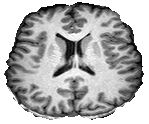
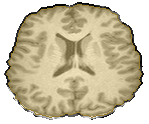
Bit-identical5,898,240 of 5,898,240 voxels equal
Bit-identical5,898,240 of 5,898,240 voxels equal
Bit-identical5,898,240 of 5,898,240 voxels equal
Axial slice 66 of 110; the crosshair on the mask's edge. The interactive viewer needs JavaScript; the metrics below are complete without it.
Every comparison, computed in float64 over every voxel of the outputs
| Comparison (A − B), verdict and reason | Output | max |Δ| | Values that differ | RMS of Δ | max |Δ| ÷ range | 1 − NCC |
|---|---|---|---|---|---|---|
| The original against itself: the yardstick | ||||||
FSL bet 6.0.7.23 − FSL bet 6.0.7.17referenceFSL 6.0.7.23 gives FSL 6.0.7.17’s values on this T1w: the version step changes nothing computed here. The images’ headers differ in FSL’s build string only (descrip: newimage 2601.0’s 2601.0 2025-12-08T15:20:57Z). | both outputs | identical: 0 of 5,898,240 values differ | ||||
| The replica against the original and itself | ||||||
| replica − FSL bet 6.0.7.17Bit-identicalThe same values, every one. The NIfTI headers too, byte for byte. | both outputs | identical: 0 of 5,898,240 values differ | ||||
| replica (reproduce) − FSL bet 6.0.7.17Bit-identicalThe same values, every one. The NIfTI headers too, byte for byte. | both outputs | identical: 0 of 5,898,240 values differ | ||||
| replica − FSL bet 6.0.7.23Bit-identicalThe same values as FSL 6.0.7.23, every one. The NIfTI headers too, byte for byte. | both outputs | identical: 0 of 5,898,240 values differ | ||||
| replica, fix − reproduceBit-identicalNo correction of the register applies to this input: both modes give the same values. | both outputs | identical: 0 of 5,898,240 values differ | ||||
| The clean room against the original and the replica | ||||||
| clean room − FSL bet 6.0.7.23Bit-identicalThe same values as FSL 6.0.7.23’s, every one. | both outputs | identical: 0 of 5,898,240 values differ | ||||
| clean room (reproduce) − FSL bet 6.0.7.23Bit-identicalThe same values as FSL 6.0.7.23’s, every one. | both outputs | identical: 0 of 5,898,240 values differ | ||||
| clean room − replica (both following FSL 6.0.7.23)Bit-identicalThe clean room gives the replica’s values, every one. | both outputs | identical: 0 of 5,898,240 values differ | ||||
Δ is A − B: for the masks +1 where only A holds a voxel, −1 where only B does. Computed in float64 over all 5,898,240 voxels of the outputs, not only those shown. The replica’s records’ threshold: every file bit-identical to FSL’s (header and data), with its exit status and messages. The clean room’s record (specs/bet.md §11): exit status and messages FSL’s, each file bit-identical or, for the masks, within a Dice coefficient and a boundary distance (betsurf’s: Dice >= 0.99, the boundary distance’s 95th percentile <= 1 voxel).
Provenance of this example
- Data: OpenNeuro ds000005 (Tom et al., 2007), snapshot 00001, sub-01, PDDL-1.0
- Inputs: BOLD reference, N4-corrected (sha256 e2edb4ebea7836d2…); fMRIPrep’s brain mask (sha256 548fdc1c1e375013…); T1w (sha256 75c615d7cce397be…)
- Runs: figures cache entry
fsl-bet/fmriprep-ds000005-run-01, computed 2026-10-25T22:38:13+00:00 with larmorxccbec9978309; FSL 6.0.7.17 (fsl-bet2 2111.8, fsl-newimage 2203.12, fsl-meshclass 2111.0); FSL in fMRIPrep 25.2.6’s image (fsl-bet2 2111.8, fsl-newimage 2501.4, fsl-miscmaths 2412.4); larmorx-nc 0.0.1; 7f84379b40f399876909ecf7c236105d6b7c43fdec5111fb7b03f8dee204ac10; every command, its environment, threads and exit status are in itsRUN_INFO.json - Inputs: BOLD reference, N4-corrected (sha256 e2edb4ebea7836d2…); T1w (sha256 75c615d7cce397be…)
- Runs: figures cache entry
fsl-bet/fmriprep-ds000005-run-01-fsl-6.0.7.23, computed 2026-10-29T10:13:59+00:00 with larmorxcaefd642193a; FSL 6.0.7.23 (fsl-bet2 2111.9, fsl-newimage 2601.0, fsl-meshclass 2111.0); FSL in fMRIPrep 25.2.6’s image (fsl-bet2 2111.8, fsl-newimage 2501.4, fsl-miscmaths 2412.4); larmorx-nc 0.0.1; 7f84379b40f399876909ecf7c236105d6b7c43fdec5111fb7b03f8dee204ac10; every command, its environment, threads and exit status are in itsRUN_INFO.json - Inputs: BOLD reference, N4-corrected (sha256 e2edb4ebea7836d2…); T1w (sha256 75c615d7cce397be…)
- Runs: figures cache entry
fsl-bet/fmriprep-ds000005-run-01-original, computed 2026-11-05T12:47:51+00:00 with larmorx73c3baf9c975; FSL 6.0.7.23 (fsl-bet2 2111.9, fsl-newimage 2601.0, fsl-meshclass 2111.0); “larmorx 0.0.1 (crate larmorx-fsl: the clean-room original)”, as the cache entry records it; every command, its environment, threads and exit status are in itsRUN_INFO.json
Every number above is in fsl-bet.json, exported by python -m larmorx_validation evidence fsl-bet.
The skull and the scalp: betsurf
betsurf with a T2 (the call bet -A2 makes after its registrations), on a synthetic head, which shows the three surfaces whole: on a real head that was not defaced, the scalp would show a face. The replica’s full comparison compares betsurf on real T1w and T2w images as well (a child, an adult of 82, a tumour, a Philips scanner), from FLIRT’s registrations, byte for byte. Real heads whose faces their datasets removed show the surfaces too: bet -A and -A2 on two heads of the data panel, below. On this head the clean room’s three surfaces lie within half a millimetre of FSL 6.0.7.23’s (95 % of their vertices within 0.006 mm), and its masks differ in a few voxels. Its record measures the real heads.
Worked example
betsurf: the skull and the scalp
What this shows: The replica gives FSL’s four masks, every voxel. The clean room’s masks differ from FSL’s in 2 to 14 voxels at their edges, within its record’s thresholds; the difference is not closed.
- Replica against FSL betsurf 6.0.7.23Bit-identical
- Clean room against FSL betsurf 6.0.7.23Open difference
betsurf with a T2 (the call bet -A2 makes, after FLIRT) on the comparison suite’s synthetic head, from FSL bet2’s surface of it: profiles along the surface’s normals through both images find the inner skull, the outer skull and the scalp; three surfaces are deformed onto them in turn. A synthetic head shows them whole: on a real head the scalp would show a face. FSL 6.0.7.17, fMRIPrep’s FSL and the replica in both modes; choose the mask above the panels. FSL 6.0.7.23’s output, and the replica’s run compared with it, are shown beside them (the replica’s reference since the version update of 2026-10-29). LARMORX’s clean room (Apache-2.0, written from the specification without FSL’s source) runs the same call in fix and in reproduce, compared with FSL 6.0.7.23, its reference.
- Data
- the comparison suite’s synthetic head (96 × 112 × 84 voxels of 2 mm: ellipsoidal shells of brain, CSF, skull and scalp, an intensity ramp, seeded noise), T1- and T2-like
- Command
betsurf -o -m -s head.nii.gz head-t2.nii.gz head_mesh.vtk head_to_std.mat out- Programs
- FSL 6.0.7.17 (fsl-bet2 2111.8, fsl-newimage 2203.12, fsl-meshclass 2111.0); FSL in fMRIPrep 25.2.6’s image (fsl-bet2 2111.8, fsl-newimage 2501.4, fsl-miscmaths 2412.4); larmorx-nc 0.0.1; larmorx 0.0.1 (crate larmorx-fsl: the clean room)
- Grid
- 96 × 112 × 84 voxels of 2 mm, shown whole
- FSL versions
- FSL 6.0.7.17’s panels as first computed; FSL 6.0.7.23 (the replica’s reference since 2026-10-29) on the same arguments, with the replica’s run compared with it: on this head it gives 6.0.7.17’s values (the headers’ build string aside). The case explorer below shows the full comparison’s record (against FSL 6.0.7.17) and the standard comparison’s record (against FSL 6.0.7.23) side by side.



Bit-identical903,168 of 903,168 voxels equal
Bit-identical903,168 of 903,168 voxels equal

Axial slice 43 of 84; the crosshair on the skull's mask. The interactive viewer needs JavaScript; the metrics below are complete without it.
Every comparison, computed in float64 over every voxel of the outputs
| Comparison (A − B), verdict and reason | Output | max |Δ| | Values that differ | RMS of Δ | max |Δ| ÷ range | 1 − NCC |
|---|---|---|---|---|---|---|
| The original against itself: the yardstick | ||||||
FSL betsurf 6.0.7.23 − FSL betsurf 6.0.7.17referenceFSL 6.0.7.23 gives FSL 6.0.7.17’s values on this head: the version step changes nothing computed here. The images’ headers differ in FSL’s build string only (descrip: newimage 2601.0’s 2601.0 2025-12-08T15:20:57Z). | every output | identical: 0 of 903,168 values differ | ||||
FSL betsurf, fMRIPrep's build − FSL betsurf 6.0.7.17referenceTwo builds of FSL (fMRIPrep’s image, with newer image libraries, and the installation in ~/fsl) give the same values on this head: FSL’s own variability is zero here (FSL is deterministic, single-threaded). The NIfTI headers of inskull, outskull, outskin, skull differ (FSL’s build string, descrip). | every output | identical: 0 of 903,168 values differ | ||||
| The replica against the original and itself | ||||||
| replica − FSL betsurf 6.0.7.17Bit-identicalThe same values, every one. The NIfTI headers too, byte for byte. | every output | identical: 0 of 903,168 values differ | ||||
| replica − FSL betsurf, fMRIPrep's buildBit-identicalThe replica gives the values of fMRIPrep’s own build of FSL too. | every output | identical: 0 of 903,168 values differ | ||||
| replica (reproduce) − FSL betsurf 6.0.7.17Bit-identicalThe same values, every one. The NIfTI headers too, byte for byte. | every output | identical: 0 of 903,168 values differ | ||||
| replica − FSL betsurf 6.0.7.23Bit-identicalThe same values as FSL 6.0.7.23, every one. The NIfTI headers too, byte for byte. | every output | identical: 0 of 903,168 values differ | ||||
| replica, fix − reproduceBit-identicalNo correction of the register applies to this input: both modes give the same values. | every output | identical: 0 of 903,168 values differ | ||||
| The clean room against the original and the replica | ||||||
| clean room − FSL betsurf 6.0.7.23Open differenceThe clean room’s masks differ from FSL 6.0.7.23’s in a few voxels at their edges: inner skull mask: 2 voxels of 214,470 (Dice 1.00000); outer skull mask: 5 voxels of 247,499 (Dice 0.99999); scalp mask: 14 voxels of 294,275 (Dice 0.99998); skull mask (-s): 8 voxels of 55,255 (Dice 0.99993). betsurf’s profiles agree with FSL’s one by one (330 of 330 probed); its surfaces settle a little elsewhere where few profiles vote and at the scalp (docs/findings/fsl-bet-clean-room.md, betsurf). The record holds betsurf to its masks (Dice >= 0.99, boundary p95 <= 1 voxel), which these meet; the difference is not closed: the clean room could still match FSL. | Inner skull mask | 1 | 2 of 903,168 (0.000221 %) | 0.00149 | 1 | 6.11e−6 |
| Outer skull mask | 1 | 5 of 903,168 (0.000554 %) | 0.00235 | 1 | 1.39e−5 | |
| Scalp mask | 1 | 14 of 903,168 (0.00155 %) | 0.00394 | 1 | 3.53e−5 | |
| Skull mask (-s) | 1 | 8 of 903,168 (0.000886 %) | 0.00298 | 1 | 7.71e−5 | |
| clean room (reproduce) − FSL betsurf 6.0.7.23Open differenceThe clean room’s masks differ from FSL 6.0.7.23’s in a few voxels at their edges: inner skull mask: 2 voxels of 214,470 (Dice 1.00000); outer skull mask: 5 voxels of 247,499 (Dice 0.99999); scalp mask: 14 voxels of 294,275 (Dice 0.99998); skull mask (-s): 8 voxels of 55,255 (Dice 0.99993). betsurf’s profiles agree with FSL’s one by one (330 of 330 probed); its surfaces settle a little elsewhere where few profiles vote and at the scalp (docs/findings/fsl-bet-clean-room.md, betsurf). The record holds betsurf to its masks (Dice >= 0.99, boundary p95 <= 1 voxel), which these meet; the difference is not closed: the clean room could still match FSL. | Inner skull mask | 1 | 2 of 903,168 (0.000221 %) | 0.00149 | 1 | 6.11e−6 |
| Outer skull mask | 1 | 5 of 903,168 (0.000554 %) | 0.00235 | 1 | 1.39e−5 | |
| Scalp mask | 1 | 14 of 903,168 (0.00155 %) | 0.00394 | 1 | 3.53e−5 | |
| Skull mask (-s) | 1 | 8 of 903,168 (0.000886 %) | 0.00298 | 1 | 7.71e−5 | |
| clean room − replica (both following FSL 6.0.7.23)Open differenceThe clean room’s masks differ from the replica’s in a few voxels at their edges: inner skull mask: 2 voxels of 214,470 (Dice 1.00000); outer skull mask: 5 voxels of 247,499 (Dice 0.99999); scalp mask: 14 voxels of 294,275 (Dice 0.99998); skull mask (-s): 8 voxels of 55,255 (Dice 0.99993). betsurf’s profiles agree with FSL’s one by one (330 of 330 probed); its surfaces settle a little elsewhere where few profiles vote and at the scalp (docs/findings/fsl-bet-clean-room.md, betsurf). The record holds betsurf to its masks (Dice >= 0.99, boundary p95 <= 1 voxel), which these meet; the difference is not closed: the clean room could still match FSL. | Inner skull mask | 1 | 2 of 903,168 (0.000221 %) | 0.00149 | 1 | 6.11e−6 |
| Outer skull mask | 1 | 5 of 903,168 (0.000554 %) | 0.00235 | 1 | 1.39e−5 | |
| Scalp mask | 1 | 14 of 903,168 (0.00155 %) | 0.00394 | 1 | 3.53e−5 | |
| Skull mask (-s) | 1 | 8 of 903,168 (0.000886 %) | 0.00298 | 1 | 7.71e−5 | |
Δ is A − B: for the masks +1 where only A holds a voxel, −1 where only B does. Computed in float64 over all 903,168 voxels of the outputs, not only those shown. The replica’s records’ threshold: every file bit-identical to FSL’s (header and data), with its exit status and messages. The clean room’s record (specs/bet.md §11): exit status and messages FSL’s, each file bit-identical or, for the masks, within a Dice coefficient and a boundary distance (betsurf’s: Dice >= 0.99, the boundary distance’s 95th percentile <= 1 voxel).
Provenance of this example
- Data: the comparison suite’s synthetic head (larmorx_validation.parity.fsl_bet: shells of brain, CSF, skull and scalp, 2 mm voxels, seeded noise), generated
- Inputs: synthetic head, T1-like (sha256 263003478288d934…); synthetic head, T2-like (sha256 0127039ce996f183…); FSL bet2’s surface of it (sha256 bc4cfb4c522c5d37…); its matrix to MNI152 (sha256 da3e076989f8c9ca…); its known brain (sha256 353dc873a376fafa…)
- Runs: figures cache entry
fsl-bet/betsurf-synthetic-head, computed 2026-10-25T22:38:36+00:00 with larmorxccbec9978309; FSL 6.0.7.17 (fsl-bet2 2111.8, fsl-newimage 2203.12, fsl-meshclass 2111.0); FSL in fMRIPrep 25.2.6’s image (fsl-bet2 2111.8, fsl-newimage 2501.4, fsl-miscmaths 2412.4); larmorx-nc 0.0.1; 7f84379b40f399876909ecf7c236105d6b7c43fdec5111fb7b03f8dee204ac10; every command, its environment, threads and exit status are in itsRUN_INFO.json - Inputs: synthetic head, T1-like (sha256 263003478288d934…); synthetic head, T2-like (sha256 0127039ce996f183…); FSL bet2’s surface of it (sha256 bc4cfb4c522c5d37…); its matrix to MNI152 (sha256 da3e076989f8c9ca…)
- Runs: figures cache entry
fsl-bet/betsurf-synthetic-head-fsl-6.0.7.23, computed 2026-10-29T10:14:07+00:00 with larmorxcaefd642193a; FSL 6.0.7.23 (fsl-bet2 2111.9, fsl-newimage 2601.0, fsl-meshclass 2111.0); FSL in fMRIPrep 25.2.6’s image (fsl-bet2 2111.8, fsl-newimage 2501.4, fsl-miscmaths 2412.4); larmorx-nc 0.0.1; 7f84379b40f399876909ecf7c236105d6b7c43fdec5111fb7b03f8dee204ac10; every command, its environment, threads and exit status are in itsRUN_INFO.json - Inputs: synthetic head, T1-like (sha256 263003478288d934…); synthetic head, T2-like (sha256 0127039ce996f183…); FSL bet2’s surface of it (sha256 bc4cfb4c522c5d37…); its matrix to MNI152 (sha256 da3e076989f8c9ca…)
- Runs: figures cache entry
fsl-bet/betsurf-synthetic-head-original, computed 2026-11-05T12:47:55+00:00 with larmorx73c3baf9c975; FSL 6.0.7.23 (fsl-bet2 2111.9, fsl-newimage 2601.0, fsl-meshclass 2111.0); “larmorx 0.0.1 (crate larmorx-fsl: the clean-room original)”, as the cache entry records it; every command, its environment, threads and exit status are in itsRUN_INFO.json
Every number above is in fsl-bet.json, exported by python -m larmorx_validation evidence fsl-bet.
On the data panel: a three-year-old’s BOLD reference
The data panel’s youngest subject (ds000228, aged 3.5: a small head, an oblique field of view), through fMRIPrep’s BET call. The record runs the call on every run of the panel that has BOLD runs. As a panel case beside the examples above, it is stored as three full-resolution slices, and the crosshair moves through them.
Worked example
Data panel: a three-year-old's BOLD reference
What this shows: On the data panel’s youngest head, the replica and the clean room both give FSL’s brain and mask, every voxel, and the replica also gives fMRIPrep’s own output.
- Replica against FSL bet 6.0.7.23Bit-identical
- Clean room against FSL bet 6.0.7.23Bit-identical
The data panel’s youngest subject: the BET node fMRIPrep 25.2.6 ran on the N4-corrected BOLD reference of OpenNeuro ds000228 sub-pixar008, aged 3.5 (a small head, an oblique field of view; task pixar), bet <boldref> <out> -f 0.20 -m, given to FSL 6.0.7.17, fMRIPrep’s build of FSL and the replica in both modes, beside the outputs fMRIPrep’s node wrote. As a panel case beside the examples above, it is stored as three full-resolution slices. FSL 6.0.7.23’s output, and the replica’s run compared with it, are shown beside them (the replica’s reference since the version update of 2026-10-29). LARMORX’s clean room (Apache-2.0, written from the specification without FSL’s source) runs the same call in fix and in reproduce, compared with FSL 6.0.7.23, its reference.
- Data
- OpenNeuro ds000228 (Richardson et al., 2018), version 1.1.1, sub-pixar008 (3.5 years), task pixar (CC0-1.0): the BOLD reference fMRIPrep computed and N4-corrected; shown around the masks, dilated by 2 voxels
- Node
- fMRIPrep 25.2.6,
bold_fit_wf/enhance_and_skullstrip_bold_wf/skullstrip_first_pass(niworkflows’ first skull strip) - Command
bet sub-pixar008_task-pixar_desc-hmc_boldref_corrected.nii.gz sub-pixar008_task-pixar_desc-hmc_boldref_corrected_brain.nii.gz -f 0.20 -m- Programs
- FSL 6.0.7.17 (fsl-bet2 2111.8, fsl-newimage 2203.12, fsl-meshclass 2111.0); FSL in fMRIPrep 25.2.6’s image (fsl-bet2 2111.8, fsl-newimage 2501.4, fsl-miscmaths 2412.4); larmorx-nc 0.0.1 (the replica), from larmorx at commit
ccbec9978309; larmorx 0.0.1 (crate larmorx-fsl: the clean room) - Mask
- 43,291 of 131,072 voxels; the replica’s the same, voxel for voxel
- Grid
- 64 × 64 × 32 voxels of 3 × 3 × 3.3 mm; shown: 53 × 61 × 32 around the brain
- FSL versions
- FSL 6.0.7.17’s panels as first computed; FSL 6.0.7.23 (the replica’s reference since 2026-10-29) on the same arguments, with the replica’s run compared with it: on this child’s BOLD reference it gives 6.0.7.17’s values (the headers’ build string aside). The case explorer below shows the full comparison’s record (against FSL 6.0.7.17) and the standard comparison’s record (against FSL 6.0.7.23) side by side.
Data shown
- Children and adults watching a short film (OpenNeuro ds000228, version 1.1.1, doi:10.18112/openneuro.ds000228.v1.1.1), CC0 1.0 public-domain dedication.


Bit-identical131,072 of 131,072 voxels equal
Bit-identical131,072 of 131,072 voxels equal
Bit-identical131,072 of 131,072 voxels equal
Bit-identical131,072 of 131,072 voxels equal
Axial slice 16 of 32; the crosshair at the centre of the shown region; the three slices through it are stored at full resolution. The interactive viewer needs JavaScript; the metrics below are complete without it.
Stored for this example: three full-resolution slices, one per plane, through display voxel (27, 29, 16): where the main comparison differs most, or the field's centre where nothing differs; every metric is computed over every voxel of the files.
Every comparison, computed in float64 over every voxel of the outputs
| Comparison (A − B), verdict and reason | Output | max |Δ| | Values that differ | RMS of Δ | max |Δ| ÷ range | 1 − NCC |
|---|---|---|---|---|---|---|
| The original against itself: the yardstick | ||||||
FSL bet 6.0.7.23 − FSL bet 6.0.7.17referenceFSL 6.0.7.23 gives FSL 6.0.7.17’s values on this child’s BOLD reference: the version step changes nothing computed here. The images’ headers differ in FSL’s build string only (descrip: newimage 2601.0’s 2601.0 2025-12-08T15:20:57Z). | both outputs | identical: 0 of 131,072 values differ | ||||
FSL bet, fMRIPrep's build − FSL bet 6.0.7.17referenceTwo builds of FSL (fMRIPrep’s image, with newer image libraries, and the installation in ~/fsl) give the same values on this child’s BOLD reference: FSL’s own variability is zero here (FSL is deterministic, single-threaded). The NIfTI headers of mask, brain differ (FSL’s build string, descrip). | both outputs | identical: 0 of 131,072 values differ | ||||
| The replica against the original, fMRIPrep's output and itself | ||||||
| replica − FSL bet 6.0.7.17Bit-identicalThe same values, every one. The NIfTI headers too, byte for byte. | both outputs | identical: 0 of 131,072 values differ | ||||
| replica − FSL bet, fMRIPrep's buildBit-identicalThe replica gives the values of fMRIPrep’s own build of FSL too. | both outputs | identical: 0 of 131,072 values differ | ||||
| replica (reproduce) − FSL bet 6.0.7.17Bit-identicalThe same values, every one. The NIfTI headers too, byte for byte. | both outputs | identical: 0 of 131,072 values differ | ||||
| replica − FSL bet 6.0.7.23Bit-identicalThe same values as FSL 6.0.7.23, every one. The NIfTI headers too, byte for byte. | both outputs | identical: 0 of 131,072 values differ | ||||
replica − fMRIPrep's outputBit-identicalThe replica gives the values fMRIPrep’s node wrote, every voxel of the brain and of the mask (the headers differ only in FSL’s build string, descrip). | both outputs | identical: 0 of 131,072 values differ | ||||
| replica, fix − reproduceBit-identicalNo correction of the register applies to this input: both modes give the same values. | both outputs | identical: 0 of 131,072 values differ | ||||
| The clean room against the original and the replica | ||||||
| clean room − FSL bet 6.0.7.23Bit-identicalThe same values as FSL 6.0.7.23’s, every one. | both outputs | identical: 0 of 131,072 values differ | ||||
| clean room (reproduce) − FSL bet 6.0.7.23Bit-identicalThe same values as FSL 6.0.7.23’s, every one. | both outputs | identical: 0 of 131,072 values differ | ||||
| clean room − replica (both following FSL 6.0.7.23)Bit-identicalThe clean room gives the replica’s values, every one. | both outputs | identical: 0 of 131,072 values differ | ||||
Δ is A − B: for the masks +1 where only A holds a voxel, −1 where only B does. Computed in float64 over all 131,072 voxels of the outputs, not only those shown. The replica’s records’ threshold: every file bit-identical to FSL’s (header and data), with its exit status and messages. The clean room’s record (specs/bet.md §11): exit status and messages FSL’s, each file bit-identical or, for the masks, within a Dice coefficient and a boundary distance (betsurf’s: Dice >= 0.99, the boundary distance’s 95th percentile <= 1 voxel).
Provenance of this example
- Data: OpenNeuro ds000228 (Richardson et al., 2018), version 1.1.1, sub-pixar008 (3.5 years), task pixar, CC0-1.0
- Inputs: BOLD reference, N4-corrected (sha256 4537975eac27fbce…); fMRIPrep’s brain mask (sha256 bdbdc20428c94799…)
- Runs: figures cache entry
fsl-bet/panel-ds000228-pixar008, computed 2026-10-25T22:38:40+00:00 with larmorxccbec9978309; FSL 6.0.7.17 (fsl-bet2 2111.8, fsl-newimage 2203.12, fsl-meshclass 2111.0); FSL in fMRIPrep 25.2.6’s image (fsl-bet2 2111.8, fsl-newimage 2501.4, fsl-miscmaths 2412.4); larmorx-nc 0.0.1; 7f84379b40f399876909ecf7c236105d6b7c43fdec5111fb7b03f8dee204ac10; every command, its environment, threads and exit status are in itsRUN_INFO.json - Inputs: BOLD reference, N4-corrected (sha256 4537975eac27fbce…)
- Runs: figures cache entry
fsl-bet/panel-ds000228-pixar008-fsl-6.0.7.23, computed 2026-10-29T10:14:09+00:00 with larmorxcaefd642193a; FSL 6.0.7.23 (fsl-bet2 2111.9, fsl-newimage 2601.0, fsl-meshclass 2111.0); FSL in fMRIPrep 25.2.6’s image (fsl-bet2 2111.8, fsl-newimage 2501.4, fsl-miscmaths 2412.4); larmorx-nc 0.0.1; 7f84379b40f399876909ecf7c236105d6b7c43fdec5111fb7b03f8dee204ac10; every command, its environment, threads and exit status are in itsRUN_INFO.json - Inputs: BOLD reference, N4-corrected (sha256 4537975eac27fbce…)
- Runs: figures cache entry
fsl-bet/panel-ds000228-pixar008-original, computed 2026-11-05T12:47:52+00:00 with larmorx73c3baf9c975; FSL 6.0.7.23 (fsl-bet2 2111.9, fsl-newimage 2601.0, fsl-meshclass 2111.0); “larmorx 0.0.1 (crate larmorx-fsl: the clean-room original)”, as the cache entry records it; every command, its environment, threads and exit status are in itsRUN_INFO.json
Every number above is in fsl-bet.json, exported by python -m larmorx_validation evidence fsl-bet.
The variations that run FSL’s other programs: -S, -B, -A, -A2
Four of the script’s variations run other FSL programs.
-Sremoves the eyes and optic nerves, one of SIENA’s cleanups. It runsbet2for the raw brain and skull,standard_space_roito cut the head to MNI152’s dilated brain mask andbet2again on it, FLIRT to bring MNI152’s eye mask into the head,fslmaths’ morphology,fslstats’ mean and standard deviation of the brain, anddcfor a threshold 3.5 deviations above it.-Bremoves the bias field and the neck, SIENA’s other cleanup. It runsstandard_space_roi, FAST’s bias field,fslmathsto divide it out,standard_space_roiagain and the script itself with-R; with-s,standard_space_roi -maskFOVandbet2for the skull.-Aand-A2register the head to MNI152 with FLIRT and givebet2’s mesh tobetsurf(-A2with the T2w, which FLIRT first registers to the T1w).
The replica runs FSL 6.0.7.23’s script for each. Every program it runs is the replica’s own, called in the same process with the words bash would give it, with the script’s temporary files (-d keeps them), messages and exit statuses; GNU dc’s arithmetic for -S’s threshold is replicated too. Its record compares them on synthetic heads (every option they pass on, -d, -v, and the order of the variations: the last one given wins) and on the six real heads of the data panel shown below. Each passes, with every file FSL writes byte for byte.
Each example shows FSL 6.0.7.23’s run (the record’s own, from the cache of the original’s runs) and the replica with fix and with reproduce. For -S and -B it also shows FSL’s bet without the option on the same head (-m, with -s where the option writes a skull image). That comparison, with and without the option, is FSL against FSL: it shows the option’s effect and has no verdict. These heads were defaced by their datasets (checked in LARMORX’s test-data panel), so the whole field of view is shown, as three full-resolution slices through the crosshair.
The replica’s fix differs from FSL only where it names a correction of a program the script runs. In both -B examples that is FAST’s class variances (FSL-202, the cancellation in FAST’s single-precision statistics), from which -B’s bias field comes, so the unbiased head and the brain bet finds in it move a little. FLIRT’s integer output inside standard_space_roi (FSL-09) is named on two heads.
Each example also shows the clean room on the same call, with fix and with reproduce, every program the script runs its own (bet2, FLIRT, FAST, fslmaths, fslstats, standard_space_roi, betsurf), with its comparisons after the replica’s. Its reproduce gives FSL 6.0.7.23’s values, every one, on -S (both heads), on the 82-year-old’s -B and on standard_space_roi. On the 3.5-year-old’s -B its brain differs in 2,439 of 6,488,064 values. This is the record’s one failure among these: the robust centre, on this image stored in neurological order, starts bet2 a few bits elsewhere (an open question of the specification). On -A and -A2, betsurf’s masks differ at their edges (Dice 0.9993 to 0.9996; the scalp the most), as betsurf’s own record shows. Its fix differs from FSL where it names a correction (FSL-09, FSL-182, FSL-202). It also differs where it computes the C library’s maths functions correctly rounded instead of as glibc does (GLIBC-07, which no notice names): FLIRT’s rotations inside standard_space_roi and betsurf’s smoothing move a little with them.
-S: the eyes and optic nerves
Worked example
bet -S: the eyes removed, an adult
What this shows: With -S, the replica gives FSL’s files in fix and in reproduce. The clean room gives them in reproduce; in fix it corrects FSL-09 and computes the C library’s maths correctly rounded (GLIBC-07), and 1,277 brain values move.
- Replica against FSL bet 6.0.7.23Bit-identical
- Clean room against FSL bet 6.0.7.23Deliberate correction
-S (SIENA’s eye and optic-nerve cleanup) runs bet2 for the raw brain and skull, standard_space_roi to cut the head to MNI152’s dilated brain mask, bet2 again on that, FLIRT to bring MNI152’s eye mask into the head through the registration’s inverse, fslmaths to dilate it and remove it from the raw mask, fslstats for the brain’s mean and standard deviation and dc for a threshold 3.5 deviations above it, then fslmaths’ morphology for the final brain, mask and skull. Every program is the replica’s, called in the same process. On the raw T1w of ds000005 sub-01, bet <T1w> out -S -m. Beside them, LARMORX’s clean room in both modes on the same call (since 2026-11-05), compared with FSL’s run and the replica’s.
- Data
- OpenNeuro ds000005 (Tom et al., 2007), snapshot 00001, sub-01 (PDDL-1.0): the raw T1w; its face was removed by the dataset’s defacing (checked in larmorx-testdata’s panel.toml), so the whole field of view is shown
- Command
bet <T1w> out -S -m- Without the option
bet <T1w> out -m -sby FSL 6.0.7.23 on the same head, beside it- Programs
- FSL 6.0.7.23 (fsl-bet2 2111.9, fsl-newimage 2601.0, fsl-meshclass 2111.0), its
betscript running FSL’s programs; larmorx-nc 0.0.1 (the replica: every program in its process), from larmorx at commit73451f78a400 - Files compared
out.nii.gz,out_mask.nii.gz,out_skull.nii.gz(and every other file, in the record)- Mask
- 718,478 of 5,898,240 voxels in FSL’s
- Record
real/adult-ds000005-Sof the replica’s standard record: pass, 8 of 8 checks- Grid
- 160 × 192 × 192 voxels of 1 × 1.33 × 1.33 mm; shown: 160 × 192 × 192, the whole field of view (three slices through the crosshair)
- Clean room
- LARMORX’s clean room (crate larmorx-fsl, Apache-2.0; larmorx 0.0.1 (crate larmorx-fsl: the clean room)), from larmorx at commit
73c3baf9c975:larmorx fsl beton the same call (bet <T1w> out -S -m), infixand inreproduce, every program the script runs its own clean-room program, in this process; the standard images read from FSL 6.0.7.23’s data ($FSLDIR/data/standard) by the data search. Named by its default: FSL-09; by reproduce: FSL-09.
Data shown
- Mixed-gambles task (OpenNeuro ds000005, version 00001), Open Data Commons Public Domain Dedication and Licence 1.0.
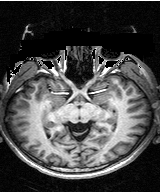
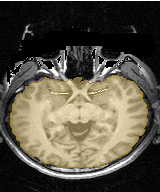
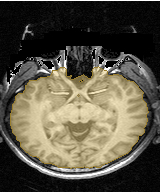
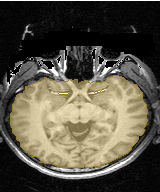

Bit-identical5,898,240 of 5,898,240 voxels equal

Axial slice 81 of 192; the crosshair inside the largest region where -S changed FSL's mask; the three slices through it are stored at full resolution. The interactive viewer needs JavaScript; the metrics below are complete without it.
Stored for this example: three full-resolution slices, one per plane, through display voxel (54, 115, 81): where the main comparison differs most, or the field's centre where nothing differs; every metric is computed over every voxel of the files.
Every comparison, computed in float64 over every voxel of the outputs
| Comparison (A − B), verdict and reason | Output | max |Δ| | Values that differ | RMS of Δ | max |Δ| ÷ range | 1 − NCC |
|---|---|---|---|---|---|---|
| The original against itself: what -S changes | ||||||
| bet -S -m − bet -m -s (both FSL 6.0.7.23)referenceWhat -S changes in FSL’s own output (the eyes and optic nerves removed): its mask holds 718,478 voxels where bet -m -s’s holds 729,640: 11,162 removed, 0 added. Both runs are FSL 6.0.7.23’s; no verdict: this row is the option’s effect, not a comparison of LARMORX. | Brain | 940 | 11,132 of 5,898,240 (0.189 %) | 10.2 | 1 | 0.00771 |
| Brain mask | 1 | 11,162 of 5,898,240 (0.189 %) | 0.0435 | 1 | 0.00875 | |
| Skull image (bet2 -s) | 100 | 4,335 of 5,898,240 (0.0735 %) | 2.71 | 1 | 0.0492 | |
| The replica against the original and itself | ||||||
replica − FSL bet 6.0.7.23Bit-identicalThe default, fix, gives FSL’s values too, in out.nii.gz, out_mask.nii.gz, out_skull.nii.gz: it names FSL-09 (FLIRT inside standard_space_roi writes its resampled head in the input’s integer type truncated toward zero; the default rounds to the nearest integer), corrections of intermediate values (inside the programs the script runs) that change nothing it writes here. | every output | identical: 0 of 5,898,240 values differ | ||||
replica (reproduce) − FSL bet 6.0.7.23Bit-identicalThe same values, every one, in out.nii.gz, out_mask.nii.gz, out_skull.nii.gz. The NIfTI headers too, byte for byte. The record compares every file FSL writes byte for byte, with FSL’s exit status and messages: this case passes. reproduce names FSL-09 where FSL’s behaviour is reproduced. | every output | identical: 0 of 5,898,240 values differ | ||||
| replica, fix − reproduceBit-identicalBoth modes give the same values: the default names FSL-09, whose corrections change only intermediate values here. | every output | identical: 0 of 5,898,240 values differ | ||||
| The clean room against the original, itself and the replica | ||||||
clean room − FSL bet 6.0.7.23Deliberate correctionDeliberate in the default: the default’s corrections, each named as it is made: FSL-09 (FLIRT’s integer output inside standard_space_roi: rounded to the nearest and clamped where FLIRT truncates toward zero and wraps); and the default computes the C library’s maths functions correctly rounded, the same on every platform, where FSL takes glibc 2.35’s (GLIBC-07, named nowhere, as decided on 2026-11-04); reproduce computes them as glibc does. Inside the script’s programs (FLIRT’s rotations and windowed sinc, bet2’s powf, betsurf’s smoothing) their last bits move the registration’s or the surfaces’ path a little. reproduce gives FSL’s values, every one. What the default changes: brain: 1,277 of 5,898,240 values (the non-zero voxels’ Dice 0.99911); brain mask: 1,277 of 5,898,240 values (the non-zero voxels’ Dice 0.99911); skull image (bet2 -s): 5 of 5,898,240 values (the … findings | Brain | 558 | 1,277 of 5,898,240 (0.0217 %) | 2.04 | 1 | 0.000308 |
| Brain mask | 1 | 1,277 of 5,898,240 (0.0217 %) | 0.0147 | 1 | 0.00101 | |
| Skull image (bet2 -s) | 100 | 5 of 5,898,240 (8.48e−5 %) | 0.0921 | 1 | 6.11e−5 | |
clean room (reproduce) − FSL bet 6.0.7.23Bit-identicalThe same values as FSL 6.0.7.23’s, every one, in out.nii.gz, out_mask.nii.gz, out_skull.nii.gz. Its record case real/adult-ds000005-S (the clean room against FSL 6.0.7.23): pass, 10 of 10 checks. findings | every output | identical: 0 of 5,898,240 values differ | ||||
| clean room, fix − reproduceDeliberate correctionThe default’s corrections, each named as it is made: FSL-09 (FLIRT’s integer output inside standard_space_roi: rounded to the nearest and clamped where FLIRT truncates toward zero and wraps); and the default computes the C library’s maths functions correctly rounded, the same on every platform, where FSL takes glibc 2.35’s (GLIBC-07, named nowhere, as decided on 2026-11-04); reproduce computes them as glibc does. Inside the script’s programs (FLIRT’s rotations and windowed sinc, bet2’s powf, betsurf’s smoothing) their last bits move the registration’s or the surfaces’ path a little. What they change: brain: 1,277 of 5,898,240 values (the non-zero voxels’ Dice 0.99911); brain mask: 1,277 of 5,898,240 values (the non-zero voxels’ Dice 0.99911); skull image (bet2 -s): 5 of 5,898,240 values (the non-zero voxels’ Dice 0.99994). findings | Brain | 558 | 1,277 of 5,898,240 (0.0217 %) | 2.04 | 1 | 0.000308 |
| Brain mask | 1 | 1,277 of 5,898,240 (0.0217 %) | 0.0147 | 1 | 0.00101 | |
| Skull image (bet2 -s) | 100 | 5 of 5,898,240 (8.48e−5 %) | 0.0921 | 1 | 6.11e−5 | |
clean room − replica, both fixDeliberate correctionIn reproduce both give FSL’s values; the two defaults differ in their corrections’ arithmetic (the clean room names FSL-09; the replica’s are named in its run) and in the maths functions: the clean room’s default computes them correctly rounded (GLIBC-07), the replica’s as glibc does. Where they differ: brain: 1,277 of 5,898,240 values (the non-zero voxels’ Dice 0.99911); brain mask: 1,277 of 5,898,240 values (the non-zero voxels’ Dice 0.99911); skull image (bet2 -s): 5 of 5,898,240 values (the non-zero voxels’ Dice 0.99994). findings | Brain | 558 | 1,277 of 5,898,240 (0.0217 %) | 2.04 | 1 | 0.000308 |
| Brain mask | 1 | 1,277 of 5,898,240 (0.0217 %) | 0.0147 | 1 | 0.00101 | |
| Skull image (bet2 -s) | 100 | 5 of 5,898,240 (8.48e−5 %) | 0.0921 | 1 | 6.11e−5 | |
Δ is A − B: for the masks +1 where only A holds a voxel, −1 where only B does. Computed in float64 over all 5,898,240 voxels of the outputs, not only the three slices shown. The replica’s record compares reproduce with FSL: every file bit-identical (header and data), with FSL’s exit status and messages; its default, fix, is reported (the record’s list of what fix changed).
Provenance of this example
- Data: OpenNeuro ds000005 (Tom et al., 2007), snapshot 00001, sub-01, PDDL-1.0
- Inputs: T1w (sha256 75c615d7cce397be…)
- Runs: figures cache entry
fsl-bet/options-adult-ds000005-S, computed 2026-11-04T20:37:02+00:00 with larmorx73451f78a400; FSL 6.0.7.23 (fsl-bet2 2111.9, fsl-newimage 2601.0, fsl-meshclass 2111.0); larmorx-nc 0.0.1; every command, its environment, threads and exit status are in itsRUN_INFO.json - Runs of the clean room: figures cache entry
fsl-bet/options-adult-ds000005-S-original, computed 2026-11-05T12:48:24+00:00 with larmorx73c3baf9c975; “larmorx 0.0.1 (crate larmorx-fsl: the clean-room original)”, as the cache entry records it; every command, its environment and exit status in itsRUN_INFO.json
Every number above is in fsl-bet.json, exported by python -m larmorx_validation evidence fsl-bet.
Worked example
bet -S: a head with a brain tumour
What this shows: With -S on a head with a tumour, the replica gives FSL’s files in fix and in reproduce. The clean room gives them in reproduce; in fix it corrects FSL-182 and computes the C library’s maths correctly rounded (GLIBC-07), and 470 brain values move.
- Replica against FSL bet 6.0.7.23Bit-identical
- Clean room against FSL bet 6.0.7.23Deliberate correction
The same variation on the T1w of a patient with a brain tumour (ds005003 sub-RS001), bet <T1w> out -S: the mask and the skull image are written without -m too. Beside them, LARMORX’s clean room in both modes on the same call (since 2026-11-05), compared with FSL’s run and the replica’s.
- Data
- OpenNeuro ds005003 (Leuthardt et al.), version 2.0.0, sub-RS001 ses-1 (a brain tumour) (CC0-1.0): the raw T1w; its face was removed by the dataset’s defacing (checked in larmorx-testdata’s panel.toml), so the whole field of view is shown
- Command
bet <T1w> out -S- Without the option
bet <T1w> out -m -sby FSL 6.0.7.23 on the same head, beside it- Programs
- FSL 6.0.7.23 (fsl-bet2 2111.9, fsl-newimage 2601.0, fsl-meshclass 2111.0), its
betscript running FSL’s programs; larmorx-nc 0.0.1 (the replica: every program in its process), from larmorx at commit73451f78a400 - Files compared
out.nii.gz,out_mask.nii.gz,out_skull.nii.gz(and every other file, in the record)- Mask
- 1,527,914 of 9,437,184 voxels in FSL’s
- Record
real/tumour-Sof the replica’s standard record: pass, 8 of 8 checks- Grid
- 144 × 256 × 256 voxels of 1.2 × 0.977 × 0.977 mm; shown: 144 × 256 × 256, the whole field of view (three slices through the crosshair)
- Clean room
- LARMORX’s clean room (crate larmorx-fsl, Apache-2.0; larmorx 0.0.1 (crate larmorx-fsl: the clean room)), from larmorx at commit
73c3baf9c975:larmorx fsl beton the same call (bet <T1w> out -S), infixand inreproduce, every program the script runs its own clean-room program, in this process; the standard images read from FSL 6.0.7.23’s data ($FSLDIR/data/standard) by the data search. Named by its default: FSL-182; by reproduce: nothing.
Data shown
- Retrospective Task/Rest fMRI Data from Tumor Patients (OpenNeuro ds005003, version 2.0.0, doi:10.18112/openneuro.ds005003.v2.0.0), CC0 1.0 public-domain dedication.
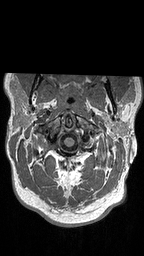
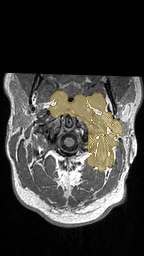
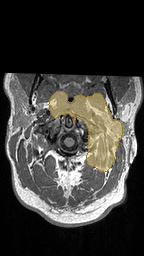

Bit-identical9,437,184 of 9,437,184 voxels equal

Axial slice 48 of 256; the crosshair inside the largest region where -S changed FSL's mask; the three slices through it are stored at full resolution. The interactive viewer needs JavaScript; the metrics below are complete without it.
Stored for this example: three full-resolution slices, one per plane, through display voxel (104, 121, 48): where the main comparison differs most, or the field's centre where nothing differs; every metric is computed over every voxel of the files.
Every comparison, computed in float64 over every voxel of the outputs
| Comparison (A − B), verdict and reason | Output | max |Δ| | Values that differ | RMS of Δ | max |Δ| ÷ range | 1 − NCC |
|---|---|---|---|---|---|---|
| The original against itself: what -S changes | ||||||
| bet -S − bet -m -s (both FSL 6.0.7.23)referenceWhat -S changes in FSL’s own output (the eyes and optic nerves removed): its mask holds 1,527,914 voxels where bet -m -s’s holds 1,547,192: 19,278 removed, 0 added. Both runs are FSL 6.0.7.23’s; no verdict: this row is the option’s effect, not a comparison of LARMORX. | Brain | 956 | 19,269 of 9,437,184 (0.204 %) | 21.3 | 1 | 0.0255 |
| Brain mask | 1 | 19,278 of 9,437,184 (0.204 %) | 0.0452 | 1 | 0.00746 | |
| Skull image (bet2 -s) | 100 | 4,277 of 9,437,184 (0.0453 %) | 2.13 | 1 | 0.0271 | |
| The replica against the original and itself | ||||||
replica − FSL bet 6.0.7.23Bit-identicalThe default, fix, gives FSL’s values too, in out.nii.gz, out_mask.nii.gz, out_skull.nii.gz: no correction of the register applies to this call. | every output | identical: 0 of 9,437,184 values differ | ||||
replica (reproduce) − FSL bet 6.0.7.23Bit-identicalThe same values, every one, in out.nii.gz, out_mask.nii.gz, out_skull.nii.gz. The NIfTI headers too, byte for byte. The record compares every file FSL writes byte for byte, with FSL’s exit status and messages: this case passes. | every output | identical: 0 of 9,437,184 values differ | ||||
| replica, fix − reproduceBit-identicalBoth modes give the same values: no correction of the register applies to this call. | every output | identical: 0 of 9,437,184 values differ | ||||
| The clean room against the original, itself and the replica | ||||||
clean room − FSL bet 6.0.7.23Deliberate correctionDeliberate in the default: the default’s corrections, each named as it is made: FSL-182 (fslstats’ -S (-S’s eye threshold) without a mask: the masked forms’ variance, clamped at 0 and summed in double precision); and the default computes the C library’s maths functions correctly rounded, the same on every platform, where FSL takes glibc 2.35’s (GLIBC-07, named nowhere, as decided on 2026-11-04); reproduce computes them as glibc does. Inside the script’s programs (FLIRT’s rotations and windowed sinc, bet2’s powf, betsurf’s smoothing) their last bits move the registration’s or the surfaces’ path a little. reproduce gives FSL’s values, every one. What the default changes: brain: 470 of 9,437,184 values (the non-zero voxels’ Dice 0.99985); brain mask: 470 of 9,437,184 values (the non-zero voxels’ Dice 0.99985); skull image (bet2 -s): 4 of 9,437,184 values (the non-zero v… findings | Brain | 262 | 470 of 9,437,184 (0.00498 %) | 1.18 | 0.521 | 8.05e−5 |
| Brain mask | 1 | 470 of 9,437,184 (0.00498 %) | 0.00706 | 1 | 0.000184 | |
| Skull image (bet2 -s) | 100 | 4 of 9,437,184 (4.24e−5 %) | 0.0651 | 1 | 2.64e−5 | |
clean room (reproduce) − FSL bet 6.0.7.23Bit-identicalThe same values as FSL 6.0.7.23’s, every one, in out.nii.gz, out_mask.nii.gz, out_skull.nii.gz. Its record case real/tumour-S (the clean room against FSL 6.0.7.23): pass, 10 of 10 checks. findings | every output | identical: 0 of 9,437,184 values differ | ||||
| clean room, fix − reproduceDeliberate correctionThe default’s corrections, each named as it is made: FSL-182 (fslstats’ -S (-S’s eye threshold) without a mask: the masked forms’ variance, clamped at 0 and summed in double precision); and the default computes the C library’s maths functions correctly rounded, the same on every platform, where FSL takes glibc 2.35’s (GLIBC-07, named nowhere, as decided on 2026-11-04); reproduce computes them as glibc does. Inside the script’s programs (FLIRT’s rotations and windowed sinc, bet2’s powf, betsurf’s smoothing) their last bits move the registration’s or the surfaces’ path a little. What they change: brain: 470 of 9,437,184 values (the non-zero voxels’ Dice 0.99985); brain mask: 470 of 9,437,184 values (the non-zero voxels’ Dice 0.99985); skull image (bet2 -s): 4 of 9,437,184 values (the non-zero voxels’ Dice 0.99997). findings | Brain | 262 | 470 of 9,437,184 (0.00498 %) | 1.18 | 0.521 | 8.05e−5 |
| Brain mask | 1 | 470 of 9,437,184 (0.00498 %) | 0.00706 | 1 | 0.000184 | |
| Skull image (bet2 -s) | 100 | 4 of 9,437,184 (4.24e−5 %) | 0.0651 | 1 | 2.64e−5 | |
clean room − replica, both fixDeliberate correctionIn reproduce both give FSL’s values; the two defaults differ in their corrections’ arithmetic (the clean room names FSL-182; the replica’s are named in its run) and in the maths functions: the clean room’s default computes them correctly rounded (GLIBC-07), the replica’s as glibc does. Where they differ: brain: 470 of 9,437,184 values (the non-zero voxels’ Dice 0.99985); brain mask: 470 of 9,437,184 values (the non-zero voxels’ Dice 0.99985); skull image (bet2 -s): 4 of 9,437,184 values (the non-zero voxels’ Dice 0.99997). findings | Brain | 262 | 470 of 9,437,184 (0.00498 %) | 1.18 | 0.521 | 8.05e−5 |
| Brain mask | 1 | 470 of 9,437,184 (0.00498 %) | 0.00706 | 1 | 0.000184 | |
| Skull image (bet2 -s) | 100 | 4 of 9,437,184 (4.24e−5 %) | 0.0651 | 1 | 2.64e−5 | |
Δ is A − B: for the masks +1 where only A holds a voxel, −1 where only B does. Computed in float64 over all 9,437,184 voxels of the outputs, not only the three slices shown. The replica’s record compares reproduce with FSL: every file bit-identical (header and data), with FSL’s exit status and messages; its default, fix, is reported (the record’s list of what fix changed).
Provenance of this example
- Data: OpenNeuro ds005003 (Leuthardt et al.), version 2.0.0, sub-RS001 ses-1 (a brain tumour), CC0-1.0
- Inputs: T1w (sha256 cf629160e24ea365…)
- Runs: figures cache entry
fsl-bet/options-tumour-S, computed 2026-11-04T20:38:01+00:00 with larmorx73451f78a400; FSL 6.0.7.23 (fsl-bet2 2111.9, fsl-newimage 2601.0, fsl-meshclass 2111.0); larmorx-nc 0.0.1; every command, its environment, threads and exit status are in itsRUN_INFO.json - Runs of the clean room: figures cache entry
fsl-bet/options-tumour-S-original, computed 2026-11-05T12:49:05+00:00 with larmorx73c3baf9c975; “larmorx 0.0.1 (crate larmorx-fsl: the clean-room original)”, as the cache entry records it; every command, its environment and exit status in itsRUN_INFO.json
Every number above is in fsl-bet.json, exported by python -m larmorx_validation evidence fsl-bet.
-B: the bias field and the neck
Worked example
bet -B: the bias field and the neck, a 3-year-old
What this shows: With -B, the replica gives FSL’s files in reproduce; in fix it corrects FSL-202, and the brain mask moves (Dice 0.9955). The clean room differs from FSL in both modes: in reproduce 2,439 brain values, its record’s one failure among these heads.
- Replica against FSL bet 6.0.7.23Deliberate correction
- Clean room against FSL bet 6.0.7.23Open difference
-B (SIENA’s bias field and neck cleanup) runs standard_space_roi, FAST for the bias field of the premasked head, fslmaths to divide the head by it, standard_space_roi again on the unbiased head and then the bet script itself with -R (and, with -s, standard_space_roi -maskFOV and bet2 for the skull). The brain is the unbiased head’s. On the T1w of the data panel’s youngest subject (ds000228 sub-pixar008, aged 3.5), bet <T1w> out -B -m. Beside them, LARMORX’s clean room in both modes on the same call (since 2026-11-05), compared with FSL’s run and the replica’s.
- Data
- OpenNeuro ds000228 (Richardson et al., 2018), version 1.1.1, sub-pixar008 (3.5 years) (CC0-1.0): the raw T1w; its face was removed by the dataset’s defacing (checked in larmorx-testdata’s panel.toml), so the whole field of view is shown
- Command
bet <T1w> out -B -m- Without the option
bet <T1w> out -mby FSL 6.0.7.23 on the same head, beside it- Programs
- FSL 6.0.7.23 (fsl-bet2 2111.9, fsl-newimage 2601.0, fsl-meshclass 2111.0), its
betscript running FSL’s programs; larmorx-nc 0.0.1 (the replica: every program in its process), from larmorx at commit73451f78a400 - Files compared
out.nii.gz,out_mask.nii.gz(and every other file, in the record)- Mask
- 1,147,095 of 6,488,064 voxels in FSL’s
- Record
real/child-3y-Bof the replica’s standard record: pass, 7 of 7 checks; its default,fix, changes 1,122,749 values (the record’s list of whatfixchanged)- Grid
- 176 × 192 × 192 voxels of 1 × 1 × 1 mm; shown: 176 × 192 × 192, the whole field of view (three slices through the crosshair)
- Clean room
- LARMORX’s clean room (crate larmorx-fsl, Apache-2.0; larmorx 0.0.1 (crate larmorx-fsl: the clean room)), from larmorx at commit
73c3baf9c975:larmorx fsl beton the same call (bet <T1w> out -B -m), infixand inreproduce, every program the script runs its own clean-room program, in this process; the standard images read from FSL 6.0.7.23’s data ($FSLDIR/data/standard) by the data search. Named by its default: FSL-202; by reproduce: FSL-202.
Data shown
- Children and adults watching a short film (OpenNeuro ds000228, version 1.1.1, doi:10.18112/openneuro.ds000228.v1.1.1), CC0 1.0 public-domain dedication.
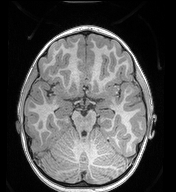
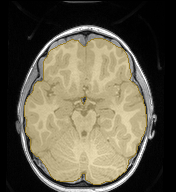
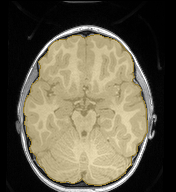
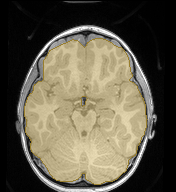
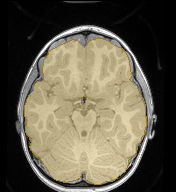
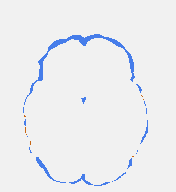
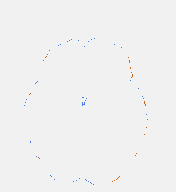
Axial slice 105 of 192; the crosshair inside the largest region where -B changed FSL's mask; the three slices through it are stored at full resolution. The interactive viewer needs JavaScript; the metrics below are complete without it.
Stored for this example: three full-resolution slices, one per plane, through display voxel (84, 89, 105): where the main comparison differs most, or the field's centre where nothing differs; every metric is computed over every voxel of the files.
Every comparison, computed in float64 over every voxel of the outputs
| Comparison (A − B), verdict and reason | Output | max |Δ| | Values that differ | RMS of Δ | max |Δ| ÷ range | 1 − NCC |
|---|---|---|---|---|---|---|
| The original against itself: what -B changes | ||||||
| bet -B -m − bet -m (both FSL 6.0.7.23)referenceWhat -B changes in FSL’s own output (the bias field divided out and the neck cut away before the brain is extracted): its mask holds 1,147,095 voxels where bet -m’s holds 1,226,194: 83,506 removed, 4,407 added. Both runs are FSL 6.0.7.23’s; no verdict: this row is the option’s effect, not a comparison of LARMORX. | Brain | 372 | 1,224,219 of 6,488,064 (18.9 %) | 22.1 | 0.888 | 0.028 |
| Brain mask | 1 | 87,913 of 6,488,064 (1.35 %) | 0.116 | 1 | 0.0445 | |
| The replica against the original and itself | ||||||
replica − FSL bet 6.0.7.23Deliberate correctionCorrected by default with a notice: FSL-202 (FAST’s class variances: the square of a single-precision mean rounded to single precision, so most digits cancel; the default squares it in double precision). bet -B divides the head by FAST’s bias field before it extracts the brain, and bet’s surface then settles on the slightly different unbiased head: brain: 1,112,421 values; brain mask: 10,328 voxels of 1,147,095 (Dice 0.9955). reproduce gives FSL’s bytes (the row of reproduce against FSL in this table), and the record compares that mode. FSL-202 | Brain | 339 | 1,112,421 of 6,488,064 (17.1 %) | 5.68 | 0.799 | 0.00196 |
| Brain mask | 1 | 10,328 of 6,488,064 (0.159 %) | 0.0399 | 1 | 0.00547 | |
replica (reproduce) − FSL bet 6.0.7.23Bit-identicalThe same values, every one, in out.nii.gz, out_mask.nii.gz. The NIfTI headers too, byte for byte. The record compares every file FSL writes byte for byte, with FSL’s exit status and messages: this case passes. reproduce names FSL-202 where FSL’s behaviour is reproduced. | both outputs | identical: 0 of 6,488,064 values differ | ||||
replica, fix − reproduceDeliberate correctionCorrected by default with a notice: FSL-202 (FAST’s class variances: the square of a single-precision mean rounded to single precision, so most digits cancel; the default squares it in double precision). bet -B divides the head by FAST’s bias field before it extracts the brain, and bet’s surface then settles on the slightly different unbiased head: brain: 1,112,421 values; brain mask: 10,328 voxels of 1,147,095 (Dice 0.9955). reproduce gives FSL’s bytes (the row of reproduce against FSL in this table), and the record compares that mode. FSL-202 | Brain | 339 | 1,112,421 of 6,488,064 (17.1 %) | 5.68 | 0.799 | 0.00196 |
| Brain mask | 1 | 10,328 of 6,488,064 (0.159 %) | 0.0399 | 1 | 0.00547 | |
| The clean room against the original, itself and the replica | ||||||
clean room − FSL bet 6.0.7.23Open differenceNot FSL 6.0.7.23’s values: brain: 1,124,885 of 6,488,064 values (the non-zero voxels’ Dice 0.99699); brain mask: 9,933 of 6,488,064 values (the non-zero voxels’ Dice 0.99567). The clean room runs the script’s programs as its own clean-room programs (FLIRT, FAST, fslmaths, fslstats, bet2), each held to its record’s thresholds where it is not bit-identical. In the default also: the default computes the C library’s maths functions correctly rounded, the same on every platform, where FSL takes glibc 2.35’s (GLIBC-07, named nowhere, as decided on 2026-11-04); reproduce computes them as glibc does. Inside the script’s programs (FLIRT’s rotations and windowed sinc, bet2’s powf, betsurf’s smoothing) their last bits move the registration’s or the surfaces’ path a little. Its record case real/child-3y-B (the clean room against FSL 6.0.7.23): fail, 6 of 9 checks: the record’s failure: -B… findings | Brain | 327 | 1,124,885 of 6,488,064 (17.3 %) | 5.5 | 0.77 | 0.00184 |
| Brain mask | 1 | 9,933 of 6,488,064 (0.153 %) | 0.0391 | 1 | 0.00526 | |
clean room (reproduce) − FSL bet 6.0.7.23Open differenceNot FSL 6.0.7.23’s values: brain: 2,439 of 6,488,064 values (the non-zero voxels’ Dice 0.99892); brain mask: 3,890 of 6,488,064 values (the non-zero voxels’ Dice 0.99830). The clean room runs the script’s programs as its own clean-room programs (FLIRT, FAST, fslmaths, fslstats, bet2), each held to its record’s thresholds where it is not bit-identical. Its record case real/child-3y-B (the clean room against FSL 6.0.7.23): fail, 6 of 9 checks: the record’s failure: -B’s last step, bet -R with -c from the robust centre, starts bet2 a few bits from FSL’s on this neurologically stored image (the specification’s open question of random testing’s cases 622 and 677: the conversion of a centre in voxels into FSL’s radiological frame). The difference is not closed: the clean room could still give FSL’s files. findings | Brain | 325 | 2,439 of 6,488,064 (0.0376 %) | 3.24 | 0.765 | 0.000639 |
| Brain mask | 1 | 3,890 of 6,488,064 (0.06 %) | 0.0245 | 1 | 0.00206 | |
| clean room, fix − reproduceDeliberate correctionThe default’s corrections, each named as it is made: FSL-202 (FAST’s class variances (the bias field of -B) with the square of the double-precision mean, where FAST squares a single-precision mean in single precision); and the default computes the C library’s maths functions correctly rounded, the same on every platform, where FSL takes glibc 2.35’s (GLIBC-07, named nowhere, as decided on 2026-11-04); reproduce computes them as glibc does. Inside the script’s programs (FLIRT’s rotations and windowed sinc, bet2’s powf, betsurf’s smoothing) their last bits move the registration’s or the surfaces’ path a little. What they change: brain: 1,125,148 of 6,488,064 values (the non-zero voxels’ Dice 0.99690); brain mask: 10,075 of 6,488,064 values (the non-zero voxels’ Dice 0.99561). findings | Brain | 327 | 1,125,148 of 6,488,064 (17.3 %) | 5.56 | 0.77 | 0.00188 |
| Brain mask | 1 | 10,075 of 6,488,064 (0.155 %) | 0.0394 | 1 | 0.00533 | |
clean room − replica, both fixOpen differenceThe clean room’s reproduce is not FSL’s here (the comparison above); the replica’s is. Where they differ: brain: 1,124,271 of 6,488,064 values (the non-zero voxels’ Dice 0.99715); brain mask: 8,749 of 6,488,064 values (the non-zero voxels’ Dice 0.99619). findings | Brain | 339 | 1,124,271 of 6,488,064 (17.3 %) | 5.51 | 0.799 | 0.00185 |
| Brain mask | 1 | 8,749 of 6,488,064 (0.135 %) | 0.0367 | 1 | 0.00463 | |
Δ is A − B: for the masks +1 where only A holds a voxel, −1 where only B does. Computed in float64 over all 6,488,064 voxels of the outputs, not only the three slices shown. The replica’s record compares reproduce with FSL: every file bit-identical (header and data), with FSL’s exit status and messages; its default, fix, is reported (the record’s list of what fix changed).
Provenance of this example
- Data: OpenNeuro ds000228 (Richardson et al., 2018), version 1.1.1, sub-pixar008 (3.5 years), CC0-1.0
- Inputs: T1w (sha256 676a3d6f7583199a…)
- Runs: figures cache entry
fsl-bet/options-child-3y-B, computed 2026-11-04T20:38:34+00:00 with larmorx73451f78a400; FSL 6.0.7.23 (fsl-bet2 2111.9, fsl-newimage 2601.0, fsl-meshclass 2111.0); larmorx-nc 0.0.1; every command, its environment, threads and exit status are in itsRUN_INFO.json - Runs of the clean room: figures cache entry
fsl-bet/options-child-3y-B-original, computed 2026-11-05T12:49:45+00:00 with larmorx73c3baf9c975; “larmorx 0.0.1 (crate larmorx-fsl: the clean-room original)”, as the cache entry records it; every command, its environment and exit status in itsRUN_INFO.json
Every number above is in fsl-bet.json, exported by python -m larmorx_validation evidence fsl-bet.
Worked example
bet -B -s: an adult of 82 with the neck
What this shows: With -B -s, both ports give FSL’s files in reproduce. In fix both correct FSL-09 and FSL-202, so the unbiased head and the brain move a little (the replica’s mask: Dice 0.9862); the clean room’s fix also computes the C library’s maths correctly rounded (GLIBC-07).
- Replica against FSL bet 6.0.7.23Deliberate correction
- Clean room against FSL bet 6.0.7.23Deliberate correction
The same variation with the skull image (-s: standard_space_roi -maskFOV, then bet2 on the unbiased head) on the T1w of an adult of 82 whose field of view reaches far down the neck (ds003592 sub-280), bet <T1w> out -B -s. Beside them, LARMORX’s clean room in both modes on the same call (since 2026-11-05), compared with FSL’s run and the replica’s.
- Data
- OpenNeuro ds003592 (Spreng et al.), version 1.0.13, sub-280 ses-1 (82 years) (CC0-1.0): the raw T1w; its face was removed by the dataset’s defacing (checked in larmorx-testdata’s panel.toml), so the whole field of view is shown
- Command
bet <T1w> out -B -s- Without the option
bet <T1w> out -m -sby FSL 6.0.7.23 on the same head, beside it- Programs
- FSL 6.0.7.23 (fsl-bet2 2111.9, fsl-newimage 2601.0, fsl-meshclass 2111.0), its
betscript running FSL’s programs; larmorx-nc 0.0.1 (the replica: every program in its process), from larmorx at commit73451f78a400 - Files compared
out.nii.gz,out_mask.nii.gz,out_skull.nii.gz(and every other file, in the record)- Mask
- 1,313,483 of 12,582,912 voxels in FSL’s
- Record
real/older-82y-Bof the replica’s standard record: pass, 8 of 8 checks; its default,fix, changes 1,398,022 values (the record’s list of whatfixchanged)- Grid
- 192 × 256 × 256 voxels of 1 × 1 × 1 mm; shown: 192 × 256 × 256, the whole field of view (three slices through the crosshair)
- Clean room
- LARMORX’s clean room (crate larmorx-fsl, Apache-2.0; larmorx 0.0.1 (crate larmorx-fsl: the clean room)), from larmorx at commit
6bd495946451:larmorx fsl beton the same call (bet <T1w> out -B -s), infixand inreproduce, every program the script runs its own clean-room program, in this process; the standard images read from FSL 6.0.7.23’s data ($FSLDIR/data/standard) by the data search. Named by its default: FSL-09, FSL-202; by reproduce: FSL-09, FSL-202.
Data shown
- Neurocognitive aging data release (OpenNeuro ds003592, version 1.0.13, doi:10.18112/openneuro.ds003592.v1.0.13), CC0 1.0 public-domain dedication.
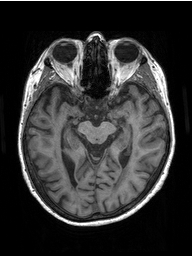
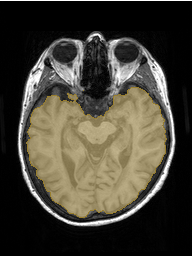
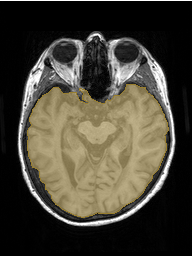
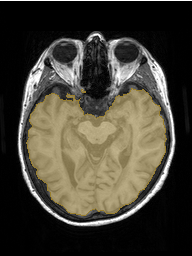
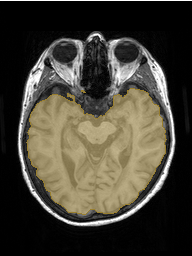
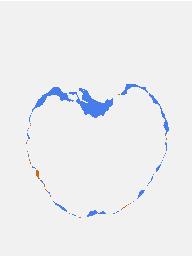
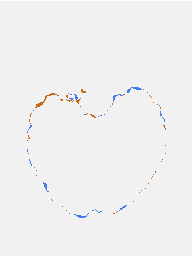
Axial slice 119 of 256; the crosshair inside the largest region where -B changed FSL's mask; the three slices through it are stored at full resolution. The interactive viewer needs JavaScript; the metrics below are complete without it.
Stored for this example: three full-resolution slices, one per plane, through display voxel (97, 139, 119): where the main comparison differs most, or the field's centre where nothing differs; every metric is computed over every voxel of the files.
Every comparison, computed in float64 over every voxel of the outputs
| Comparison (A − B), verdict and reason | Output | max |Δ| | Values that differ | RMS of Δ | max |Δ| ÷ range | 1 − NCC |
|---|---|---|---|---|---|---|
| The original against itself: what -B changes | ||||||
| bet -B -s − bet -m -s (both FSL 6.0.7.23)referenceWhat -B changes in FSL’s own output (the bias field divided out and the neck cut away before the brain is extracted): its mask holds 1,313,483 voxels where bet -m -s’s holds 1,385,558: 114,419 removed, 42,344 added. Both runs are FSL 6.0.7.23’s; no verdict: this row is the option’s effect, not a comparison of LARMORX. | Brain | 683 | 1,427,816 of 12,582,912 (11.3 %) | 18.8 | 1 | 0.0462 |
| Brain mask | 1 | 156,763 of 12,582,912 (1.25 %) | 0.112 | 1 | 0.0646 | |
| Skull image (bet2 -s) | 100 | 79,245 of 12,582,912 (0.63 %) | 7.94 | 1 | 0.569 | |
| The replica against the original and itself | ||||||
replica − FSL bet 6.0.7.23Deliberate correctionCorrected by default with a notice: FSL-09 (FLIRT inside standard_space_roi writes its resampled head in the input’s integer type truncated toward zero; the default rounds to the nearest integer); FSL-202 (FAST’s class variances: the square of a single-precision mean rounded to single precision, so most digits cancel; the default squares it in double precision). bet -B divides the head by FAST’s bias field before it extracts the brain, and bet’s surface then settles on the slightly different unbiased head: brain: 1,309,708 values; brain mask: 36,147 voxels of 1,313,483 (Dice 0.9862); skull image (bet2 -s): 52,167 values. reproduce gives FSL’s bytes (the row of reproduce against FSL in this table), and the record compares that mode. FSL-09 FSL-202 | Brain | 296 | 1,309,708 of 12,582,912 (10.4 %) | 7.38 | 0.533 | 0.00798 |
| Brain mask | 1 | 36,147 of 12,582,912 (0.287 %) | 0.0536 | 1 | 0.0154 | |
| Skull image (bet2 -s) | 100 | 52,167 of 12,582,912 (0.415 %) | 6.44 | 1 | 0.389 | |
replica (reproduce) − FSL bet 6.0.7.23Bit-identicalThe same values, every one, in out.nii.gz, out_mask.nii.gz, out_skull.nii.gz. The NIfTI headers too, byte for byte. The record compares every file FSL writes byte for byte, with FSL’s exit status and messages: this case passes. reproduce names FSL-09, FSL-202 where FSL’s behaviour is reproduced. | every output | identical: 0 of 12,582,912 values differ | ||||
replica, fix − reproduceDeliberate correctionCorrected by default with a notice: FSL-09 (FLIRT inside standard_space_roi writes its resampled head in the input’s integer type truncated toward zero; the default rounds to the nearest integer); FSL-202 (FAST’s class variances: the square of a single-precision mean rounded to single precision, so most digits cancel; the default squares it in double precision). bet -B divides the head by FAST’s bias field before it extracts the brain, and bet’s surface then settles on the slightly different unbiased head: brain: 1,309,708 values; brain mask: 36,147 voxels of 1,313,483 (Dice 0.9862); skull image (bet2 -s): 52,167 values. reproduce gives FSL’s bytes (the row of reproduce against FSL in this table), and the record compares that mode. FSL-09 FSL-202 | Brain | 296 | 1,309,708 of 12,582,912 (10.4 %) | 7.38 | 0.533 | 0.00798 |
| Brain mask | 1 | 36,147 of 12,582,912 (0.287 %) | 0.0536 | 1 | 0.0154 | |
| Skull image (bet2 -s) | 100 | 52,167 of 12,582,912 (0.415 %) | 6.44 | 1 | 0.389 | |
| The clean room against the original, itself and the replica | ||||||
clean room − FSL bet 6.0.7.23Deliberate correctionDeliberate in the default: the default’s corrections, each named as it is made: FSL-09 (FLIRT’s integer output inside standard_space_roi: rounded to the nearest and clamped where FLIRT truncates toward zero and wraps); FSL-202 (FAST’s class variances (the bias field of -B) with the square of the double-precision mean, where FAST squares a single-precision mean in single precision); and the default computes the C library’s maths functions correctly rounded, the same on every platform, where FSL takes glibc 2.35’s (GLIBC-07, named nowhere, as decided on 2026-11-04); reproduce computes them as glibc does. Inside the script’s programs (FLIRT’s rotations and windowed sinc, bet2’s powf, betsurf’s smoothing) their last bits move the registration’s or the surfaces’ path a little. reproduce gives FSL’s values, every one. What the default changes: brain: 1,328,685 of 12,582,91… findings | Brain | 301 | 1,328,685 of 12,582,912 (10.6 %) | 7.45 | 0.541 | 0.00813 |
| Brain mask | 1 | 37,021 of 12,582,912 (0.294 %) | 0.0542 | 1 | 0.0158 | |
| Skull image (bet2 -s) | 100 | 53,619 of 12,582,912 (0.426 %) | 6.53 | 1 | 0.4 | |
clean room (reproduce) − FSL bet 6.0.7.23Bit-identicalThe same values as FSL 6.0.7.23’s, every one, in out.nii.gz, out_mask.nii.gz, out_skull.nii.gz. Its record case real/older-82y-B (the clean room against FSL 6.0.7.23): pass, 10 of 10 checks. findings | every output | identical: 0 of 12,582,912 values differ | ||||
| clean room, fix − reproduceDeliberate correctionThe default’s corrections, each named as it is made: FSL-09 (FLIRT’s integer output inside standard_space_roi: rounded to the nearest and clamped where FLIRT truncates toward zero and wraps); FSL-202 (FAST’s class variances (the bias field of -B) with the square of the double-precision mean, where FAST squares a single-precision mean in single precision); and the default computes the C library’s maths functions correctly rounded, the same on every platform, where FSL takes glibc 2.35’s (GLIBC-07, named nowhere, as decided on 2026-11-04); reproduce computes them as glibc does. Inside the script’s programs (FLIRT’s rotations and windowed sinc, bet2’s powf, betsurf’s smoothing) their last bits move the registration’s or the surfaces’ path a little. What they change: brain: 1,328,685 of 12,582,912 values (the non-zero voxels’ Dice 0.98599); brain mask: 37,021 of 12,582,912 values… findings | Brain | 301 | 1,328,685 of 12,582,912 (10.6 %) | 7.45 | 0.541 | 0.00813 |
| Brain mask | 1 | 37,021 of 12,582,912 (0.294 %) | 0.0542 | 1 | 0.0158 | |
| Skull image (bet2 -s) | 100 | 53,619 of 12,582,912 (0.426 %) | 6.53 | 1 | 0.4 | |
clean room − replica, both fixDeliberate correctionIn reproduce both give FSL’s values; the two defaults differ in their corrections’ arithmetic (the clean room names FSL-09, FSL-202; the replica’s are named in its run) and in the maths functions: the clean room’s default computes them correctly rounded (GLIBC-07), the replica’s as glibc does. Where they differ: brain: 1,325,841 of 12,582,912 values (the non-zero voxels’ Dice 0.98718); brain mask: 33,818 of 12,582,912 values (the non-zero voxels’ Dice 0.98709); skull image (bet2 -s): 53,270 of 12,582,912 values (the non-zero voxels’ Dice 0.60502). findings | Brain | 301 | 1,325,841 of 12,582,912 (10.5 %) | 7.02 | 0.541 | 0.00722 |
| Brain mask | 1 | 33,818 of 12,582,912 (0.269 %) | 0.0518 | 1 | 0.0144 | |
| Skull image (bet2 -s) | 100 | 53,270 of 12,582,912 (0.423 %) | 6.51 | 1 | 0.397 | |
Δ is A − B: for the masks +1 where only A holds a voxel, −1 where only B does. Computed in float64 over all 12,582,912 voxels of the outputs, not only the three slices shown. The replica’s record compares reproduce with FSL: every file bit-identical (header and data), with FSL’s exit status and messages; its default, fix, is reported (the record’s list of what fix changed).
Provenance of this example
- Data: OpenNeuro ds003592 (Spreng et al.), version 1.0.13, sub-280 ses-1 (82 years), CC0-1.0
- Inputs: T1w (sha256 d3a7785714277f42…)
- Runs: figures cache entry
fsl-bet/options-older-82y-B, computed 2026-11-04T20:40:54+00:00 with larmorx73451f78a400; FSL 6.0.7.23 (fsl-bet2 2111.9, fsl-newimage 2601.0, fsl-meshclass 2111.0); larmorx-nc 0.0.1; every command, its environment, threads and exit status are in itsRUN_INFO.json - Runs of the clean room: figures cache entry
fsl-bet/options-older-82y-B-original, computed 2026-11-05T12:51:22+00:00 with larmorx6bd495946451; “larmorx 0.0.1 (crate larmorx-fsl: the clean-room original)”, as the cache entry records it; every command, its environment and exit status in itsRUN_INFO.json
Every number above is in fsl-bet.json, exported by python -m larmorx_validation evidence fsl-bet.
-A and -A2: the skull and the scalp
On real heads betsurf’s three surfaces show whole: the inner skull, the outer skull and the scalp, as masks drawn over the T1w, with the skull between them (betsurf -s). Choose the mask above the panels.
Worked example
bet -A: the skull and the scalp of a real head
What this shows: With -A, the replica gives FSL’s files in both modes. The clean room gives FSL’s brain; betsurf’s masks differ at their edges (in fix, the non-zero voxels’ Dice from 0.9922 for the skull mask to 0.9995 for the inner skull).
- Replica against FSL bet 6.0.7.23Bit-identical
- Clean room against FSL bet 6.0.7.23Open difference
-A runs FLIRT to MNI152 (the matrix only), bet2 -e for the brain and its mesh, and betsurf, which finds the inner skull, the outer skull and the scalp along the mesh’s normals and deforms three surfaces onto them; -A2 first registers the T2w to the T1w with FLIRT (sinc interpolation) and gives it to betsurf. On the T1w of an adult of 75 scanned at 1.5 T (ds002422 sub-02), bet <T1w> out -A. Beside them, LARMORX’s clean room in both modes on the same call (since 2026-11-05), compared with FSL’s run and the replica’s.
- Data
- OpenNeuro ds002422 (Panikratova et al.), version 1.1.0, sub-02 (75 years, 1.5 T) (CC0-1.0): the raw T1w; its face was removed by the dataset’s defacing (checked in larmorx-testdata’s panel.toml), so the whole field of view is shown
- Command
bet <T1w> out -A- Programs
- FSL 6.0.7.23 (fsl-bet2 2111.9, fsl-newimage 2601.0, fsl-meshclass 2111.0), its
betscript running FSL’s programs; larmorx-nc 0.0.1 (the replica: every program in its process), from larmorx at commit73451f78a400 - Files compared
out.nii.gz,out_inskull_mask.nii.gz,out_outskull_mask.nii.gz,out_outskin_mask.nii.gz,out_skull_mask.nii.gz(and every other file, in the record)- Inner skull
- 1,797,730 of 11,534,336 voxels in FSL’s
- Record
real/older-75y-Aof the replica’s standard record: pass, 17 of 17 checks- Grid
- 256 × 256 × 176 voxels of 0.977 × 0.977 × 1 mm; shown: 176 × 256 × 256, the whole field of view (three slices through the crosshair)
- Clean room
- LARMORX’s clean room (crate larmorx-fsl, Apache-2.0; larmorx 0.0.1 (crate larmorx-fsl: the clean room)), from larmorx at commit
6bd495946451:larmorx fsl beton the same call (bet <T1w> out -A), infixand inreproduce, every program the script runs its own clean-room program, in this process; the standard images read from FSL 6.0.7.23’s data ($FSLDIR/data/standard) by the data search. Named by its default: no correction; by reproduce: nothing.
Data shown
- fMRI: resting state and arithmetic task (OpenNeuro ds002422, version 1.1.0, doi:10.18112/openneuro.ds002422.v1.1.0), CC0 1.0 public-domain dedication.
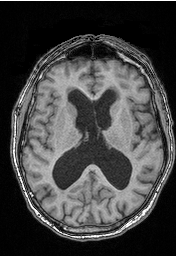
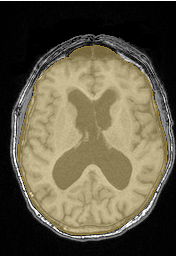
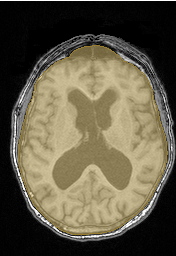
Bit-identical11,534,336 of 11,534,336 voxels equal
Bit-identical11,534,336 of 11,534,336 voxels equal

Axial slice 168 of 256; the crosshair at the inner skull's centre; the three slices through it are stored at full resolution. The interactive viewer needs JavaScript; the metrics below are complete without it.
Stored for this example: three full-resolution slices, one per plane, through display voxel (93, 107, 168): where the main comparison differs most, or the field's centre where nothing differs; every metric is computed over every voxel of the files.
Every comparison, computed in float64 over every voxel of the outputs
| Comparison (A − B), verdict and reason | Output | max |Δ| | Values that differ | RMS of Δ | max |Δ| ÷ range | 1 − NCC |
|---|---|---|---|---|---|---|
| The replica against the original and itself | ||||||
replica − FSL bet 6.0.7.23Bit-identicalThe default, fix, gives FSL’s values too, in out.nii.gz, out_inskull_mask.nii.gz, out_outskull_mask.nii.gz, out_outskin_mask.nii.gz, out_skull_mask.nii.gz: no correction of the register applies to this call. | every output | identical: 0 of 11,534,336 values differ | ||||
replica (reproduce) − FSL bet 6.0.7.23Bit-identicalThe same values, every one, in out.nii.gz, out_inskull_mask.nii.gz, out_outskull_mask.nii.gz, out_outskin_mask.nii.gz, out_skull_mask.nii.gz. The NIfTI headers too, byte for byte. The record compares every file FSL writes byte for byte, with FSL’s exit status and messages: this case passes. | every output | identical: 0 of 11,534,336 values differ | ||||
| replica, fix − reproduceBit-identicalBoth modes give the same values: no correction of the register applies to this call. | every output | identical: 0 of 11,534,336 values differ | ||||
| The clean room against the original, itself and the replica | ||||||
| clean room − FSL bet 6.0.7.23Open differenceNot FSL 6.0.7.23’s values: inner skull mask: 1,990 of 11,534,336 values (the non-zero voxels’ Dice 0.99945); outer skull mask: 2,872 of 11,534,336 values (the non-zero voxels’ Dice 0.99932); scalp mask: 13,255 of 11,534,336 values (the non-zero voxels’ Dice 0.99821); skull mask (betsurf -s): 4,870 of 11,534,336 values (the non-zero voxels’ Dice 0.99224). bet2’s brain and every step before betsurf are FSL’s; betsurf decides its profiles as FSL does and its surfaces settle a little elsewhere, the scalp most (docs/findings/fsl-bet-clean-room.md, betsurf), held to its masks’ thresholds (Dice >= 0.99, boundary p95 <= 1 voxel). In the default also: the default computes the C library’s maths functions correctly rounded, the same on every platform, where FSL takes glibc 2.35’s (GLIBC-07, named nowhere, as decided on 2026-11-04); reproduce computes them as glibc does. Inside the script’s progra… findings | Brain | 0 | 0 of 11,534,336 | 0 | 0 | 0 |
| Inner skull mask | 1 | 1,990 of 11,534,336 (0.0173 %) | 0.0131 | 1 | 0.000656 | |
| Outer skull mask | 1 | 2,872 of 11,534,336 (0.0249 %) | 0.0158 | 1 | 0.000833 | |
| Scalp mask | 1 | 13,255 of 11,534,336 (0.115 %) | 0.0339 | 1 | 0.00263 | |
| Skull mask (betsurf -s) | 1 | 4,870 of 11,534,336 (0.0422 %) | 0.0205 | 1 | 0.00798 | |
clean room (reproduce) − FSL bet 6.0.7.23Open differenceNot FSL 6.0.7.23’s values: inner skull mask: 1,618 of 11,534,336 values (the non-zero voxels’ Dice 0.99955); outer skull mask: 1,988 of 11,534,336 values (the non-zero voxels’ Dice 0.99953); scalp mask: 5,440 of 11,534,336 values (the non-zero voxels’ Dice 0.99927); skull mask (betsurf -s): 3,611 of 11,534,336 values (the non-zero voxels’ Dice 0.99425). bet2’s brain and every step before betsurf are FSL’s; betsurf decides its profiles as FSL does and its surfaces settle a little elsewhere, the scalp most (docs/findings/fsl-bet-clean-room.md, betsurf), held to its masks’ thresholds (Dice >= 0.99, boundary p95 <= 1 voxel). Its record case real/older-75y-A (the clean room against FSL 6.0.7.23): pass, 24 of 24 checks. The difference is not closed: the clean room could still give FSL’s files. findings | Brain | 0 | 0 of 11,534,336 | 0 | 0 | 0 |
| Inner skull mask | 1 | 1,618 of 11,534,336 (0.014 %) | 0.0118 | 1 | 0.000533 | |
| Outer skull mask | 1 | 1,988 of 11,534,336 (0.0172 %) | 0.0131 | 1 | 0.000576 | |
| Scalp mask | 1 | 5,440 of 11,534,336 (0.0472 %) | 0.0217 | 1 | 0.00108 | |
| Skull mask (betsurf -s) | 1 | 3,611 of 11,534,336 (0.0313 %) | 0.0177 | 1 | 0.00592 | |
| clean room, fix − reproduceDeliberate correctionThe default computes the C library’s maths functions correctly rounded, the same on every platform, where FSL takes glibc 2.35’s (GLIBC-07, named nowhere, as decided on 2026-11-04); reproduce computes them as glibc does. Inside the script’s programs (FLIRT’s rotations and windowed sinc, bet2’s powf, betsurf’s smoothing) their last bits move the registration’s or the surfaces’ path a little. What they change: inner skull mask: 1,108 of 11,534,336 values (the non-zero voxels’ Dice 0.99969); outer skull mask: 2,900 of 11,534,336 values (the non-zero voxels’ Dice 0.99931); scalp mask: 13,445 of 11,534,336 values (the non-zero voxels’ Dice 0.99819); skull mask (betsurf -s): 4,013 of 11,534,336 values (the non-zero voxels’ Dice 0.99361). findings | Brain | 0 | 0 of 11,534,336 | 0 | 0 | 0 |
| Inner skull mask | 1 | 1,108 of 11,534,336 (0.00961 %) | 0.0098 | 1 | 0.000365 | |
| Outer skull mask | 1 | 2,900 of 11,534,336 (0.0251 %) | 0.0159 | 1 | 0.000841 | |
| Scalp mask | 1 | 13,445 of 11,534,336 (0.117 %) | 0.0341 | 1 | 0.00267 | |
| Skull mask (betsurf -s) | 1 | 4,013 of 11,534,336 (0.0348 %) | 0.0187 | 1 | 0.00657 | |
clean room − replica, both fixOpen differenceThe clean room’s reproduce is not FSL’s here (the comparison above); the replica’s is. Where they differ: inner skull mask: 1,990 of 11,534,336 values (the non-zero voxels’ Dice 0.99945); outer skull mask: 2,872 of 11,534,336 values (the non-zero voxels’ Dice 0.99932); scalp mask: 13,255 of 11,534,336 values (the non-zero voxels’ Dice 0.99821); skull mask (betsurf -s): 4,870 of 11,534,336 values (the non-zero voxels’ Dice 0.99224). findings | Brain | 0 | 0 of 11,534,336 | 0 | 0 | 0 |
| Inner skull mask | 1 | 1,990 of 11,534,336 (0.0173 %) | 0.0131 | 1 | 0.000656 | |
| Outer skull mask | 1 | 2,872 of 11,534,336 (0.0249 %) | 0.0158 | 1 | 0.000833 | |
| Scalp mask | 1 | 13,255 of 11,534,336 (0.115 %) | 0.0339 | 1 | 0.00263 | |
| Skull mask (betsurf -s) | 1 | 4,870 of 11,534,336 (0.0422 %) | 0.0205 | 1 | 0.00798 | |
Δ is A − B: for the masks +1 where only A holds a voxel, −1 where only B does. Computed in float64 over all 11,534,336 voxels of the outputs, not only the three slices shown. The replica’s record compares reproduce with FSL: every file bit-identical (header and data), with FSL’s exit status and messages; its default, fix, is reported (the record’s list of what fix changed).
Provenance of this example
- Data: OpenNeuro ds002422 (Panikratova et al.), version 1.1.0, sub-02 (75 years, 1.5 T), CC0-1.0
- Inputs: T1w (sha256 0a408fc318742c97…)
- Runs: figures cache entry
fsl-bet/options-older-75y-A, computed 2026-11-04T20:37:41+00:00 with larmorx73451f78a400; FSL 6.0.7.23 (fsl-bet2 2111.9, fsl-newimage 2601.0, fsl-meshclass 2111.0); larmorx-nc 0.0.1; every command, its environment, threads and exit status are in itsRUN_INFO.json - Runs of the clean room: figures cache entry
fsl-bet/options-older-75y-A-original, computed 2026-11-05T12:51:58+00:00 with larmorx6bd495946451; “larmorx 0.0.1 (crate larmorx-fsl: the clean-room original)”, as the cache entry records it; every command, its environment and exit status in itsRUN_INFO.json
Every number above is in fsl-bet.json, exported by python -m larmorx_validation evidence fsl-bet.
Worked example
bet -A2: the surfaces with a T2w, a child
What this shows: With -A2 and a T2w, the replica gives FSL’s files in both modes. The clean room gives FSL’s brain and mask; betsurf’s masks differ at their edges (in fix, the non-zero voxels’ Dice from 0.9925 for the skull mask to 0.9994 for the inner skull).
- Replica against FSL bet 6.0.7.23Bit-identical
- Clean room against FSL bet 6.0.7.23Open difference
-A2 with the child’s T2w, on the T1w of a child of 7.5 from the head-motion study (ds000256 sub-CTS203), bet <T1w> out -A2 <T2w> -m: FLIRT registers the T2w to the T1w (sinc), then the steps of -A, betsurf profiling both images. Beside them, LARMORX’s clean room in both modes on the same call (since 2026-11-05), compared with FSL’s run and the replica’s.
- Data
- OpenNeuro ds000256 (Greene et al., 2018), snapshot 00002, sub-CTS203 (7.5 years, a child of the head-motion study) (PDDL-1.0): the raw T1w and the T2w of the same session; its face was removed by the dataset’s defacing (checked in larmorx-testdata’s panel.toml), so the whole field of view is shown
- Command
bet <T1w> out -A2 <T2w> -m- Programs
- FSL 6.0.7.23 (fsl-bet2 2111.9, fsl-newimage 2601.0, fsl-meshclass 2111.0), its
betscript running FSL’s programs; larmorx-nc 0.0.1 (the replica: every program in its process), from larmorx at commit73451f78a400 - Files compared
out.nii.gz,out_mask.nii.gz,out_inskull_mask.nii.gz,out_outskull_mask.nii.gz,out_outskin_mask.nii.gz,out_skull_mask.nii.gz(and every other file, in the record)- Mask
- 2,893,982 of 14,680,064 voxels in FSL’s
- Record
real/child-7y-A2of the replica’s standard record: pass, 18 of 18 checks- Grid
- 224 × 256 × 256 voxels of 0.8 × 0.801 × 0.801 mm; shown: 224 × 256 × 256, the whole field of view (three slices through the crosshair)
- Clean room
- LARMORX’s clean room (crate larmorx-fsl, Apache-2.0; larmorx 0.0.1 (crate larmorx-fsl: the clean room)), from larmorx at commit
6bd495946451:larmorx fsl beton the same call (bet <T1w> out -A2 <T2w> -m), infixand inreproduce, every program the script runs its own clean-room program, in this process; the standard images read from FSL 6.0.7.23’s data ($FSLDIR/data/standard) by the data search. Named by its default: FSL-51; by reproduce: FSL-51.
Data shown
- Behavioral interventions for reducing head motion in children (OpenNeuro ds000256, version 00002), Open Data Commons Public Domain Dedication and Licence 1.0.
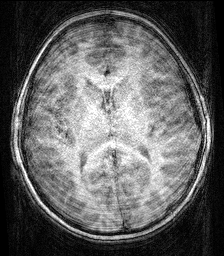
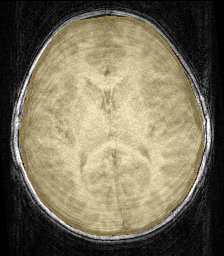
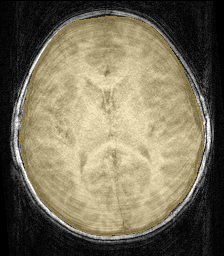
Bit-identical14,680,064 of 14,680,064 voxels equal
Bit-identical14,680,064 of 14,680,064 voxels equal

Axial slice 174 of 256; the crosshair at the inner skull's centre; the three slices through it are stored at full resolution. The interactive viewer needs JavaScript; the metrics below are complete without it.
Stored for this example: three full-resolution slices, one per plane, through display voxel (113, 124, 174): where the main comparison differs most, or the field's centre where nothing differs; every metric is computed over every voxel of the files.
Every comparison, computed in float64 over every voxel of the outputs
| Comparison (A − B), verdict and reason | Output | max |Δ| | Values that differ | RMS of Δ | max |Δ| ÷ range | 1 − NCC |
|---|---|---|---|---|---|---|
| The replica against the original and itself | ||||||
replica − FSL bet 6.0.7.23Bit-identicalThe default, fix, gives FSL’s values too, in out.nii.gz, out_mask.nii.gz, out_inskull_mask.nii.gz, out_outskull_mask.nii.gz, out_outskin_mask.nii.gz, out_skull_mask.nii.gz: no correction of the register applies to this call. | every output | identical: 0 of 14,680,064 values differ | ||||
replica (reproduce) − FSL bet 6.0.7.23Bit-identicalThe same values, every one, in out.nii.gz, out_mask.nii.gz, out_inskull_mask.nii.gz, out_outskull_mask.nii.gz, out_outskin_mask.nii.gz, out_skull_mask.nii.gz. The NIfTI headers too, byte for byte. The record compares every file FSL writes byte for byte, with FSL’s exit status and messages: this case passes. | every output | identical: 0 of 14,680,064 values differ | ||||
| replica, fix − reproduceBit-identicalBoth modes give the same values: no correction of the register applies to this call. | every output | identical: 0 of 14,680,064 values differ | ||||
| The clean room against the original, itself and the replica | ||||||
| clean room − FSL bet 6.0.7.23Open differenceNot FSL 6.0.7.23’s values: inner skull mask: 3,856 of 14,680,064 values (the non-zero voxels’ Dice 0.99939); outer skull mask: 6,380 of 14,680,064 values (the non-zero voxels’ Dice 0.99913); scalp mask: 21,712 of 14,680,064 values (the non-zero voxels’ Dice 0.99834); skull mask (betsurf -s): 9,961 of 14,680,064 values (the non-zero voxels’ Dice 0.99249). bet2’s brain and every step before betsurf are FSL’s; betsurf decides its profiles as FSL does and its surfaces settle a little elsewhere, the scalp most (docs/findings/fsl-bet-clean-room.md, betsurf), held to its masks’ thresholds (Dice >= 0.99, boundary p95 <= 1 voxel). In the default also: the default computes the C library’s maths functions correctly rounded, the same on every platform, where FSL takes glibc 2.35’s (GLIBC-07, named nowhere, as decided on 2026-11-04); reproduce computes them as glibc does. Inside the script’s progra… findings | Brain | 0 | 0 of 14,680,064 | 0 | 0 | 0 |
| Brain mask | 0 | 0 of 14,680,064 | 0 | 0 | 0 | |
| Inner skull mask | 1 | 3,856 of 14,680,064 (0.0263 %) | 0.0162 | 1 | 0.00078 | |
| Outer skull mask | 1 | 6,380 of 14,680,064 (0.0435 %) | 0.0208 | 1 | 0.00116 | |
| Scalp mask | 1 | 21,712 of 14,680,064 (0.148 %) | 0.0385 | 1 | 0.00299 | |
| Skull mask (betsurf -s) | 1 | 9,961 of 14,680,064 (0.0679 %) | 0.026 | 1 | 0.00786 | |
clean room (reproduce) − FSL bet 6.0.7.23Open differenceNot FSL 6.0.7.23’s values: inner skull mask: 3,254 of 14,680,064 values (the non-zero voxels’ Dice 0.99948); outer skull mask: 5,052 of 14,680,064 values (the non-zero voxels’ Dice 0.99931); scalp mask: 18,654 of 14,680,064 values (the non-zero voxels’ Dice 0.99857); skull mask (betsurf -s): 8,027 of 14,680,064 values (the non-zero voxels’ Dice 0.99395). bet2’s brain and every step before betsurf are FSL’s; betsurf decides its profiles as FSL does and its surfaces settle a little elsewhere, the scalp most (docs/findings/fsl-bet-clean-room.md, betsurf), held to its masks’ thresholds (Dice >= 0.99, boundary p95 <= 1 voxel). Its record case real/child-7y-A2 (the clean room against FSL 6.0.7.23): pass, 26 of 26 checks. The difference is not closed: the clean room could still give FSL’s files. findings | Brain | 0 | 0 of 14,680,064 | 0 | 0 | 0 |
| Brain mask | 0 | 0 of 14,680,064 | 0 | 0 | 0 | |
| Inner skull mask | 1 | 3,254 of 14,680,064 (0.0222 %) | 0.0149 | 1 | 0.000658 | |
| Outer skull mask | 1 | 5,052 of 14,680,064 (0.0344 %) | 0.0186 | 1 | 0.000919 | |
| Scalp mask | 1 | 18,654 of 14,680,064 (0.127 %) | 0.0356 | 1 | 0.00257 | |
| Skull mask (betsurf -s) | 1 | 8,027 of 14,680,064 (0.0547 %) | 0.0234 | 1 | 0.00633 | |
| clean room, fix − reproduceDeliberate correctionThe default’s corrections, each named as it is made: FSL-51 (betsurf’s profile searches stop at a profile’s last sample, where FSL reads past it into memory it never set); and the default computes the C library’s maths functions correctly rounded, the same on every platform, where FSL takes glibc 2.35’s (GLIBC-07, named nowhere, as decided on 2026-11-04); reproduce computes them as glibc does. Inside the script’s programs (FLIRT’s rotations and windowed sinc, bet2’s powf, betsurf’s smoothing) their last bits move the registration’s or the surfaces’ path a little. What they change: inner skull mask: 1,800 of 14,680,064 values (the non-zero voxels’ Dice 0.99971); outer skull mask: 6,522 of 14,680,064 values (the non-zero voxels’ Dice 0.99911); scalp mask: 23,790 of 14,680,064 values (the non-zero voxels’ Dice 0.99818); skull mask (betsurf -s): 8,320 of 14,680,064 values (the no… findings | Brain | 0 | 0 of 14,680,064 | 0 | 0 | 0 |
| Brain mask | 0 | 0 of 14,680,064 | 0 | 0 | 0 | |
| Inner skull mask | 1 | 1,800 of 14,680,064 (0.0123 %) | 0.0111 | 1 | 0.000364 | |
| Outer skull mask | 1 | 6,522 of 14,680,064 (0.0444 %) | 0.0211 | 1 | 0.00119 | |
| Scalp mask | 1 | 23,790 of 14,680,064 (0.162 %) | 0.0403 | 1 | 0.00328 | |
| Skull mask (betsurf -s) | 1 | 8,320 of 14,680,064 (0.0567 %) | 0.0238 | 1 | 0.00656 | |
clean room − replica, both fixOpen differenceThe clean room’s reproduce is not FSL’s here (the comparison above); the replica’s is. Where they differ: inner skull mask: 3,856 of 14,680,064 values (the non-zero voxels’ Dice 0.99939); outer skull mask: 6,380 of 14,680,064 values (the non-zero voxels’ Dice 0.99913); scalp mask: 21,712 of 14,680,064 values (the non-zero voxels’ Dice 0.99834); skull mask (betsurf -s): 9,961 of 14,680,064 values (the non-zero voxels’ Dice 0.99249). findings | Brain | 0 | 0 of 14,680,064 | 0 | 0 | 0 |
| Brain mask | 0 | 0 of 14,680,064 | 0 | 0 | 0 | |
| Inner skull mask | 1 | 3,856 of 14,680,064 (0.0263 %) | 0.0162 | 1 | 0.00078 | |
| Outer skull mask | 1 | 6,380 of 14,680,064 (0.0435 %) | 0.0208 | 1 | 0.00116 | |
| Scalp mask | 1 | 21,712 of 14,680,064 (0.148 %) | 0.0385 | 1 | 0.00299 | |
| Skull mask (betsurf -s) | 1 | 9,961 of 14,680,064 (0.0679 %) | 0.026 | 1 | 0.00786 | |
Δ is A − B: for the masks +1 where only A holds a voxel, −1 where only B does. Computed in float64 over all 14,680,064 voxels of the outputs, not only the three slices shown. The replica’s record compares reproduce with FSL: every file bit-identical (header and data), with FSL’s exit status and messages; its default, fix, is reported (the record’s list of what fix changed).
Provenance of this example
- Data: OpenNeuro ds000256 (Greene et al., 2018), snapshot 00002, sub-CTS203 (7.5 years, a child of the head-motion study), PDDL-1.0
- Inputs: T1w (sha256 185492d24fba8de9…); T2w (sha256 ecc1c76bc4c2f1fd…)
- Runs: figures cache entry
fsl-bet/options-child-7y-A2, computed 2026-11-04T20:39:47+00:00 with larmorx73451f78a400; FSL 6.0.7.23 (fsl-bet2 2111.9, fsl-newimage 2601.0, fsl-meshclass 2111.0); larmorx-nc 0.0.1; every command, its environment, threads and exit status are in itsRUN_INFO.json - Runs of the clean room: figures cache entry
fsl-bet/options-child-7y-A2-original, computed 2026-11-05T12:53:35+00:00 with larmorx6bd495946451; “larmorx 0.0.1 (crate larmorx-fsl: the clean-room original)”, as the cache entry records it; every command, its environment and exit status in itsRUN_INFO.json
Every number above is in fsl-bet.json, exported by python -m larmorx_validation evidence fsl-bet.
standard_space_roi and fslroi
standard_space_roi is FSL’s script that cuts a head with a region of the standard space. FLIRT registers the head to MNI152 (or another reference, -ssref), and convert_xfm inverts the matrix. A mask (-maskFOV, -maskMASK, -maskNONE) and a region (-roiFOV, -roiMASK, -roiNONE) are brought back into the head with FLIRT’s -applyxfm, then applied with fslmaths and fslroi. -b is MNI152’s dilated brain mask, thresholded: the call bet -S and -B make. fslroi takes a box or a range of volumes out of an image (bet -F and -Z use it).
Both ports have both programs. The replica’s are from FSL 6.0.7.23 (fsl-flirt 2111.4, fsl-avwutils 2209.6), as programs of larmorx-nc: larmorx fsl standard_space_roi, larmorx fsl fslroi; lx.fsl.standard_space_roi, lx.fsl.fslroi (their API page). fslpy’s imcp and immv, which the scripts call, are replicated with them. The clean room’s (implementation="clean-room", "original" in 0.1.0rc1; Apache-2.0) are written from specs/standard_space_roi.md and built for speed.
The clean room’s cases are in its record. Of fslroi’s 26, 24 give FSL’s files bit for bit and 2 are rejected by both alike. Of standard_space_roi’s 25, 17 are within the specification’s thresholds and 8 are rejected by both alike. The thresholds: its files FSL’s where its FLIRT gives FSL’s matrix; else the masks’ Dice ≥ 0.995 and the output’s box within one voxel, and, given FSL’s matrix, every file bit for bit. The six real heads are bit for bit.
The replica’s record holds their cases beside bet’s (the record). standard_space_roi’s 25 cover every option on synthetic heads, every output type, the failures, and six real T1w and T2w heads: 16 give FSL’s files byte for byte, 8 are rejected by both alike, and 1 is the expected divergence above (fslpy’s conversion with nibabel). fslroi’s 26 cover every argument form, data type, header and format: 24 give FSL’s files byte for byte and 2 are rejected by both.
Four defects of the script and two of fslroi are corrected or refused by fix, each named, with reproduce giving FSL’s behaviour (Corrections, below). The example: -b on the data panel’s youngest head, whose small size makes its registration to an adult template harder.
Worked example
standard_space_roi -b: the head inside MNI152's brain, a 3-year-old
What this shows: On the data panel’s youngest head, the replica gives FSL’s region in both modes. The clean room gives it in reproduce; in fix it computes the C library’s maths correctly rounded (GLIBC-07), and 2,802 values move.
- Replica against FSL standard_space_roi 6.0.7.23Bit-identical
- Clean room against FSL standard_space_roi 6.0.7.23Deliberate correction
standard_space_roi registers the head to MNI152 with FLIRT, brings a standard-space mask back into the head through the inverse (convert_xfm, FLIRT -applyxfm) and masks or cuts the head with it. -b is the call bet -S and -B make: MNI152’s dilated brain mask, thresholded at 0.5, the head kept on its own grid; -d keeps the temporary files. On the T1w of the data panel’s youngest subject (ds000228 sub-pixar008, aged 3.5), standard_space_roi <T1w> out -b -d, whose MNI152 registration a child’s small head makes harder. Beside them, LARMORX’s clean room in both modes on the same call (since 2026-11-05), compared with FSL’s run and the replica’s.
- Data
- OpenNeuro ds000228 (Richardson et al., 2018), version 1.1.1, sub-pixar008 (3.5 years) (CC0-1.0): the raw T1w; its face was removed by the dataset’s defacing (checked in larmorx-testdata’s panel.toml), so the whole field of view is shown
- Command
standard_space_roi <T1w> out -b -d- Programs
- FSL 6.0.7.23 (fsl-bet2 2111.9, fsl-newimage 2601.0, fsl-meshclass 2111.0), its
standard_space_roiscript running FLIRT, convert_xfm, fslmaths and fslval; larmorx-nc 0.0.1 (the replica: every program in its process), from larmorx at commit0b43410950ad - Files compared
out.nii.gz(and every other file, in the record)- Head kept
- 1,194,605 of 6,488,064 voxels in FSL’s
- Record
ssroi/child-bof the replica’s standard record: pass, 12 of 12 checks- Grid
- 176 × 192 × 192 voxels of 1 × 1 × 1 mm; shown: 176 × 192 × 192, the whole field of view (three slices through the crosshair)
- Clean room
- LARMORX’s clean room (crate larmorx-fsl, Apache-2.0; larmorx 0.0.1 (crate larmorx-fsl: the clean room)), from larmorx at commit
6bd495946451:larmorx fsl standard_space_roion the same call (standard_space_roi <T1w> out -b -d), infixand inreproduce, every program the script runs its own clean-room program, in this process; the standard images read from FSL 6.0.7.23’s data ($FSLDIR/data/standard) by the data search. Named by its default: no correction; by reproduce: nothing.
Data shown
- Children and adults watching a short film (OpenNeuro ds000228, version 1.1.1, doi:10.18112/openneuro.ds000228.v1.1.1), CC0 1.0 public-domain dedication.
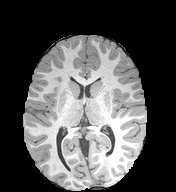
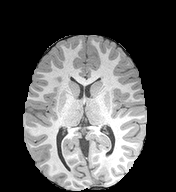
Bit-identical6,488,064 of 6,488,064 voxels equal
Bit-identical6,488,064 of 6,488,064 voxels equal

Axial slice 130 of 192; the crosshair at the kept head's centre; the three slices through it are stored at full resolution. The interactive viewer needs JavaScript; the metrics below are complete without it.
Stored for this example: three full-resolution slices, one per plane, through display voxel (86, 77, 130): where the main comparison differs most, or the field's centre where nothing differs; every metric is computed over every voxel of the files.
Every comparison, computed in float64 over every voxel of the outputs
| Comparison (A − B), verdict and reason | max |Δ| | Values that differ | RMS of Δ | max |Δ| ÷ range | 1 − NCC |
|---|---|---|---|---|---|
| The replica against the original and itself | |||||
replica − FSL standard_space_roi 6.0.7.23Bit-identicalThe default, fix, gives FSL’s values too, in out.nii.gz: no correction of the register applies to this call. | identical: 0 of 6,488,064 values differ | ||||
replica (reproduce) − FSL standard_space_roi 6.0.7.23Bit-identicalThe same values, every one, in out.nii.gz. The NIfTI headers too, byte for byte. The record compares every file FSL writes byte for byte, with FSL’s exit status and messages: this case passes. | identical: 0 of 6,488,064 values differ | ||||
| replica, fix − reproduceBit-identicalBoth modes give the same values: no correction of the register applies to this call. | identical: 0 of 6,488,064 values differ | ||||
| The clean room against the original, itself and the replica | |||||
clean room − FSL standard_space_roi 6.0.7.23Deliberate correctionDeliberate in the default: the default computes the C library’s maths functions correctly rounded, the same on every platform, where FSL takes glibc 2.35’s (GLIBC-07, named nowhere, as decided on 2026-11-04); reproduce computes them as glibc does. Inside the script’s programs (FLIRT’s rotations and windowed sinc, bet2’s powf, betsurf’s smoothing) their last bits move the registration’s or the surfaces’ path a little. reproduce gives FSL’s values, every one. What the default changes: the head inside mni152’s dilated brain mask: 2,802 of 6,488,064 values (the non-zero voxels’ Dice 0.99883). Its record case ssroi/child-b (the clean room against FSL 6.0.7.23): pass, 16 of 16 checks. findings | 334 | 2,802 of 6,488,064 (0.0432 %) | 3.06 | 0.797 | 0.000542 |
clean room (reproduce) − FSL standard_space_roi 6.0.7.23Bit-identicalThe same values as FSL 6.0.7.23’s, every one, in out.nii.gz. Its record case ssroi/child-b (the clean room against FSL 6.0.7.23): pass, 16 of 16 checks. findings | identical: 0 of 6,488,064 values differ | ||||
| clean room, fix − reproduceDeliberate correctionThe default computes the C library’s maths functions correctly rounded, the same on every platform, where FSL takes glibc 2.35’s (GLIBC-07, named nowhere, as decided on 2026-11-04); reproduce computes them as glibc does. Inside the script’s programs (FLIRT’s rotations and windowed sinc, bet2’s powf, betsurf’s smoothing) their last bits move the registration’s or the surfaces’ path a little. What they change: the head inside mni152’s dilated brain mask: 2,802 of 6,488,064 values (the non-zero voxels’ Dice 0.99883). findings | 334 | 2,802 of 6,488,064 (0.0432 %) | 3.06 | 0.797 | 0.000542 |
clean room − replica, both fixDeliberate correctionIn reproduce both give FSL’s values; the two defaults differ in their corrections’ arithmetic (the clean room names none; the replica’s are named in its run) and in the maths functions: the clean room’s default computes them correctly rounded (GLIBC-07), the replica’s as glibc does. Where they differ: the head inside mni152’s dilated brain mask: 2,802 of 6,488,064 values (the non-zero voxels’ Dice 0.99883). findings | 334 | 2,802 of 6,488,064 (0.0432 %) | 3.06 | 0.797 | 0.000542 |
Δ is A − B: for the masks +1 where only A holds a voxel, −1 where only B does. Computed in float64 over all 6,488,064 voxels of the outputs, not only the three slices shown. The replica’s record compares reproduce with FSL: every file bit-identical (header and data), with FSL’s exit status and messages; its default, fix, is reported (the record’s list of what fix changed).
Provenance of this example
- Data: OpenNeuro ds000228 (Richardson et al., 2018), version 1.1.1, sub-pixar008 (3.5 years), CC0-1.0
- Inputs: T1w (sha256 676a3d6f7583199a…)
- Runs: figures cache entry
fsl-bet/options-ssroi-child-b, computed 2026-11-04T20:41:52+00:00 with larmorx0b43410950ad; FSL 6.0.7.23 (fsl-bet2 2111.9, fsl-newimage 2601.0, fsl-meshclass 2111.0); larmorx-nc 0.0.1; every command, its environment, threads and exit status are in itsRUN_INFO.json - Runs of the clean room: figures cache entry
fsl-bet/options-ssroi-child-b-original, computed 2026-11-05T12:53:52+00:00 with larmorx6bd495946451; “larmorx 0.0.1 (crate larmorx-fsl: the clean-room original)”, as the cache entry records it; every command, its environment and exit status in itsRUN_INFO.json
Every number above is in fsl-bet.json, exported by python -m larmorx_validation evidence fsl-bet.
The standard images the variations read
-S, -B and standard_space_roi read FSL’s MNI152 T1 at 2 mm and its dilated brain mask, -S its eye mask, and -A and -A2 the T1 again (FLIRT’s reference). These are three files of FSL 6.0.7.23’s fsl-data_standard 2208.0 package, 1,420,897 bytes in all (findings, written from FSL’s source: for the replica’s authors). FAST’s -b reads no tissue priors, and betsurf no image of its own.
larmorx-nc ships these three files byte for byte, with FSL’s licence (the package is part of FSL, under its non-commercial terms), the MNI ICBM 152 notice and a manifest of each file’s origin, size and SHA-256, which a test checks. The wheel installs them beside the program, so the variations run without an FSL installation. The replica reads them from LARMORX_FSL_DATA when it is set, else from $FSLDIR/data as FSL’s script does, else from its own copy. When none has them, it refuses before running anything, naming the missing image.
The clean room never ships them, since larmorx is Apache-2.0. It reads them as data from the first of these that has them: a directory named on its call or by LARMORX_FSL_DATA; larmorx-nc’s copy, when that package is installed; $FSLDIR/data; or a cache filled once by larmorx fetch fsl-standard. That command downloads FSL’s fsl-data_standard 2208.0 package, checks it against its checksum and keeps only the three images (in LARMORX_DATA_DIR, else the platform’s user cache directory).
Random testing of both ports
A random-testing run on 2026-11-05, after the clean room gained the variations, ran both ports on 909 random calls of bet2, bet with every variation, betsurf, standard_space_roi and fslroi, on random heads of every stored type (how random testing works). The replica gave FSL’s bytes on 896. Its 13 others are where FSL’s FLIRT crashes inside standard_space_roi (FSL-75, a corrupted heap). The clean room had 114 differences, each in one category below, every one replayed with the final build. 20 are fixed: FLIRT’s search kept its starting points of equal cost in the order found, where FSL sorts them, and on small heads every cost ties at the coarse scales. The others are open, each with its numbers and reproducer.
Random testing, both ports against the original: FSL bet 6.0.7.23 (909 random calls, 2026-11-05)
| Cases | |
|---|---|
| Random cases, each run by FSL 6.0.7.23 and both ports | 909 |
| the clean room: within the record’s thresholds, every exact check passed | 792 |
| the clean room: differing (each one in a category below) | 114 |
| the clean room: a register entry named in one mode only (a notice) | 2 |
| the clean room: undefined (FSL’s values depend on memory it never wrote) | 1 |
| the replica: FSL’s bytes | 896 |
| the replica: differing (FSL’s FLIRT crashing inside standard_space_roi: FSL-75) | 13 |
| bet2, bet, betsurf | 330 / 265 / 151 |
| standard_space_roi, fslroi | 87 / 76 |
| bet’s variations -S, -B, -A, -A2 | 29 / 18 / 7 / 17 |
| bet’s -R, -F, -Z | 68 / 24 / 23 |
| an output type other than NIFTI_GZ | 476 |
| distinct options and settings drawn | 58 |
| length (minutes; 14 jobs at one thread each) | 30.9 |
A random-testing run of both ports, 31 minutes long, after the clean room gained bet’s variations, standard_space_roi and fslroi (seed bet-options-6, the seed of the random-testing run of 2026-11-04, drawn again and further; FSL’s runs served by the cache of the original’s runs where they had run), each case compared as the records compare (the replica: FSL’s bytes; the clean room: specs/bet.md §11 and §11.1, specs/standard_space_roi.md §8). The build: larmorx 5d35983b24db; two classes were fixed after it, from its findings. Every case in a memory box of 3 GiB (peaks below 0.22 GiB).
The clean room’s differences from the original, by category
| Category | Cases | Verdict | Reproducer |
|---|---|---|---|
| betsurf’s surfaces on small synthetic heads (betsurf, bet -A, -A2): the profiles are decided as FSL decides them (162 of 164 images’ shares of profiles set aside FSL’s), the skulls follow; the scalp’s deformation settles a little elsewhere (0.24 to 3.4 mm on a clean testbed), a class already open before this run, for BET’s next clean-room part | 53 | Open difference | bet-options-6-00023-original |
| Fixed after this run, with permanent cases: standard_space_roi’s FLIRT (and bet -B’s, inside its standard_space_roi) ended 37 to 303 mm (RMS) from FSL’s matrix on small heads whose costs tie at the coarse scales (every cost 1, FSL’s own measure of both matrices): FLIRT’s search kept its starting points of equal cost in the order found, where FSL sorts them with libstdc++'s std::sort (trial_ssroi_matrices.py); each agrees on replay with the final build | 15 | fixed: agrees on replay with the final build | bet-options-6-00009-original |
| standard_space_roi’s output header, FSL’s matrix given, every value FSL’s: the cut’s translation one float unit in the last place from FSL’s (e.g. qoffset_z 8.25 against 8.250000954), as fslroi’s corner below: a question for the specification (specs/standard_space_roi.md §3.2) | 9 | Open difference | bet-options-6-00128-original |
| standard_space_roi runs whose FLIRT crashes in FSL (Segmentation fault, free(): invalid pointer or size: FSL-75’s corrupted heap, undefined behaviour never reproduced), so FSL’s later steps run on missing files (fslroi’s usage), where the clean room registers and goes on | 8 | Expected divergence | bet-options-6-00060-original |
| fslroi’s boxes of a neurologically stored oblique image reaching its last x voxel: the corner’s translation one float unit in the last place from FSL’s (FSL’s equals the double product of the matrix and the corner rounded once): a question for the specification (specs/standard_space_roi.md §3.2) | 6 | Open difference | bet-options-6-00203-original |
| Fixed after this run by the same change: standard_space_roi’s output box, which follows the region brought back by FLIRT’s matrix, a few voxels from FSL’s on small heads; each agrees on replay with the final build | 5 | fixed: agrees on replay with the final build | bet-options-6-00106-original |
| bet -B and -A2 on small heads where FSL’s script fails or crashes midway (Error: input image … not found; a program crashing) and the clean room’s messages or exit status differ: not yet looked at, for BET’s next clean-room part | 5 | Open difference | bet-options-6-00225-original |
| standard_space_roi’s output header, FSL’s matrix given, on inputs whose qform and sform differ: one form’s translation whole voxels from FSL’s (e.g. qoffset_x -14.25 against -38.25), the box, its values and the other form FSL’s: which form FSL’s fslroi moves by which corner is a question for the specification (specs/standard_space_roi.md §3.2) | 4 | Open difference | bet-options-6-00189-original |
| After the fix, a registration of a small head that still ends elsewhere than FSL’s: 88 at a lower cost than FSL’s by FSL’s own measure (0.964919 against 0.967734 at 1 mm), 114 at a higher one (0.989526 against 0.985458), 803 (its output box following the matrix; given FSL’s matrix every file FSL’s): for FLIRT’s next clean-room part | 3 | Open difference | bet-options-6-00088-original |
| -maskNONE -roiNONE (or -b -maskNONE) on an input in another format than FSLOUTPUTTYPE’s: fslpy’s imcp converts it with nibabel, whose header has pixdim[4…7] 1 where the input’s are 0 and scl_slope 1 where it is 0, and NIfTI-2 for a NIFTI2 type; the clean room converts the layout and keeps the header (specs/standard_space_roi.md §2.5: pending until its bytes are checked) | 2 | Open difference | bet-options-6-00222-original |
| bet with -R or -c on a neurologically stored image: the centre’s conversion into FSL’s radiological frame starts bet2 a few bits elsewhere (the specification’s question of cases 622 and 677) | 2 | Open difference | bet-options-6-00462-original |
| standard_space_roi’s NIfTI-2 output of a NIfTI-1 input, FSL’s matrix given: FSL’s matrices in single precision (-44.40308380 against the clean room’s -44.40308296), and a sform of code 0 moved by the cut too (its translation -1.2412 where the clean room keeps the input’s 51.25): a question for the specification (specs/standard_space_roi.md §3.2) | 2 | Open difference | bet-options-6-00543-original |
Every differing case of the clean room in one category by its program, its failed checks and their details, and by its replay with the final build (validation/investigations/cleanroom-bet/trial_catchup_categories.py, its output validation/investigations/cleanroom-bet/trial_catchup_triage.json; the replays: replay_trial.py), each category’s cause established by replaying findings and by probes (trial_ssroi_matrices.py, finding_dirs.py, betsurf_shares.py; docs/findings/fsl-bet-clean-room.md); the triage’s entries: validation/difftest/triage.toml. The reproducer is a finding of this run (difftest --replay).
Every case
Each case of the three records, with what it tests, its command line, its verdict and the reason: the replica’s full comparison against FSL 6.0.7.17, its standard comparison against FSL 6.0.7.23, and the clean room’s record against FSL 6.0.7.23, a column each. Search, filter (or select a segment of a chart above) and sort; #case=<name> links to one case.
282 cases
| Case | Category | What it tests | replica 6.0.7.17 | replica 6.0.7.23 | clean room | Checks |
|---|---|---|---|---|---|---|
fmriprep/ds000005-task_mixedgamblestask_run_01-enhance_and_skullstrip_bold worked example | fMRIPrep's calls | fMRIPrep's call `bet <boldref> <out> -f 0.20 -m` (sub-01_task-mixedgamblestask_run-01_desc-hmc_boldref_corrected.nii.gz)command lineFSLOUTPUTTYPE=NIFTI_GZ bet <fMRIPrep ds000005: sub-01_task-mixedgamblestask_run-01_desc-hmc_boldref_corrected.nii.gz> out -f 0.20 -m | Bit-identical every file FSL writes, byte for byte, with FSL’s exit status and messages; the values of fMRIPrep’s own outputs of the node; fMRIPrep’s FSL gives the same values (its headers differ in the build string); FSL run again: the same bytes | Bit-identical every file FSL writes, byte for byte, with FSL’s exit status and messages; the values of fMRIPrep’s own outputs of the node; fMRIPrep’s FSL gives the same values (its headers differ in the build string); FSL run again: the same bytes | Bit-identical every value of every file FSL writes, its headers but for the program’s name in | 12/12 · 13/13 · 14/14 |
fmriprep/ds000005-task_mixedgamblestask_run_02-enhance_and_skullstrip_bold | fMRIPrep's calls | fMRIPrep's call `bet <boldref> <out> -f 0.20 -m` (sub-01_task-mixedgamblestask_run-02_desc-hmc_boldref_corrected.nii.gz)command lineFSLOUTPUTTYPE=NIFTI_GZ bet <fMRIPrep ds000005: sub-01_task-mixedgamblestask_run-02_desc-hmc_boldref_corrected.nii.gz> out -f 0.20 -m | Bit-identical every file FSL writes, byte for byte, with FSL’s exit status and messages; the values of fMRIPrep’s own outputs of the node; fMRIPrep’s FSL gives the same values (its headers differ in the build string); FSL run again: the same bytes | Bit-identical every file FSL writes, byte for byte, with FSL’s exit status and messages; the values of fMRIPrep’s own outputs of the node; fMRIPrep’s FSL gives the same values (its headers differ in the build string); FSL run again: the same bytes | Bit-identical every value of every file FSL writes, its headers but for the program’s name in | 12/12 · 13/13 · 14/14 |
fmriprep/ds000005-task_mixedgamblestask_run_03-enhance_and_skullstrip_bold | fMRIPrep's calls | fMRIPrep's call `bet <boldref> <out> -f 0.20 -m` (sub-01_task-mixedgamblestask_run-03_desc-hmc_boldref_corrected.nii.gz)command lineFSLOUTPUTTYPE=NIFTI_GZ bet <fMRIPrep ds000005: sub-01_task-mixedgamblestask_run-03_desc-hmc_boldref_corrected.nii.gz> out -f 0.20 -m | Bit-identical every file FSL writes, byte for byte, with FSL’s exit status and messages; the values of fMRIPrep’s own outputs of the node; fMRIPrep’s FSL gives the same values (its headers differ in the build string); FSL run again: the same bytes | Bit-identical every file FSL writes, byte for byte, with FSL’s exit status and messages; the values of fMRIPrep’s own outputs of the node; fMRIPrep’s FSL gives the same values (its headers differ in the build string); FSL run again: the same bytes | Bit-identical every value of every file FSL writes, its headers but for the program’s name in | 12/12 · 13/13 · 14/14 |
fmriprep/ds000228-task_pixar-enhance_and_skullstrip_bold worked example | fMRIPrep's calls | fMRIPrep's call `bet <boldref> <out> -f 0.20 -m` (sub-pixar008_task-pixar_desc-hmc_boldref_corrected.nii.gz)command lineFSLOUTPUTTYPE=NIFTI_GZ bet <fMRIPrep ds000228: sub-pixar008_task-pixar_desc-hmc_boldref_corrected.nii.gz> out -f 0.20 -m | Bit-identical every file FSL writes, byte for byte, with FSL’s exit status and messages; the values of fMRIPrep’s own outputs of the node; fMRIPrep’s FSL gives the same values (its headers differ in the build string); FSL run again: the same bytes | Bit-identical every file FSL writes, byte for byte, with FSL’s exit status and messages; the values of fMRIPrep’s own outputs of the node; fMRIPrep’s FSL gives the same values (its headers differ in the build string); FSL run again: the same bytes | Bit-identical every value of every file FSL writes, its headers but for the program’s name in | 12/12 · 13/13 · 14/14 |
fmriprep/ds000256-task_restbaseline-enhance_and_skullstrip_bold | fMRIPrep's calls | fMRIPrep's call `bet <boldref> <out> -f 0.20 -m` (sub-CTS203_task-restbaseline_desc-hmc_boldref_corrected.nii.gz)command lineFSLOUTPUTTYPE=NIFTI_GZ bet <fMRIPrep ds000256: sub-CTS203_task-restbaseline_desc-hmc_boldref_corrected.nii.gz> out -f 0.20 -m | Bit-identical every file FSL writes, byte for byte, with FSL’s exit status and messages; the values of fMRIPrep’s own outputs of the node; fMRIPrep’s FSL gives the same values (its headers differ in the build string); FSL run again: the same bytes | Bit-identical every file FSL writes, byte for byte, with FSL’s exit status and messages; the values of fMRIPrep’s own outputs of the node; fMRIPrep’s FSL gives the same values (its headers differ in the build string); FSL run again: the same bytes | Bit-identical every value of every file FSL writes, its headers but for the program’s name in | 12/12 · 13/13 · 14/14 |
fmriprep/ds000256-task_restfixationfixed-enhance_and_skullstrip_bold | fMRIPrep's calls | fMRIPrep's call `bet <boldref> <out> -f 0.20 -m` (sub-CTS203_task-restfixationfixed_desc-hmc_boldref_corrected.nii.gz)command lineFSLOUTPUTTYPE=NIFTI_GZ bet <fMRIPrep ds000256: sub-CTS203_task-restfixationfixed_desc-hmc_boldref_corrected.nii.gz> out -f 0.20 -m | Bit-identical every file FSL writes, byte for byte, with FSL’s exit status and messages; the values of fMRIPrep’s own outputs of the node; fMRIPrep’s FSL gives the same values (its headers differ in the build string); FSL run again: the same bytes | Bit-identical every file FSL writes, byte for byte, with FSL’s exit status and messages; the values of fMRIPrep’s own outputs of the node; fMRIPrep’s FSL gives the same values (its headers differ in the build string); FSL run again: the same bytes | Bit-identical every value of every file FSL writes, its headers but for the program’s name in | 12/12 · 13/13 · 14/14 |
fmriprep/ds000256-task_restfixationnofeedback-enhance_and_skullstrip_bold | fMRIPrep's calls | fMRIPrep's call `bet <boldref> <out> -f 0.20 -m` (sub-CTS203_task-restfixationnofeedback_desc-hmc_boldref_corrected.nii.gz)command lineFSLOUTPUTTYPE=NIFTI_GZ bet <fMRIPrep ds000256: sub-CTS203_task-restfixationnofeedback_desc-hmc_boldref_corrected.nii.gz> out -f 0.20 -m | Bit-identical every file FSL writes, byte for byte, with FSL’s exit status and messages; the values of fMRIPrep’s own outputs of the node; fMRIPrep’s FSL gives the same values (its headers differ in the build string); FSL run again: the same bytes | Bit-identical every file FSL writes, byte for byte, with FSL’s exit status and messages; the values of fMRIPrep’s own outputs of the node; fMRIPrep’s FSL gives the same values (its headers differ in the build string); FSL run again: the same bytes | Bit-identical every value of every file FSL writes, its headers but for the program’s name in | 12/12 · 13/13 · 14/14 |
fmriprep/ds002422-task_arithm_run_01-enhance_and_skullstrip_bold | fMRIPrep's calls | fMRIPrep's call `bet <boldref> <out> -f 0.20 -m` (sub-02_task-arithm_run-01_desc-hmc_boldref_corrected.nii.gz)command lineFSLOUTPUTTYPE=NIFTI_GZ bet <fMRIPrep ds002422: sub-02_task-arithm_run-01_desc-hmc_boldref_corrected.nii.gz> out -f 0.20 -m | Bit-identical every file FSL writes, byte for byte, with FSL’s exit status and messages; the values of fMRIPrep’s own outputs of the node; fMRIPrep’s FSL gives the same values (its headers differ in the build string); FSL run again: the same bytes | Bit-identical every file FSL writes, byte for byte, with FSL’s exit status and messages; the values of fMRIPrep’s own outputs of the node; fMRIPrep’s FSL gives the same values (its headers differ in the build string); FSL run again: the same bytes | Bit-identical every value of every file FSL writes, its headers but for the program’s name in | 12/12 · 13/13 · 14/14 |
fmriprep/ds002422-task_arithm_run_01-skullstrip_bold | fMRIPrep's calls | fMRIPrep's call `bet <boldref> <out> -f 0.20 -m` (sub-02_task-arithm_run-01_desc-coreg_boldref.nii.gz)command lineFSLOUTPUTTYPE=NIFTI_GZ bet <fMRIPrep ds002422: sub-02_task-arithm_run-01_desc-coreg_boldref.nii.gz> out -f 0.20 -m | Bit-identical every file FSL writes, byte for byte, with FSL’s exit status and messages; the values of fMRIPrep’s own outputs of the node; fMRIPrep’s FSL gives the same values (its headers differ in the build string); FSL run again: the same bytes | Bit-identical every file FSL writes, byte for byte, with FSL’s exit status and messages; the values of fMRIPrep’s own outputs of the node; fMRIPrep’s FSL gives the same values (its headers differ in the build string); FSL run again: the same bytes | Bit-identical every value of every file FSL writes, its headers but for the program’s name in | 12/12 · 13/13 · 14/14 |
fmriprep/ds002422-task_arithm_run_02-enhance_and_skullstrip_bold | fMRIPrep's calls | fMRIPrep's call `bet <boldref> <out> -f 0.20 -m` (sub-02_task-arithm_run-02_desc-hmc_boldref_corrected.nii.gz)command lineFSLOUTPUTTYPE=NIFTI_GZ bet <fMRIPrep ds002422: sub-02_task-arithm_run-02_desc-hmc_boldref_corrected.nii.gz> out -f 0.20 -m | Bit-identical every file FSL writes, byte for byte, with FSL’s exit status and messages; the values of fMRIPrep’s own outputs of the node; fMRIPrep’s FSL gives the same values (its headers differ in the build string); FSL run again: the same bytes | Bit-identical every file FSL writes, byte for byte, with FSL’s exit status and messages; the values of fMRIPrep’s own outputs of the node; fMRIPrep’s FSL gives the same values (its headers differ in the build string); FSL run again: the same bytes | Bit-identical every value of every file FSL writes, its headers but for the program’s name in | 12/12 · 13/13 · 14/14 |
fmriprep/ds002422-task_arithm_run_02-skullstrip_bold | fMRIPrep's calls | fMRIPrep's call `bet <boldref> <out> -f 0.20 -m` (sub-02_task-arithm_run-02_desc-coreg_boldref.nii.gz)command lineFSLOUTPUTTYPE=NIFTI_GZ bet <fMRIPrep ds002422: sub-02_task-arithm_run-02_desc-coreg_boldref.nii.gz> out -f 0.20 -m | Bit-identical every file FSL writes, byte for byte, with FSL’s exit status and messages; the values of fMRIPrep’s own outputs of the node; fMRIPrep’s FSL gives the same values (its headers differ in the build string); FSL run again: the same bytes | Bit-identical every file FSL writes, byte for byte, with FSL’s exit status and messages; the values of fMRIPrep’s own outputs of the node; fMRIPrep’s FSL gives the same values (its headers differ in the build string); FSL run again: the same bytes | Bit-identical every value of every file FSL writes, its headers but for the program’s name in | 12/12 · 13/13 · 14/14 |
fmriprep/ds002422-task_rest-enhance_and_skullstrip_bold | fMRIPrep's calls | fMRIPrep's call `bet <boldref> <out> -f 0.20 -m` (sub-02_task-rest_desc-hmc_boldref_corrected.nii.gz)command lineFSLOUTPUTTYPE=NIFTI_GZ bet <fMRIPrep ds002422: sub-02_task-rest_desc-hmc_boldref_corrected.nii.gz> out -f 0.20 -m | Bit-identical every file FSL writes, byte for byte, with FSL’s exit status and messages; the values of fMRIPrep’s own outputs of the node; fMRIPrep’s FSL gives the same values (its headers differ in the build string); FSL run again: the same bytes | Bit-identical every file FSL writes, byte for byte, with FSL’s exit status and messages; the values of fMRIPrep’s own outputs of the node; fMRIPrep’s FSL gives the same values (its headers differ in the build string); FSL run again: the same bytes | Bit-identical every value of every file FSL writes, its headers but for the program’s name in | 12/12 · 13/13 · 14/14 |
fmriprep/ds002422-task_rest-skullstrip_bold | fMRIPrep's calls | fMRIPrep's call `bet <boldref> <out> -f 0.20 -m` (sub-02_task-rest_desc-coreg_boldref.nii.gz)command lineFSLOUTPUTTYPE=NIFTI_GZ bet <fMRIPrep ds002422: sub-02_task-rest_desc-coreg_boldref.nii.gz> out -f 0.20 -m | Bit-identical every file FSL writes, byte for byte, with FSL’s exit status and messages; the values of fMRIPrep’s own outputs of the node; fMRIPrep’s FSL gives the same values (its headers differ in the build string); FSL run again: the same bytes | Bit-identical every file FSL writes, byte for byte, with FSL’s exit status and messages; the values of fMRIPrep’s own outputs of the node; fMRIPrep’s FSL gives the same values (its headers differ in the build string); FSL run again: the same bytes | Bit-identical every value of every file FSL writes, its headers but for the program’s name in | 12/12 · 13/13 · 14/14 |
fmriprep/ds002603-task_wm_acq_Mb4Mm3Tr550-enhance_and_skullstrip_bold | fMRIPrep's calls | fMRIPrep's call `bet <boldref> <out> -f 0.20 -m` (sub-01_task-wm_acq-Mb4Mm3Tr550_desc-hmc_boldref_corrected.nii.gz)command lineFSLOUTPUTTYPE=NIFTI_GZ bet <fMRIPrep ds002603: sub-01_task-wm_acq-Mb4Mm3Tr550_desc-hmc_boldref_corrected.nii.gz> out -f 0.20 -m | Bit-identical every file FSL writes, byte for byte, with FSL’s exit status and messages; the values of fMRIPrep’s own outputs of the node; fMRIPrep’s FSL gives the same values (its headers differ in the build string); FSL run again: the same bytes | Bit-identical every file FSL writes, byte for byte, with FSL’s exit status and messages; the values of fMRIPrep’s own outputs of the node; fMRIPrep’s FSL gives the same values (its headers differ in the build string); FSL run again: the same bytes | Bit-identical every value of every file FSL writes, its headers but for the program’s name in | 12/12 · 13/13 · 14/14 |
fmriprep/ds002603-task_wm_acq_Mb4Mm3Tr550-skullstrip_bold | fMRIPrep's calls | fMRIPrep's call `bet <boldref> <out> -f 0.20 -m` (sub-01_task-wm_acq-Mb4Mm3Tr550_desc-coreg_boldref.nii.gz)command lineFSLOUTPUTTYPE=NIFTI_GZ bet <fMRIPrep ds002603: sub-01_task-wm_acq-Mb4Mm3Tr550_desc-coreg_boldref.nii.gz> out -f 0.20 -m | Bit-identical every file FSL writes, byte for byte, with FSL’s exit status and messages; the values of fMRIPrep’s own outputs of the node; fMRIPrep’s FSL gives the same values (its headers differ in the build string); FSL run again: the same bytes | Bit-identical every file FSL writes, byte for byte, with FSL’s exit status and messages; the values of fMRIPrep’s own outputs of the node; fMRIPrep’s FSL gives the same values (its headers differ in the build string); FSL run again: the same bytes | Bit-identical every value of every file FSL writes, its headers but for the program’s name in | 12/12 · 13/13 · 14/14 |
fmriprep/ds002603-task_wm_acq_SeqMm3Tr2000-enhance_and_skullstrip_bold | fMRIPrep's calls | fMRIPrep's call `bet <boldref> <out> -f 0.20 -m` (sub-01_task-wm_acq-SeqMm3Tr2000_desc-hmc_boldref_corrected.nii.gz)command lineFSLOUTPUTTYPE=NIFTI_GZ bet <fMRIPrep ds002603: sub-01_task-wm_acq-SeqMm3Tr2000_desc-hmc_boldref_corrected.nii.gz> out -f 0.20 -m | Bit-identical every file FSL writes, byte for byte, with FSL’s exit status and messages; the values of fMRIPrep’s own outputs of the node; fMRIPrep’s FSL gives the same values (its headers differ in the build string); FSL run again: the same bytes | Bit-identical every file FSL writes, byte for byte, with FSL’s exit status and messages; the values of fMRIPrep’s own outputs of the node; fMRIPrep’s FSL gives the same values (its headers differ in the build string); FSL run again: the same bytes | Bit-identical every value of every file FSL writes, its headers but for the program’s name in | 12/12 · 13/13 · 14/14 |
fmriprep/ds002603-task_wm_acq_SeqMm3Tr2000-skullstrip_bold | fMRIPrep's calls | fMRIPrep's call `bet <boldref> <out> -f 0.20 -m` (sub-01_task-wm_acq-SeqMm3Tr2000_desc-coreg_boldref.nii.gz)command lineFSLOUTPUTTYPE=NIFTI_GZ bet <fMRIPrep ds002603: sub-01_task-wm_acq-SeqMm3Tr2000_desc-coreg_boldref.nii.gz> out -f 0.20 -m | Bit-identical every file FSL writes, byte for byte, with FSL’s exit status and messages; the values of fMRIPrep’s own outputs of the node; fMRIPrep’s FSL gives the same values (its headers differ in the build string); FSL run again: the same bytes | Bit-identical every file FSL writes, byte for byte, with FSL’s exit status and messages; the values of fMRIPrep’s own outputs of the node; fMRIPrep’s FSL gives the same values (its headers differ in the build string); FSL run again: the same bytes | Bit-identical every value of every file FSL writes, its headers but for the program’s name in | 12/12 · 13/13 · 14/14 |
fmriprep/ds003592-ses_1_task_rest_echo_1-enhance_and_skullstrip_bold | fMRIPrep's calls | fMRIPrep's call `bet <boldref> <out> -f 0.20 -m` (sub-280_ses-1_task-rest_desc-hmc_boldref_corrected.nii.gz)command lineFSLOUTPUTTYPE=NIFTI_GZ bet <fMRIPrep ds003592: sub-280_ses-1_task-rest_desc-hmc_boldref_corrected.nii.gz> out -f 0.20 -m | Bit-identical every file FSL writes, byte for byte, with FSL’s exit status and messages; the values of fMRIPrep’s own outputs of the node; fMRIPrep’s FSL gives the same values (its headers differ in the build string); FSL run again: the same bytes | Bit-identical every file FSL writes, byte for byte, with FSL’s exit status and messages; the values of fMRIPrep’s own outputs of the node; fMRIPrep’s FSL gives the same values (its headers differ in the build string); FSL run again: the same bytes | Bit-identical every value of every file FSL writes, its headers but for the program’s name in | 12/12 · 13/13 · 14/14 |
fmriprep/ds004884-ses_217_task_naming40_acq_epfid2_dir_AP_run_2-enhance_and_skullstrip_bold | fMRIPrep's calls | fMRIPrep's call `bet <boldref> <out> -f 0.20 -m` (sub-M2079_ses-217_task-naming40_acq-epfid2_dir-AP_run-2_desc-hmc_boldref_corrected.nii.gz)command lineFSLOUTPUTTYPE=NIFTI_GZ bet <fMRIPrep ds004884: sub-M2079_ses-217_task-naming40_acq-epfid2_dir-AP_run-2_desc-hmc_boldref_corrected.nii.gz> out -f 0.20 -m | Bit-identical every file FSL writes, byte for byte, with FSL’s exit status and messages; the values of fMRIPrep’s own outputs of the node; fMRIPrep’s FSL gives the same values (its headers differ in the build string); FSL run again: the same bytes | Bit-identical every file FSL writes, byte for byte, with FSL’s exit status and messages; the values of fMRIPrep’s own outputs of the node; fMRIPrep’s FSL gives the same values (its headers differ in the build string); FSL run again: the same bytes | Bit-identical every value of every file FSL writes, its headers but for the program’s name in | 12/12 · 13/13 · 14/14 |
fmriprep/ds004884-ses_217_task_rest_acq_epfidp2p2_dir_AP_run_9-enhance_and_skullstrip_bold | fMRIPrep's calls | fMRIPrep's call `bet <boldref> <out> -f 0.20 -m` (sub-M2079_ses-217_task-rest_acq-epfidp2p2_dir-AP_run-9_desc-hmc_boldref_corrected.nii.gz)command lineFSLOUTPUTTYPE=NIFTI_GZ bet <fMRIPrep ds004884: sub-M2079_ses-217_task-rest_acq-epfidp2p2_dir-AP_run-9_desc-hmc_boldref_corrected.nii.gz> out -f 0.20 -m | Bit-identical every file FSL writes, byte for byte, with FSL’s exit status and messages; the values of fMRIPrep’s own outputs of the node; fMRIPrep’s FSL gives the same values (its headers differ in the build string); FSL run again: the same bytes | Bit-identical every file FSL writes, byte for byte, with FSL’s exit status and messages; the values of fMRIPrep’s own outputs of the node; fMRIPrep’s FSL gives the same values (its headers differ in the build string); FSL run again: the same bytes | Bit-identical every value of every file FSL writes, its headers but for the program’s name in | 12/12 · 13/13 · 14/14 |
fmriprep/ds004958-task_rest-enhance_and_skullstrip_bold | fMRIPrep's calls | fMRIPrep's call `bet <boldref> <out> -f 0.20 -m` (sub-fsm64ps_task-rest_sbref_corrected.nii.gz)command lineFSLOUTPUTTYPE=NIFTI_GZ bet <fMRIPrep ds004958: sub-fsm64ps_task-rest_sbref_corrected.nii.gz> out -f 0.20 -m | Bit-identical every file FSL writes, byte for byte, with FSL’s exit status and messages; the values of fMRIPrep’s own outputs of the node; fMRIPrep’s FSL gives the same values (its headers differ in the build string); FSL run again: the same bytes | Bit-identical every file FSL writes, byte for byte, with FSL’s exit status and messages; the values of fMRIPrep’s own outputs of the node; fMRIPrep’s FSL gives the same values (its headers differ in the build string); FSL run again: the same bytes | Bit-identical every value of every file FSL writes, its headers but for the program’s name in | 12/12 · 13/13 · 14/14 |
fmriprep/ds005003-ses_1_task_motor-enhance_and_skullstrip_bold | fMRIPrep's calls | fMRIPrep's call `bet <boldref> <out> -f 0.20 -m` (sub-RS001_ses-1_task-motor_desc-hmc_boldref_corrected.nii.gz)command lineFSLOUTPUTTYPE=NIFTI_GZ bet <fMRIPrep ds005003: sub-RS001_ses-1_task-motor_desc-hmc_boldref_corrected.nii.gz> out -f 0.20 -m | Bit-identical every file FSL writes, byte for byte, with FSL’s exit status and messages; the values of fMRIPrep’s own outputs of the node; fMRIPrep’s FSL gives the same values (its headers differ in the build string); FSL run again: the same bytes | Bit-identical every file FSL writes, byte for byte, with FSL’s exit status and messages; the values of fMRIPrep’s own outputs of the node; fMRIPrep’s FSL gives the same values (its headers differ in the build string); FSL run again: the same bytes | Bit-identical every value of every file FSL writes, its headers but for the program’s name in | 12/12 · 13/13 · 14/14 |
fmriprep/ds005003-ses_1_task_rest-enhance_and_skullstrip_bold | fMRIPrep's calls | fMRIPrep's call `bet <boldref> <out> -f 0.20 -m` (sub-RS001_ses-1_task-rest_desc-hmc_boldref_corrected.nii.gz)command lineFSLOUTPUTTYPE=NIFTI_GZ bet <fMRIPrep ds005003: sub-RS001_ses-1_task-rest_desc-hmc_boldref_corrected.nii.gz> out -f 0.20 -m | Bit-identical every file FSL writes, byte for byte, with FSL’s exit status and messages; the values of fMRIPrep’s own outputs of the node; fMRIPrep’s FSL gives the same values (its headers differ in the build string); FSL run again: the same bytes | Bit-identical every file FSL writes, byte for byte, with FSL’s exit status and messages; the values of fMRIPrep’s own outputs of the node; fMRIPrep’s FSL gives the same values (its headers differ in the build string); FSL run again: the same bytes | Bit-identical every value of every file FSL writes, its headers but for the program’s name in | 12/12 · 13/13 · 14/14 |
fmriprep/ds005040-task_clip_run_1-enhance_and_skullstrip_bold | fMRIPrep's calls | fMRIPrep's call `bet <boldref> <out> -f 0.20 -m` (sub-002_task-clip_run-1_desc-hmc_boldref_corrected.nii.gz)command lineFSLOUTPUTTYPE=NIFTI_GZ bet <fMRIPrep ds005040: sub-002_task-clip_run-1_desc-hmc_boldref_corrected.nii.gz> out -f 0.20 -m | Bit-identical every file FSL writes, byte for byte, with FSL’s exit status and messages; the values of fMRIPrep’s own outputs of the node; fMRIPrep’s FSL gives the same values (its headers differ in the build string); FSL run again: the same bytes | Bit-identical every file FSL writes, byte for byte, with FSL’s exit status and messages; the values of fMRIPrep’s own outputs of the node; fMRIPrep’s FSL gives the same values (its headers differ in the build string); FSL run again: the same bytes | Bit-identical every value of every file FSL writes, its headers but for the program’s name in | 12/12 · 13/13 · 14/14 |
fmriprep/ds005040-task_clip_run_1-skullstrip_bold | fMRIPrep's calls | fMRIPrep's call `bet <boldref> <out> -f 0.20 -m` (sub-002_task-clip_run-1_desc-coreg_boldref.nii.gz)command lineFSLOUTPUTTYPE=NIFTI_GZ bet <fMRIPrep ds005040: sub-002_task-clip_run-1_desc-coreg_boldref.nii.gz> out -f 0.20 -m | Bit-identical every file FSL writes, byte for byte, with FSL’s exit status and messages; the values of fMRIPrep’s own outputs of the node; fMRIPrep’s FSL gives the same values (its headers differ in the build string); FSL run again: the same bytes | Bit-identical every file FSL writes, byte for byte, with FSL’s exit status and messages; the values of fMRIPrep’s own outputs of the node; fMRIPrep’s FSL gives the same values (its headers differ in the build string); FSL run again: the same bytes | Bit-identical every value of every file FSL writes, its headers but for the program’s name in | 12/12 · 13/13 · 14/14 |
fmriprep/ds005454-task_rest-enhance_and_skullstrip_bold | fMRIPrep's calls | fMRIPrep's call `bet <boldref> <out> -f 0.20 -m` (sub-16_task-rest_desc-hmc_boldref_corrected.nii.gz)command lineFSLOUTPUTTYPE=NIFTI_GZ bet <fMRIPrep ds005454: sub-16_task-rest_desc-hmc_boldref_corrected.nii.gz> out -f 0.20 -m | Bit-identical every file FSL writes, byte for byte, with FSL’s exit status and messages; the values of fMRIPrep’s own outputs of the node; fMRIPrep’s FSL gives the same values (its headers differ in the build string); FSL run again: the same bytes | Bit-identical every file FSL writes, byte for byte, with FSL’s exit status and messages; the values of fMRIPrep’s own outputs of the node; fMRIPrep’s FSL gives the same values (its headers differ in the build string); FSL run again: the same bytes | Bit-identical every value of every file FSL writes, its headers but for the program’s name in | 12/12 · 13/13 · 14/14 |
fmriprep/ds005454-task_rest-skullstrip_bold | fMRIPrep's calls | fMRIPrep's call `bet <boldref> <out> -f 0.20 -m` (sub-16_task-rest_desc-coreg_boldref.nii.gz)command lineFSLOUTPUTTYPE=NIFTI_GZ bet <fMRIPrep ds005454: sub-16_task-rest_desc-coreg_boldref.nii.gz> out -f 0.20 -m | Bit-identical every file FSL writes, byte for byte, with FSL’s exit status and messages; the values of fMRIPrep’s own outputs of the node; fMRIPrep’s FSL gives the same values (its headers differ in the build string); FSL run again: the same bytes | Bit-identical every file FSL writes, byte for byte, with FSL’s exit status and messages; the values of fMRIPrep’s own outputs of the node; fMRIPrep’s FSL gives the same values (its headers differ in the build string); FSL run again: the same bytes | Bit-identical every value of every file FSL writes, its headers but for the program’s name in | 12/12 · 13/13 · 14/14 |
fmriprep/ds005752-ses_01_task_rest_dir_forward-enhance_and_skullstrip_bold | fMRIPrep's calls | fMRIPrep's call `bet <boldref> <out> -f 0.20 -m` (sub-ON01016_ses-01_task-rest_dir-forward_desc-hmc_boldref_corrected.nii.gz)command lineFSLOUTPUTTYPE=NIFTI_GZ bet <fMRIPrep ds005752: sub-ON01016_ses-01_task-rest_dir-forward_desc-hmc_boldref_corrected.nii.gz> out -f 0.20 -m | Bit-identical every file FSL writes, byte for byte, with FSL’s exit status and messages; the values of fMRIPrep’s own outputs of the node; fMRIPrep’s FSL gives the same values (its headers differ in the build string); FSL run again: the same bytes | Bit-identical every file FSL writes, byte for byte, with FSL’s exit status and messages; the values of fMRIPrep’s own outputs of the node; fMRIPrep’s FSL gives the same values (its headers differ in the build string); FSL run again: the same bytes | Bit-identical every value of every file FSL writes, its headers but for the program’s name in | 12/12 · 13/13 · 14/14 |
fmriprep/ds005752-ses_01_task_rest_dir_reverse-enhance_and_skullstrip_bold | fMRIPrep's calls | fMRIPrep's call `bet <boldref> <out> -f 0.20 -m` (sub-ON01016_ses-01_task-rest_dir-reverse_desc-hmc_boldref_corrected.nii.gz)command lineFSLOUTPUTTYPE=NIFTI_GZ bet <fMRIPrep ds005752: sub-ON01016_ses-01_task-rest_dir-reverse_desc-hmc_boldref_corrected.nii.gz> out -f 0.20 -m | Bit-identical every file FSL writes, byte for byte, with FSL’s exit status and messages; the values of fMRIPrep’s own outputs of the node; fMRIPrep’s FSL gives the same values (its headers differ in the build string); FSL run again: the same bytes | Bit-identical every file FSL writes, byte for byte, with FSL’s exit status and messages; the values of fMRIPrep’s own outputs of the node; fMRIPrep’s FSL gives the same values (its headers differ in the build string); FSL run again: the same bytes | Bit-identical every value of every file FSL writes, its headers but for the program’s name in | 12/12 · 13/13 · 14/14 |
bet2/default | bet2 | bet2's defaults (-f 0.5)command lineFSLOUTPUTTYPE=NIFTI_GZ bet2 <generated: head> out | Bit-identical every file FSL writes, byte for byte, with FSL’s exit status and messages; FSL’s mask against the phantom’s known brain: Dice 0.9536, the replica’s the same | Bit-identical every file FSL writes, byte for byte, with FSL’s exit status and messages; FSL’s mask against the phantom’s known brain: Dice 0.9536, the replica’s the same | Bit-identical every value of every file FSL writes, its headers but for the program’s name in | 7/7 · 8/8 |
bet2/all-outputs | bet2 | -o -m -s -e -v: every output, verbosecommand lineFSLOUTPUTTYPE=NIFTI_GZ bet2 <generated: head> out -o -m -s -e -v | Bit-identical every file FSL writes, byte for byte, with FSL’s exit status and messages; FSL’s mask against the phantom’s known brain: Dice 0.9536, the replica’s the same | Bit-identical every file FSL writes, byte for byte, with FSL’s exit status and messages; FSL’s mask against the phantom’s known brain: Dice 0.9536, the replica’s the same | Bit-identical every value of every file FSL writes, its headers but for the program’s name in | 15/15 · 16/16 · 19/19 |
bet2/f-0.1 | bet2 | -f 0.1command lineFSLOUTPUTTYPE=NIFTI_GZ bet2 <generated: head> out -f 0.1 -m | Bit-identical every file FSL writes, byte for byte, with FSL’s exit status and messages; FSL’s mask against the phantom’s known brain: Dice 0.9507, the replica’s the same | Bit-identical every file FSL writes, byte for byte, with FSL’s exit status and messages; FSL’s mask against the phantom’s known brain: Dice 0.9507, the replica’s the same | Bit-identical every value of every file FSL writes, its headers but for the program’s name in | 8/8 · 9/9 · 10/10 |
bet2/f-0.3 | bet2 | -f 0.3command lineFSLOUTPUTTYPE=NIFTI_GZ bet2 <generated: head> out -f 0.3 -m | Bit-identical every file FSL writes, byte for byte, with FSL’s exit status and messages; FSL’s mask against the phantom’s known brain: Dice 0.9526, the replica’s the same | Bit-identical every file FSL writes, byte for byte, with FSL’s exit status and messages; FSL’s mask against the phantom’s known brain: Dice 0.9526, the replica’s the same | Bit-identical every value of every file FSL writes, its headers but for the program’s name in | 8/8 · 9/9 · 10/10 |
bet2/f-0.7 | bet2 | -f 0.7command lineFSLOUTPUTTYPE=NIFTI_GZ bet2 <generated: head> out -f 0.7 -m | Bit-identical every file FSL writes, byte for byte, with FSL’s exit status and messages; FSL’s mask against the phantom’s known brain: Dice 0.9567, the replica’s the same | Bit-identical every file FSL writes, byte for byte, with FSL’s exit status and messages; FSL’s mask against the phantom’s known brain: Dice 0.9567, the replica’s the same | Bit-identical every value of every file FSL writes, its headers but for the program’s name in | 8/8 · 9/9 · 10/10 |
bet2/f-0.9 | bet2 | -f 0.9command lineFSLOUTPUTTYPE=NIFTI_GZ bet2 <generated: head> out -f 0.9 -m | Bit-identical every file FSL writes, byte for byte, with FSL’s exit status and messages; FSL’s mask against the phantom’s known brain: Dice 0.5599, the replica’s the same | Bit-identical every file FSL writes, byte for byte, with FSL’s exit status and messages; FSL’s mask against the phantom’s known brain: Dice 0.5599, the replica’s the same | Bit-identical every value of every file FSL writes, its headers but for the program’s name in | 8/8 · 9/9 · 10/10 |
bet2/g-0.4 | bet2 | -g -0.4command lineFSLOUTPUTTYPE=NIFTI_GZ bet2 <generated: head> out -g -0.4 -m | Bit-identical every file FSL writes, byte for byte, with FSL’s exit status and messages | Bit-identical every file FSL writes, byte for byte, with FSL’s exit status and messages | Bit-identical every value of every file FSL writes, its headers but for the program’s name in | 6/6 · 7/7 · 8/8 |
bet2/g0.4 | bet2 | -g 0.4command lineFSLOUTPUTTYPE=NIFTI_GZ bet2 <generated: head> out -g 0.4 -m | Bit-identical every file FSL writes, byte for byte, with FSL’s exit status and messages | Bit-identical every file FSL writes, byte for byte, with FSL’s exit status and messages | Bit-identical every value of every file FSL writes, its headers but for the program’s name in | 6/6 · 7/7 · 8/8 |
bet2/r | bet2 | -r 60 (the radius)command lineFSLOUTPUTTYPE=NIFTI_GZ bet2 <generated: head> out -r 60 -m | Bit-identical every file FSL writes, byte for byte, with FSL’s exit status and messages | Bit-identical every file FSL writes, byte for byte, with FSL’s exit status and messages | Bit-identical every value of every file FSL writes, its headers but for the program’s name in | 6/6 · 7/7 · 8/8 |
bet2/c | bet2 | -c: the centre in voxelscommand lineFSLOUTPUTTYPE=NIFTI_GZ bet2 <generated: head> out -c 48 56 38 -m | Bit-identical every file FSL writes, byte for byte, with FSL’s exit status and messages | Bit-identical every file FSL writes, byte for byte, with FSL’s exit status and messages | Bit-identical every value of every file FSL writes, its headers but for the program’s name in | 6/6 · 7/7 · 8/8 |
bet2/w | bet2 | -w 2 and -w 0.5 (smoothness)command lineFSLOUTPUTTYPE=NIFTI_GZ bet2 <generated: head> out -w 2 -m | Bit-identical every file FSL writes, byte for byte, with FSL’s exit status and messages | Bit-identical every file FSL writes, byte for byte, with FSL’s exit status and messages | Bit-identical every value of every file FSL writes, its headers but for the program’s name in | 6/6 · 7/7 · 8/8 |
bet2/w-0.5 | bet2 | -w 0.5command lineFSLOUTPUTTYPE=NIFTI_GZ bet2 <generated: head> out -w 0.5 -m | Bit-identical every file FSL writes, byte for byte, with FSL’s exit status and messages | Bit-identical every file FSL writes, byte for byte, with FSL’s exit status and messages | Bit-identical every value of every file FSL writes, its headers but for the program’s name in | 6/6 · 7/7 · 8/8 |
bet2/t | bet2 | -t: thresholdingcommand lineFSLOUTPUTTYPE=NIFTI_GZ bet2 <generated: head> out -t -m | Bit-identical every file FSL writes, byte for byte, with FSL’s exit status and messages | Bit-identical every file FSL writes, byte for byte, with FSL’s exit status and messages | Bit-identical every value of every file FSL writes, its headers but for the program’s name in | 6/6 · 7/7 · 8/8 |
bet2/n | bet2 | -n: no brain imagecommand lineFSLOUTPUTTYPE=NIFTI_GZ bet2 <generated: head> out -n -m | Bit-identical every file FSL writes, byte for byte, with FSL’s exit status and messages | Bit-identical every file FSL writes, byte for byte, with FSL’s exit status and messages | Bit-identical every value of every file FSL writes, its headers but for the program’s name in | 5/5 · 6/6 |
bet2/ct | bet2 | --ct: CT intensitiescommand lineFSLOUTPUTTYPE=NIFTI_GZ bet2 <generated: head-ct> out --ct -m | Bit-identical every file FSL writes, byte for byte, with FSL’s exit status and messages | Bit-identical every file FSL writes, byte for byte, with FSL’s exit status and messages | Bit-identical every value of every file FSL writes, its headers but for the program’s name in | 6/6 · 7/7 · 8/8 |
bet2/d1d2 | bet2 | the hidden --parameter_d1/d2command lineFSLOUTPUTTYPE=NIFTI_GZ bet2 <generated: head> out --parameter_d1=5 --parameter_d2=2 -m | Bit-identical every file FSL writes, byte for byte, with FSL’s exit status and messages | Bit-identical every file FSL writes, byte for byte, with FSL’s exit status and messages | Bit-identical every value of every file FSL writes, its headers but for the program’s name in | 6/6 · 7/7 · 8/8 |
bet2/short-run | bet2 | a run of one-letter options (-mno)command lineFSLOUTPUTTYPE=NIFTI_GZ bet2 <generated: head> out -mno | Bit-identical every file FSL writes, byte for byte, with FSL’s exit status and messages | Bit-identical every file FSL writes, byte for byte, with FSL’s exit status and messages | Bit-identical every value of every file FSL writes, its headers but for the program’s name in | 6/6 · 7/7 · 8/8 |
bet2/repeated | bet2 | an option given twice keeps the lastcommand lineFSLOUTPUTTYPE=NIFTI_GZ bet2 <generated: head> out -f 0.2 -f 0.6 -m | Bit-identical every file FSL writes, byte for byte, with FSL’s exit status and messages | Bit-identical every file FSL writes, byte for byte, with FSL’s exit status and messages | Bit-identical every value of every file FSL writes, its headers but for the program’s name in | 6/6 · 7/7 · 8/8 |
bet2/t2 | bet2 | the T2-like headcommand lineFSLOUTPUTTYPE=NIFTI_GZ bet2 <generated: head-t2> out -m | Bit-identical every file FSL writes, byte for byte, with FSL’s exit status and messages | Bit-identical every file FSL writes, byte for byte, with FSL’s exit status and messages | Bit-identical every value of every file FSL writes, its headers but for the program’s name in | 6/6 · 7/7 · 8/8 |
bet2/help | bet2 | -hcommand lineFSLOUTPUTTYPE=NIFTI_GZ bet2 -h | Bit-identical every file FSL writes, byte for byte, with FSL’s exit status and messages | Bit-identical every file FSL writes, byte for byte, with FSL’s exit status and messages | Bit-identical every value of every file FSL writes, its headers but for the program’s name in | 4/4 · 5/5 |
bet2/usage | bet2 | no argumentscommand lineFSLOUTPUTTYPE=NIFTI_GZ bet2 | Rejected by both both refuse (exit 1) with FSL’s usage | Rejected by both both refuse (exit 1) with FSL’s usage | Rejected by both both refuse (exit 1) with FSL’s usage | 4/4 · 5/5 |
bet2/one-argument | bet2 | one argumentcommand lineFSLOUTPUTTYPE=NIFTI_GZ bet2 <generated: head> | Rejected by both both refuse (exit 255) with error: not enough arguments, use bet -h for help | Rejected by both both refuse (exit 255) with error: not enough arguments, use bet -h for help | Rejected by both both refuse (exit 255) with error: not enough arguments, use bet -h for help | 4/4 · 5/5 |
bet2/dash-names | bet2 | an output name starting with -command lineFSLOUTPUTTYPE=NIFTI_GZ bet2 <generated: head> -m | Rejected by both both refuse (exit 255) with error : two first arguments should be input and output names, see bet -h for help | Rejected by both both refuse (exit 255) with error : two first arguments should be input and output names, see bet -h for help | Rejected by both both refuse (exit 255) with error : two first arguments should be input and output names, see bet -h for help | 4/4 · 5/5 |
bet2/unknown-option | bet2 | an unknown optioncommand lineFSLOUTPUTTYPE=NIFTI_GZ bet2 <generated: head> out -x | Rejected by both both refuse (exit 1) with FSL’s usage | Rejected by both both refuse (exit 1) with FSL’s usage | Rejected by both both refuse (exit 1) with FSL’s usage | 4/4 · 5/5 |
bet2/missing-value | bet2 | -f without its valuecommand lineFSLOUTPUTTYPE=NIFTI_GZ bet2 <generated: head> out -f | Rejected by both both refuse (exit 1) with FSL’s usage | Rejected by both both refuse (exit 1) with FSL’s usage | Rejected by both both refuse (exit 1) with FSL’s usage | 4/4 · 5/5 |
bet2/bad-number | bet2 | -f with a wordcommand lineFSLOUTPUTTYPE=NIFTI_GZ bet2 <generated: head> out -f abc | Rejected by both both refuse (exit 1) with FSL’s usage | Rejected by both both refuse (exit 1) with FSL’s usage | Rejected by both both refuse (exit 1) with FSL’s usage | 4/4 · 5/5 |
bet2/long-without-equals | bet2 | --parameter_d1 5: long options need =command lineFSLOUTPUTTYPE=NIFTI_GZ bet2 <generated: head> out --parameter_d1 5 | Rejected by both both refuse (exit 1) with FSL’s usage | Rejected by both both refuse (exit 1) with FSL’s usage | Rejected by both both refuse (exit 1) with FSL’s usage | 4/4 · 5/5 |
bet2/f-out-of-range | bet2 | -f 1.5command lineFSLOUTPUTTYPE=NIFTI_GZ bet2 <generated: head> out -f 1.5 | Rejected by both both refuse (exit 1) with Fractional intensity threshold must be between 0 and 1! | Rejected by both both refuse (exit 1) with Fractional intensity threshold must be between 0 and 1! | Rejected by both both refuse (exit 1) with Fractional intensity threshold must be between 0 and 1! | 4/4 · 5/5 |
bet2/g-out-of-range | bet2 | -g -2command lineFSLOUTPUTTYPE=NIFTI_GZ bet2 <generated: head> out -g -2 | Rejected by both both refuse (exit 1) with Vertical gradient must be between -1 and 1! | Rejected by both both refuse (exit 1) with Vertical gradient must be between -1 and 1! | Rejected by both both refuse (exit 1) with Vertical gradient must be between -1 and 1! | 4/4 · 5/5 |
bet2/unrecognised-token | bet2 | a third wordcommand lineFSLOUTPUTTYPE=NIFTI_GZ bet2 <generated: head> out extra | Rejected by both both refuse (exit 1) with FSL’s usage | Rejected by both both refuse (exit 1) with FSL’s usage | Rejected by both both refuse (exit 1) with FSL’s usage | 4/4 · 5/5 |
bet2/missing-input | bet2 | an input that does not exist (FSL aborts)command lineFSLOUTPUTTYPE=NIFTI_GZ bet2 /nonexistent/in out | Expected divergence FSL aborts or crashes here; the replica prints FSL’s messages before it and stops: bet2: stopped: FSL’s bet2 aborts here with an uncaught std::runtime_error (Failed to read volume /nonexistent/in / Error : No image files match: /nonexistent/in) (larmorx) | Expected divergence FSL aborts or crashes here; the replica prints FSL’s messages before it and stops: bet2: stopped: FSL’s bet2 aborts here with an uncaught std::runtime_error (Failed to read volume /nonexistent/in / Error : No image files match: /nonexistent/in) (larmorx) | Expected divergence FSL aborts or crashes here; the clean room prints FSL’s messages before it and stops: larmorx fsl bet2: /nonexistent/in cannot be read; FSL aborts here (larmorx) | 4/4 · 5/5 |
bet2/img-output | bet2 | an output name with .img and no .hdr (FSL-40: FSL aborts)command lineFSLOUTPUTTYPE=NIFTI_GZ bet2 <generated: head> out.img | Expected divergence FSL aborts or crashes here; the replica prints FSL’s messages before it and stops: bet2: stopped: FSL’s bet2 aborts here with an uncaught std::out_of_range (basic_string::erase: a name with .img but no .hdr, FSL-40) (larmorx) | Expected divergence FSL aborts or crashes here; the replica prints FSL’s messages before it and stops: bet2: stopped: FSL’s bet2 aborts here with an uncaught std::out_of_range (basic_string::erase: a name with .img but no .hdr, FSL-40) (larmorx) | Expected divergence FSL aborts or crashes here; the clean room prints FSL’s messages before it and stops: larmorx fsl bet2: a name holds ‘.img’ and no ‘.hdr’, on which FSL aborts (FSL-40) (larmorx) | 4/4 · 5/5 |
defects/hdr-in-name | defects of FSL | an output name with .hdr inside (FSL-40)command lineFSLOUTPUTTYPE=NIFTI_GZ bet2 <generated: head> a.hdrb -m | Bit-identical every file FSL writes, byte for byte, with FSL’s exit status and messages; in | Bit-identical every file FSL writes, byte for byte, with FSL’s exit status and messages; in | Bit-identical every value of every file FSL writes, its headers but for the program’s name in | 6/6 · 7/7 · 8/8 |
bet2/constant | bet2 | a constant image: FSL 6.0.7.23 takes the robust maximum as the median (FSL-41, fixed upstream; 6.0.7.17 read an empty list and crashed), then crashes in the mask's fill from the surface's NaN centre (FSL-43); reproduce does not fillcommand lineFSLOUTPUTTYPE=NIFTI_GZ bet2 <generated: constant> out -m | Expected divergence FSL crashes here (status -11) on what it leaves undefined (FSL-43). The replica’s default refuses with the reason; with reproduce it keeps every part FSL defines, fills the rest deterministically, names the entry and writes its outputs (run twice: the same bytes; the rule of the corrections by default for failure cases). FSL’s messages before the crash are compared; it writes no output to compare. | Expected divergence FSL crashes here (status -11) on what it leaves undefined (FSL-43). The replica’s default refuses with the reason; with reproduce it keeps every part FSL defines, fills the rest deterministically, names the entry and writes its outputs (run twice: the same bytes; the rule of the corrections by default for failure cases). FSL’s messages before the crash are compared; it writes no output to compare. | Expected divergence FSL crashes here (status -11) on what it leaves undefined (FSL-43). The clean room’s default refuses with the reason; with reproduce it keeps every part FSL defines, fills the rest deterministically, names the entry and writes its outputs (run twice: the same bytes; the rule of the corrections by default for failure cases). FSL’s messages before the crash are compared; it writes no output to compare. | 6/6 · 7/7 |
defects/nan-f | defects of FSL | -f nan (FSL-42; FSL crashes in its fill, FSL-43)command lineFSLOUTPUTTYPE=NIFTI_GZ bet2 <generated: head> out -f nan -m | Expected divergence FSL crashes here (status -11) on what it leaves undefined (FSL-42). The replica’s default refuses with the reason; with reproduce it keeps every part FSL defines, fills the rest deterministically, names the entry and writes its outputs (run twice: the same bytes; the rule of the corrections by default for failure cases). FSL’s messages before the crash are compared; it writes no output to compare. | Expected divergence FSL crashes here (status -11) on what it leaves undefined (FSL-42). The replica’s default refuses with the reason; with reproduce it keeps every part FSL defines, fills the rest deterministically, names the entry and writes its outputs (run twice: the same bytes; the rule of the corrections by default for failure cases). FSL’s messages before the crash are compared; it writes no output to compare. | Expected divergence FSL crashes here (status -11) on what it leaves undefined (FSL-42). The clean room’s default refuses with the reason; with reproduce it keeps every part FSL defines, fills the rest deterministically, names the entry and writes its outputs (run twice: the same bytes; the rule of the corrections by default for failure cases). FSL’s messages before the crash are compared; it writes no output to compare. | 6/6 · 7/7 |
defects/negative-r | defects of FSL | -r -50 (FSL-42)command lineFSLOUTPUTTYPE=NIFTI_GZ bet2 <generated: head> out -r -50 -m | Deliberate correction Refused by default (FSL-42, rule B: the input makes no sense and FSL silently does something arbitrary): bet2 checks -f and -g against their ranges only (NaN passes) and the other numeric options not at all, and computes with them. The replica’s default stops with an error naming the entry (exit status 1); | Deliberate correction Refused by default (FSL-42, rule B: the input makes no sense and FSL silently does something arbitrary): bet2 checks -f and -g against their ranges only (NaN passes) and the other numeric options not at all, and computes with them. The replica’s default stops with an error naming the entry (exit status 1); | Deliberate correction Refused by default (FSL-42, rule B: the input makes no sense and FSL silently does something arbitrary): bet2 checks -f and -g against their ranges only (NaN passes) and the other numeric options not at all, and computes with them. The clean room’s default stops with an error naming the entry (exit status 1); | 6/6 · 7/7 · 8/8 |
defects/zero-w | defects of FSL | -w 0 (FSL-42; FSL crashes in its fill, FSL-43)command lineFSLOUTPUTTYPE=NIFTI_GZ bet2 <generated: head> out -w 0 -m | Expected divergence FSL crashes here (status -11) on what it leaves undefined (FSL-42). The replica’s default refuses with the reason; with reproduce it keeps every part FSL defines, fills the rest deterministically, names the entry and writes its outputs (run twice: the same bytes; the rule of the corrections by default for failure cases). FSL’s messages before the crash are compared; it writes no output to compare. | Expected divergence FSL crashes here (status -11) on what it leaves undefined (FSL-42). The replica’s default refuses with the reason; with reproduce it keeps every part FSL defines, fills the rest deterministically, names the entry and writes its outputs (run twice: the same bytes; the rule of the corrections by default for failure cases). FSL’s messages before the crash are compared; it writes no output to compare. | Expected divergence FSL crashes here (status -11) on what it leaves undefined (FSL-42). The clean room’s default refuses with the reason; with reproduce it keeps every part FSL defines, fills the rest deterministically, names the entry and writes its outputs (run twice: the same bytes; the rule of the corrections by default for failure cases). FSL’s messages before the crash are compared; it writes no output to compare. | 6/6 · 7/7 |
formats/head-i16 | file formats | head-i16: brain and maskcommand lineFSLOUTPUTTYPE=NIFTI_GZ bet2 <generated: head-i16> out -m | Bit-identical every file FSL writes, byte for byte, with FSL’s exit status and messages | Bit-identical every file FSL writes, byte for byte, with FSL’s exit status and messages | Bit-identical every value of every file FSL writes, its headers but for the program’s name in | 6/6 · 7/7 · 8/8 |
formats/head-u8 | file formats | head-u8: brain and maskcommand lineFSLOUTPUTTYPE=NIFTI_GZ bet2 <generated: head-u8> out -m | Bit-identical every file FSL writes, byte for byte, with FSL’s exit status and messages | Bit-identical every file FSL writes, byte for byte, with FSL’s exit status and messages | Bit-identical every value of every file FSL writes, its headers but for the program’s name in | 6/6 · 7/7 · 8/8 |
formats/head-i8 | file formats | head-i8: brain and maskcommand lineFSLOUTPUTTYPE=NIFTI_GZ bet2 <generated: head-i8> out -m | Bit-identical every file FSL writes, byte for byte, with FSL’s exit status and messages | Bit-identical every file FSL writes, byte for byte, with FSL’s exit status and messages | Bit-identical every value of every file FSL writes, its headers but for the program’s name in | 6/6 · 7/7 · 8/8 |
formats/head-u16 | file formats | head-u16: brain and maskcommand lineFSLOUTPUTTYPE=NIFTI_GZ bet2 <generated: head-u16> out -m | Bit-identical every file FSL writes, byte for byte, with FSL’s exit status and messages | Bit-identical every file FSL writes, byte for byte, with FSL’s exit status and messages | Bit-identical every value of every file FSL writes, its headers but for the program’s name in | 6/6 · 7/7 · 8/8 |
formats/head-i32 | file formats | head-i32: brain and maskcommand lineFSLOUTPUTTYPE=NIFTI_GZ bet2 <generated: head-i32> out -m | Bit-identical every file FSL writes, byte for byte, with FSL’s exit status and messages | Bit-identical every file FSL writes, byte for byte, with FSL’s exit status and messages | Bit-identical every value of every file FSL writes, its headers but for the program’s name in | 6/6 · 7/7 · 8/8 |
formats/head-f64 | file formats | head-f64: brain and maskcommand lineFSLOUTPUTTYPE=NIFTI_GZ bet2 <generated: head-f64> out -m | Bit-identical every file FSL writes, byte for byte, with FSL’s exit status and messages | Bit-identical every file FSL writes, byte for byte, with FSL’s exit status and messages | Bit-identical every value of every file FSL writes, its headers but for the program’s name in | 6/6 · 7/7 · 8/8 |
formats/head-i16-scaled | file formats | head-i16-scaled: brain and maskcommand lineFSLOUTPUTTYPE=NIFTI_GZ bet2 <generated: head-i16-scaled> out -m | Bit-identical every file FSL writes, byte for byte, with FSL’s exit status and messages | Bit-identical every file FSL writes, byte for byte, with FSL’s exit status and messages | Bit-identical every value of every file FSL writes, its headers but for the program’s name in | 6/6 · 7/7 · 8/8 |
formats/head-neuro | file formats | head-neuro: brain and maskcommand lineFSLOUTPUTTYPE=NIFTI_GZ bet2 <generated: head-neuro> out -m | Bit-identical every file FSL writes, byte for byte, with FSL’s exit status and messages | Bit-identical every file FSL writes, byte for byte, with FSL’s exit status and messages | Bit-identical every value of every file FSL writes, its headers but for the program’s name in | 6/6 · 7/7 · 8/8 |
formats/head-qform-only | file formats | head-qform-only: brain and maskcommand lineFSLOUTPUTTYPE=NIFTI_GZ bet2 <generated: head-qform-only> out -m | Bit-identical every file FSL writes, byte for byte, with FSL’s exit status and messages | Bit-identical every file FSL writes, byte for byte, with FSL’s exit status and messages | Bit-identical every value of every file FSL writes, its headers but for the program’s name in | 6/6 · 7/7 · 8/8 |
formats/head-sform-only | file formats | head-sform-only: brain and maskcommand lineFSLOUTPUTTYPE=NIFTI_GZ bet2 <generated: head-sform-only> out -m | Bit-identical every file FSL writes, byte for byte, with FSL’s exit status and messages | Bit-identical every file FSL writes, byte for byte, with FSL’s exit status and messages | Bit-identical every value of every file FSL writes, its headers but for the program’s name in | 6/6 · 7/7 · 8/8 |
formats/head-noxform | file formats | head-noxform: brain and maskcommand lineFSLOUTPUTTYPE=NIFTI_GZ bet2 <generated: head-noxform> out -m | Bit-identical every file FSL writes, byte for byte, with FSL’s exit status and messages | Bit-identical every file FSL writes, byte for byte, with FSL’s exit status and messages | Bit-identical every value of every file FSL writes, its headers but for the program’s name in | 6/6 · 7/7 · 8/8 |
formats/head-oblique | file formats | head-oblique: brain and maskcommand lineFSLOUTPUTTYPE=NIFTI_GZ bet2 <generated: head-oblique> out -m | Bit-identical every file FSL writes, byte for byte, with FSL’s exit status and messages | Bit-identical every file FSL writes, byte for byte, with FSL’s exit status and messages | Bit-identical every value of every file FSL writes, its headers but for the program’s name in | 6/6 · 7/7 · 8/8 |
formats/head-nifti2 | file formats | head-nifti2: brain and maskcommand lineFSLOUTPUTTYPE=NIFTI_GZ bet2 <generated: head-nifti2> out -m | Bit-identical every file FSL writes, byte for byte, with FSL’s exit status and messages | Bit-identical every file FSL writes, byte for byte, with FSL’s exit status and messages | Bit-identical every value of every file FSL writes, its headers but for the program’s name in | 6/6 · 7/7 · 8/8 |
formats/head-uncompressed | file formats | head-uncompressed: brain and maskcommand lineFSLOUTPUTTYPE=NIFTI_GZ bet2 <generated: head-uncompressed> out -m | Bit-identical every file FSL writes, byte for byte, with FSL’s exit status and messages | Bit-identical every file FSL writes, byte for byte, with FSL’s exit status and messages | Bit-identical every value of every file FSL writes, its headers but for the program’s name in | 6/6 · 7/7 · 8/8 |
formats/pair-input | file formats | a NIfTI pair input (.hdr/.img)command lineFSLOUTPUTTYPE=NIFTI_GZ bet2 <generated: head-pair> out -m | Bit-identical every file FSL writes, byte for byte, with FSL’s exit status and messages | Bit-identical every file FSL writes, byte for byte, with FSL’s exit status and messages | Bit-identical every value of every file FSL writes, its headers but for the program’s name in | 6/6 · 7/7 · 8/8 |
formats/analyze-input | file formats | an ANALYZE 7.5 inputcommand lineFSLOUTPUTTYPE=NIFTI_GZ bet2 <generated: head-analyze> out -m | Bit-identical every file FSL writes, byte for byte, with FSL’s exit status and messages | Bit-identical every file FSL writes, byte for byte, with FSL’s exit status and messages | Bit-identical every value of every file FSL writes, its headers but for the program’s name in | 6/6 · 7/7 · 8/8 |
formats/output-NIFTI | file formats | FSLOUTPUTTYPE=NIFTIcommand lineFSLOUTPUTTYPE=NIFTI bet2 <generated: head> out -m -s | Bit-identical every file FSL writes, byte for byte, with FSL’s exit status and messages | Bit-identical every file FSL writes, byte for byte, with FSL’s exit status and messages | Bit-identical every value of every file FSL writes, its headers but for the program’s name in | 7/7 · 8/8 · 10/10 |
formats/output-NIFTI_PAIR | file formats | FSLOUTPUTTYPE=NIFTI_PAIRcommand lineFSLOUTPUTTYPE=NIFTI_PAIR bet2 <generated: head> out -m -s | Bit-identical every file FSL writes, byte for byte, with FSL’s exit status and messages | Bit-identical every file FSL writes, byte for byte, with FSL’s exit status and messages | Bit-identical every value of every file FSL writes, its headers but for the program’s name in | 10/10 · 11/11 |
formats/output-NIFTI2 | file formats | FSLOUTPUTTYPE=NIFTI2command lineFSLOUTPUTTYPE=NIFTI2 bet2 <generated: head> out -m -s | Bit-identical every file FSL writes, byte for byte, with FSL’s exit status and messages | Bit-identical every file FSL writes, byte for byte, with FSL’s exit status and messages | Bit-identical every value of every file FSL writes, its headers but for the program’s name in | 7/7 · 8/8 · 10/10 |
formats/output-NIFTI2_GZ | file formats | FSLOUTPUTTYPE=NIFTI2_GZcommand lineFSLOUTPUTTYPE=NIFTI2_GZ bet2 <generated: head> out -m -s | Bit-identical every file FSL writes, byte for byte, with FSL’s exit status and messages | Bit-identical every file FSL writes, byte for byte, with FSL’s exit status and messages | Bit-identical every value of every file FSL writes, its headers but for the program’s name in | 7/7 · 8/8 · 10/10 |
formats/output-NIFTI_PAIR_GZ | file formats | FSLOUTPUTTYPE=NIFTI_PAIR_GZcommand lineFSLOUTPUTTYPE=NIFTI_PAIR_GZ bet2 <generated: head> out -m -s | Bit-identical every file FSL writes, byte for byte, with FSL’s exit status and messages | Bit-identical every file FSL writes, byte for byte, with FSL’s exit status and messages | Bit-identical every value of every file FSL writes, its headers but for the program’s name in | 10/10 · 11/11 |
formats/output-ANALYZE | file formats | FSLOUTPUTTYPE=ANALYZEcommand lineFSLOUTPUTTYPE=ANALYZE bet2 <generated: head> out -m -s | Rejected by both both refuse (exit 1) with Legal values are: NIFTI, NIFTI_PAIR, NIFTI_GZ, NIFTI_PAIR_GZ | Rejected by both both refuse (exit 1) with Legal values are: NIFTI, NIFTI_PAIR, NIFTI2, NIFTI2_PAIR, NIFTI_GZ, NIFTI_PAIR_GZ, NIFTI2_GZ, NIFTI2_PAIR_GZ, NIFTI_ZST, NIFTI_PAIR_ZST, NIFTI2_ZST, NIFTI2_PAIR_ZST, NIFTI_BZ2, NIFTI_PAIR_BZ2, NIFTI2_BZ2, NIFTI2_PAIR_BZ2 | Rejected by both both refuse (exit 1) with Legal values are: NIFTI, NIFTI_PAIR, NIFTI2, NIFTI2_PAIR, NIFTI_GZ, NIFTI_PAIR_GZ, NIFTI2_GZ, NIFTI2_PAIR_GZ, NIFTI_ZST, NIFTI_PAIR_ZST, NIFTI2_ZST, NIFTI2_PAIR_ZST, NIFTI_BZ2, NIFTI_PAIR_BZ2, NIFTI2_BZ2, NIFTI2_PAIR_BZ2 | 4/4 · 5/5 |
formats/output-ANALYZE_GZ | file formats | FSLOUTPUTTYPE=ANALYZE_GZcommand lineFSLOUTPUTTYPE=ANALYZE_GZ bet2 <generated: head> out -m -s | Rejected by both both refuse (exit 1) with Legal values are: NIFTI, NIFTI_PAIR, NIFTI_GZ, NIFTI_PAIR_GZ | Rejected by both both refuse (exit 1) with Legal values are: NIFTI, NIFTI_PAIR, NIFTI2, NIFTI2_PAIR, NIFTI_GZ, NIFTI_PAIR_GZ, NIFTI2_GZ, NIFTI2_PAIR_GZ, NIFTI_ZST, NIFTI_PAIR_ZST, NIFTI2_ZST, NIFTI2_PAIR_ZST, NIFTI_BZ2, NIFTI_PAIR_BZ2, NIFTI2_BZ2, NIFTI2_PAIR_BZ2 | Rejected by both both refuse (exit 1) with Legal values are: NIFTI, NIFTI_PAIR, NIFTI2, NIFTI2_PAIR, NIFTI_GZ, NIFTI_PAIR_GZ, NIFTI2_GZ, NIFTI2_PAIR_GZ, NIFTI_ZST, NIFTI_PAIR_ZST, NIFTI2_ZST, NIFTI2_PAIR_ZST, NIFTI_BZ2, NIFTI_PAIR_BZ2, NIFTI2_BZ2, NIFTI2_PAIR_BZ2 | 4/4 · 5/5 |
formats/output-unset | file formats | FSLOUTPUTTYPE unset (FSL stops)command lineFSLOUTPUTTYPE=NIFTI_GZ bet2 <generated: head> out -m | Rejected by both both refuse (exit 1) with e.g. tcsh or csh users add the line “source ${FSLDIR}/etc/fslconf/fsl.csh” | Rejected by both both refuse (exit 1) with e.g. tcsh or csh users add the line “source ${FSLDIR}/etc/fslconf/fsl.csh” | Rejected by both both refuse (exit 1) with e.g. tcsh or csh users add the line “source ${FSLDIR}/etc/fslconf/fsl.csh” | 4/4 · 5/5 |
formats/output-bad | file formats | FSLOUTPUTTYPE=JPEGcommand lineFSLOUTPUTTYPE=JPEG bet2 <generated: head> out -m | Rejected by both both refuse (exit 1) with Legal values are: NIFTI, NIFTI_PAIR, NIFTI_GZ, NIFTI_PAIR_GZ | Rejected by both both refuse (exit 1) with Legal values are: NIFTI, NIFTI_PAIR, NIFTI2, NIFTI2_PAIR, NIFTI_GZ, NIFTI_PAIR_GZ, NIFTI2_GZ, NIFTI2_PAIR_GZ, NIFTI_ZST, NIFTI_PAIR_ZST, NIFTI2_ZST, NIFTI2_PAIR_ZST, NIFTI_BZ2, NIFTI_PAIR_BZ2, NIFTI2_BZ2, NIFTI2_PAIR_BZ2 | Rejected by both both refuse (exit 1) with Legal values are: NIFTI, NIFTI_PAIR, NIFTI2, NIFTI2_PAIR, NIFTI_GZ, NIFTI_PAIR_GZ, NIFTI2_GZ, NIFTI2_PAIR_GZ, NIFTI_ZST, NIFTI_PAIR_ZST, NIFTI2_ZST, NIFTI2_PAIR_ZST, NIFTI_BZ2, NIFTI_PAIR_BZ2, NIFTI2_BZ2, NIFTI2_PAIR_BZ2 | 4/4 · 5/5 |
formats/4d-input | file formats | a 4D input: its first volume, with FSL's warningcommand lineFSLOUTPUTTYPE=NIFTI_GZ bet2 <generated: head-4d> out -m | Bit-identical every file FSL writes, byte for byte, with FSL’s exit status and messages | Bit-identical every file FSL writes, byte for byte, with FSL’s exit status and messages | Bit-identical every value of every file FSL writes, its headers but for the program’s name in | 6/6 · 7/7 · 8/8 |
defects/2d | defects of FSL | a single slice: the mask's fill starts below the image (FSL-43)command lineFSLOUTPUTTYPE=NIFTI_GZ bet2 <generated: head-2d> out -m | Bit-identical every file FSL writes, byte for byte, with FSL’s exit status and messages; in | Bit-identical every file FSL writes, byte for byte, with FSL’s exit status and messages; in | Bit-identical every value of every file FSL writes, its headers but for the program’s name in | 6/6 · 7/7 · 8/8 |
defects/extensions | defects of FSL | two extensions of different sizes kept (FSL_LOAD_NIFTI_EXTENSIONS=1, FSL-56)command lineFSLOUTPUTTYPE=NIFTI FSL_LOAD_NIFTI_EXTENSIONS=1 bet2 <generated: head-ext> out -m | Bit-identical every file FSL writes, byte for byte, with FSL’s exit status and messages; in | Bit-identical every file FSL writes, byte for byte, with FSL’s exit status and messages; in | Bit-identical every value of every file FSL writes, its headers but for the program’s name in | 6/6 · 7/7 |
formats/extensions-dropped | file formats | extensions in the input, not kept by defaultcommand lineFSLOUTPUTTYPE=NIFTI bet2 <generated: head-ext> out -m | Bit-identical every file FSL writes, byte for byte, with FSL’s exit status and messages | Bit-identical every file FSL writes, byte for byte, with FSL’s exit status and messages | Bit-identical every value of every file FSL writes, its headers but for the program’s name in | 6/6 · 7/7 · 8/8 |
bet/default | bet | bet's defaultscommand lineFSLOUTPUTTYPE=NIFTI_GZ bet <generated: head> out | Bit-identical every file FSL writes, byte for byte, with FSL’s exit status and messages | Bit-identical every file FSL writes, byte for byte, with FSL’s exit status and messages | Bit-identical every value of every file FSL writes, its headers but for the program’s name in | 5/5 · 6/6 |
bet/options | bet | every bet2 option bet passes oncommand lineFSLOUTPUTTYPE=NIFTI_GZ bet <generated: head> out -o -m -s -e -t -f 0.4 -g 0.1 -r 70 -c 48 56 38 | Bit-identical every file FSL writes, byte for byte, with FSL’s exit status and messages | Bit-identical every file FSL writes, byte for byte, with FSL’s exit status and messages | Bit-identical every value of every file FSL writes, its headers but for the program’s name in | 9/9 · 10/10 · 13/13 |
bet/verbose | bet | -v: the script's variables, then bet2's messagescommand lineFSLOUTPUTTYPE=NIFTI_GZ bet <generated: head> out -m -v | Bit-identical every file FSL writes, byte for byte, with FSL’s exit status and messages | Bit-identical every file FSL writes, byte for byte, with FSL’s exit status and messages | Bit-identical every value of every file FSL writes, its headers but for the program’s name in | 6/6 · 7/7 · 8/8 |
bet/robust | bet | -R: bet2 again from the brain's centrecommand lineFSLOUTPUTTYPE=NIFTI_GZ bet <generated: head-offcentre> out -R -m | Bit-identical every file FSL writes, byte for byte, with FSL’s exit status and messages | Bit-identical every file FSL writes, byte for byte, with FSL’s exit status and messages | Bit-identical every value of every file FSL writes, its headers but for the program’s name in | 8/8 · 9/9 · 10/10 |
bet/robust-n | bet | -R -n: the script removes -ncommand lineFSLOUTPUTTYPE=NIFTI_GZ bet <generated: head> out -R -n -m | Bit-identical every file FSL writes, byte for byte, with FSL’s exit status and messages | Bit-identical every file FSL writes, byte for byte, with FSL’s exit status and messages | Bit-identical every value of every file FSL writes, its headers but for the program’s name in | 6/6 · 7/7 · 8/8 |
bet/robust-verbose | bet | -R -vcommand lineFSLOUTPUTTYPE=NIFTI_GZ bet <generated: head> out -R -v | Bit-identical every file FSL writes, byte for byte, with FSL’s exit status and messages | Bit-identical every file FSL writes, byte for byte, with FSL’s exit status and messages | Bit-identical every value of every file FSL writes, its headers but for the program’s name in | 5/5 · 6/6 |
bet/fmri | bet | -F: the first volume's mask, dilated, on every volumecommand lineFSLOUTPUTTYPE=NIFTI_GZ bet <generated: head-4d> out -F | Bit-identical every file FSL writes, byte for byte, with FSL’s exit status and messages | Bit-identical every file FSL writes, byte for byte, with FSL’s exit status and messages | Bit-identical every value of every file FSL writes, its headers but for the program’s name in | 8/8 · 9/9 · 10/10 |
bet/fmri-verbose | bet | -F -v -f 0.4command lineFSLOUTPUTTYPE=NIFTI_GZ bet <generated: head-4d> out -F -v -f 0.4 | Bit-identical every file FSL writes, byte for byte, with FSL’s exit status and messages | Bit-identical every file FSL writes, byte for byte, with FSL’s exit status and messages | Bit-identical every value of every file FSL writes, its headers but for the program’s name in | 6/6 · 7/7 · 8/8 |
bet/small-fov | bet | -Z: a slab padded to 100 mm (FSL-45: the crop back needs imglob)command lineFSLOUTPUTTYPE=NIFTI_GZ bet <generated: slab> out -Z -m | Bit-identical every file FSL writes, byte for byte, with FSL’s exit status and messages; in | Bit-identical every file FSL writes, byte for byte, with FSL’s exit status and messages; in | Bit-identical every value of every file FSL writes, its headers but for the program’s name in | 6/6 · 7/7 · 8/8 |
bet/small-fov-verbose | bet | -Z -v -scommand lineFSLOUTPUTTYPE=NIFTI_GZ bet <generated: slab> out -Z -m -v -s | Bit-identical every file FSL writes, byte for byte, with FSL’s exit status and messages | Bit-identical every file FSL writes, byte for byte, with FSL’s exit status and messages; in | Bit-identical every value of every file FSL writes, its headers but for the program’s name in | 7/7 · 8/8 · 10/10 |
bet/small-fov-large | bet | -Z on an image already 100 mm high: no paddingcommand lineFSLOUTPUTTYPE=NIFTI_GZ bet <generated: head> out -Z -m | Bit-identical every file FSL writes, byte for byte, with FSL’s exit status and messages | Bit-identical every file FSL writes, byte for byte, with FSL’s exit status and messages | Bit-identical every value of every file FSL writes, its headers but for the program’s name in | 6/6 · 7/7 · 8/8 |
bet/debug | bet | -d: the temporary files keptcommand lineFSLOUTPUTTYPE=NIFTI_GZ bet <generated: slab> out -Z -d | Bit-identical every file FSL writes, byte for byte, with FSL’s exit status and messages | Bit-identical every file FSL writes, byte for byte, with FSL’s exit status and messages; in | Bit-identical every value of every file FSL writes, its headers but for the program’s name in | 8/8 · 9/9 · 12/12 |
bet/pending-S | bet | Expected divergence Pending: bet: -S (eye and optic nerve cleanup) runs FSL’s FLIRT (standard_space_roi and flirt), which larmorx does not replicate yet; this option is pending (larmorx) | – | – | 1/1 | |
bet/pending-B | bet | Expected divergence Pending: bet: -B (bias field and neck cleanup) runs FSL’s FLIRT (standard_space_roi) and FAST (the bias field), which larmorx does not replicate yet; this option is pending (larmorx) | – | – | 1/1 | |
bet/pending-A | bet | Expected divergence Pending: bet: -A (skull and scalp surfaces) runs FSL’s FLIRT (the registration to MNI152), which larmorx does not replicate yet; this option is pending (larmorx) | – | – | 1/1 | |
bet/pending-A2 | bet | Expected divergence Pending: bet: -A2 (skull and scalp surfaces with a T2) runs FSL’s FLIRT (the T2-to-T1 and MNI152 registrations), which larmorx does not replicate yet; this option is pending (larmorx) | – | – | 1/1 | |
bet/usage | bet | bet without an outputcommand lineFSLOUTPUTTYPE=NIFTI_GZ bet <generated: head> | Rejected by both both refuse (exit 1) with FSL’s usage | Rejected by both both refuse (exit 1) with FSL’s usage | Rejected by both both refuse (exit 1) with FSL’s usage | 4/4 · 5/5 |
bet/no-input | bet | an input that does not existcommand lineFSLOUTPUTTYPE=NIFTI_GZ bet /nonexistent/in out | Rejected by both both refuse (exit 1) with Error: input image /nonexistent/in not valid | Rejected by both both refuse (exit 1) with Error: input image /nonexistent/in not valid | Rejected by both both refuse (exit 1) with Error: input image /nonexistent/in not valid | 4/4 · 5/5 |
bet/unknown-option | bet | an unknown optioncommand lineFSLOUTPUTTYPE=NIFTI_GZ bet <generated: head> out -w 2 | Rejected by both both refuse (exit 1) with FSL’s usage | Rejected by both both refuse (exit 1) with FSL’s usage | Rejected by both both refuse (exit 1) with FSL’s usage | 4/4 · 5/5 |
bet/missing-value | bet | -f without its valuecommand lineFSLOUTPUTTYPE=NIFTI_GZ bet <generated: head> out -f | Rejected by both both refuse (exit 1) with FSL’s usage | Rejected by both both refuse (exit 1) with FSL’s usage | Rejected by both both refuse (exit 1) with FSL’s usage | 4/4 · 5/5 |
bet/c-short | bet | -c with two numberscommand lineFSLOUTPUTTYPE=NIFTI_GZ bet <generated: head> out -c 1 2 | Rejected by both both refuse (exit 1) with FSL’s usage | Rejected by both both refuse (exit 1) with FSL’s usage | Rejected by both both refuse (exit 1) with FSL’s usage | 4/4 · 5/5 |
bet/bet2-fails | bet | bet2 refuses (-f 2): the script's ERR trapcommand lineFSLOUTPUTTYPE=NIFTI_GZ bet <generated: head> out -f 2 | Rejected by both both refuse (exit 1) with bet failed during command: | Rejected by both both refuse (exit 1) with bet failed during command: | Rejected by both both refuse (exit 1) with bet failed during command: | 4/4 · 5/5 |
defects/blank-in-output | defects of FSL | an output name with a blank (FSL-44)command lineFSLOUTPUTTYPE=NIFTI_GZ bet <generated: head> 'my out' -m | Rejected by both both refuse (exit 1) with FSL’s usage. In | Rejected by both both refuse (exit 1) with FSL’s usage. In | Rejected by both both refuse (exit 1) with FSL’s usage. In | 4/4 · 5/5 |
defects/empty-argument | defects of FSL | an empty argument ends the options (FSL-44)command lineFSLOUTPUTTYPE=NIFTI_GZ bet <generated: head> out '' -m | Bit-identical every file FSL writes, byte for byte, with FSL’s exit status and messages; in | Bit-identical every file FSL writes, byte for byte, with FSL’s exit status and messages; in | Bit-identical every value of every file FSL writes, its headers but for the program’s name in | 5/5 · 6/6 |
defects/cleanup | defects of FSL | the cleanup glob removes out_tmp* files it did not create (FSL-46)command lineFSLOUTPUTTYPE=NIFTI_GZ bet <generated: head-4d> out -F (with out_tmp_notes.txt present) | Bit-identical every file FSL writes, byte for byte, with FSL’s exit status and messages; in | Bit-identical every file FSL writes, byte for byte, with FSL’s exit status and messages; in | Bit-identical every value of every file FSL writes, its headers but for the program’s name in | 6/6 · 7/7 · 8/8 |
betsurf/t1only | betsurf | --t1only -o -m -s: bet -A's callcommand lineFSLOUTPUTTYPE=NIFTI_GZ betsurf --t1only -o -m -s <generated: head> <generated: head-mesh> <generated: head-mat> out | Bit-identical every file FSL writes, byte for byte, with FSL’s exit status and messages | Bit-identical every file FSL writes, byte for byte, with FSL’s exit status and messages | Open difference Within the record’s thresholds, not bit-identical (masks: Dice; boundary distance p95 / max in voxels; drawn surfaces: their distance p95 / max): out_outskin_mask.nii.gz: 0.999999; 0.00 / 1.00; out_outskin_mesh.nii.gz: 0.00 / 1.00. betsurf’s profiles agree with FSL’s one by one; where few of them vote, and at the scalp, its surfaces settle a little elsewhere (docs/findings/fsl-bet-clean-room.md, betsurf). | 16/16 · 17/17 · 23/23 |
betsurf/t1t2 worked example | betsurf | -o -m -s with the T2: bet -A2's callcommand lineFSLOUTPUTTYPE=NIFTI_GZ betsurf -o -m -s <generated: head> <generated: head-t2> <generated: head-mesh> <generated: head-mat> out | Bit-identical every file FSL writes, byte for byte, with FSL’s exit status and messages | Bit-identical every file FSL writes, byte for byte, with FSL’s exit status and messages | Open difference Within the record’s thresholds, not bit-identical (masks: Dice; boundary distance p95 / max in voxels; drawn surfaces: their distance p95 / max): out_inskull_mask.nii.gz: 0.999995; 0.00 / 1.00; out_inskull_mesh.nii.gz: 0.00 / 1.00; out_outskin_mask.nii.gz: 0.999976; 0.00 / 1.00; out_outskin_mesh.nii.gz: 0.00 / 1.00. betsurf’s profiles agree with FSL’s one by one; where few of them vote, and at the scalp, its surfaces settle a little elsewhere (docs/findings/fsl-bet-clean-room.md, betsurf). | 14/14 · 15/15 · 21/21 |
betsurf/verbose | betsurf | -v -mcommand lineFSLOUTPUTTYPE=NIFTI_GZ betsurf -v -m <generated: head> <generated: head-t2> <generated: head-mesh> <generated: head-mat> out | Bit-identical every file FSL writes, byte for byte, with FSL’s exit status and messages | Bit-identical every file FSL writes, byte for byte, with FSL’s exit status and messages | Open difference Within the record’s thresholds, not bit-identical (masks: Dice; boundary distance p95 / max in voxels; drawn surfaces: their distance p95 / max): out_inskull_mask.nii.gz: 0.999995; 0.00 / 1.00; out_outskin_mask.nii.gz: 0.999976; 0.00 / 1.00; out_outskull_mask.nii.gz: 0.999990; 0.00 / 1.00. betsurf’s profiles agree with FSL’s one by one; where few of them vote, and at the scalp, its surfaces settle a little elsewhere (docs/findings/fsl-bet-clean-room.md, betsurf). | 10/10 · 11/11 · 13/13 |
betsurf/precision | betsurf | -p 1: retessellatedcommand lineFSLOUTPUTTYPE=NIFTI_GZ betsurf -1 -p 1 -m <generated: head> <generated: head-mesh> <generated: head-mat> out | Bit-identical every file FSL writes, byte for byte, with FSL’s exit status and messages | Bit-identical every file FSL writes, byte for byte, with FSL’s exit status and messages | Open difference Within the record’s thresholds, not bit-identical (masks: Dice; boundary distance p95 / max in voxels; drawn surfaces: their distance p95 / max): out_outskin_mask.nii.gz: 0.999999; 0.00 / 1.00. betsurf’s profiles agree with FSL’s one by one; where few of them vote, and at the scalp, its surfaces settle a little elsewhere (docs/findings/fsl-bet-clean-room.md, betsurf). | 10/10 · 11/11 · 13/13 |
betsurf/surfaces-only | betsurf | no option: the meshes onlycommand lineFSLOUTPUTTYPE=NIFTI_GZ betsurf <generated: head> <generated: head-t2> <generated: head-mesh> <generated: head-mat> out | Bit-identical every file FSL writes, byte for byte, with FSL’s exit status and messages | Bit-identical every file FSL writes, byte for byte, with FSL’s exit status and messages | Bit-identical every value of every file FSL writes, its headers but for the program’s name in | 7/7 · 8/8 |
betsurf/help | betsurf | -hcommand lineFSLOUTPUTTYPE=NIFTI_GZ betsurf -h | Bit-identical every file FSL writes, byte for byte, with FSL’s exit status and messages | Bit-identical every file FSL writes, byte for byte, with FSL’s exit status and messages | Bit-identical every value of every file FSL writes, its headers but for the program’s name in | 4/4 · 5/5 |
betsurf/too-few | betsurf | too few argumentscommand lineFSLOUTPUTTYPE=NIFTI_GZ betsurf <generated: head> <generated: head-mesh> <generated: head-mat> | Rejected by both both refuse (exit 255) with FSL’s usage | Rejected by both both refuse (exit 255) with FSL’s usage | Rejected by both both refuse (exit 255) with FSL’s usage | 4/4 · 5/5 |
defects/too-few-t1only | defects of FSL | --t1only with too few arguments exits 0 (FSL-54)command lineFSLOUTPUTTYPE=NIFTI_GZ betsurf --t1only <generated: head> <generated: head-mesh> | Bit-identical every file FSL writes, byte for byte, with FSL’s exit status and messages; in | Bit-identical every file FSL writes, byte for byte, with FSL’s exit status and messages; in | Bit-identical every value of every file FSL writes, its headers but for the program’s name in | 4/4 · 5/5 |
betsurf/no-matrix | betsurf | a matrix that cannot be openedcommand lineFSLOUTPUTTYPE=NIFTI_GZ betsurf <generated: head> <generated: head-t2> <generated: head-mesh> /nonexistent.mat out | Rejected by both both refuse (exit 255) with unable to open /nonexistent.mat | Rejected by both both refuse (exit 255) with unable to open /nonexistent.mat | Rejected by both both refuse (exit 255) with unable to open /nonexistent.mat | 4/4 · 5/5 |
defects/no-matrix-t1only | defects of FSL | --t1only with a missing matrix exits 0 (FSL-54)command lineFSLOUTPUTTYPE=NIFTI_GZ betsurf -1 <generated: head> <generated: head-mesh> /nonexistent.mat out | Bit-identical every file FSL writes, byte for byte, with FSL’s exit status and messages; in | Bit-identical every file FSL writes, byte for byte, with FSL’s exit status and messages; in | Bit-identical every value of every file FSL writes, its headers but for the program’s name in | 4/4 · 5/5 |
betsurf/no-mesh | betsurf | a mesh that cannot be openedcommand lineFSLOUTPUTTYPE=NIFTI_GZ betsurf <generated: head> <generated: head-t2> /nonexistent.vtk <generated: head-mat> out | Rejected by both both refuse (exit 255) with terminating. | Rejected by both both refuse (exit 255) with terminating. | Rejected by both both refuse (exit 255) with terminating. | 4/4 · 5/5 |
betsurf/dash-argument | betsurf | a word starting with - among the filescommand lineFSLOUTPUTTYPE=NIFTI_GZ betsurf <generated: head> -o <generated: head-t2> <generated: head-mesh> <generated: head-mat> out | Rejected by both both refuse (exit 255) with FSL’s usage | Rejected by both both refuse (exit 255) with FSL’s usage | Rejected by both both refuse (exit 255) with FSL’s usage | 4/4 · 5/5 |
betsurf/bad-option | betsurf | an unknown optioncommand lineFSLOUTPUTTYPE=NIFTI_GZ betsurf -x <generated: head> | Rejected by both both refuse (exit 1) with FSL’s usage | Rejected by both both refuse (exit 1) with FSL’s usage | Rejected by both both refuse (exit 1) with FSL’s usage | 4/4 · 5/5 |
betsurf/p-bad | betsurf | -p with a wordcommand lineFSLOUTPUTTYPE=NIFTI_GZ betsurf -p x <generated: head> | Rejected by both both refuse (exit 1) with FSL’s usage | Rejected by both both refuse (exit 1) with FSL’s usage | Rejected by both both refuse (exit 1) with FSL’s usage | 4/4 · 5/5 |
defects/short-matrix | defects of FSL | a matrix of 6 numbers (FSL-53)command lineFSLOUTPUTTYPE=NIFTI_GZ betsurf -1 -m <generated: head> <generated: head-mesh> <generated: short-mat> out | Deliberate correction Refused by default (FSL-53, rule B: the input makes no sense and FSL silently does something arbitrary): betsurf computes with the matrix entries it could not read. The replica’s default stops with an error naming the entry (exit status 1); | Deliberate correction Refused by default (FSL-53, rule B: the input makes no sense and FSL silently does something arbitrary): betsurf computes with the matrix entries it could not read. The replica’s default stops with an error naming the entry (exit status 1); | Deliberate correction Refused by default (FSL-53, rule B: the input makes no sense and FSL silently does something arbitrary): betsurf computes with the matrix entries it could not read. The clean room’s default stops with an error naming the entry (exit status 1); | 10/10 · 11/11 · 13/13 |
defects/mesh-unread | defects of FSL | a coordinate that does not read (FSL-52: FSL crashes; reproduce fills what FSL leaves undefined)command lineFSLOUTPUTTYPE=NIFTI_GZ betsurf -1 -m <generated: head> <generated: mesh-unread> <generated: head-mat> out | Expected divergence FSL crashes here (status -11) on what it leaves undefined (FSL-52). The replica’s default refuses with the reason; with reproduce it keeps every part FSL defines, fills the rest deterministically, names the entry and writes its outputs (run twice: the same bytes; the rule of the corrections by default for failure cases). FSL’s messages before the crash are compared; it writes no output to compare. | Expected divergence FSL crashes here (status -11) on what it leaves undefined (FSL-52). The replica’s default refuses with the reason; with reproduce it keeps every part FSL defines, fills the rest deterministically, names the entry and writes its outputs (run twice: the same bytes; the rule of the corrections by default for failure cases). FSL’s messages before the crash are compared; it writes no output to compare. | Expected divergence FSL crashes here (status -11) on what it leaves undefined (FSL-52). The clean room’s default refuses with the reason; with reproduce it keeps every part FSL defines, fills the rest deterministically, names the entry and writes its outputs (run twice: the same bytes; the rule of the corrections by default for failure cases). FSL’s messages before the crash are compared; it writes no output to compare. | 6/6 · 7/7 |
defects/mesh-missing-vertex | defects of FSL | a face naming a vertex the mesh does not have (FSL-52: FSL crashes; reproduce fills what FSL leaves undefined)command lineFSLOUTPUTTYPE=NIFTI_GZ betsurf -1 -m <generated: head> <generated: mesh-missing-vertex> <generated: head-mat> out | Expected divergence FSL crashes here (status -11) on what it leaves undefined (FSL-52). The replica’s default refuses with the reason; with reproduce it keeps every part FSL defines, fills the rest deterministically, names the entry and writes its outputs (run twice: the same bytes; the rule of the corrections by default for failure cases). FSL’s messages before the crash are compared; it writes no output to compare. | Expected divergence FSL crashes here (status -11) on what it leaves undefined (FSL-52). The replica’s default refuses with the reason; with reproduce it keeps every part FSL defines, fills the rest deterministically, names the entry and writes its outputs (run twice: the same bytes; the rule of the corrections by default for failure cases). FSL’s messages before the crash are compared; it writes no output to compare. | Expected divergence FSL crashes here (status -11) on what it leaves undefined (FSL-52). The clean room’s default refuses with the reason; with reproduce it keeps every part FSL defines, fills the rest deterministically, names the entry and writes its outputs (run twice: the same bytes; the rule of the corrections by default for failure cases). FSL’s messages before the crash are compared; it writes no output to compare. | 6/6 · 7/7 |
defects/mesh-truncated | defects of FSL | a mesh file that ends after two vertices (FSL-52: FSL crashes; reproduce fills what FSL leaves undefined)command lineFSLOUTPUTTYPE=NIFTI_GZ betsurf -1 -m <generated: head> <generated: mesh-truncated> <generated: head-mat> out | Expected divergence FSL crashes here (status -11) on what it leaves undefined (FSL-52). The replica’s default refuses with the reason; with reproduce it keeps every part FSL defines, fills the rest deterministically, names the entry and writes its outputs (run twice: the same bytes; the rule of the corrections by default for failure cases). FSL’s messages before the crash are compared; it writes no output to compare. | Expected divergence FSL crashes here (status -11) on what it leaves undefined (FSL-52). The replica’s default refuses with the reason; with reproduce it keeps every part FSL defines, fills the rest deterministically, names the entry and writes its outputs (run twice: the same bytes; the rule of the corrections by default for failure cases). FSL’s messages before the crash are compared; it writes no output to compare. | Expected divergence FSL crashes here (status -11) on what it leaves undefined (FSL-52). The clean room’s default refuses with the reason; with reproduce it keeps every part FSL defines, fills the rest deterministically, names the entry and writes its outputs (run twice: the same bytes; the rule of the corrections by default for failure cases). FSL’s messages before the crash are compared; it writes no output to compare. | 6/6 · 7/7 |
defects/t2-other-grid | defects of FSL | a T2 on another grid (FSL-48)command lineFSLOUTPUTTYPE=NIFTI_GZ betsurf -m <generated: head> <generated: head-t2-small> <generated: head-mesh> <generated: head-mat> out | Deliberate correction Refused by default (FSL-48, rule B: the input makes no sense and FSL silently does something arbitrary): betsurf samples a T2 on another grid at the T1’s voxel coordinates. The replica’s default stops with an error naming the entry (exit status 1); | Deliberate correction Refused by default (FSL-48, rule B: the input makes no sense and FSL silently does something arbitrary): betsurf samples a T2 on another grid at the T1’s voxel coordinates. The replica’s default stops with an error naming the entry (exit status 1); | Deliberate correction Refused by default (FSL-48, rule B: the input makes no sense and FSL silently does something arbitrary): betsurf samples a T2 on another grid at the T1’s voxel coordinates. The clean room’s default stops with an error naming the entry (exit status 1); | 10/10 · 11/11 · 13/13 |
betsurf/off-mesh | betsurf | an OFF meshcommand lineFSLOUTPUTTYPE=NIFTI_GZ betsurf -1 -m <generated: head> <generated: head-mesh-off> <generated: head-mat> out | Bit-identical every file FSL writes, byte for byte, with FSL’s exit status and messages | Bit-identical every file FSL writes, byte for byte, with FSL’s exit status and messages | Open difference Within the record’s thresholds, not bit-identical (masks: Dice; boundary distance p95 / max in voxels; drawn surfaces: their distance p95 / max): out_outskin_mask.nii.gz: 0.999999; 0.00 / 1.00. betsurf’s profiles agree with FSL’s one by one; where few of them vote, and at the scalp, its surfaces settle a little elsewhere (docs/findings/fsl-bet-clean-room.md, betsurf). | 10/10 · 11/11 · 13/13 |
betsurf/fs-mesh | betsurf | a FreeSurfer ASCII meshcommand lineFSLOUTPUTTYPE=NIFTI_GZ betsurf -1 -m <generated: head> <generated: head-mesh-fs> <generated: head-mat> out | Bit-identical every file FSL writes, byte for byte, with FSL’s exit status and messages | Bit-identical every file FSL writes, byte for byte, with FSL’s exit status and messages | Open difference Within the record’s thresholds, not bit-identical (masks: Dice; boundary distance p95 / max in voxels; drawn surfaces: their distance p95 / max): out_outskin_mask.nii.gz: 0.999999; 0.00 / 1.00. betsurf’s profiles agree with FSL’s one by one; where few of them vote, and at the scalp, its surfaces settle a little elsewhere (docs/findings/fsl-bet-clean-room.md, betsurf). | 10/10 · 11/11 · 13/13 |
real/child-3y | real heads | a child of 3.5 years (ds000228): bet's defaults and -mcommand lineFSLOUTPUTTYPE=NIFTI_GZ bet <child-3y: a real T1w or EPI of the test data> out -m | Bit-identical every file FSL writes, byte for byte, with FSL’s exit status and messages; fMRIPrep’s FSL gives the same values (its headers differ in the build string); FSL run again: the same bytes | Bit-identical every file FSL writes, byte for byte, with FSL’s exit status and messages; fMRIPrep’s FSL gives the same values (its headers differ in the build string); FSL run again: the same bytes | Bit-identical every value of every file FSL writes, its headers but for the program’s name in | 8/8 · 9/9 · 10/10 |
real/child-3y-R | real heads | a child of 3.5 years (ds000228): -R -m -s -ecommand lineFSLOUTPUTTYPE=NIFTI_GZ bet <child-3y: a real T1w or EPI of the test data> out -R -m -s -e | Bit-identical every file FSL writes, byte for byte, with FSL’s exit status and messages | – | – | 8/8 |
real/child-7y | real heads | a child of 7.5 years with motion (ds000256): bet's defaults and -mcommand lineFSLOUTPUTTYPE=NIFTI_GZ bet <child-7y: a real T1w or EPI of the test data> out -m | Bit-identical every file FSL writes, byte for byte, with FSL’s exit status and messages; fMRIPrep’s FSL gives the same values (its headers differ in the build string); FSL run again: the same bytes | Bit-identical every file FSL writes, byte for byte, with FSL’s exit status and messages; fMRIPrep’s FSL gives the same values (its headers differ in the build string); FSL run again: the same bytes | Bit-identical every value of every file FSL writes, its headers but for the program’s name in | 8/8 · 9/9 · 10/10 |
real/child-7y-R | real heads | a child of 7.5 years with motion (ds000256): -R -m -s -ecommand lineFSLOUTPUTTYPE=NIFTI_GZ bet <child-7y: a real T1w or EPI of the test data> out -R -m -s -e | Bit-identical every file FSL writes, byte for byte, with FSL’s exit status and messages | – | – | 8/8 |
real/adult-ds000005 | real heads | an adult, the fMRIPrep run's T1w (ds000005): bet's defaults and -mcommand lineFSLOUTPUTTYPE=NIFTI_GZ bet <adult-ds000005: a real T1w or EPI of the test data> out -m | Bit-identical every file FSL writes, byte for byte, with FSL’s exit status and messages; fMRIPrep’s FSL gives the same values (its headers differ in the build string); FSL run again: the same bytes | Bit-identical every file FSL writes, byte for byte, with FSL’s exit status and messages; fMRIPrep’s FSL gives the same values (its headers differ in the build string); FSL run again: the same bytes | Bit-identical every value of every file FSL writes, its headers but for the program’s name in | 8/8 · 9/9 · 10/10 |
real/adult-ds000005-R worked example | real heads | an adult, the fMRIPrep run's T1w (ds000005): -R -m -s -ecommand lineFSLOUTPUTTYPE=NIFTI_GZ bet <adult-ds000005: a real T1w or EPI of the test data> out -R -m -s -e | Bit-identical every file FSL writes, byte for byte, with FSL’s exit status and messages | – | – | 8/8 |
real/older-75y | real heads | an adult of 75 years at 1.5 T (ds002422): bet's defaults and -mcommand lineFSLOUTPUTTYPE=NIFTI_GZ bet <older-75y: a real T1w or EPI of the test data> out -m | Bit-identical every file FSL writes, byte for byte, with FSL’s exit status and messages; fMRIPrep’s FSL gives the same values (its headers differ in the build string); FSL run again: the same bytes | Bit-identical every file FSL writes, byte for byte, with FSL’s exit status and messages; fMRIPrep’s FSL gives the same values (its headers differ in the build string); FSL run again: the same bytes | Bit-identical every value of every file FSL writes, its headers but for the program’s name in | 8/8 · 9/9 · 10/10 |
real/older-75y-R | real heads | an adult of 75 years at 1.5 T (ds002422): -R -m -s -ecommand lineFSLOUTPUTTYPE=NIFTI_GZ bet <older-75y: a real T1w or EPI of the test data> out -R -m -s -e | Bit-identical every file FSL writes, byte for byte, with FSL’s exit status and messages | – | – | 8/8 |
real/older-82y | real heads | an adult of 82 years (ds003592): bet's defaults and -mcommand lineFSLOUTPUTTYPE=NIFTI_GZ bet <older-82y: a real T1w or EPI of the test data> out -m | Bit-identical every file FSL writes, byte for byte, with FSL’s exit status and messages; fMRIPrep’s FSL gives the same values (its headers differ in the build string); FSL run again: the same bytes | Bit-identical every file FSL writes, byte for byte, with FSL’s exit status and messages; fMRIPrep’s FSL gives the same values (its headers differ in the build string); FSL run again: the same bytes | Bit-identical every value of every file FSL writes, its headers but for the program’s name in | 8/8 · 9/9 · 10/10 |
real/older-82y-R | real heads | an adult of 82 years (ds003592): -R -m -s -ecommand lineFSLOUTPUTTYPE=NIFTI_GZ bet <older-82y: a real T1w or EPI of the test data> out -R -m -s -e | Bit-identical every file FSL writes, byte for byte, with FSL’s exit status and messages | – | – | 8/8 |
real/7t | real heads | 7 T, MP2RAGE (ds005454): bet's defaults and -mcommand lineFSLOUTPUTTYPE=NIFTI_GZ bet <7t: a real T1w or EPI of the test data> out -m | Bit-identical every file FSL writes, byte for byte, with FSL’s exit status and messages; fMRIPrep’s FSL gives the same values (its headers differ in the build string); FSL run again: the same bytes | Bit-identical every file FSL writes, byte for byte, with FSL’s exit status and messages; fMRIPrep’s FSL gives the same values (its headers differ in the build string); FSL run again: the same bytes | Bit-identical every value of every file FSL writes, its headers but for the program’s name in | 8/8 · 9/9 · 10/10 |
real/7t-R | real heads | 7 T, MP2RAGE (ds005454): -R -m -s -ecommand lineFSLOUTPUTTYPE=NIFTI_GZ bet <7t: a real T1w or EPI of the test data> out -R -m -s -e | Bit-identical every file FSL writes, byte for byte, with FSL’s exit status and messages | – | – | 8/8 |
real/tumour | real heads | a tumour (ds005003): bet's defaults and -mcommand lineFSLOUTPUTTYPE=NIFTI_GZ bet <tumour: a real T1w or EPI of the test data> out -m | Bit-identical every file FSL writes, byte for byte, with FSL’s exit status and messages; fMRIPrep’s FSL gives the same values (its headers differ in the build string); FSL run again: the same bytes | Bit-identical every file FSL writes, byte for byte, with FSL’s exit status and messages; fMRIPrep’s FSL gives the same values (its headers differ in the build string); FSL run again: the same bytes | Bit-identical every value of every file FSL writes, its headers but for the program’s name in | 8/8 · 9/9 · 10/10 |
real/tumour-R | real heads | a tumour (ds005003): -R -m -s -ecommand lineFSLOUTPUTTYPE=NIFTI_GZ bet <tumour: a real T1w or EPI of the test data> out -R -m -s -e | Bit-identical every file FSL writes, byte for byte, with FSL’s exit status and messages | – | – | 8/8 |
real/stroke | real heads | a stroke (ds004884): bet's defaults and -mcommand lineFSLOUTPUTTYPE=NIFTI_GZ bet <stroke: a real T1w or EPI of the test data> out -m | Bit-identical every file FSL writes, byte for byte, with FSL’s exit status and messages; fMRIPrep’s FSL gives the same values (its headers differ in the build string); FSL run again: the same bytes | Bit-identical every file FSL writes, byte for byte, with FSL’s exit status and messages; fMRIPrep’s FSL gives the same values (its headers differ in the build string); FSL run again: the same bytes | Bit-identical every value of every file FSL writes, its headers but for the program’s name in | 8/8 · 9/9 · 10/10 |
real/stroke-R | real heads | a stroke (ds004884): -R -m -s -ecommand lineFSLOUTPUTTYPE=NIFTI_GZ bet <stroke: a real T1w or EPI of the test data> out -R -m -s -e | Bit-identical every file FSL writes, byte for byte, with FSL’s exit status and messages | – | – | 8/8 |
real/philips | real heads | a Philips scanner (ds002603): bet's defaults and -mcommand lineFSLOUTPUTTYPE=NIFTI_GZ bet <philips: a real T1w or EPI of the test data> out -m | Bit-identical every file FSL writes, byte for byte, with FSL’s exit status and messages; fMRIPrep’s FSL gives the same values (its headers differ in the build string); FSL run again: the same bytes | Bit-identical every file FSL writes, byte for byte, with FSL’s exit status and messages; fMRIPrep’s FSL gives the same values (its headers differ in the build string); FSL run again: the same bytes | Bit-identical every value of every file FSL writes, its headers but for the program’s name in | 8/8 · 9/9 · 10/10 |
real/philips-R | real heads | a Philips scanner (ds002603): -R -m -s -ecommand lineFSLOUTPUTTYPE=NIFTI_GZ bet <philips: a real T1w or EPI of the test data> out -R -m -s -e | Bit-identical every file FSL writes, byte for byte, with FSL’s exit status and messages | – | – | 8/8 |
real/adult-ds000005-surf | real heads | an adult (ds000005): betsurf --t1only -o -m -s on FLIRT's matrixcommand lineFSLOUTPUTTYPE=NIFTI_GZ betsurf --t1only -o -m -s <adult-ds000005: a real T1w or EPI of the test data> <adult-ds000005: bet2 -e's mesh> <adult-ds000005: FLIRT's matrix to MNI152> out | Bit-identical every file FSL writes, byte for byte, with FSL’s exit status and messages | – | Open difference Within the record’s thresholds, not bit-identical (masks: Dice; boundary distance p95 / max in voxels; drawn surfaces: their distance p95 / max): out_inskull_mask.nii.gz: 0.999307; 0.00 / 2.00; out_inskull_mesh.nii.gz: 0.00 / 1.73; out_outskin_mask.nii.gz: 0.996755; 1.00 / 6.08; out_outskin_mesh.nii.gz: 1.00 / 5.92. betsurf’s profiles agree with FSL’s one by one; where few of them vote, and at the scalp, its surfaces settle a little elsewhere (docs/findings/fsl-bet-clean-room.md, betsurf). | 14/14 · 21/21 |
real/older-82y-surf | real heads | an adult of 82 years: betsurf --t1only -o -m -s on FLIRT's matrixcommand lineFSLOUTPUTTYPE=NIFTI_GZ betsurf --t1only -o -m -s <older-82y: a real T1w or EPI of the test data> <older-82y: bet2 -e's mesh> <older-82y: FLIRT's matrix to MNI152> out | Bit-identical every file FSL writes, byte for byte, with FSL’s exit status and messages | – | Open difference Within the record’s thresholds, not bit-identical (masks: Dice; boundary distance p95 / max in voxels; drawn surfaces: their distance p95 / max): out_inskull_mask.nii.gz: 0.998963; 0.00 / 3.00; out_inskull_mesh.nii.gz: 0.00 / 3.00; out_outskin_mask.nii.gz: 0.999113; 0.00 / 6.16; out_outskin_mesh.nii.gz: 0.00 / 6.16. betsurf’s profiles agree with FSL’s one by one; where few of them vote, and at the scalp, its surfaces settle a little elsewhere (docs/findings/fsl-bet-clean-room.md, betsurf). | 14/14 · 21/21 |
real/child-7y-surf-t2 | real heads | a child of 7.5 years (ds000256): betsurf -o -m -s with the T2 FLIRT registeredcommand lineFSLOUTPUTTYPE=NIFTI_GZ betsurf -o -m -s <child-7y: a real T1w or EPI of the test data> <child-7y: the T2w, FLIRT-registered> <child-7y: bet2 -e's mesh> <child-7y: FLIRT's matrix to MNI152> out | Bit-identical every file FSL writes, byte for byte, with FSL’s exit status and messages | – | Open difference Within the record’s thresholds, not bit-identical (masks: Dice; boundary distance p95 / max in voxels; drawn surfaces: their distance p95 / max): out_inskull_mask.nii.gz: 0.999482; 0.00 / 1.41; out_inskull_mesh.nii.gz: 0.00 / 1.73; out_outskin_mask.nii.gz: 0.998574; 1.00 / 7.62; out_outskin_mesh.nii.gz: 1.00 / 7.62. betsurf’s profiles agree with FSL’s one by one; where few of them vote, and at the scalp, its surfaces settle a little elsewhere (docs/findings/fsl-bet-clean-room.md, betsurf). | 14/14 · 21/21 |
real/tumour-surf-t2 | real heads | a tumour (ds005003): betsurf -o -m -s with the T2 FLIRT registeredcommand lineFSLOUTPUTTYPE=NIFTI_GZ betsurf -o -m -s <tumour: a real T1w or EPI of the test data> <tumour: the T2w, FLIRT-registered> <tumour: bet2 -e's mesh> <tumour: FLIRT's matrix to MNI152> out | Bit-identical every file FSL writes, byte for byte, with FSL’s exit status and messages | – | Open difference Within the record’s thresholds, not bit-identical (masks: Dice; boundary distance p95 / max in voxels; drawn surfaces: their distance p95 / max): out_inskull_mask.nii.gz: 0.999732; 0.00 / 1.41; out_inskull_mesh.nii.gz: 0.00 / 1.73; out_outskin_mask.nii.gz: 0.998004; 1.00 / 8.06; out_outskin_mesh.nii.gz: 1.00 / 8.06. betsurf’s profiles agree with FSL’s one by one; where few of them vote, and at the scalp, its surfaces settle a little elsewhere (docs/findings/fsl-bet-clean-room.md, betsurf). | 14/14 · 21/21 |
real/philips-surf-t2 | real heads | a Philips scanner (ds002603): betsurf -o -m -s with the T2 FLIRT registeredcommand lineFSLOUTPUTTYPE=NIFTI_GZ betsurf -o -m -s <philips: a real T1w or EPI of the test data> <philips: the T2w, FLIRT-registered> <philips: bet2 -e's mesh> <philips: FLIRT's matrix to MNI152> out | Bit-identical every file FSL writes, byte for byte, with FSL’s exit status and messages | – | Open difference out_outskin_mask.nii.gz: 0.993521; 2.00 / 14.25 (threshold >= 0.99; p95 <= 1.0); out_outskin_mesh.nii.gz: 1.73 / 14.25 (threshold p95 <= 1.0) | 14/14 · 19/21 |
real/bold-F | real heads | a BOLD series (ds000005): bet -Fcommand lineFSLOUTPUTTYPE=NIFTI_GZ bet <bold-ds000005: a real T1w or EPI of the test data> out -F | Bit-identical every file FSL writes, byte for byte, with FSL’s exit status and messages | Bit-identical every file FSL writes, byte for byte, with FSL’s exit status and messages | Bit-identical every value of every file FSL writes, its headers but for the program’s name in | 6/6 · 7/7 · 8/8 |
real/bold-first | real heads | a BOLD series (ds000005): bet2 on its first volume (FSL's warning)command lineFSLOUTPUTTYPE=NIFTI_GZ bet2 <bold-ds000005: a real T1w or EPI of the test data> out -f 0.3 -m | Bit-identical every file FSL writes, byte for byte, with FSL’s exit status and messages | Bit-identical every file FSL writes, byte for byte, with FSL’s exit status and messages | Bit-identical every value of every file FSL writes, its headers but for the program’s name in | 6/6 · 7/7 · 8/8 |
difftest/bet-F-double-series | random testing | Bit-identical every file FSL writes, byte for byte, with FSL’s exit status and messages | Bit-identical every file FSL writes, byte for byte, with FSL’s exit status and messages | – | 6/6 · 7/7 | |
difftest/bet-script-failure-constant | random testing | Expected divergence FSL crashes here (status 1) on what it leaves undefined (FSL-41). The replica’s default refuses with the reason; with reproduce it keeps every part FSL defines, fills the rest deterministically, names the entry and writes its outputs (run twice: the same bytes; the rule of the corrections by default for failure cases). FSL’s messages before the crash are compared; it writes no output to compare. | Expected divergence FSL crashes here (status 1) on what it leaves undefined (FSL-43). The replica’s default refuses with the reason; with reproduce it keeps every part FSL defines, fills the rest deterministically, names the entry and writes its outputs (run twice: the same bytes; the rule of the corrections by default for failure cases). FSL’s messages before the crash are compared; it writes no output to compare. | – | 5/5 · 6/6 | |
difftest/bet2-filled-then-output-type | random testing | Expected divergence FSL crashes here (status -11) on what it leaves undefined (FSL-41). The replica’s default refuses with the reason; with reproduce it keeps every part FSL defines, fills the rest deterministically, names the entry and writes its outputs (run twice: the same bytes; the rule of the corrections by default for failure cases). FSL’s messages before the crash are compared; it writes no output to compare. | Expected divergence FSL crashes here (status -11) on what it leaves undefined (FSL-43). The replica’s default refuses with the reason; with reproduce it keeps every part FSL defines, fills the rest deterministically, names the entry and writes its outputs (run twice: the same bytes; the rule of the corrections by default for failure cases). FSL’s messages before the crash are compared; it writes no output to compare. | – | 5/5 · 6/6 | |
difftest/bet2-verbose-constant-filled | random testing | Expected divergence FSL crashes here (status -11) on what it leaves undefined (FSL-41). The replica’s default refuses with the reason; with reproduce it keeps every part FSL defines, fills the rest deterministically, names the entry and writes its outputs (run twice: the same bytes; the rule of the corrections by default for failure cases). FSL’s messages before the crash are compared; it writes no output to compare. | Expected divergence FSL crashes here (status -11) on what it leaves undefined (FSL-43). The replica’s default refuses with the reason; with reproduce it keeps every part FSL defines, fills the rest deterministically, names the entry and writes its outputs (run twice: the same bytes; the rule of the corrections by default for failure cases). FSL’s messages before the crash are compared; it writes no output to compare. | – | 6/6 · 7/7 | |
difftest/betsurf-empty-brain | random testing | Expected divergence FSL crashes here (status -11) on what it leaves undefined (FSL-43). The replica’s default refuses with the reason; with reproduce it keeps every part FSL defines, fills the rest deterministically, names the entry and writes its outputs (run twice: the same bytes; the rule of the corrections by default for failure cases). FSL’s messages before the crash are compared; it writes no output to compare. | Expected divergence FSL crashes here (status -11) on what it leaves undefined (FSL-43). The replica’s default refuses with the reason; with reproduce it keeps every part FSL defines, fills the rest deterministically, names the entry and writes its outputs (run twice: the same bytes; the rule of the corrections by default for failure cases). FSL’s messages before the crash are compared; it writes no output to compare. | – | 6/6 · 7/7 | |
difftest/betsurf-t1only-output-type | random testing | Rejected by both both refuse (exit 1) with Legal values are: NIFTI, NIFTI_PAIR, NIFTI_GZ, NIFTI_PAIR_GZ | Rejected by both both refuse (exit 1) with Legal values are: NIFTI, NIFTI_PAIR, NIFTI2, NIFTI2_PAIR, NIFTI_GZ, NIFTI_PAIR_GZ, NIFTI2_GZ, NIFTI2_PAIR_GZ, NIFTI_ZST, NIFTI_PAIR_ZST, NIFTI2_ZST, NIFTI2_PAIR_ZST, NIFTI_BZ2, NIFTI_PAIR_BZ2, NIFTI2_BZ2, NIFTI2_PAIR_BZ2 | – | 5/5 · 6/6 | |
difftest/cog-warning-empty-brain | random testing | Bit-identical every file FSL writes, byte for byte, with FSL’s exit status and messages | Bit-identical every file FSL writes, byte for byte, with FSL’s exit status and messages | – | 5/5 · 6/6 | |
bet2/binary-mask | bet2 | --binaryMask: the surface found on a brain mask, the brain, mask, outline, skull and thresholds from the input (FSL 6.0.7.23)command lineFSLOUTPUTTYPE=NIFTI_GZ bet2 <generated: head> out --binaryMask={1} -m -o -s -t | – | Bit-identical every file FSL writes, byte for byte, with FSL’s exit status and messages | Bit-identical every value of every file FSL writes, its headers but for the program’s name in | 9/9 · 12/12 |
bet2/binary-mask-verbose | bet2 | --binaryMask -v: the parameters printed are the mask'scommand lineFSLOUTPUTTYPE=NIFTI_GZ bet2 <generated: head> out --binaryMask={1} -v -e | – | Bit-identical every file FSL writes, byte for byte, with FSL’s exit status and messages | Bit-identical every value of every file FSL writes, its headers but for the program’s name in | 7/7 |
defects/binary-mask-ct | defects of FSL | --ct --binaryMask: FSL cuts the brain image from the mask (FSL-62)command lineFSLOUTPUTTYPE=NIFTI_GZ bet2 <generated: head-ct> out --binaryMask={1} --ct -m | – | Bit-identical every file FSL writes, byte for byte, with FSL’s exit status and messages; in | Bit-identical every value of every file FSL writes, its headers but for the program’s name in | 7/7 · 8/8 |
bet2/binary-mask-missing | bet2 | --binaryMask naming no image (FSL aborts)command lineFSLOUTPUTTYPE=NIFTI_GZ bet2 <generated: head> out --binaryMask=/nonexistent/mask | – | Expected divergence FSL aborts or crashes here; the replica prints FSL’s messages before it and stops: bet2: stopped: FSL’s bet2 aborts here with an uncaught std::runtime_error (Failed to read volume /nonexistent/mask / Error : No image files match: /nonexistent/mask) (larmorx) | Expected divergence FSL aborts or crashes here; the clean room prints FSL’s messages before it and stops: larmorx fsl bet2: /nonexistent/mask cannot be read; FSL aborts here (larmorx) | 5/5 · 4/4 |
formats/head-zst | file formats | head-zst: brain and maskcommand lineFSLOUTPUTTYPE=NIFTI_GZ bet2 <generated: head-zst> out -m | – | Bit-identical every file FSL writes, byte for byte, with FSL’s exit status and messages | Bit-identical every value of every file FSL writes, its headers but for the program’s name in | 7/7 · 8/8 |
formats/head-bz2 | file formats | head-bz2: brain and maskcommand lineFSLOUTPUTTYPE=NIFTI_GZ bet2 <generated: head-bz2> out -m | – | Bit-identical every file FSL writes, byte for byte, with FSL’s exit status and messages | Bit-identical every value of every file FSL writes, its headers but for the program’s name in | 7/7 · 8/8 |
formats/output-NIFTI_ZST | file formats | FSLOUTPUTTYPE=NIFTI_ZSTcommand lineFSLOUTPUTTYPE=NIFTI_ZST bet2 <generated: head> out -m -s | – | Bit-identical every file FSL writes, byte for byte, with FSL’s exit status and messages | Bit-identical every value of every file FSL writes, its headers but for the program’s name in | 8/8 · 10/10 |
formats/output-NIFTI2_PAIR_ZST | file formats | FSLOUTPUTTYPE=NIFTI2_PAIR_ZSTcommand lineFSLOUTPUTTYPE=NIFTI2_PAIR_ZST bet2 <generated: head> out -m -s | – | Bit-identical every file FSL writes, byte for byte, with FSL’s exit status and messages | Bit-identical every value of every file FSL writes, its headers but for the program’s name in | 11/11 · 10/10 |
formats/output-NIFTI_BZ2 | file formats | FSLOUTPUTTYPE=NIFTI_BZ2command lineFSLOUTPUTTYPE=NIFTI_BZ2 bet2 <generated: head> out -m -s | – | Bit-identical every file FSL writes, byte for byte, with FSL’s exit status and messages | Bit-identical every value of every file FSL writes, its headers but for the program’s name in | 8/8 · 10/10 |
formats/output-NIFTI_PAIR_BZ2 | file formats | FSLOUTPUTTYPE=NIFTI_PAIR_BZ2command lineFSLOUTPUTTYPE=NIFTI_PAIR_BZ2 bet2 <generated: head> out -m -s | – | Bit-identical every file FSL writes, byte for byte, with FSL’s exit status and messages | Bit-identical every value of every file FSL writes, its headers but for the program’s name in | 11/11 · 10/10 |
bet/zst-output | bet | FSLOUTPUTTYPE=NIFTI_ZST through the script (fslval, fslmaths on zstd files; FSL 6.0.7.23)command lineFSLOUTPUTTYPE=NIFTI_ZST bet <generated: head-4d> out -m -F | – | Bit-identical every file FSL writes, byte for byte, with FSL’s exit status and messages | Bit-identical every value of every file FSL writes, its headers but for the program’s name in | 7/7 · 8/8 |
bet/fmri-int8 | bet | -F of an int8 head with negative values: fslroi writes uint8 (FSL-217), bet2 runs on 128 to 255command lineFSLOUTPUTTYPE=NIFTI_GZ bet <generated: head-i8> out -F | – | Bit-identical every file FSL writes, byte for byte, with FSL’s exit status and messages; in | Bit-identical every value of every file FSL writes, its headers but for the program’s name in | 7/7 · 8/8 |
bet/fmri-int8-positive | bet | -F of an int8 head without negative values: the same values either way (FSL-217 not named)command lineFSLOUTPUTTYPE=NIFTI_GZ bet <generated: head-i8-positive> out -F | – | Bit-identical every file FSL writes, byte for byte, with FSL’s exit status and messages; in | Bit-identical every value of every file FSL writes, its headers but for the program’s name in | 7/7 · 8/8 |
bet/small-fov-int8 | bet | -Z of an int8 slab with negative values: fslroi's slices and fslmerge (FSL-217)command lineFSLOUTPUTTYPE=NIFTI_GZ bet <generated: slab-i8> out -Z -m | – | Bit-identical every file FSL writes, byte for byte, with FSL’s exit status and messages; in | Bit-identical every value of every file FSL writes, its headers but for the program’s name in | 7/7 · 8/8 |
bet/small-fov-int8-debug | bet | -Z -d of an int8 slab: the int8 temporary files kept (FSL-217)command lineFSLOUTPUTTYPE=NIFTI_GZ bet <generated: slab-i8> out -Z -d | – | Bit-identical every file FSL writes, byte for byte, with FSL’s exit status and messages; in | Bit-identical every value of every file FSL writes, its headers but for the program’s name in | 9/9 · 12/12 |
bet/eyes | bet | -S: the eyes and optic nerves removed (standard_space_roi -b, FLIRT, fslmaths, fslstats, dc)command lineFSLOUTPUTTYPE=NIFTI_GZ bet <generated: head> out -S -m | – | Bit-identical every file FSL writes, byte for byte, with FSL’s exit status and messages; in | Bit-identical every value of every file FSL writes, its headers but for the program’s name in | 11/11 · 13/13 |
bet/eyes-debug | bet | -S -d: every temporary file kept (standard_space_roi's too)command lineFSLOUTPUTTYPE=NIFTI_GZ bet <generated: head> out -S -d | – | Bit-identical every file FSL writes, byte for byte, with FSL’s exit status and messages; in | Bit-identical every value of every file FSL writes, its headers but for the program’s name in | 23/23 · 38/38 |
bet/eyes-verbose | bet | -S -v -t -f 0.4: the options passed to both bet2 runs (the later -f wins)command lineFSLOUTPUTTYPE=NIFTI_GZ bet <generated: head> out -S -v -t -f 0.4 | – | Bit-identical every file FSL writes, byte for byte, with FSL’s exit status and messages; in | Bit-identical every value of every file FSL writes, its headers but for the program’s name in | 8/8 · 10/10 |
bet/eyes-outline-mesh | bet | -S -o -e: the outline and mesh only in the temporary bet2 runcommand lineFSLOUTPUTTYPE=NIFTI_GZ bet <generated: head> out -S -o -e -m | – | Bit-identical every file FSL writes, byte for byte, with FSL’s exit status and messages; in | Bit-identical every value of every file FSL writes, its headers but for the program’s name in | 8/8 · 10/10 |
bet/eyes-no-brain | bet | -S -n: the raw brain is not written and fslmaths aborts (the ERR trap)command lineFSLOUTPUTTYPE=NIFTI_GZ bet <generated: head> out -S -n | – | Expected divergence FSL aborts or crashes here; the replica prints FSL’s messages before it and stops: bet failed during command: | Expected divergence FSL aborts or crashes here; the clean room prints FSL’s messages before it and stops: larmorx fsl fslmaths: FSL aborts here (signal 6); exit status 1 (larmorx) | 17/17 · 26/26 |
bet/eyes-pair | bet | -S with FSLOUTPUTTYPE=NIFTI_PAIR (every program's output a pair)command lineFSLOUTPUTTYPE=NIFTI_PAIR bet <generated: head> out -S | – | Bit-identical every file FSL writes, byte for byte, with FSL’s exit status and messages; in | Bit-identical every value of every file FSL writes, its headers but for the program’s name in | 11/11 · 10/10 |
bet/bias | bet | -B: FAST's bias field removed, the neck cut (standard_space_roi -b twice), bet -Rcommand lineFSLOUTPUTTYPE=NIFTI_GZ bet <generated: head> out -B | – | Bit-identical every file FSL writes, byte for byte, with FSL’s exit status and messages; in | Bit-identical every value of every file FSL writes, its headers but for the program’s name in | 9/9 · 10/10 |
bet/bias-debug | bet | -B -d: FAST's and standard_space_roi's files keptcommand lineFSLOUTPUTTYPE=NIFTI_GZ bet <generated: head> out -B -d | – | Bit-identical every file FSL writes, byte for byte, with FSL’s exit status and messages; in | Bit-identical every value of every file FSL writes, its headers but for the program’s name in | 29/29 · 48/48 |
bet/bias-skull | bet | -B -s -v: the skull from standard_space_roi -maskFOV -roiNONE and bet2, immvcommand lineFSLOUTPUTTYPE=NIFTI_GZ bet <generated: head> out -B -s -v | – | Bit-identical every file FSL writes, byte for byte, with FSL’s exit status and messages; in | Bit-identical every value of every file FSL writes, its headers but for the program’s name in | 8/8 · 10/10 |
bet/bias-n | bet | -B -n -o: the robust run removes -n (the brain written)command lineFSLOUTPUTTYPE=NIFTI_GZ bet <generated: head> out -B -n -o | – | Bit-identical every file FSL writes, byte for byte, with FSL’s exit status and messages; in | Bit-identical every value of every file FSL writes, its headers but for the program’s name in | 8/8 · 10/10 |
bet/surfaces | bet | -A: FLIRT to MNI152, bet2 -e, betsurf --t1only -o -m -scommand lineFSLOUTPUTTYPE=NIFTI_GZ bet <generated: head> out -A | – | Bit-identical every file FSL writes, byte for byte, with FSL’s exit status and messages | Open difference Within the record’s thresholds, not bit-identical (masks: Dice; boundary distance p95 / max in voxels; drawn surfaces: their distance p95 / max): out_outskin_mesh.nii.gz: 0.00 / 1.00. | 20/20 · 27/27 |
bet/surfaces-debug | bet | -A -d -m: FLIRT's matrix keptcommand lineFSLOUTPUTTYPE=NIFTI_GZ bet <generated: head> out -A -d -m | – | Bit-identical every file FSL writes, byte for byte, with FSL’s exit status and messages | Open difference Within the record’s thresholds, not bit-identical (masks: Dice; boundary distance p95 / max in voxels; drawn surfaces: their distance p95 / max): out_outskin_mesh.nii.gz: 0.00 / 1.00. | 19/19 · 27/27 |
bet/surfaces-t2 | bet | -A2 <T2>: FLIRT of the T2 (sinc), FLIRT to MNI152, bet2 -e, betsurf -o -m -scommand lineFSLOUTPUTTYPE=NIFTI_GZ bet <generated: head> out -A2 <generated: head-t2> | – | Bit-identical every file FSL writes, byte for byte, with FSL’s exit status and messages | Open difference Within the record’s thresholds, not bit-identical (masks: Dice; boundary distance p95 / max in voxels; drawn surfaces: their distance p95 / max): out_inskull_mesh.nii.gz: 0.00 / 1.00; out_outskin_mask.nii.gz: 0.999950; 0.00 / 1.00; out_outskin_mesh.nii.gz: 0.00 / 1.00; out_outskull_mask.nii.gz: 0.999988; 0.00 / 1.00. | 19/19 · 26/26 |
bet/surfaces-t2-debug | bet | -A2 <T2> -d -vcommand lineFSLOUTPUTTYPE=NIFTI_GZ bet <generated: head> out -A2 <generated: head-t2> -d -v | – | Bit-identical every file FSL writes, byte for byte, with FSL’s exit status and messages | Open difference Within the record’s thresholds, not bit-identical (masks: Dice; boundary distance p95 / max in voxels; drawn surfaces: their distance p95 / max): out_inskull_mesh.nii.gz: 0.00 / 1.00; out_outskin_mask.nii.gz: 0.999950; 0.00 / 1.00; out_outskin_mesh.nii.gz: 0.00 / 1.00; out_outskull_mask.nii.gz: 0.999988; 0.00 / 1.00. | 20/20 · 28/28 |
bet/surfaces-t2-missing | bet | -A2 of a T2 that does not exist: FLIRT fails (the ERR trap)command lineFSLOUTPUTTYPE=NIFTI_GZ bet <generated: head> out -A2 /nonexistent/t2 | – | Expected divergence FSL aborts or crashes here; the replica prints FSL’s messages before it and stops: betsurf: stopped: FSL’s betsurf aborts here with an uncaught std::runtime_error (Failed to read volume out_tmp_T2_to_T1 / Error : No image files match: out_tmp_T2_to_T1) (larmo… | Expected divergence FSL aborts or crashes here; the clean room prints FSL’s messages before it and stops: larmorx fsl betsurf: out_tmp_T2_to_T1 cannot be read; FSL aborts here (larmorx) | 8/8 |
bet/surfaces-t2-no-value | bet | -A2 as the last argument: the usagecommand lineFSLOUTPUTTYPE=NIFTI_GZ bet <generated: head> out -A2 | – | Rejected by both both refuse (exit 1) with FSL’s usage | Rejected by both both refuse (exit 1) with FSL’s usage | 5/5 · 4/4 |
bet/last-variation | bet | -B -R -S -A: the last variation given (-A)command lineFSLOUTPUTTYPE=NIFTI_GZ bet <generated: head> out -B -R -S -A | – | Bit-identical every file FSL writes, byte for byte, with FSL’s exit status and messages | Open difference Within the record’s thresholds, not bit-identical (masks: Dice; boundary distance p95 / max in voxels; drawn surfaces: their distance p95 / max): out_outskin_mesh.nii.gz: 0.00 / 1.00. | 17/17 · 24/24 |
defects/eyes-threshold-exponent | defects of FSL | -S on intensities above 1e6: fslstats prints 2.1e+06 and dc reads the exponent as commands (FSL-216)command lineFSLOUTPUTTYPE=NIFTI_GZ bet <generated: head-large> out -S -m | – | Bit-identical every file FSL writes, byte for byte, with FSL’s exit status and messages; in | Bit-identical every value of every file FSL writes, its headers but for the program’s name in | 8/8 · 10/10 |
defects/eyes-nan | defects of FSL | -S with NaN voxels in the brain: FLIRT inside standard_space_roi fails (FSL-14; convert_xfm aborts, the script goes on), bet2 then aborts (FSL-216's threshold is not reached)command lineFSLOUTPUTTYPE=NIFTI_GZ bet <generated: head-nan> out -S | – | Expected divergence FSL aborts or crashes here; the replica prints FSL’s messages before it and stops: bet2: stopped: FSL’s bet2 aborts here with an uncaught std::runtime_error (Failed to read volume out_tmp_premask / Error : No image files match: out_tmp_premask) (larmorx) | Expected divergence FSL aborts or crashes here; the clean room prints FSL’s messages before it and stops: larmorx fsl fslmaths: FSL aborts here (signal 6); exit status 1 (larmorx) | 10/10 · 13/13 |
defects/bias-skull-echo | defects of FSL | -B -e -s: the skull's sed passes bet2's options through echo, which takes -e (FSL-63)command lineFSLOUTPUTTYPE=NIFTI_GZ bet <generated: head> out -B -e -s | – | Bit-identical every file FSL writes, byte for byte, with FSL’s exit status and messages; in | Bit-identical every value of every file FSL writes, its headers but for the program’s name in | 8/8 · 10/10 |
real/adult-ds000005-S worked example | real heads | an adult (ds000005): bet -S -m (the eyes removed)command lineFSLOUTPUTTYPE=NIFTI_GZ bet <adult-ds000005: a real T1w or EPI of the test data> out -S -m | – | Bit-identical every file FSL writes, byte for byte, with FSL’s exit status and messages; in | Bit-identical every value of every file FSL writes, its headers but for the program’s name in | 8/8 · 10/10 |
real/tumour-S worked example | real heads | a tumour (ds005003): bet -Scommand lineFSLOUTPUTTYPE=NIFTI_GZ bet <tumour: a real T1w or EPI of the test data> out -S | – | Bit-identical every file FSL writes, byte for byte, with FSL’s exit status and messages | Bit-identical every value of every file FSL writes, its headers but for the program’s name in | 8/8 · 10/10 |
real/child-3y-B worked example | real heads | a 3.5-year-old (ds000228): bet -B -m (the bias field, the neck)command lineFSLOUTPUTTYPE=NIFTI_GZ bet <child-3y: a real T1w or EPI of the test data> out -B -m | – | Bit-identical every file FSL writes, byte for byte, with FSL’s exit status and messages; in | Open difference stage by stage (-d): the first file that differs: none (threshold FLIRT’s matrices, FAST’s bias field or FLIRT’s resampled images (their programs’ own thresholds); else the step that made it); out.nii.gz: 0.998917; 0.00 / 2.24 (threshold >= 0.995; <= 0.5 / 2.… | 7/7 · 6/9 |
real/older-82y-B worked example | real heads | an adult of 82 years with the neck (ds003592): bet -B -scommand lineFSLOUTPUTTYPE=NIFTI_GZ bet <older-82y: a real T1w or EPI of the test data> out -B -s | – | Bit-identical every file FSL writes, byte for byte, with FSL’s exit status and messages; in | Bit-identical every value of every file FSL writes, its headers but for the program’s name in | 8/8 · 10/10 |
real/older-75y-A worked example | real heads | an adult of 75 years at 1.5 T (ds002422): bet -Acommand lineFSLOUTPUTTYPE=NIFTI_GZ bet <older-75y: a real T1w or EPI of the test data> out -A | – | Bit-identical every file FSL writes, byte for byte, with FSL’s exit status and messages | Open difference Within the record’s thresholds, not bit-identical (masks: Dice; boundary distance p95 / max in voxels; drawn surfaces: their distance p95 / max): out_inskull_mask.nii.gz: 0.999550; 0.00 / 2.24; out_inskull_mesh.nii.gz: 0.00 / 2.24; out_outskin_mask.nii.gz: 0.999268; 0.00 / 4.90; out_outskin_mesh.nii.gz: 0.00 / 4.90. | 17/17 · 24/24 |
real/child-7y-A2 worked example | real heads | a child of 7.5 years with motion (ds000256): bet -A2 with its T2wcommand lineFSLOUTPUTTYPE=NIFTI_GZ bet <child-7y: a real T1w or EPI of the test data> out -A2 <t2:child-7y: a real T1w or EPI of the test data> -m | – | Bit-identical every file FSL writes, byte for byte, with FSL’s exit status and messages | Open difference Within the record’s thresholds, not bit-identical (masks: Dice; boundary distance p95 / max in voxels; drawn surfaces: their distance p95 / max): out_inskull_mask.nii.gz: 0.999482; 0.00 / 1.41; out_inskull_mesh.nii.gz: 0.00 / 1.73; out_outskin_mask.nii.gz: 0.998574; 1.00 / 7.62; out_outskin_mesh.nii.gz: 1.00 / 7.62. | 18/18 · 26/26 |
fslroi/t | fslroi | one volume (tmin tsize) of a 3D imagecommand lineFSLOUTPUTTYPE=NIFTI_GZ fslroi <generated: head> out 0 1 | – | Bit-identical every file FSL writes, byte for byte, with FSL’s exit status and messages | Bit-identical every value of every file FSL writes, its headers but for the program’s name in | 6/6 |
fslroi/box | fslroi | a box with a negative start (zeros outside) and a size of -1command lineFSLOUTPUTTYPE=NIFTI_GZ fslroi <generated: head> out 10 40 -2 30 5 -1 | – | Bit-identical every file FSL writes, byte for byte, with FSL’s exit status and messages | Bit-identical every value of every file FSL writes, its headers but for the program’s name in | 6/6 |
fslroi/box-4d | fslroi | x, y, z and t of a BOLD seriescommand lineFSLOUTPUTTYPE=NIFTI_GZ fslroi <bold-ds000005: a real T1w or EPI of the test data> out 10 20 12 30 5 10 2 3 | – | Bit-identical every file FSL writes, byte for byte, with FSL’s exit status and messages | Bit-identical every value of every file FSL writes, its headers but for the program’s name in | 6/6 |
fslroi/t-4d | fslroi | volumes 3 to the end (-1) of a BOLD seriescommand lineFSLOUTPUTTYPE=NIFTI_GZ fslroi <bold-ds000005: a real T1w or EPI of the test data> out 3 -1 | – | Bit-identical every file FSL writes, byte for byte, with FSL’s exit status and messages | Bit-identical every value of every file FSL writes, its headers but for the program’s name in | 6/6 |
fslroi/type-head-i16 | fslroi | a box of head-i16 (its type, orientation, transforms and format kept)command lineFSLOUTPUTTYPE=NIFTI_GZ fslroi <generated: head-i16> out 3 50 4 60 2 40 | – | Bit-identical every file FSL writes, byte for byte, with FSL’s exit status and messages | Bit-identical every value of every file FSL writes, its headers but for the program’s name in | 6/6 |
fslroi/type-head-u8 | fslroi | a box of head-u8 (its type, orientation, transforms and format kept)command lineFSLOUTPUTTYPE=NIFTI_GZ fslroi <generated: head-u8> out 3 50 4 60 2 40 | – | Bit-identical every file FSL writes, byte for byte, with FSL’s exit status and messages | Bit-identical every value of every file FSL writes, its headers but for the program’s name in | 6/6 |
fslroi/type-head-i8 | fslroi | a box of head-i8 (its type, orientation, transforms and format kept)command lineFSLOUTPUTTYPE=NIFTI_GZ fslroi <generated: head-i8> out 3 50 4 60 2 40 | – | Bit-identical every file FSL writes, byte for byte, with FSL’s exit status and messages; in | Bit-identical every value of every file FSL writes, its headers but for the program’s name in | 6/6 |
fslroi/type-head-u16 | fslroi | a box of head-u16 (its type, orientation, transforms and format kept)command lineFSLOUTPUTTYPE=NIFTI_GZ fslroi <generated: head-u16> out 3 50 4 60 2 40 | – | Bit-identical every file FSL writes, byte for byte, with FSL’s exit status and messages | Bit-identical every value of every file FSL writes, its headers but for the program’s name in | 6/6 |
fslroi/type-head-i32 | fslroi | a box of head-i32 (its type, orientation, transforms and format kept)command lineFSLOUTPUTTYPE=NIFTI_GZ fslroi <generated: head-i32> out 3 50 4 60 2 40 | – | Bit-identical every file FSL writes, byte for byte, with FSL’s exit status and messages | Bit-identical every value of every file FSL writes, its headers but for the program’s name in | 6/6 |
fslroi/type-head-f64 | fslroi | a box of head-f64 (its type, orientation, transforms and format kept)command lineFSLOUTPUTTYPE=NIFTI_GZ fslroi <generated: head-f64> out 3 50 4 60 2 40 | – | Bit-identical every file FSL writes, byte for byte, with FSL’s exit status and messages | Bit-identical every value of every file FSL writes, its headers but for the program’s name in | 6/6 |
fslroi/type-head-i16-scaled | fslroi | a box of head-i16-scaled (its type, orientation, transforms and format kept)command lineFSLOUTPUTTYPE=NIFTI_GZ fslroi <generated: head-i16-scaled> out 3 50 4 60 2 40 | – | Bit-identical every file FSL writes, byte for byte, with FSL’s exit status and messages | Bit-identical every value of every file FSL writes, its headers but for the program’s name in | 6/6 |
fslroi/type-head-neuro | fslroi | a box of head-neuro (its type, orientation, transforms and format kept)command lineFSLOUTPUTTYPE=NIFTI_GZ fslroi <generated: head-neuro> out 3 50 4 60 2 40 | – | Bit-identical every file FSL writes, byte for byte, with FSL’s exit status and messages | Bit-identical every value of every file FSL writes, its headers but for the program’s name in | 6/6 |
fslroi/type-head-oblique | fslroi | a box of head-oblique (its type, orientation, transforms and format kept)command lineFSLOUTPUTTYPE=NIFTI_GZ fslroi <generated: head-oblique> out 3 50 4 60 2 40 | – | Bit-identical every file FSL writes, byte for byte, with FSL’s exit status and messages | Bit-identical every value of every file FSL writes, its headers but for the program’s name in | 6/6 |
fslroi/type-head-noxform | fslroi | a box of head-noxform (its type, orientation, transforms and format kept)command lineFSLOUTPUTTYPE=NIFTI_GZ fslroi <generated: head-noxform> out 3 50 4 60 2 40 | – | Bit-identical every file FSL writes, byte for byte, with FSL’s exit status and messages | Bit-identical every value of every file FSL writes, its headers but for the program’s name in | 6/6 |
fslroi/type-head-pair | fslroi | a box of head-pair (its type, orientation, transforms and format kept)command lineFSLOUTPUTTYPE=NIFTI_GZ fslroi <generated: head-pair> out 3 50 4 60 2 40 | – | Bit-identical every file FSL writes, byte for byte, with FSL’s exit status and messages | Bit-identical every value of every file FSL writes, its headers but for the program’s name in | 6/6 |
fslroi/type-head-nifti2 | fslroi | a box of head-nifti2 (its type, orientation, transforms and format kept)command lineFSLOUTPUTTYPE=NIFTI_GZ fslroi <generated: head-nifti2> out 3 50 4 60 2 40 | – | Bit-identical every file FSL writes, byte for byte, with FSL’s exit status and messages | Bit-identical every value of every file FSL writes, its headers but for the program’s name in | 6/6 |
fslroi/type-head-analyze | fslroi | a box of head-analyze (its type, orientation, transforms and format kept)command lineFSLOUTPUTTYPE=NIFTI_GZ fslroi <generated: head-analyze> out 3 50 4 60 2 40 | – | Bit-identical every file FSL writes, byte for byte, with FSL’s exit status and messages | Bit-identical every value of every file FSL writes, its headers but for the program’s name in | 6/6 |
fslroi/output-pair | fslroi | FSLOUTPUTTYPE=NIFTI_PAIRcommand lineFSLOUTPUTTYPE=NIFTI_PAIR fslroi <generated: head> out 3 50 4 60 2 40 | – | Bit-identical every file FSL writes, byte for byte, with FSL’s exit status and messages | Bit-identical every value of every file FSL writes, its headers but for the program’s name in | 7/7 · 6/6 |
fslroi/usage | fslroi | three arguments: the usage (exit 1)command lineFSLOUTPUTTYPE=NIFTI_GZ fslroi <generated: head> out 1 | – | Rejected by both both refuse (exit 1) with FSL’s usage | Rejected by both both refuse (exit 1) with FSL’s usage | 5/5 · 4/4 |
fslroi/no-arguments | fslroi | no arguments: the usagecommand lineFSLOUTPUTTYPE=NIFTI_GZ fslroi | – | Rejected by both both refuse (exit 1) with FSL’s usage | Rejected by both both refuse (exit 1) with FSL’s usage | 5/5 · 4/4 |
fslroi/invalid-roi | fslroi | a size of -3: Invalid ROI dimensions, exit 0 (FSL-215)command lineFSLOUTPUTTYPE=NIFTI_GZ fslroi <generated: head> out 5 -3 | – | Bit-identical every file FSL writes, byte for byte, with FSL’s exit status and messages; in | Bit-identical every value of every file FSL writes, its headers but for the program’s name in | 5/5 · 4/4 |
fslroi/time-out-of-bounds | fslroi | a time index past the series: Out of Bounds, exit 0 (FSL-215)command lineFSLOUTPUTTYPE=NIFTI_GZ fslroi <generated: head> out 0 10 0 10 0 10 5 1 | – | Bit-identical every file FSL writes, byte for byte, with FSL’s exit status and messages; in | Bit-identical every value of every file FSL writes, its headers but for the program’s name in | 5/5 · 4/4 |
fslroi/missing-input | fslroi | an input that does not exist: exit 0 (FSL-215)command lineFSLOUTPUTTYPE=NIFTI_GZ fslroi /nonexistent/in out 0 1 | – | Bit-identical every file FSL writes, byte for byte, with FSL’s exit status and messages; in | Bit-identical every value of every file FSL writes, its headers but for the program’s name in | 5/5 · 4/4 |
fslroi/words | fslroi | numbers that are words (atoi: 0)command lineFSLOUTPUTTYPE=NIFTI_GZ fslroi <generated: head> out a b | – | Bit-identical every file FSL writes, byte for byte, with FSL’s exit status and messages; in | Bit-identical every value of every file FSL writes, its headers but for the program’s name in | 5/5 · 4/4 |
fslroi/int8-negative | fslroi | an int8 image with negative values: written as uint8 with the same bytes (FSL-217)command lineFSLOUTPUTTYPE=NIFTI_GZ fslroi <generated: head-i8> out 0 1 | – | Bit-identical every file FSL writes, byte for byte, with FSL’s exit status and messages; in | Bit-identical every value of every file FSL writes, its headers but for the program’s name in | 6/6 |
fslroi/int8-positive | fslroi | an int8 image without negative values: uint8 (FSL-217, the type only)command lineFSLOUTPUTTYPE=NIFTI_GZ fslroi <generated: head-i8-positive> out 0 1 | – | Bit-identical every file FSL writes, byte for byte, with FSL’s exit status and messages; in | Bit-identical every value of every file FSL writes, its headers but for the program’s name in | 6/6 |
ssroi/phantom-default | standard_ | the T2-like head to the T1-like one (-ssref): the FOV mask and cutcommand lineFSLOUTPUTTYPE=NIFTI_GZ standard_space_roi <generated: head-t2> out -ssref <generated: head> | – | Bit-identical every file FSL writes, byte for byte, with FSL’s exit status and messages | Bit-identical every value of every file FSL writes, its headers but for the program’s name in | 6/6 |
ssroi/phantom-debug | standard_ | -d: the temporary files keptcommand lineFSLOUTPUTTYPE=NIFTI_GZ standard_space_roi <generated: head-t2> out -ssref <generated: head> -d | – | Bit-identical every file FSL writes, byte for byte, with FSL’s exit status and messages | Bit-identical every value of every file FSL writes, its headers but for the program’s name in | 14/14 · 20/20 |
ssroi/phantom-masknone | standard_ | -maskNONE: the cut onlycommand lineFSLOUTPUTTYPE=NIFTI_GZ standard_space_roi <generated: head-t2> out -ssref <generated: head> -maskNONE | – | Bit-identical every file FSL writes, byte for byte, with FSL’s exit status and messages | Bit-identical every value of every file FSL writes, its headers but for the program’s name in | 6/6 |
ssroi/phantom-roinone | standard_ | -roiNONE -d: the mask only (imcp of the masked image)command lineFSLOUTPUTTYPE=NIFTI_GZ standard_space_roi <generated: head-t2> out -ssref <generated: head> -roiNONE -d | – | Bit-identical every file FSL writes, byte for byte, with FSL’s exit status and messages | Bit-identical every value of every file FSL writes, its headers but for the program’s name in | 12/12 · 16/16 |
ssroi/phantom-none | standard_ | -maskNONE -roiNONE: imcp of the input, as stored (.nii.gz)command lineFSLOUTPUTTYPE=NIFTI_GZ standard_space_roi <generated: head-t2> out -ssref <generated: head> -maskNONE -roiNONE | – | Bit-identical every file FSL writes, byte for byte, with FSL’s exit status and messages | Bit-identical every value of every file FSL writes, its headers but for the program’s name in | 6/6 |
ssroi/phantom-none-convert | standard_ | -maskNONE -roiNONE with FSLOUTPUTTYPE=NIFTI: fslpy converts the .nii.gz input with nibabelcommand lineFSLOUTPUTTYPE=NIFTI standard_space_roi <generated: head-t2> out -ssref <generated: head> -maskNONE -roiNONE | – | Expected divergence Not replicated yet: standard_space_roi copies an input of another file type than FSLOUTPUTTYPE’s with fslpy’s imcp, which converts it with nibabel. The replica refuses that conversion clearly in both modes, naming it (findings/fsl-flirt.md, “Not replicated yet”); every other step of the script is FSL’s. | Bit-identical every value of every file FSL writes, its headers but for the program’s name in | 1/1 · 6/6 |
ssroi/phantom-masks | standard_ | -maskMASK and -roiMASK (the head's mask as a standard-space mask) -dcommand lineFSLOUTPUTTYPE=NIFTI_GZ standard_space_roi <generated: head-t2> out -ssref <generated: head> -maskMASK <generated: head-mask> -roiMASK <generated: head-mask> -d | – | Bit-identical every file FSL writes, byte for byte, with FSL’s exit status and messages | Bit-identical every value of every file FSL writes, its headers but for the program’s name in | 14/14 · 20/20 |
ssroi/phantom-altinput | standard_ | -altinput: another image masked and cutcommand lineFSLOUTPUTTYPE=NIFTI_GZ standard_space_roi <generated: head-t2> out -ssref <generated: head> -altinput <generated: head-i16> | – | Bit-identical every file FSL writes, byte for byte, with FSL’s exit status and messages | Bit-identical every value of every file FSL writes, its headers but for the program’s name in | 6/6 |
ssroi/phantom-flirt-options | standard_ | FLIRT's options after the script's (-dof 6 -cost mutualinfo)command lineFSLOUTPUTTYPE=NIFTI_GZ standard_space_roi <generated: head-t2> out -ssref <generated: head> -dof 6 -cost mutualinfo | – | Bit-identical every file FSL writes, byte for byte, with FSL’s exit status and messages | Bit-identical every value of every file FSL writes, its headers but for the program’s name in | 6/6 |
ssroi/phantom-pair | standard_ | FSLOUTPUTTYPE=NIFTI_PAIR (every file a pair; imcp copies the pair)command lineFSLOUTPUTTYPE=NIFTI_PAIR standard_space_roi <generated: head-t2> out -ssref <generated: head> -roiNONE | – | Bit-identical every file FSL writes, byte for byte, with FSL’s exit status and messages | Bit-identical every value of every file FSL writes, its headers but for the program’s name in | 7/7 · 6/6 |
ssroi/phantom-last-wins | standard_ | -maskNONE -maskFOV -roiNONE -roiFOV: the last of each kindcommand lineFSLOUTPUTTYPE=NIFTI_GZ standard_space_roi <generated: head-t2> out -ssref <generated: head> -maskNONE -maskFOV -roiNONE -roiFOV | – | Bit-identical every file FSL writes, byte for byte, with FSL’s exit status and messages | Bit-identical every value of every file FSL writes, its headers but for the program’s name in | 6/6 |
ssroi/usage | standard_ | one argument: the usage (exit 1; FSLDIR in its text)command lineFSLOUTPUTTYPE=NIFTI_GZ standard_space_roi <generated: head> | – | Rejected by both both refuse (exit 1) with FSL’s usage | Rejected by both both refuse (exit 1) with FSL’s usage | 5/5 · 4/4 |
ssroi/invalid-input | standard_ | an input that does not existcommand lineFSLOUTPUTTYPE=NIFTI_GZ standard_space_roi /nonexistent/in out | – | Rejected by both both refuse (exit 1) with Input image /nonexistent/in not valid | Rejected by both both refuse (exit 1) with Input image /nonexistent/in not valid | 5/5 · 4/4 |
ssroi/empty-input | standard_ | an empty input: remove_ext's usage becomes its name (FSL-211)command lineFSLOUTPUTTYPE=NIFTI_GZ standard_space_roi '' out | – | Rejected by both both refuse (exit 1) with FSL’s usage. In | Rejected by both both refuse (exit 1) with FSL’s usage. In | 5/5 · 4/4 |
ssroi/invalid-ssref | standard_ | -ssref of an image that does not existcommand lineFSLOUTPUTTYPE=NIFTI_GZ standard_space_roi <generated: head> out -ssref /nonexistent/ref | – | Rejected by both both refuse (exit 1) with standard space reference image not valid | Rejected by both both refuse (exit 1) with standard space reference image not valid | 5/5 · 4/4 |
ssroi/ssref-without-value | standard_ | -ssref as the last argument: the usagecommand lineFSLOUTPUTTYPE=NIFTI_GZ standard_space_roi <generated: head> out -ssref | – | Rejected by both both refuse (exit 1) with FSL’s usage | Rejected by both both refuse (exit 1) with FSL’s usage | 5/5 · 4/4 |
ssroi/invalid-altinput | standard_ | -altinput of an image that does not existcommand lineFSLOUTPUTTYPE=NIFTI_GZ standard_space_roi <generated: head> out -altinput /nonexistent/x | – | Rejected by both both refuse (exit 1) with Input image /nonexistent/x not valid | Rejected by both both refuse (exit 1) with Input image /nonexistent/x not valid | 5/5 · 4/4 |
ssroi/invalid-roimask | standard_ | -roiMASK of an image that does not existcommand lineFSLOUTPUTTYPE=NIFTI_GZ standard_space_roi <generated: head> out -roiMASK /nonexistent/x | – | Rejected by both both refuse (exit 1) with Image /nonexistent/x not valid | Rejected by both both refuse (exit 1) with Image /nonexistent/x not valid | 5/5 · 4/4 |
ssroi/invalid-maskmask | standard_ | -maskMASK of an image that does not existcommand lineFSLOUTPUTTYPE=NIFTI_GZ standard_space_roi <generated: head> out -maskMASK /nonexistent/x | – | Rejected by both both refuse (exit 1) with Image /nonexistent/x not valid | Rejected by both both refuse (exit 1) with Image /nonexistent/x not valid | 5/5 · 4/4 |
defects/flirt-refuses | defects of FSL | an option FLIRT refuses: the script goes on and exits 0 without an output (FSL-214)command lineFSLOUTPUTTYPE=NIFTI_GZ standard_space_roi <generated: head-t2> out -ssref <generated: head> -bogus | – | Bit-identical every file FSL writes, byte for byte, with FSL’s exit status and messages; in | Bit-identical every value of every file FSL writes, its headers but for the program’s name in | 5/5 · 4/4 |
defects/output-blank | defects of FSL | an output name with a blank: split into words (FSL-211)command lineFSLOUTPUTTYPE=NIFTI_GZ standard_space_roi <generated: head-t2> 'out put' -ssref <generated: head> -dof 6 | – | Rejected by both both refuse (exit 1) with FSL’s usage. In | Rejected by both both refuse (exit 1) with FSL’s usage. In | 5/5 · 4/4 |
defects/input-blank | defects of FSL | an input name with a blank: not valid (FSL-211)command lineFSLOUTPUTTYPE=NIFTI_GZ standard_space_roi '{0} x' out -ssref <generated: head> | – | Rejected by both both refuse (exit 1) with Input image | Rejected by both both refuse (exit 1) with Input image | 5/5 · 4/4 |
defects/option-blank | defects of FSL | an option with a blank ends the options with the shell's message (FSL-211)command lineFSLOUTPUTTYPE=NIFTI_GZ standard_space_roi <generated: head-t2> out -ssref <generated: head> '-d -maskNONE' | – | Bit-identical every file FSL writes, byte for byte, with FSL’s exit status and messages; in | Bit-identical every value of every file FSL writes, its headers but for the program’s name in | 5/5 · 4/4 |
defects/cleanup-glob | defects of FSL | a file of the user named <out>_tmp...: the cleanup removes it (FSL-212)command lineFSLOUTPUTTYPE=NIFTI_GZ standard_space_roi <generated: head-t2> out -ssref <generated: head> (with out_tmp_notes.txt present) | – | Bit-identical every file FSL writes, byte for byte, with FSL’s exit status and messages; in | Bit-identical every value of every file FSL writes, its headers but for the program’s name in | 6/6 |
defects/maskthr-env | defects of FSL | maskthr in the environment applied to the mask (FSL-213)command lineFSLOUTPUTTYPE=NIFTI_GZ maskthr=-thr 0.9 standard_space_roi <generated: head-t2> out -ssref <generated: head> -roiNONE -d | – | Bit-identical every file FSL writes, byte for byte, with FSL’s exit status and messages; in | Bit-identical every value of every file FSL writes, its headers but for the program’s name in | 12/12 · 16/16 |
ssroi/adult-default | standard_ | an adult's T1w (ds000005) to MNI152 2 mm: the defaultscommand lineFSLOUTPUTTYPE=NIFTI_GZ standard_space_roi <adult-ds000005: a real T1w or EPI of the test data> out | – | Bit-identical every file FSL writes, byte for byte, with FSL’s exit status and messages; in | Bit-identical every value of every file FSL writes, its headers but for the program’s name in | 6/6 |
ssroi/child-b worked example | standard_ | a 3.5-year-old's T1w: -b -d (bet -S and -B's call)command lineFSLOUTPUTTYPE=NIFTI_GZ standard_space_roi <child-3y: a real T1w or EPI of the test data> out -b -d | – | Bit-identical every file FSL writes, byte for byte, with FSL’s exit status and messages | Bit-identical every value of every file FSL writes, its headers but for the program’s name in | 12/12 · 16/16 |
ssroi/older-maskfov | standard_ | an 82-year-old's T1w: -maskFOV -roiNONE -d (bet -B's skull call)command lineFSLOUTPUTTYPE=NIFTI_GZ standard_space_roi <older-82y: a real T1w or EPI of the test data> out -maskFOV -roiNONE -d | – | Bit-identical every file FSL writes, byte for byte, with FSL’s exit status and messages; in | Bit-identical every value of every file FSL writes, its headers but for the program’s name in | 12/12 · 16/16 |
ssroi/tumour-roimask | standard_ | a tumour's T1w: -maskNONE -roiMASK MNI152's brain maskcommand lineFSLOUTPUTTYPE=NIFTI_GZ standard_space_roi <tumour: a real T1w or EPI of the test data> out -maskNONE -roiMASK $FSLDIR/data/standard/MNI152_T1_2mm_brain_mask.nii.gz | – | Bit-identical every file FSL writes, byte for byte, with FSL’s exit status and messages | Bit-identical every value of every file FSL writes, its headers but for the program’s name in | 6/6 |
ssroi/philips-b-masks | standard_ | a Philips T1w: -b then -maskMASK (the last mask, -b's threshold kept)command lineFSLOUTPUTTYPE=NIFTI_GZ standard_space_roi <philips: a real T1w or EPI of the test data> out -b -maskMASK $FSLDIR/data/standard/MNI152_T1_2mm_brain_mask.nii.gz | – | Bit-identical every file FSL writes, byte for byte, with FSL’s exit status and messages | Bit-identical every value of every file FSL writes, its headers but for the program’s name in | 6/6 |
ssroi/t2-default | standard_ | a T2w (ds000256) to the T1 template: the defaultscommand lineFSLOUTPUTTYPE=NIFTI_GZ standard_space_roi <t2:child-7y: a real T1w or EPI of the test data> out | – | Bit-identical every file FSL writes, byte for byte, with FSL’s exit status and messages | Bit-identical every value of every file FSL writes, its headers but for the program’s name in | 6/6 |
difftest/bet-fill-by-index | random testing | – | Bit-identical every file FSL writes, byte for byte, with FSL’s exit status and messages; in | – | 8/8 | |
difftest/bet-robust-cog-minus-zero | random testing | – | Bit-identical every file FSL writes, byte for byte, with FSL’s exit status and messages; in | – | 6/6 | |
difftest/bet-robust-crash-filled | random testing | – | Expected divergence FSL crashes here (status 1) on what it leaves undefined (FSL-43). The replica’s default refuses with the reason; with reproduce it keeps every part FSL defines, fills the rest deterministically, names the entry and writes its outputs (run twice: the same bytes; the rule of the corrections by default for failure cases). FSL’s messages before the crash are compared; it writes no output to compare. | – | 7/7 | |
difftest/bet-robust-echo-e-bet2-refuses | random testing | – | Expected divergence FSL crashes here (status 1) on what it leaves undefined (FSL-43). The replica’s default refuses with the reason; with reproduce it keeps every part FSL defines, fills the rest deterministically, names the entry and writes its outputs (run twice: the same bytes; the rule of the corrections by default for failure cases). FSL’s messages before the crash are compared; it writes no output to compare. | – | 6/6 | |
difftest/bet-robust-mesh-echo | random testing | – | Bit-identical every file FSL writes, byte for byte, with FSL’s exit status and messages; in | – | 6/6 | |
difftest/bet-small-fov-n-nothing-cropped | random testing | – | Bit-identical every file FSL writes, byte for byte, with FSL’s exit status and messages | – | 5/5 | |
difftest/bet2-centre-neurological-solve | random testing | – | Bit-identical every file FSL writes, byte for byte, with FSL’s exit status and messages | – | 7/7 | |
difftest/bet2-fill-by-index | random testing | – | Bit-identical every file FSL writes, byte for byte, with FSL’s exit status and messages | – | 6/6 | |
difftest/bet2-fill-memory-beyond | random testing | – | Expected divergence FSL’s fill of the mask starts outside the image and reads memory beyond the volume (FSL-43): its values there depend on that memory. The replica’s reproduce does FSL’s fill point by point inside the volume, reads that memory as not part of the mask and names the entry; its default starts the fill at the nearest voxel inside. | – | 6/6 | |
difftest/bet2-n-crash-nothing-asked | random testing | – | Expected divergence FSL crashes here (status -11) on what it leaves undefined (FSL-43). The replica’s default refuses with the reason; with reproduce it keeps every part FSL defines, fills the rest deterministically, names the entry and writes its outputs (run twice: the same bytes; the rule of the corrections by default for failure cases). FSL’s messages before the crash are compared; it writes no output to compare. | – | 7/7 | |
defects/eyes-negative-mean | defects of FSL | -S on a head whose brain has a negative mean: dc reads fslstats' minus sign as its subtraction, with too few numbers on its stack (FSL-216)command lineFSLOUTPUTTYPE=NIFTI_GZ bet <generated: head-negative> out -S -m | – | – | Bit-identical every value of every file FSL writes, its headers but for the program’s name in | 10/10 |
Speed
The wall time of the whole command, the median of three runs, on fMRIPrep’s call, bet2 -m on real T1w images, and betsurf on real heads, with and without a T2 (benchmark). FSL’s programs run on one thread; the clean room’s work runs in parallel, with the same result at any thread count.
bet 6.0.7.23Seconds for the whole command (reading, computing, writing), the median of repeated runs, on a log scale. The factor is how many times faster the clean room is than FSL, both on one thread.
- FSL bet 6.0.7.23 (single-threaded)
- replica, 1 thread
- replica, 24 threads
- clean room, 1 thread
- clean room, 24 threads
- bet: fMRIPrep's call, ds000005 BOLD reference (64 x 64 x 34)FSL bet 6.0.7.23 (single-threaded) 0.669 sreplica, 1 thread 0.388 sreplica, 24 threads 0.379 sclean room, 1 thread 0.243 sclean room, 24 threads 0.0575 s2.8×
- bet2: adult, ds000005 (160 x 192 x 192)FSL bet 6.0.7.23 (single-threaded) 1.25 sreplica, 1 thread 0.722 sreplica, 24 threads 0.718 sclean room, 1 thread 0.495 sclean room, 24 threads 0.172 s2.5×
- bet2: child of 3.5 years, ds000228 (176 x 192 x 192)FSL bet 6.0.7.23 (single-threaded) 1.32 sreplica, 1 thread 0.823 sreplica, 24 threads 0.815 sclean room, 1 thread 0.531 sclean room, 24 threads 0.179 s2.5×
- bet2: adult of 82 years, ds003592 (192 x 256 x 256)FSL bet 6.0.7.23 (single-threaded) 2.02 sreplica, 1 thread 1.03 sreplica, 24 threads 1.04 sclean room, 1 thread 0.7 sclean room, 24 threads 0.282 s2.9×
- bet2: 7 T MP2RAGE, ds005454 (224 x 272 x 288)FSL bet 6.0.7.23 (single-threaded) 3.06 sreplica, 1 thread 1.75 sreplica, 24 threads 1.76 sclean room, 1 thread 1.21 sclean room, 24 threads 0.468 s2.5×
- betsurf: T1 only: adult, ds000005FSL bet 6.0.7.23 (single-threaded) 6.51 sreplica, 1 thread 3.91 sreplica, 24 threads 2.58 sclean room, 1 thread 2.14 sclean room, 24 threads 0.611 s3×
- betsurf: T1 only: adult of 82 years, ds003592FSL bet 6.0.7.23 (single-threaded) 11.8 sreplica, 1 thread 6.37 sreplica, 24 threads 3.75 sclean room, 1 thread 3.28 sclean room, 24 threads 0.919 s3.6×
- betsurf: T1 and T2: child of 7 years, ds000256FSL bet 6.0.7.23 (single-threaded) 18.4 sreplica, 1 thread 9.86 sreplica, 24 threads 5.81 sclean room, 1 thread 5.32 sclean room, 24 threads 1.36 s3.5×
- betsurf: T1 and T2: glioma, ds005003FSL bet 6.0.7.23 (single-threaded) 12.2 sreplica, 1 thread 6.83 sreplica, 24 threads 4.39 sclean room, 1 thread 3.89 sclean room, 24 threads 0.979 s3.1×
From the benchmark report docs/benchmarks/fsl-bet.json (AMD Ryzen 9 7945HX with Radeon Graphics, 32 logical CPUs; each program in a clean environment, outputs NIfTI-1 gzipped).
Corrections by default
Both ports correct FSL’s deterministic defects with fix, the default, and warn. upstream_defects="reproduce" (on the command line --upstream-defects reproduce from the next release, LARMORX_UPSTREAM_DEFECTS=reproduce in 0.1.0rc1) gives FSL’s behaviour byte for byte (register).
Among the corrections:
bet2removes.hdrfrom a name wherever it stands (FSL-40).- A mask’s fill can start outside the image (FSL-43: on a single slice; FSL then reaches the image’s voxels through its linear index, and memory beyond it).
- The
betscript splits names with blanks (FSL-44), leaves-Z’s outputs padded when FSL is not on thePATH(FSL-45), removes files it did not create (FSL-46), and, with-R, loses a leading-ethrough bash’secho(FSL-63). - One skull profile with an empty search range ends
betsurfwithout a message or an output (FSL-50). --t1onlyexits 0 when it fails (FSL-54).- An image with two or more extensions gets a wrong data offset (FSL-56).
- Since FSL 6.0.7.23, a name holding
.imgor.hdropens another file (FSL-60), and--ctwith--binaryMaskconverts the mask instead of the image (FSL-62).
Inputs that make no sense, which FSL uses silently, are refused by fix with a message naming the entry: NaN or meaningless numeric options (FSL-42), a T2 on another grid (FSL-48), a short matrix file (FSL-53), NaN inside the brain (FSL-55), and, since FSL 6.0.7.23, a --binaryMask on another grid than the input (FSL-61).
Where FSL crashes on what it leaves undefined, fix refuses, and reproduce fills it deterministically, with a warning: the median of an empty list (FSL-41: a constant or binary image; FSL 6.0.7.23 fixed it, taking the robust maximum), mesh values FSL never sets (FSL-52), and a fill from a centre that is not a number (FSL-43). Two of FSL’s choices are kept and documented (FSL-49, FSL-57).
With the variations and the scripts they run:
-S’s eye threshold is computed bydcfrom whatfslstatsprints, so a mean printed with an exponent or a minus sign becomesdccommands (FSL-216).fixreads the numbers as numbers, and refuses a mean that is not a number.standard_space_roisplits names with blanks (FSL-211), removes every file named like its temporary files (FSL-212), applies amaskthrit finds in the environment (FSL-213), and checks no step’s status, going on after a failed program on missing files (FSL-214:fixrefuses, stopping at the first failure).fslroiexits with status 0 after the errors it reports (FSL-215).fslroiandfslmergewrite an int8 image as uint8 with the same bytes, sobet -Fand-Zrunbet2on the wrapped values (FSL-217:fixkeeps int8).
Inside the variations, the corrections of the programs the script runs apply as in each program (FLIRT’s FSL-09 and FSL-14, fslstats’ FSL-182, FAST’s FSL-202), named where they change a value.
Known limits
The clean room is experimental:
betsurf’s surfaces differ from FSL’s where few profiles vote and at the scalp; one real head’s scalp misses its threshold.- A centre on an image stored in neurological order can start
bet2a few bits elsewhere (the 3.5-year-old’s-B). standard_space_roi’s output header, on random headers, is one float unit from FSL’s in its translation; or a form’s translation is whole voxels apart where the qform and sform differ; or it is in single precision where FSL writes NIfTI-2. fslpy’s conversion of an input of another file type is not yet checked byte for byte.-Band-A2on tiny heads, where FSL’s script fails midway, print other messages.
These wait for answers in its specification or for BET’s next clean-room part (findings).
The replica does not replicate fslpy’s imcp conversion of an image to another file type with nibabel (standard_space_roi with -maskNONE -roiNONE on an input whose type is not FSLOUTPUTTYPE’s), which it refuses clearly in both modes. Its short random-testing run of 2,699 random calls (of bet2, bet with every variation, betsurf, fslroi and standard_space_roi) met it 8 times; 2,580 calls agreed, and 70 differed only by a notice. Its other differences were two notices of the replica’s own, fixed with permanent cases; the corrections inside the programs, which change only intermediate values there; and FLIRT’s buffer overrun on constant and tiny images (FSL-75), after which FSL’s FLIRT crashes or finishes as its memory’s layout decides (findings, written from FSL’s source: for the replica’s authors).
fMRIPrep’s image has no dc, so its own bet -R and -Z stop there, and the T1w example shows no run of it.
FSL 6.0.7.23 computes the inverses, solves and determinants of its 4 × 4 matrices through LAPACK (Armadillo 14.2.1 on OpenBLAS 0.3.33), where 6.0.7.17 used closed forms, so the last bits change. The replica follows that arithmetic, checked bit for bit against FSL’s own library on 30.2 million seeded matrices of 22 kinds (random, affine, rigid, diagonal, triangular, singular, and with NaN and infinite entries, among others). Random testing had found the change in bet2’s -c on an image stored in neurological order (a slightly different start, 18 of 15,360 voxels) and in fslstats -C’s sign of zero under bet -R on a one-voxel-wide image: they are two cases of the record now, both bit-identical.
OpenBLAS chooses its kernels by the CPU, and on CPUs with AVX-512 they fuse multiplications and additions, so FSL’s own last bits depend on the machine (FSL-64). The records run FSL on the kernels of CPUs without AVX-512, the order the replica follows on every platform. The cross-platform checks (how they work) hold the other five platforms to LARMORX’s own Linux output.
History
- 2026-10-29: the version update. The replica follows FSL 6.0.7.23, first translated from 6.0.7.17’s source; its standard comparison runs against FSL 6.0.7.23. In the update’s third part, the replica follows 6.0.7.23’s new matrix arithmetic.
- 2026-10-30: the clean room’s
bet2andbet. - 2026-10-31: the clean room’s
betsurf; the correctly roundedtanhon request (--tanh correctly-rounded), decided that day (GLIBC-06). - 2026-11-03: FAST’s class variances corrected by default (FSL-202), which the
-Bexamples show. - 2026-11-04: the replica runs
bet -S,-B,-Aand-A2, with FSL’sstandard_space_roiandfslroiand the three standard images inlarmorx-nc; its standard comparison has 263 cases since. The clean room’sreproducecomputespowfandexpexactly as glibc 2.35 does, and no notice names it (GLIBC-07, decided that day). The replica’s short random-testing run of 2,699 calls. - 2026-11-05: the clean room runs the variations, every program the script runs its own, with its own
standard_space_roiandfslroi, written from specs/bet.md §5.3 and specs/standard_space_roi.md; its record adds them. Each example of the variations shows it since. The random-testing run of 909 calls of both ports, after it.
Data credits
The data this page shows or names: each dataset with its version, DOI and licence, from LARMORX's test-data catalog. Public-domain dedications (CC0, PDDL) ask nothing; the datasets are cited all the same.
- Mixed-gambles task (OpenNeuro ds000005, version 00001), Open Data Commons Public Domain Dedication and Licence 1.0.
- Children and adults watching a short film (OpenNeuro ds000228, version 1.1.1, doi:10.18112/openneuro.ds000228.v1.1.1), CC0 1.0 public-domain dedication.
- Behavioral interventions for reducing head motion in children (OpenNeuro ds000256, version 00002), Open Data Commons Public Domain Dedication and Licence 1.0.
- fMRI: resting state and arithmetic task (OpenNeuro ds002422, version 1.1.0, doi:10.18112/openneuro.ds002422.v1.1.0), CC0 1.0 public-domain dedication.
- MB-EPI-comparison (OpenNeuro ds002603, version 1.0.0, doi:10.18112/openneuro.ds002603.v1.0.0), CC0 1.0 public-domain dedication.
- Neurocognitive aging data release (OpenNeuro ds003592, version 1.0.13, doi:10.18112/openneuro.ds003592.v1.0.13), CC0 1.0 public-domain dedication.
- Aphasia Recovery Cohort (OpenNeuro ds004884, version 1.0.2, doi:10.18112/openneuro.ds004884.v1.0.2), CC0 1.0 public-domain dedication.
- The FreeSurfer Maintenance Dataset (OpenNeuro ds004958, version 1.0.0, doi:10.18112/openneuro.ds004958.v1.0.0), CC0 1.0 public-domain dedication.
- Retrospective Task/Rest fMRI Data from Tumor Patients (OpenNeuro ds005003, version 2.0.0, doi:10.18112/openneuro.ds005003.v2.0.0), CC0 1.0 public-domain dedication.
- Political Moralization (OpenNeuro ds005040, version 1.2.0, doi:10.18112/openneuro.ds005040.v1.2.0), CC0 1.0 public-domain dedication.
- fMRIPrep boot camp 7T training dataset (OpenNeuro ds005454, version 1.0.0, doi:10.18112/openneuro.ds005454.v1.0.0), Creative Commons Attribution 4.0 (CC BY 4.0). Attribution: Sleight EC, Esteban O, Grouiller F. fMRIPrep boot camp -- 7T training dataset. OpenNeuro ds005454, version 1.0.0. doi:10.18112/openneuro.ds005454.v1.0.0 The images shown are adapted from it: reoriented to RAS, cropped to the region shown, masked outside it, and shown as the outputs of the programs compared.
- NIMH Healthy Research Volunteer Dataset (OpenNeuro ds005752, version 2.1.0, doi:10.18112/openneuro.ds005752.v2.1.0), CC0 1.0 public-domain dedication.